ABC: A System for Sequential Synthesis and Verification
 
Loading...
Searching...
No Matches
expand.c File Reference
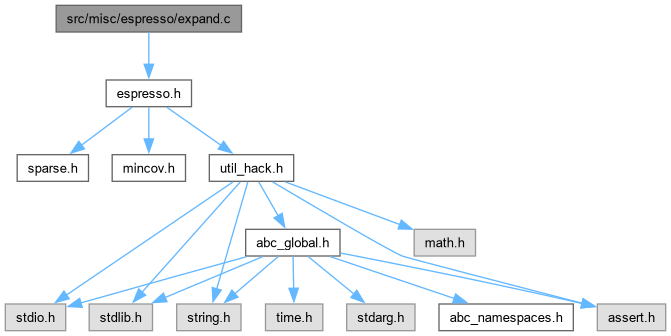
#include "espresso.h"
Include dependency graph for expand.c:

Go to the source code of this file.

Macros

#define NEW
 

Functions

ABC_NAMESPACE_IMPL_START pcover expand (INOUT pcover F, IN pcover R, IN bool nonsparse)
 
void expand1 (pcover BB, pcover CC, pcube RAISE, pcube FREESET, pcube OVEREXPANDED_CUBE, pcube SUPER_CUBE, pcube INIT_LOWER, int *num_covered, pcube c)
 
void essen_parts (pcover BB, pcover CC, pcube RAISE, pcube FREESET)
 
void essen_raising (pcover BB, pcube RAISE, pcube FREESET)
 
void elim_lowering (pcover BB, pcover CC, pcube RAISE, pcube FREESET)
 
int most_frequent (pcover CC, pcube FREESET)
 
void setup_BB_CC (pcover BB, pcover CC)
 
void select_feasible (pcover BB, pcover CC, pcube RAISE, pcube FREESET, pcube SUPER_CUBE, int *num_covered)
 
bool feasibly_covered (pcover BB, pcube c, pcube RAISE, pcube new_lower)
 
void mincov (pcover BB, pcube RAISE, pcube FREESET)
 
pcover find_all_primes (pcover BB, pcube RAISE, pcube FREESET)
 
pcover all_primes (pcover F, pcover R)
 

Macro Definition Documentation

◆ NEW

#define NEW

Function Documentation

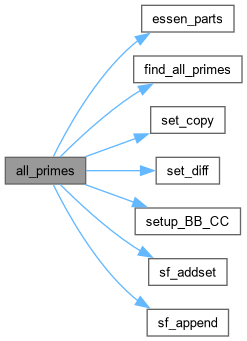
◆ all_primes()

pcover all_primes ( pcover F,
pcover R )

Definition at line 669 of file expand.c.
671{
672 register pcube last, p, RAISE, FREESET;
673 pcover Fall_primes, B1;
674
675 FREESET = new_cube();
676 RAISE = new_cube();
677 Fall_primes = new_cover(F->count);
678
679 foreach_set(F, last, p) {
680 if (TESTP(p, PRIME)) {
681 Fall_primes = sf_addset(Fall_primes, p);
682 } else {
683 /* Setup for call to essential parts */
684 (void) set_copy(RAISE, p);
685 (void) set_diff(FREESET, cube.fullset, RAISE);
686 setup_BB_CC(R, /* CC */ (pcover) NULL);
687 essen_parts(R, /* CC */ (pcover) NULL, RAISE, FREESET);
688
689 /* Find all of the primes, and add them to the prime set */
690 B1 = find_all_primes(R, RAISE, FREESET);
691 Fall_primes = sf_append(Fall_primes, B1);
692 }
693 }
694
695 set_free(RAISE);
696 set_free(FREESET);
697 return Fall_primes;
698}
#define pcover
Definition espresso.h:264
pset_family sf_addset()
#define new_cube()
Definition espresso.h:262
void setup_BB_CC()
void essen_parts()
#define set_free(r)
Definition espresso.h:167
#define TESTP(set, flag)
Definition espresso.h:124
#define pcube
Definition espresso.h:261
pset set_diff()
#define foreach_set(R, last, p)
Definition espresso.h:135
#define PRIME
Definition espresso.h:127
pset_family sf_append()
pcover find_all_primes()
pset set_copy()
#define new_cover(i)
Definition espresso.h:265
Cube * p
Definition exorList.c:222
Definition exor.h:123
Here is the call graph for this function:

◆ elim_lowering()

void elim_lowering ( pcover BB,
pcover CC,
pcube RAISE,
pcube FREESET )

Definition at line 288 of file expand.c.
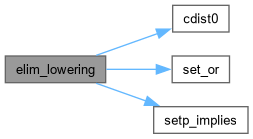
291{
292 register pcube p, r = set_or(cube.temp[0], RAISE, FREESET);
293 pcube last;
294
295 /*
296 * Remove sets of BB which are orthogonal to future expansions
297 */
298 foreach_active_set(BB, last, p) {
299#ifdef NO_INLINE
300 if (! cdist0(p, r))
301#else
302 {register int w,lastw;register unsigned int x;if((lastw=cube.inword)!=-1){x=p[
303lastw]&r[lastw];if(~(x|x>>1)&cube.inmask)goto false;for(w=1;w<lastw;w++){x=p[w]
304&r[w];if(~(x|x>>1)&DISJOINT)goto false;}}}{register int w,var,lastw;register
305pcube mask;for(var=cube.num_binary_vars;var<cube.num_vars;var++){mask=cube.
306var_mask[var];lastw=cube.last_word[var];for(w=cube.first_word[var];w<=lastw;w++)
307if(p[w]&r[w]&mask[w])goto nextvar;goto false;nextvar:;}}continue;false:
308#endif
309 BB->active_count--, RESET(p, ACTIVE);
310 }
311
312
313 /*
314 * Remove sets of CC which cannot be covered by future expansions
315 */
316 if (CC != (pcover) NULL) {
317 foreach_active_set(CC, last, p) {
318#ifdef NO_INLINE
319 if (! setp_implies(p, r))
320#else
321 INLINEsetp_implies(p, r, /* when false => */ goto false1);
322 /* when true => go to end of loop */ continue;
323 false1:
324#endif
325 CC->active_count--, RESET(p, ACTIVE);
326 }
327 }
328}
#define DISJOINT
Definition espresso.h:514
#define INLINEsetp_implies(a, b, when_false)
Definition espresso.h:228
#define ACTIVE
Definition espresso.h:129
#define foreach_active_set(R, last, p)
Definition espresso.h:139
bool setp_implies()
#define RESET(set, flag)
Definition espresso.h:123
pset set_or()
bool cdist0()
unsigned short var
Definition giaNewBdd.h:35
Here is the call graph for this function:

◆ essen_parts()

void essen_parts ( pcover BB,
pcover CC,
pcube RAISE,
pcube FREESET )

Definition at line 210 of file expand.c.
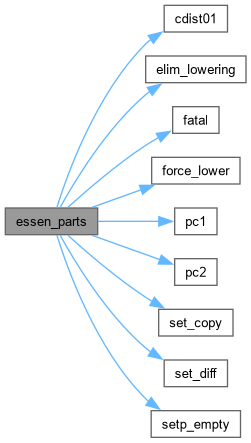
213{
214 register pcube p, r = RAISE;
215 pcube lastp, xlower = cube.temp[0];
216 int dist;
217
218 (void) set_copy(xlower, cube.emptyset);
219
220 foreach_active_set(BB, lastp, p) {
221#ifdef NO_INLINE
222 if ((dist = cdist01(p, r)) > 1) goto exit_if;
223#else
224 {register int w,last;register unsigned int x;dist=0;if((last=cube.inword)!=-1)
225{x=p[last]&r[last];if((x=~(x|x>>1)&cube.inmask))if((dist=count_ones(x))>1)goto
226exit_if;for(w=1;w<last;w++){x=p[w]&r[w];if((x=~(x|x>>1)&DISJOINT))if(dist==1||(
227dist+=count_ones(x))>1)goto exit_if;}}}{register int w,var,last;register pcube
228mask;for(var=cube.num_binary_vars;var<cube.num_vars;var++){mask=cube.var_mask[
229var];last=cube.last_word[var];for(w=cube.first_word[var];w<=last;w++)if(p[w]&r[
230w]&mask[w])goto nextvar;if(++dist>1)goto exit_if;nextvar:;}}
231#endif
232 if (dist == 0) {
233 fatal("ON-set and OFF-set are not orthogonal");
234 } else {
235 (void) force_lower(xlower, p, r);
236 BB->active_count--;
237 RESET(p, ACTIVE);
238 }
239exit_if: ;
240 }
241
242 if (! setp_empty(xlower)) {
243 (void) set_diff(FREESET, FREESET, xlower);/* remove from free set */
244 elim_lowering(BB, CC, RAISE, FREESET);
245 }
246
247 if (debug & EXPAND1)
248 printf("ESSEN_PARTS:\tRAISE=%s FREESET=%s\n", pc1(RAISE), pc2(FREESET));
249}
char * pc1()
void elim_lowering()
pset force_lower()
#define EXPAND1
Definition espresso.h:354
void fatal()
char * pc2()
unsigned int debug
Definition globals.c:19
bool setp_empty()
int cdist01()
#define count_ones(v)
Definition espresso.h:245
Here is the call graph for this function:

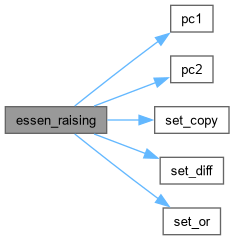
◆ essen_raising()

void essen_raising ( pcover BB,
pcube RAISE,
pcube FREESET )

Definition at line 259 of file expand.c.

262{
263 register pcube last, p, xraise = cube.temp[0];
264
265 /* Form union of all cubes of BB, and then take complement wrt FREESET */
266 (void) set_copy(xraise, cube.emptyset);
267 foreach_active_set(BB, last, p)
268 INLINEset_or(xraise, xraise, p);
269 (void) set_diff(xraise, FREESET, xraise);
270
271 (void) set_or(RAISE, RAISE, xraise); /* add to raising set */
272 (void) set_diff(FREESET, FREESET, xraise); /* remove from free set */
273
274 if (debug & EXPAND1)
275 printf("ESSEN_RAISING:\tRAISE=%s FREESET=%s\n",
276 pc1(RAISE), pc2(FREESET));
277}
#define INLINEset_or(r, a, b)
Definition espresso.h:205
Here is the call graph for this function:

◆ expand()

ABC_NAMESPACE_IMPL_START pcover expand ( INOUT pcover F,
IN pcover R,
IN bool nonsparse )

Definition at line 53 of file expand.c.
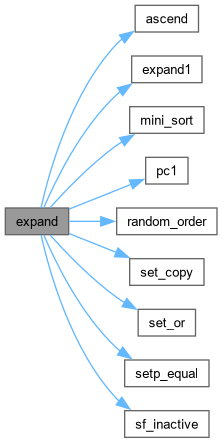
57{
58 register pcube last, p;
59 pcube RAISE, FREESET, INIT_LOWER, SUPER_CUBE, OVEREXPANDED_CUBE;
60 int var, num_covered;
61 bool change;
62
63 /* Order the cubes according to "chewing-away from the edges" of mini */
65 F = random_order(F);
66 else
67 F = mini_sort(F, ascend);
68
69 /* Allocate memory for variables needed by expand1() */
70 RAISE = new_cube();
71 FREESET = new_cube();
72 INIT_LOWER = new_cube();
73 SUPER_CUBE = new_cube();
74 OVEREXPANDED_CUBE = new_cube();
75
76 /* Setup the initial lowering set (differs only for nonsparse) */
77 if (nonsparse)
78 for(var = 0; var < cube.num_vars; var++)
79 if (cube.sparse[var])
80 (void) set_or(INIT_LOWER, INIT_LOWER, cube.var_mask[var]);
81
82 /* Mark all cubes as not covered, and maybe essential */
83 foreach_set(F, last, p) {
84 RESET(p, COVERED);
86 }
87
88 /* Try to expand each nonprime and noncovered cube */
89 foreach_set(F, last, p) {
90 /* do not expand if PRIME or if covered by previous expansion */
91 if (! TESTP(p, PRIME) && ! TESTP(p, COVERED)) {
92
93 /* expand the cube p, result is RAISE */
94 expand1(R, F, RAISE, FREESET, OVEREXPANDED_CUBE, SUPER_CUBE,
95 INIT_LOWER, &num_covered, p);
96 if (debug & EXPAND)
97 printf("EXPAND: %s (covered %d)\n", pc1(p), num_covered);
98 (void) set_copy(p, RAISE);
99 SET(p, PRIME);
100 RESET(p, COVERED); /* not really necessary */
101
102 /* See if we generated an inessential prime */
103 if (num_covered == 0 && ! setp_equal(p, OVEREXPANDED_CUBE)) {
104 SET(p, NONESSEN);
105 }
106 }
107 }
108
109 /* Delete any cubes of F which became covered during the expansion */
110 F->active_count = 0;
111 change = FALSE;
112 foreach_set(F, last, p) {
113 if (TESTP(p, COVERED)) {
114 RESET(p, ACTIVE);
115 change = TRUE;
116 } else {
117 SET(p, ACTIVE);
118 F->active_count++;
119 }
120 }
121 if (change)
122 F = sf_inactive(F);
123
124 free_cube(RAISE);
125 free_cube(FREESET);
126 free_cube(INIT_LOWER);
127 free_cube(SUPER_CUBE);
128 free_cube(OVEREXPANDED_CUBE);
129 return F;
130}
#define TRUE
Definition abcBm.c:38
#define FALSE
Definition abcBm.c:37
int ascend()
pset_family sf_inactive()
#define EXPAND
Definition espresso.h:353
pcover random_order()
void expand1()
pcover mini_sort()
#define COVERED
Definition espresso.h:131
#define free_cube(r)
Definition espresso.h:263
#define SET(set, flag)
Definition espresso.h:122
#define NONESSEN
Definition espresso.h:128
bool use_random_order
Definition globals.c:38
bool setp_equal()
Here is the call graph for this function:

◆ expand1()

void expand1 ( pcover BB,
pcover CC,
pcube RAISE,
pcube FREESET,
pcube OVEREXPANDED_CUBE,
pcube SUPER_CUBE,
pcube INIT_LOWER,
int * num_covered,
pcube c )

Definition at line 135 of file expand.c.
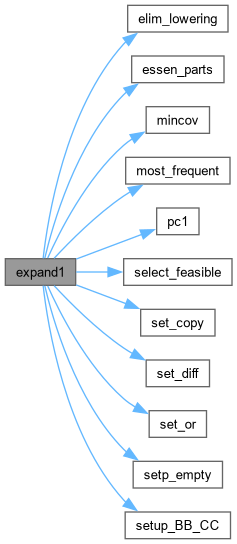
146{
147 int bestindex;
148
149 if (debug & EXPAND1)
150 printf("\nEXPAND1: \t%s\n", pc1(c));
151
152 /* initialize BB and CC */
153 SET(c, PRIME); /* don't try to cover ourself */
154 setup_BB_CC(BB, CC);
155
156 /* initialize count of # cubes covered, and the supercube of them */
157 *num_covered = 0;
158 (void) set_copy(SUPER_CUBE, c);
159
160 /* Initialize the lowering, raising and unassigned sets */
161 (void) set_copy(RAISE, c);
162 (void) set_diff(FREESET, cube.fullset, RAISE);
163
164 /* If some parts are forced into lowering set, remove them */
165 if (! setp_empty(INIT_LOWER)) {
166 (void) set_diff(FREESET, FREESET, INIT_LOWER);
167 elim_lowering(BB, CC, RAISE, FREESET);
168 }
169
170 /* Determine what can be raised, and return the over-expanded cube */
171 essen_parts(BB, CC, RAISE, FREESET);
172 (void) set_or(OVEREXPANDED_CUBE, RAISE, FREESET);
173
174 /* While there are still cubes which can be covered, cover them ! */
175 if (CC->active_count > 0) {
176 select_feasible(BB, CC, RAISE, FREESET, SUPER_CUBE, num_covered);
177 }
178
179 /* While there are still cubes covered by the overexpanded cube ... */
180 while (CC->active_count > 0) {
181 bestindex = most_frequent(CC, FREESET);
182 set_insert(RAISE, bestindex);
183 set_remove(FREESET, bestindex);
184 essen_parts(BB, CC, RAISE, FREESET);
185 }
186
187 /* Finally, when all else fails, choose the largest possible prime */
188 /* We will loop only if we decide unravelling OFF-set is too expensive */
189 while (BB->active_count > 0) {
190 mincov(BB, RAISE, FREESET);
191 }
192
193 /* Raise any remaining free coordinates */
194 (void) set_or(RAISE, RAISE, FREESET);
195}
void mincov()
void select_feasible()
#define set_insert(set, e)
Definition espresso.h:172
#define set_remove(set, e)
Definition espresso.h:171
int most_frequent()
Here is the call graph for this function:

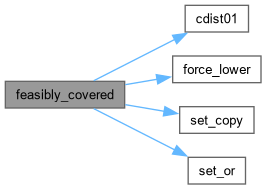
◆ feasibly_covered()

bool feasibly_covered ( pcover BB,
pcube c,
pcube RAISE,
pcube new_lower )

Definition at line 521 of file expand.c.

524{
525 register pcube p, r = set_or(cube.temp[0], RAISE, c);
526 int dist;
527 pcube lastp;
528
529 set_copy(new_lower, cube.emptyset);
530 foreach_active_set(BB, lastp, p) {
531#ifdef NO_INLINE
532 if ((dist = cdist01(p, r)) > 1) goto exit_if;
533#else
534 {register int w,last;register unsigned int x;dist=0;if((last=cube.inword)!=-1)
535{x=p[last]&r[last];if((x=~(x|x>>1)&cube.inmask))if((dist=count_ones(x))>1)goto
536exit_if;for(w=1;w<last;w++){x=p[w]&r[w];if((x=~(x|x>>1)&DISJOINT))if(dist==1||(
537dist+=count_ones(x))>1)goto exit_if;}}}{register int w,var,last;register pcube
538mask;for(var=cube.num_binary_vars;var<cube.num_vars;var++){mask=cube.var_mask[
539var];last=cube.last_word[var];for(w=cube.first_word[var];w<=last;w++)if(p[w]&r[
540w]&mask[w])goto nextvar;if(++dist>1)goto exit_if;nextvar:;}}
541#endif
542 if (dist == 0)
543 return FALSE;
544 else
545 (void) force_lower(new_lower, p, r);
546 exit_if: ;
547 }
548 return TRUE;
549}
Here is the call graph for this function:

◆ find_all_primes()

pcover find_all_primes ( pcover BB,
pcube RAISE,
pcube FREESET )

Definition at line 634 of file expand.c.
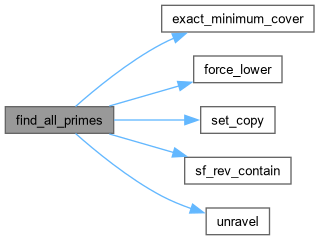
637{
638 register pset last, p, plower;
639 pset_family B, B1;
640
641 if (BB->active_count == 0) {
642 B1 = new_cover(1);
643 p = GETSET(B1, B1->count++);
644 (void) set_copy(p, RAISE);
645 SET(p, PRIME);
646 } else {
647 B = new_cover(BB->active_count);
648 foreach_active_set(BB, last, p) {
649 plower = set_copy(GETSET(B, B->count++), cube.emptyset);
650 (void) force_lower(plower, p, RAISE);
651 }
652 B = sf_rev_contain(unravel(B, cube.num_binary_vars));
653 B1 = exact_minimum_cover(B);
654 foreach_set(B1, last, p) {
655 INLINEset_diff(p, FREESET, p);
656 INLINEset_or(p, p, RAISE);
657 SET(p, PRIME);
658 }
659 free_cover(B);
660 }
661 return B1;
662}
#define INLINEset_diff(r, a, b)
Definition espresso.h:208
pset_family exact_minimum_cover()
#define free_cover(r)
Definition espresso.h:266
pcover unravel()
#define GETSET(family, index)
Definition espresso.h:161
struct set_family * pset_family
pset_family sf_rev_contain()
unsigned int * pset
Definition espresso.h:73
int count
Definition espresso.h:80
Here is the call graph for this function:

◆ mincov()

void mincov ( pcover BB,
pcube RAISE,
pcube FREESET )

Definition at line 560 of file expand.c.
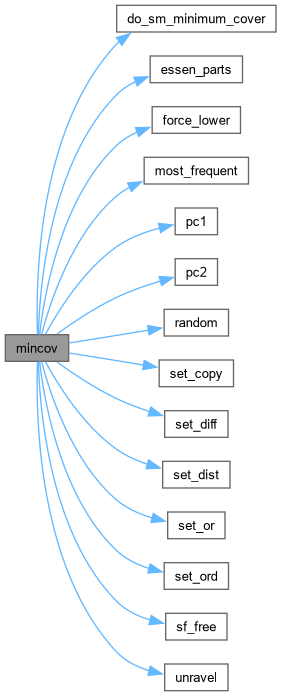
563{
564 int expansion, nset, var, dist;
565 pset_family B;
566 register pcube xraise=cube.temp[0], xlower, p, last, plower;
567
568#ifdef RANDOM_MINCOV
569#if defined(_POSIX_SOURCE) || defined(__SVR4)
570 dist = rand() % set_ord(FREESET);
571#else
572 dist = random() % set_ord(FREESET);
573#endif
574 for(var = 0; var < cube.size && dist >= 0; var++) {
575 if (is_in_set(FREESET, var)) {
576 dist--;
577 }
578 }
579
580 set_insert(RAISE, var);
581 set_remove(FREESET, var);
582 (void) essen_parts(BB, /*CC*/ (pcover) NULL, RAISE, FREESET);
583#else
584
585 /* Create B which are those cubes which we must avoid intersecting */
586 B = new_cover(BB->active_count);
587 foreach_active_set(BB, last, p) {
588 plower = set_copy(GETSET(B, B->count++), cube.emptyset);
589 (void) force_lower(plower, p, RAISE);
590 }
591
592 /* Determine how many sets it will blow up into after the unravel */
593 nset = 0;
594 foreach_set(B, last, p) {
595 expansion = 1;
596 for(var = cube.num_binary_vars; var < cube.num_vars; var++) {
597 if ((dist=set_dist(p, cube.var_mask[var])) > 1) {
598 expansion *= dist;
599 if (expansion > 500) goto heuristic_mincov;
600 }
601 }
602 nset += expansion;
603 if (nset > 500) goto heuristic_mincov;
604 }
605
606 B = unravel(B, cube.num_binary_vars);
607 xlower = do_sm_minimum_cover(B);
608
609 /* Add any remaining free parts to the raising set */
610 (void) set_or(RAISE, RAISE, set_diff(xraise, FREESET, xlower));
611 (void) set_copy(FREESET, cube.emptyset); /* free set is empty */
612 BB->active_count = 0; /* BB satisfied */
613 if (debug & EXPAND1) {
614 printf("MINCOV: \tRAISE=%s FREESET=%s\n", pc1(RAISE), pc2(FREESET));
615 }
616 sf_free(B);
617 set_free(xlower);
618 return;
619
620heuristic_mincov:
621 sf_free(B);
622 /* most_frequent will pick first free part */
623 set_insert(RAISE, most_frequent(/*CC*/ (pcover) NULL, FREESET));
624 (void) set_diff(FREESET, FREESET, RAISE);
625 essen_parts(BB, /*CC*/ (pcover) NULL, RAISE, FREESET);
626 return;
627#endif
628}
#define is_in_set(set, e)
Definition espresso.h:170
void sf_free()
int set_ord()
pset do_sm_minimum_cover()
int set_dist()
long random()
Here is the call graph for this function:

◆ most_frequent()

int most_frequent ( pcover CC,
pcube FREESET )

Definition at line 338 of file expand.c.
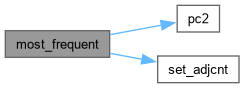
341{
342 register int i, best_part, best_count, *count;
343 register pset p, last;
344
345 /* Count occurences of each variable */
346 count = ALLOC(int, cube.size);
347 for(i = 0; i < cube.size; i++)
348 count[i] = 0;
349 if (CC != (pcover) NULL)
350 foreach_active_set(CC, last, p)
351 set_adjcnt(p, count, 1);
352
353 /* Now find which free part occurs most often */
354 best_count = best_part = -1;
355 for(i = 0; i < cube.size; i++)
356 if (is_in_set(FREESET,i) && count[i] > best_count) {
357 best_part = i;
358 best_count = count[i];
359 }
360 FREE(count);
361
362 if (debug & EXPAND1)
363 printf("MOST_FREQUENT:\tbest=%d FREESET=%s\n", best_part, pc2(FREESET));
364 return best_part;
365}
#define ALLOC(type, num)
Definition avl.h:27
#define FREE(obj)
Definition avl.h:31
void set_adjcnt()
Here is the call graph for this function:

◆ select_feasible()

void select_feasible ( pcover BB,
pcover CC,
pcube RAISE,
pcube FREESET,
pcube SUPER_CUBE,
int * num_covered )

Definition at line 404 of file expand.c.
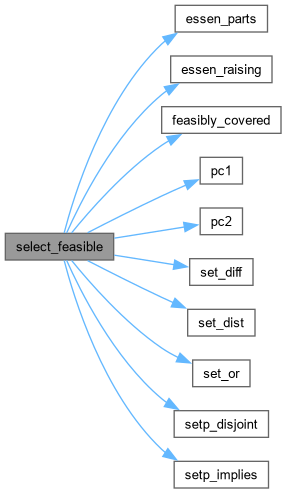
408{
409 register pcube p, last;
410 register pcube bestfeas = NULL; // Suppress "might be used uninitialized"
411 register pcube *feas;
412 register int i, j;
413 pcube *feas_new_lower;
414 int bestcount, bestsize, count, size, numfeas, lastfeas;
415 pcover new_lower;
416
417 /* Start out with all cubes covered by the over-expanded cube as
418 * the "possibly" feasibly-covered cubes (pfcc)
419 */
420 feas = ALLOC(pcube, CC->active_count);
421 numfeas = 0;
422 foreach_active_set(CC, last, p)
423 feas[numfeas++] = p;
424
425 /* Setup extra cubes to record parts forced low after a covering */
426 feas_new_lower = ALLOC(pcube, CC->active_count);
427 new_lower = new_cover(numfeas);
428 for(i = 0; i < numfeas; i++)
429 feas_new_lower[i] = GETSET(new_lower, i);
430
431
432loop:
433 /* Find the essentially raised parts -- this might cover some cubes
434 for us, without having to find out if they are fcc or not
435 */
436 essen_raising(BB, RAISE, FREESET);
437
438 /* Now check all "possibly" feasibly covered cubes to check feasibility */
439 lastfeas = numfeas;
440 numfeas = 0;
441 for(i = 0; i < lastfeas; i++) {
442 p = feas[i];
443
444 /* Check active because essen_parts might have removed it */
445 if (TESTP(p, ACTIVE)) {
446
447 /* See if the cube is already covered by RAISE --
448 * this can happen because of essen_raising() or because of
449 * the previous "loop"
450 */
451 if (setp_implies(p, RAISE)) {
452 (*num_covered) += 1;
453 (void) set_or(SUPER_CUBE, SUPER_CUBE, p);
454 CC->active_count--;
455 RESET(p, ACTIVE);
456 SET(p, COVERED);
457 /* otherwise, test if it is feasibly covered */
458 } else if (feasibly_covered(BB,p,RAISE,feas_new_lower[numfeas])) {
459 feas[numfeas] = p; /* save the fcc */
460 numfeas++;
461 }
462 }
463 }
464 if (debug & EXPAND1)
465 printf("SELECT_FEASIBLE: started with %d pfcc, ended with %d fcc\n",
466 lastfeas, numfeas);
467
468 /* Exit here if there are no feasibly covered cubes */
469 if (numfeas == 0) {
470 FREE(feas);
471 FREE(feas_new_lower);
472 free_cover(new_lower);
473 return;
474 }
475
476 /* Now find which is the best feasibly covered cube */
477 bestcount = 0;
478 bestsize = 9999;
479 for(i = 0; i < numfeas; i++) {
480 size = set_dist(feas[i], FREESET); /* # of newly raised parts */
481 count = 0; /* # of other cubes which remain fcc after raising */
482
483#define NEW
484#ifdef NEW
485 for(j = 0; j < numfeas; j++)
486 if (setp_disjoint(feas_new_lower[i], feas[j]))
487 count++;
488#else
489 for(j = 0; j < numfeas; j++)
490 if (setp_implies(feas[j], feas[i]))
491 count++;
492#endif
493 if (count > bestcount) {
494 bestcount = count;
495 bestfeas = feas[i];
496 bestsize = size;
497 } else if (count == bestcount && size < bestsize) {
498 bestfeas = feas[i];
499 bestsize = size;
500 }
501 }
502
503 /* Add the necessary parts to the raising set */
504 (void) set_or(RAISE, RAISE, bestfeas);
505 (void) set_diff(FREESET, FREESET, RAISE);
506 if (debug & EXPAND1)
507 printf("FEASIBLE: \tRAISE=%s FREESET=%s\n", pc1(RAISE), pc2(FREESET));
508 essen_parts(BB, CC, RAISE, FREESET);
509 goto loop;
510/* NOTREACHED */
511}
bool setp_disjoint()
void essen_raising()
bool feasibly_covered()
unsigned long long size
Definition giaNewBdd.h:39
Here is the call graph for this function:

◆ setup_BB_CC()

void setup_BB_CC ( pcover BB,
pcover CC )

Definition at line 375 of file expand.c.

377{
378 register pcube p, last;
379
380 /* Create the block and cover set families */
381 BB->active_count = BB->count;
382 foreach_set(BB, last, p)
383 SET(p, ACTIVE);
384
385 if (CC != (pcover) NULL) {
386 CC->active_count = CC->count;
387 foreach_set(CC, last, p)
388 if (TESTP(p, COVERED) || TESTP(p, PRIME))
389 CC->active_count--, RESET(p, ACTIVE);
390 else
391 SET(p, ACTIVE);
392 }
393}