ABC: A System for Sequential Synthesis and Verification
 
Loading...
Searching...
No Matches
ifDec16.c File Reference
#include "if.h"
#include "bool/kit/kit.h"
#include "misc/vec/vecMem.h"
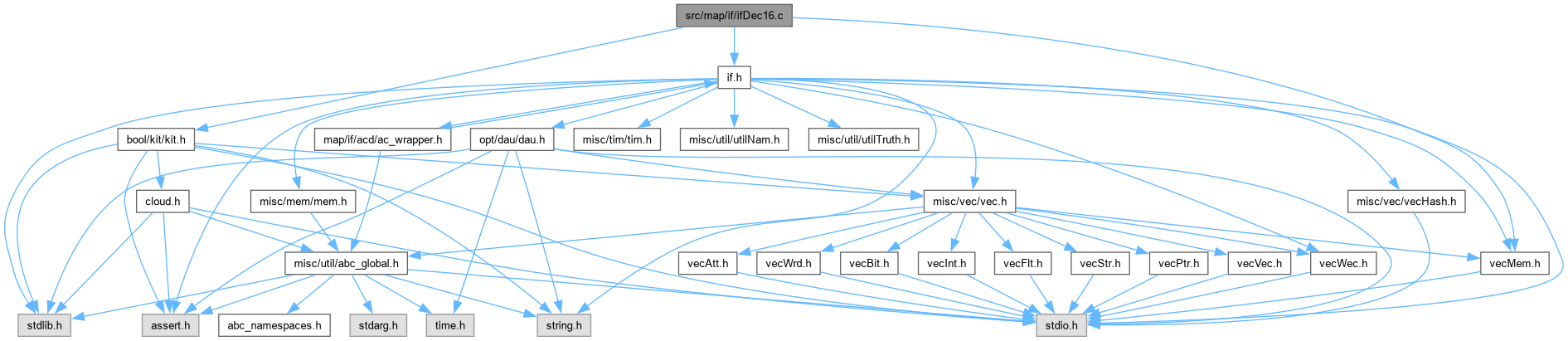
Include dependency graph for ifDec16.c:

Go to the source code of this file.

Classes

struct  If_Grp_t_
 
struct  If_Hte_t_
 

Macros

#define CLU_VAR_MAX   16
 DECLARATIONS ///.
 
#define CLU_WRD_MAX   (1 << ((CLU_VAR_MAX)-6))
 
#define CLU_MEM_MAX   1000
 
#define CLU_UNUSED   0xff
 

Typedefs

typedef struct If_Grp_t_ If_Grp_t
 DECLARATIONS ///.
 
typedef struct If_Hte_t_ If_Hte_t
 

Functions

void Kit_DsdPrintFromTruth (unsigned *pTruth, int nVars)
 
void Extra_PrintBinary (FILE *pFile, unsigned Sign[], int nBits)
 
int If_CluSupportSize (word *t, int nVars)
 
unsigned int If_CluPrimeCudd (unsigned int p)
 
void If_CluHashTableCheck (If_Man_t *p)
 
void If_CluHashPrintStats (If_Man_t *p, int t)
 
int If_CluHashFindMedian (If_Man_t *p, int t)
 
int If_CluHashKey (word *pTruth, int nWords, int Size)
 
unsigned * If_CluHashLookup (If_Man_t *p, word *pTruth, int t)
 
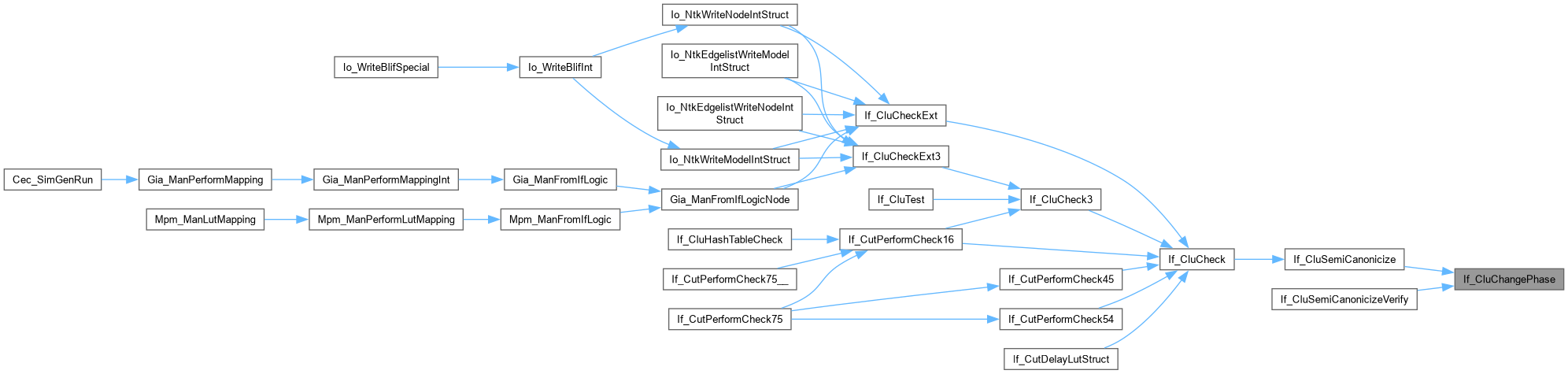
void If_CluChangePhase (word *pF, int nVars, int iVar)
 
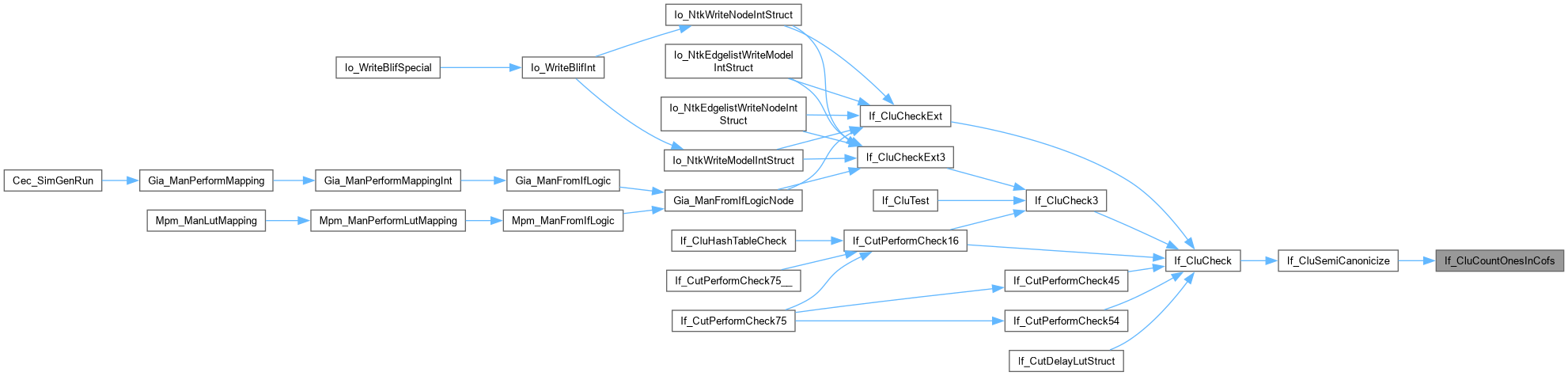
void If_CluCountOnesInCofs (word *pTruth, int nVars, int *pStore)
 
unsigned If_CluSemiCanonicize (word *pTruth, int nVars, int *pCanonPerm)
 
void If_CluSemiCanonicizeVerify (word *pTruth, word *pTruth0, int nVars, int *pCanonPerm, unsigned uCanonPhase)
 
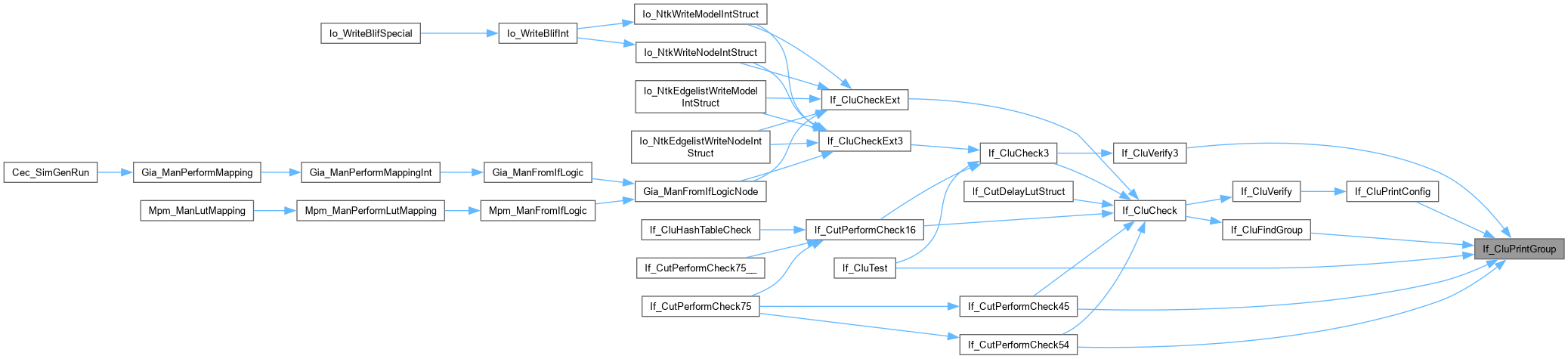
void If_CluPrintGroup (If_Grp_t *g)
 
void If_CluPrintConfig (int nVars, If_Grp_t *g, If_Grp_t *r, word BStruth, word *pFStruth)
 
void If_CluInitTruthTables ()
 
void If_CluVerify (word *pF, int nVars, If_Grp_t *g, If_Grp_t *r, word BStruth, word *pFStruth)
 
void If_CluVerify3 (word *pF, int nVars, If_Grp_t *g, If_Grp_t *g2, If_Grp_t *r, word BStruth, word BStruth2, word FStruth)
 
void If_CluSwapVars (word *pTruth, int nVars, int *V2P, int *P2V, int iVar, int jVar)
 
void If_CluReverseOrder (word *pTruth, int nVars, int *V2P, int *P2V, int iVarStart)
 
void If_CluMoveVar2 (word *pF, int nVars, int *Var2Pla, int *Pla2Var, int v, int p)
 
void If_CluMoveVar (word *pF, int nVars, int *Var2Pla, int *Pla2Var, int v, int p)
 
void If_CluMoveGroupToMsb (word *pF, int nVars, int *V2P, int *P2V, If_Grp_t *g)
 
void If_CluReverseOrder_old (word *pF, int nVars, int *V2P, int *P2V, int iVarStart)
 
int If_CluCountCofs (word *pF, int nVars, int nBSsize, int iShift, word pCofs[3][CLU_WRD_MAX/4])
 
int If_CluCountCofs4 (word *pF, int nVars, int nBSsize, word pCofs[6][CLU_WRD_MAX/4])
 
void If_CluCofactors (word *pF, int nVars, int iVar, word *pCof0, word *pCof1)
 
int If_CluDetectSpecialCaseCofs (word *pF, int nVars, int iVar)
 
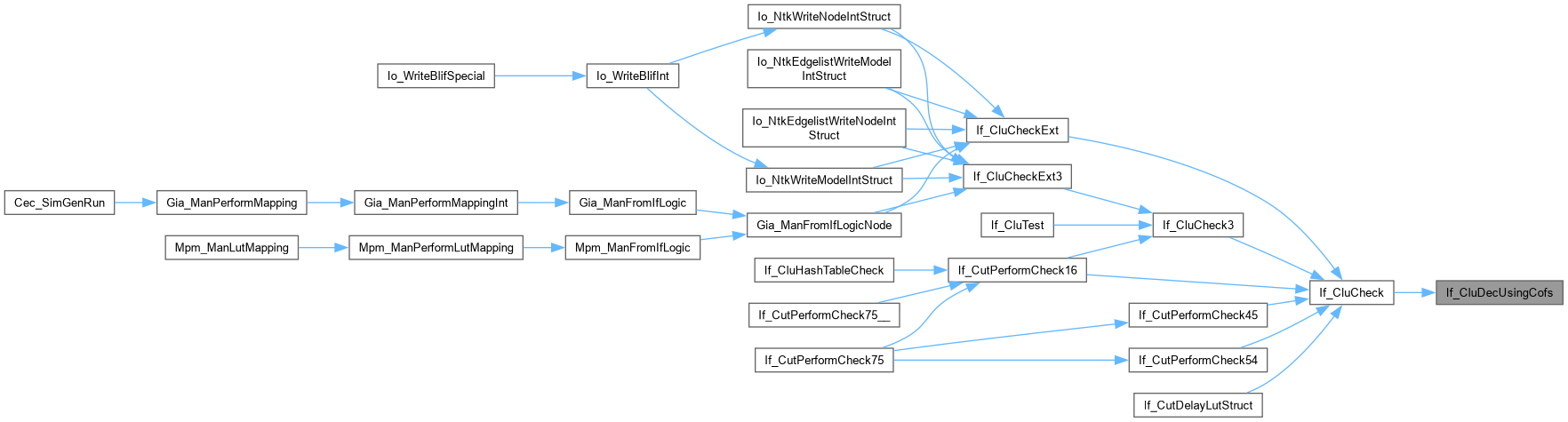
If_Grp_t If_CluDecUsingCofs (word *pTruth, int nVars, int nLutLeaf)
 
word If_CluDeriveDisjoint (word *pF, int nVars, int *V2P, int *P2V, If_Grp_t *g, If_Grp_t *r)
 
void If_CluDeriveDisjoint4 (word *pF, int nVars, int *V2P, int *P2V, If_Grp_t *g, If_Grp_t *r, word *pTruth0, word *pTruth1)
 
word If_CluDeriveNonDisjoint (word *pF, int nVars, int *V2P, int *P2V, If_Grp_t *g, If_Grp_t *r)
 
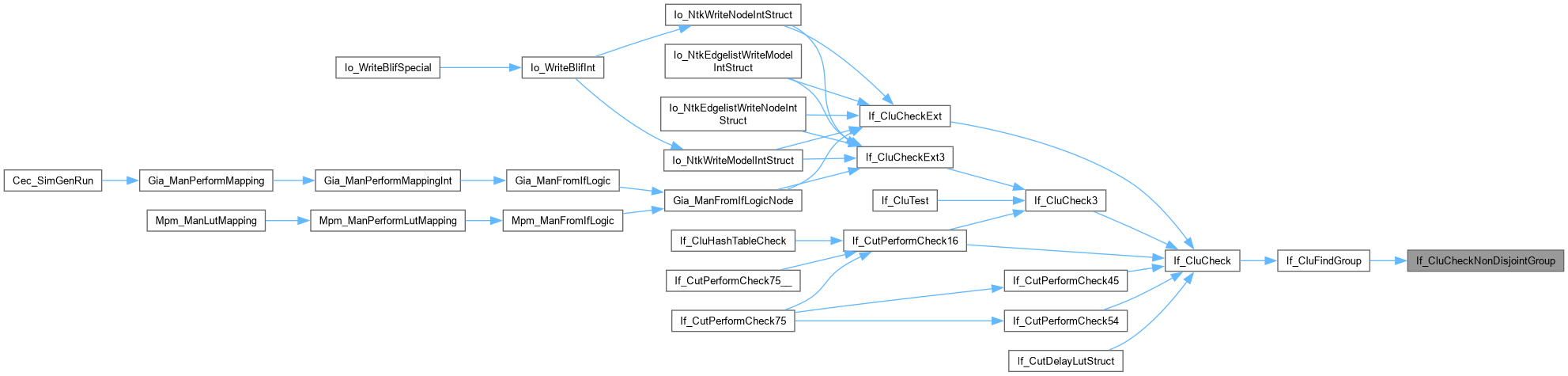
int If_CluCheckNonDisjointGroup (word *pF, int nVars, int *V2P, int *P2V, If_Grp_t *g)
 
If_Grp_t If_CluFindGroup (word *pF, int nVars, int iVarStart, int iVarStop, int *V2P, int *P2V, int nBSsize, int fDisjoint)
 
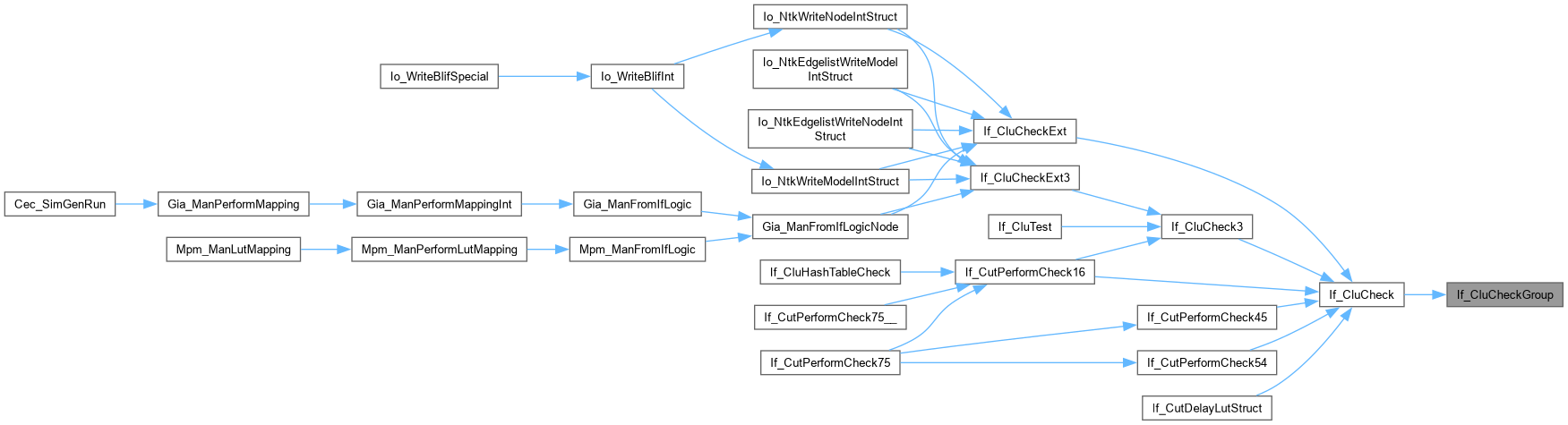
void If_CluCheckGroup (word *pTruth, int nVars, If_Grp_t *g)
 
void If_CluCheckPerm (word *pTruth, word *pF, int nVars, int *V2P, int *P2V)
 
int If_CluMinimumBase (word *t, int *pSupp, int nVarsAll, int *pnVars)
 
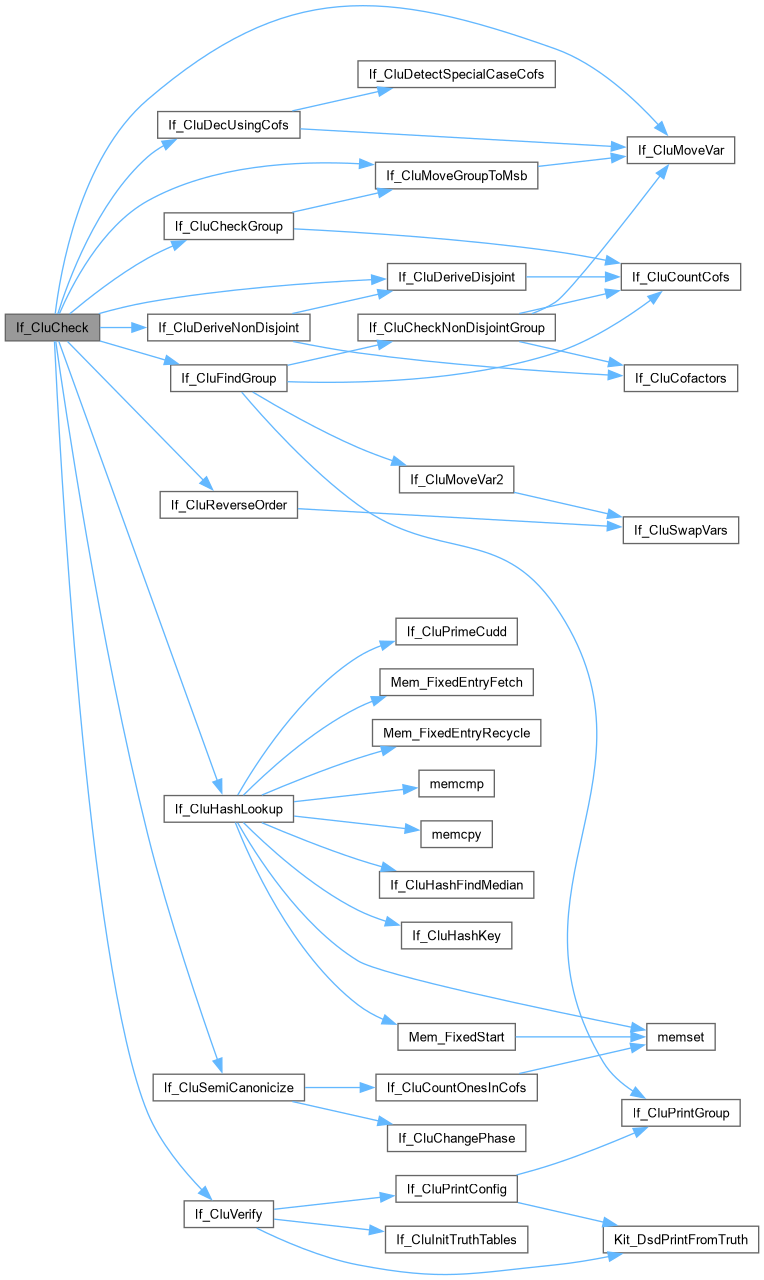
If_Grp_t If_CluCheck (If_Man_t *p, word *pTruth0, int nVars, int iVarStart, int iVarStop, int nLutLeaf, int nLutRoot, If_Grp_t *pR, word *pFunc0, word *pFunc1, word *pLeftOver, int fHashing)
 
int If_CluCheckDecInAny (word t, int nVars)
 
int If_CluCheckDecIn (word t, int nVars)
 
int If_CluCheckDecInU (word t, int nVars)
 
int If_CluCheckDecOut (word t, int nVars)
 
int If_CluCheckDecOutU (word t, int nVars)
 
int If_CutPerformCheck45 (If_Man_t *p, unsigned *pTruth, int nVars, int nLeaves, char *pStr)
 
int If_CutPerformCheck54 (If_Man_t *p, unsigned *pTruth, int nVars, int nLeaves, char *pStr)
 
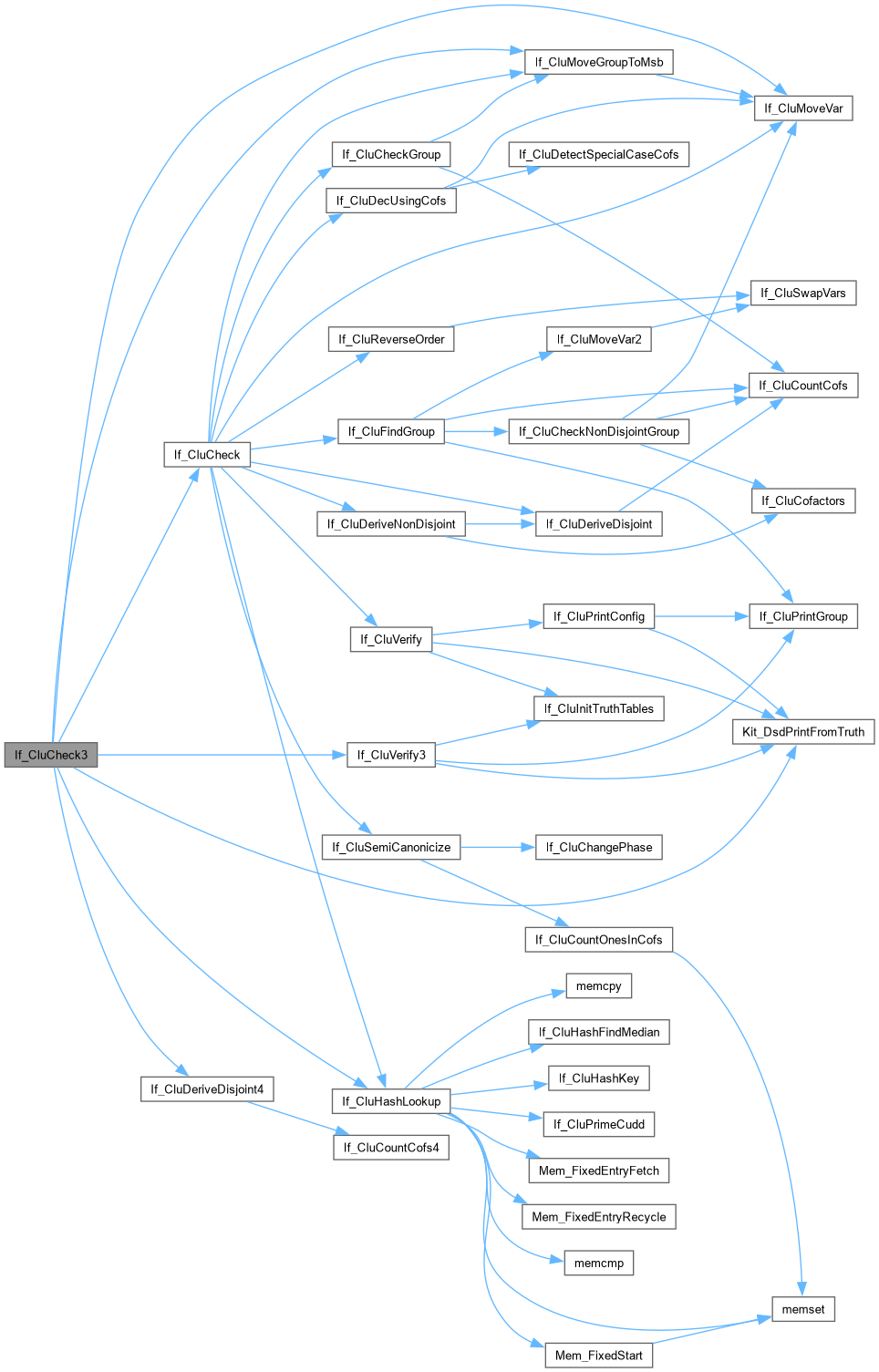
If_Grp_t If_CluCheck3 (If_Man_t *p, word *pTruth0, int nVars, int nLutLeaf, int nLutLeaf2, int nLutRoot, If_Grp_t *pR, If_Grp_t *pG2, word *pFunc0, word *pFunc1, word *pFunc2)
 
int If_CluCheckExt (void *pMan, word *pTruth, int nVars, int nLutLeaf, int nLutRoot, char *pLut0, char *pLut1, word *pFunc0, word *pFunc1)
 
int If_CluCheckExt3 (void *pMan, word *pTruth, int nVars, int nLutLeaf, int nLutLeaf2, int nLutRoot, char *pLut0, char *pLut1, char *pLut2, word *pFunc0, word *pFunc1, word *pFunc2)
 
float If_CluDelayMax (If_Grp_t *g, float *pDelays)
 
float If_CutDelayLutStruct (If_Man_t *p, If_Cut_t *pCut, char *pStr, float WireDelay)
 
int If_CutPerformCheck16 (If_Man_t *p, unsigned *pTruth0, int nVars, int nLeaves, char *pStr)
 
void If_CluTest ()
 

Variables

int s_Count2 = 0
 
int s_Count3 = 0
 

Macro Definition Documentation

◆ CLU_MEM_MAX

#define CLU_MEM_MAX   1000

Definition at line 33 of file ifDec16.c.

◆ CLU_UNUSED

#define CLU_UNUSED   0xff

Definition at line 34 of file ifDec16.c.

◆ CLU_VAR_MAX

#define CLU_VAR_MAX   16

DECLARATIONS ///.

CFile****************************************************************

FileName [ifDec16.c]

SystemName [ABC: Logic synthesis and verification system.]

PackageName [FPGA mapping based on priority cuts.]

Synopsis [Fast checking procedures.]

Author [Alan Mishchenko]

Affiliation [UC Berkeley]

Date [Ver. 1.0. Started - November 21, 2006.]

Revision [

Id
ifDec16.c,v 1.00 2006/11/21 00:00:00 alanmi Exp

]

Definition at line 31 of file ifDec16.c.

◆ CLU_WRD_MAX

#define CLU_WRD_MAX   (1 << ((CLU_VAR_MAX)-6))

Definition at line 32 of file ifDec16.c.

Typedef Documentation

◆ If_Grp_t

typedef struct If_Grp_t_ If_Grp_t

DECLARATIONS ///.

Definition at line 37 of file ifDec16.c.

◆ If_Hte_t

typedef struct If_Hte_t_ If_Hte_t

Definition at line 46 of file ifDec16.c.

Function Documentation

◆ Extra_PrintBinary()

void Extra_PrintBinary ( FILE * pFile,
unsigned Sign[],
int nBits )
extern

Function*************************************************************

Synopsis [Prints the bit string.]

Description []

SideEffects []

SeeAlso []

Definition at line 516 of file extraUtilFile.c.

517{
518 int i;
519 for ( i = nBits-1; i >= 0; i-- )
520 fprintf( pFile, "%c", '0' + Abc_InfoHasBit(Sign, i) );
521// fprintf( pFile, "\n" );
522}

◆ If_CluChangePhase()

void If_CluChangePhase ( word * pF,
int nVars,
int iVar )

Definition at line 439 of file ifDec16.c.
440{
441 int nWords = If_CluWordNum( nVars );
442 assert( iVar < nVars );
443 if ( iVar < 6 )
444 {
445 int i, Shift = (1 << iVar);
446 for ( i = 0; i < nWords; i++ )
447 pF[i] = ((pF[i] & ~Truth6[iVar]) << Shift) | ((pF[i] & Truth6[iVar]) >> Shift);
448 }
449 else
450 {
451 word Temp;
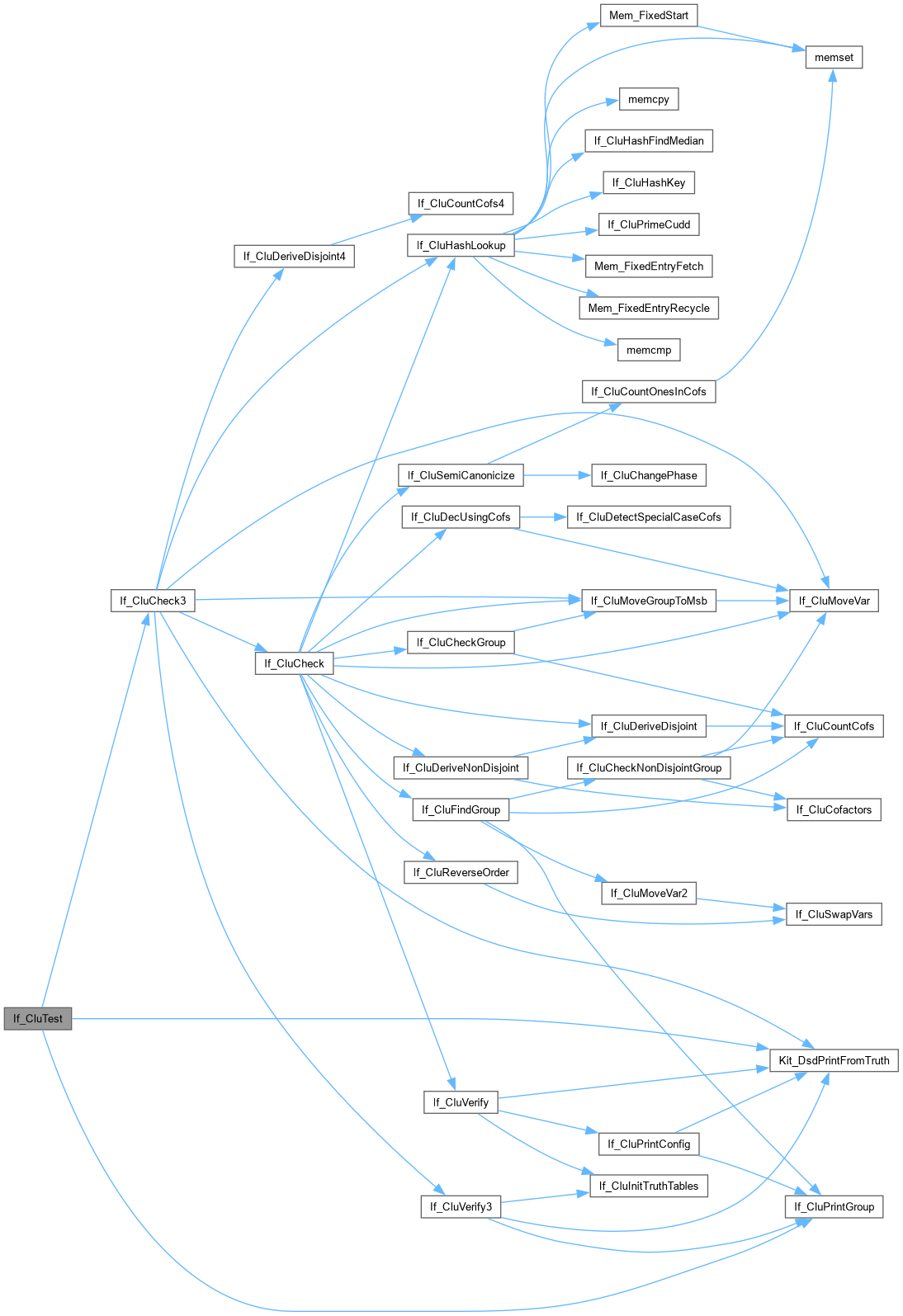
452 int i, k, Step = (1 << (iVar - 6));
453 for ( k = 0; k < nWords; k += 2*Step )
454 {
455 for ( i = 0; i < Step; i++ )
456 {
457 Temp = pF[i];
458 pF[i] = pF[Step+i];
459 pF[Step+i] = Temp;
460 }
461 pF += 2*Step;
462 }
463 }
464}
int nWords
Definition abcNpn.c:127
unsigned __int64 word
DECLARATIONS ///.
Definition kitPerm.c:36
#define assert(ex)
Definition util_old.h:213
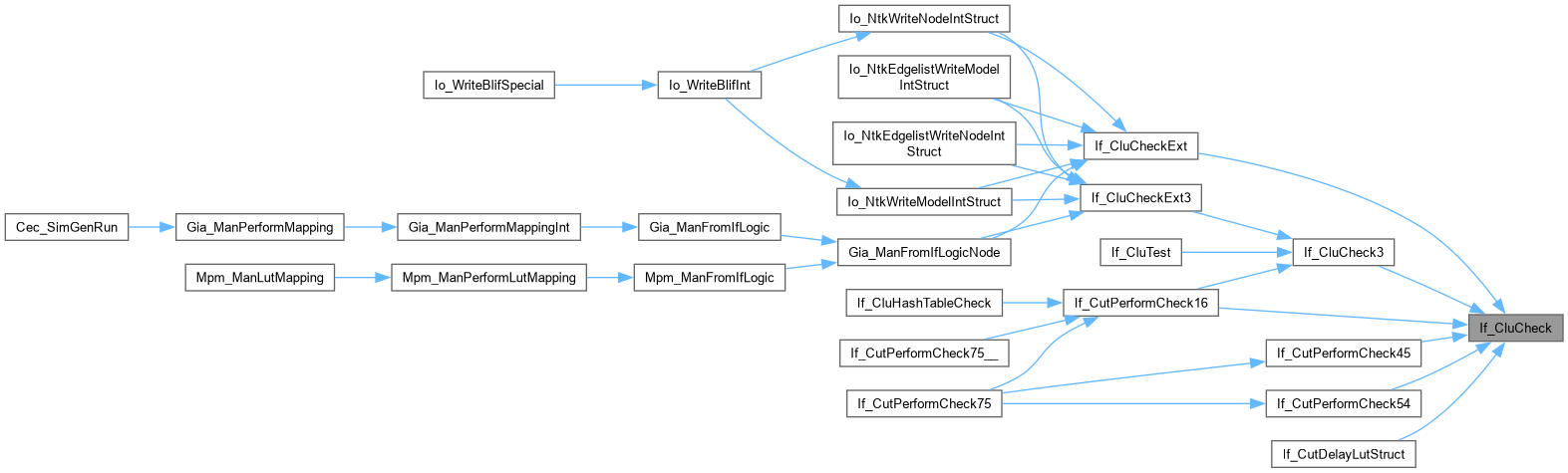
Here is the caller graph for this function:

◆ If_CluCheck()

If_Grp_t If_CluCheck ( If_Man_t * p,
word * pTruth0,
int nVars,
int iVarStart,
int iVarStop,
int nLutLeaf,
int nLutRoot,
If_Grp_t * pR,
word * pFunc0,
word * pFunc1,
word * pLeftOver,
int fHashing )

G1.pVars[nLutLeaf+i] = P2V[i];

Definition at line 1553 of file ifDec16.c.
1555{
1556// int fEnableHashing = 0;
1557 If_Grp_t G1 = {0}, R = {0};
1558 unsigned * pHashed = NULL;
1559 word Truth, pTruth[CLU_WRD_MAX], pF[CLU_WRD_MAX];//, pG[CLU_WRD_MAX];
1560 int V2P[CLU_VAR_MAX+2], P2V[CLU_VAR_MAX+2], pCanonPerm[CLU_VAR_MAX];
1561 int i, nSupp, uCanonPhase;
1562 int nLutSize = p ? p->pPars->nLutSize : nVars;
1563 assert( nVars <= CLU_VAR_MAX );
1564 assert( nVars <= nLutLeaf + nLutRoot - 1 );
1565
1566 if ( pR )
1567 {
1568 pR->nVars = 0;
1569 *pFunc0 = 0;
1570 *pFunc1 = 0;
1571 }
1572
1573 // canonicize truth table
1574 If_CluCopy( pTruth, pTruth0, nLutSize );
1575
1576 if ( 0 )
1577 {
1578 uCanonPhase = If_CluSemiCanonicize( pTruth, nVars, pCanonPerm );
1579 If_CluAdjustBig( pTruth, nVars, nLutSize );
1580 }
1581
1582// If_CluSemiCanonicizeVerify( pTruth, pTruth0, nVars, pCanonPerm, uCanonPhase );
1583// If_CluCopy( pTruth, pTruth0, nLutSize );
1584
1585 /*
1586 {
1587 int pCanonPerm[32];
1588 short pStore[32];
1589 unsigned uCanonPhase;
1590 If_CluCopy( pF, pTruth, nVars );
1591 uCanonPhase = Kit_TruthSemiCanonicize( pF, pG, nVars, pCanonPerm );
1592 G1.nVars = 1;
1593 return G1;
1594 }
1595*/
1596 // check minnimum base
1597 If_CluCopy( pF, pTruth, nVars );
1598 for ( i = 0; i < nVars; i++ )
1599 V2P[i] = P2V[i] = i;
1600 // check support
1601 nSupp = If_CluSupport( pF, nVars );
1602//Extra_PrintBinary( stdout, &nSupp, 16 ); printf( "\n" );
1603 if ( !nSupp || !If_CluSuppIsMinBase(nSupp) )
1604 {
1605// assert( 0 );
1606 return G1;
1607 }
1608
1609 // check hash table
1610 if ( p && fHashing )
1611 {
1612 pHashed = If_CluHashLookup( p, pTruth, 0 );
1613 if ( pHashed && *pHashed != CLU_UNUSED )
1614 If_CluUns2Grp( *pHashed, &G1 );
1615 }
1616
1617 // update the variable order so that the first var was the last one
1618 if ( iVarStop )
1619 If_CluMoveVar( pF, nVars, V2P, P2V, 0, nVars-1 );
1620
1621 if ( G1.nVars == 0 )
1622 {
1623 s_Count2++;
1624
1625 // detect easy cofs
1626 if ( iVarStart == 0 )
1627 G1 = If_CluDecUsingCofs( pTruth, nVars, nLutLeaf );
1628 if ( G1.nVars == 0 )
1629 {
1630 // perform testing
1631 G1 = If_CluFindGroup( pF, nVars, iVarStart, iVarStop, V2P, P2V, nLutLeaf, nLutLeaf + nLutRoot == nVars + 1 );
1632 // If_CluCheckPerm( pTruth, pF, nVars, V2P, P2V );
1633 if ( G1.nVars == 0 )
1634 {
1635 // perform testing with a smaller set
1636 if ( nVars < nLutLeaf + nLutRoot - 2 )
1637 {
1638 nLutLeaf--;
1639 G1 = If_CluFindGroup( pF, nVars, iVarStart, iVarStop, V2P, P2V, nLutLeaf, nLutLeaf + nLutRoot == nVars + 1 );
1640 nLutLeaf++;
1641 }
1642 // perform testing with a smaller set
1643 if ( nLutLeaf > 4 && nVars < nLutLeaf + nLutRoot - 3 )
1644 {
1645 nLutLeaf--;
1646 nLutLeaf--;
1647 G1 = If_CluFindGroup( pF, nVars, iVarStart, iVarStop, V2P, P2V, nLutLeaf, nLutLeaf + nLutRoot == nVars + 1 );
1648 nLutLeaf++;
1649 nLutLeaf++;
1650 }
1651 if ( G1.nVars == 0 )
1652 {
1653 // perform testing with a different order
1654 If_CluReverseOrder( pF, nVars, V2P, P2V, iVarStart );
1655 G1 = If_CluFindGroup( pF, nVars, iVarStart, iVarStop, V2P, P2V, nLutLeaf, nLutLeaf + nLutRoot == nVars + 1 );
1656
1657 // check permutation
1658 // If_CluCheckPerm( pTruth, pF, nVars, V2P, P2V );
1659 if ( G1.nVars == 0 )
1660 {
1661 // remember free set, just in case
1662// for ( i = 0; i < nVars - nLutLeaf; i++ )
1664 // if <XY>, this will not be used
1665 // if <XYZ>, this will not be hashed
1666
1667 /*
1668 if ( nVars == 6 )
1669 {
1670 Extra_PrintHex( stdout, (unsigned *)pF, nVars ); printf( " " );
1671 Kit_DsdPrintFromTruth( (unsigned*)pF, nVars ); printf( "\n" );
1672 if ( !If_CutPerformCheck07( (unsigned *)pF, 6, 6, NULL ) )
1673 printf( "no\n" );
1674 }
1675 */
1676 if ( pHashed )
1677 *pHashed = If_CluGrp2Uns( &G1 );
1678 return G1;
1679 }
1680 }
1681 }
1682 }
1683 }
1684
1685 // derive
1686 if ( pR )
1687 {
1688 int iNewPos;
1689
1690 If_CluMoveGroupToMsb( pF, nVars, V2P, P2V, &G1 );
1691 if ( G1.nMyu == 2 )
1692 {
1693 Truth = If_CluDeriveDisjoint( pF, nVars, V2P, P2V, &G1, &R );
1694 iNewPos = R.nVars - 1;
1695 }
1696 else
1697 {
1698 Truth = If_CluDeriveNonDisjoint( pF, nVars, V2P, P2V, &G1, &R );
1699 iNewPos = R.nVars - 2;
1700 }
1701 assert( R.pVars[iNewPos] == nVars );
1702
1703 // adjust the functions
1704 Truth = If_CluAdjust( Truth, G1.nVars );
1705 if ( R.nVars < 6 )
1706 pF[0] = If_CluAdjust( pF[0], R.nVars );
1707
1708// Kit_DsdPrintFromTruth( (unsigned*)&Truth, G1.nVars ); printf( " ...1\n" );
1709// Kit_DsdPrintFromTruth( (unsigned*)pF, R.nVars ); printf( " ...1\n" );
1710
1711 // update the variable order of R so that the new var was the first one
1712// if ( iVarStart == 0 )
1713 {
1714 int k, V2P2[CLU_VAR_MAX+2], P2V2[CLU_VAR_MAX+2];
1715 assert( iNewPos >= iVarStart );
1716 for ( k = 0; k < R.nVars; k++ )
1717 V2P2[k] = P2V2[k] = k;
1718 If_CluMoveVar( pF, R.nVars, V2P2, P2V2, iNewPos, iVarStart );
1719 for ( k = iNewPos; k > iVarStart; k-- )
1720 R.pVars[k] = R.pVars[k-1];
1721 R.pVars[iVarStart] = nVars;
1722 }
1723
1724// Kit_DsdPrintFromTruth( (unsigned*)pF, R.nVars ); printf( " ...2\n" );
1725
1726 if ( pLeftOver )
1727 {
1728 if ( R.nVars < 6 )
1729 *pLeftOver = If_CluAdjust( pF[0], R.nVars );
1730 else
1731 If_CluCopy( pLeftOver, pF, R.nVars );
1732 If_CluAdjustBig( pLeftOver, R.nVars, nLutSize );
1733 }
1734
1735 // perform checking
1736 if ( 0 )
1737 {
1738 If_CluCheckGroup( pTruth, nVars, &G1 );
1739 If_CluVerify( pTruth, nVars, &G1, &R, Truth, pF );
1740 }
1741
1742 // save functions
1743 *pR = R;
1744 if ( pFunc0 )
1745 *pFunc0 = pF[0];
1746 if ( pFunc1 )
1747 *pFunc1 = Truth;
1748 }
1749
1750 if ( pHashed )
1751 *pHashed = If_CluGrp2Uns( &G1 );
1752 return G1;
1753}
Cube * p
Definition exorList.c:222
void If_CluMoveGroupToMsb(word *pF, int nVars, int *V2P, int *P2V, If_Grp_t *g)
Definition ifDec16.c:855
word If_CluDeriveNonDisjoint(word *pF, int nVars, int *V2P, int *P2V, If_Grp_t *g, If_Grp_t *r)
Definition ifDec16.c:1237
unsigned * If_CluHashLookup(If_Man_t *p, word *pTruth, int t)
Definition ifDec16.c:233
void If_CluVerify(word *pF, int nVars, If_Grp_t *g, If_Grp_t *r, word BStruth, word *pFStruth)
Definition ifDec16.c:641
void If_CluReverseOrder(word *pTruth, int nVars, int *V2P, int *P2V, int iVarStart)
Definition ifDec16.c:800
#define CLU_UNUSED
Definition ifDec16.c:34
void If_CluMoveVar(word *pF, int nVars, int *Var2Pla, int *Pla2Var, int v, int p)
Definition ifDec16.c:818
If_Grp_t If_CluDecUsingCofs(word *pTruth, int nVars, int nLutLeaf)
Definition ifDec16.c:1112
unsigned If_CluSemiCanonicize(word *pTruth, int nVars, int *pCanonPerm)
Definition ifDec16.c:485
int s_Count2
Definition ifDec16.c:79
word If_CluDeriveDisjoint(word *pF, int nVars, int *V2P, int *P2V, If_Grp_t *g, If_Grp_t *r)
Definition ifDec16.c:1183
#define CLU_WRD_MAX
Definition ifDec16.c:32
struct If_Grp_t_ If_Grp_t
DECLARATIONS ///.
Definition ifDec16.c:37
void If_CluCheckGroup(word *pTruth, int nVars, If_Grp_t *g)
Definition ifDec16.c:1420
If_Grp_t If_CluFindGroup(word *pF, int nVars, int iVarStart, int iVarStop, int *V2P, int *P2V, int nBSsize, int fDisjoint)
Definition ifDec16.c:1306
#define CLU_VAR_MAX
DECLARATIONS ///.
Definition ifDec16.c:31
char nVars
Definition ifDec16.c:40
char nMyu
Definition ifDec16.c:41
Here is the call graph for this function:
Here is the caller graph for this function:

◆ If_CluCheck3()

If_Grp_t If_CluCheck3 ( If_Man_t * p,
word * pTruth0,
int nVars,
int nLutLeaf,
int nLutLeaf2,
int nLutRoot,
If_Grp_t * pR,
If_Grp_t * pG2,
word * pFunc0,
word * pFunc1,
word * pFunc2 )

Definition at line 1909 of file ifDec16.c.
1911{
1912 int fEnableHashing = 0;
1913 static int Counter = 0;
1914 unsigned * pHashed = NULL;
1915 word pLeftOver[CLU_WRD_MAX], Func0, Func1, Func2;
1916 If_Grp_t G1 = {0}, G2 = {0}, R = {0}, R2 = {0};
1917 int i;
1918 Counter++;
1919// if ( Counter == 37590 )
1920// {
1921// int ns = 0;
1922// }
1923
1924 // check hash table
1925 if ( p && fEnableHashing )
1926 {
1927 pHashed = If_CluHashLookup( p, pTruth0, 1 );
1928 if ( pHashed && *pHashed != CLU_UNUSED )
1929 {
1930 If_CluUns2Grp( *pHashed, &G1 );
1931 return G1;
1932 }
1933 }
1934 s_Count3++;
1935
1936 // check two-node decomposition
1937 G1 = If_CluCheck( p, pTruth0, nVars, 0, 0, nLutLeaf, nLutRoot + nLutLeaf2 - 1, &R2, &Func0, &Func1, pLeftOver, 0 );
1938 // decomposition does not exist
1939 if ( G1.nVars == 0 )
1940 {
1941 // check for decomposition with two outputs
1942 if ( (G1.nMyu == 3 || G1.nMyu == 4) && nLutLeaf == nLutLeaf2 && nVars - nLutLeaf + 2 <= nLutRoot )
1943 {
1944 int V2P[CLU_VAR_MAX+2], P2V[CLU_VAR_MAX+2];
1945 word Func0, Func1, Func2;
1946 int iVar0, iVar1;
1947
1948 G1.nVars = nLutLeaf;
1949 If_CluCopy( pLeftOver, pTruth0, nVars );
1950 for ( i = 0; i < nVars; i++ )
1951 V2P[i] = P2V[i] = i;
1952
1953 If_CluMoveGroupToMsb( pLeftOver, nVars, V2P, P2V, &G1 );
1954 If_CluDeriveDisjoint4( pLeftOver, nVars, V2P, P2V, &G1, &R, &Func1, &Func2 );
1955
1956 // move the two vars to the front
1957 for ( i = 0; i < R.nVars; i++ )
1958 V2P[i] = P2V[i] = i;
1959 If_CluMoveVar( pLeftOver, R.nVars, V2P, P2V, R.nVars-2, 0 );
1960 If_CluMoveVar( pLeftOver, R.nVars, V2P, P2V, R.nVars-1, 1 );
1961 iVar0 = R.pVars[R.nVars-2];
1962 iVar1 = R.pVars[R.nVars-1];
1963 for ( i = R.nVars-1; i > 1; i-- )
1964 R.pVars[i] = R.pVars[i-2];
1965 R.pVars[0] = iVar0;
1966 R.pVars[1] = iVar1;
1967
1968 Func0 = pLeftOver[0];
1969 If_CluVerify3( pTruth0, nVars, &G1, &G1, &R, Func1, Func2, Func0 );
1970 if ( pFunc1 && pFunc2 )
1971 {
1972 *pFunc0 = Func0;
1973 *pFunc1 = Func1;
1974 *pFunc2 = Func2;
1975 *pG2 = G1;
1976 *pR = R;
1977 }
1978
1979 if ( pHashed )
1980 *pHashed = If_CluGrp2Uns( &G1 );
1981// Kit_DsdPrintFromTruth( (unsigned*)pTruth0, nVars ); printf( "\n" );
1982// If_CluPrintGroup( &G1 );
1983 return G1;
1984 }
1985
1986/*
1987// if ( nVars == 6 )
1988 {
1989// Extra_PrintHex( stdout, (unsigned *)pTruth0, nVars ); printf( " " );
1990 Kit_DsdPrintFromTruth( (unsigned*)pTruth0, nVars ); printf( "\n" );
1991 if ( p != NULL )
1992 If_CluCheck3( NULL, pTruth0, nVars, nLutLeaf, nLutLeaf2, nLutRoot, pR, pG2, pFunc0, pFunc1, pFunc2 );
1993 }
1994*/
1995 if ( pHashed )
1996 *pHashed = If_CluGrp2Uns( &G1 );
1997 return G1;
1998 }
1999 // decomposition exists and sufficient
2000 if ( R2.nVars <= nLutRoot )
2001 {
2002 if ( pG2 ) *pG2 = G2;
2003 if ( pR ) *pR = R2;
2004 if ( pFunc0 ) *pFunc0 = Func0;
2005 if ( pFunc1 ) *pFunc1 = Func1;
2006 if ( pFunc2 ) *pFunc2 = 0;
2007 if ( pHashed )
2008 *pHashed = If_CluGrp2Uns( &G1 );
2009 return G1;
2010 }
2011
2012 // try second decomposition
2013 {
2014 int Test = 0;
2015 if ( Test )
2016 {
2017 Kit_DsdPrintFromTruth( (unsigned*)&pLeftOver, R2.nVars ); printf( "\n" );
2018 }
2019 }
2020
2021 // the new variable is at the bottom - skip it (iVarStart = 1)
2022 if ( p->pPars->nStructType == 0 ) // allowed
2023 G2 = If_CluCheck( p, pLeftOver, R2.nVars, 0, 0, nLutLeaf2, nLutRoot, &R, &Func0, &Func2, NULL, 0 );
2024 else if ( p->pPars->nStructType == 1 ) // not allowed
2025 G2 = If_CluCheck( p, pLeftOver, R2.nVars, 1, 0, nLutLeaf2, nLutRoot, &R, &Func0, &Func2, NULL, 0 );
2026 else if ( p->pPars->nStructType == 2 ) // required
2027 G2 = If_CluCheck( p, pLeftOver, R2.nVars, 0, 1, nLutLeaf2, nLutRoot, &R, &Func0, &Func2, NULL, 0 );
2028 else assert( 0 );
2029
2030 if ( G2.nVars == 0 )
2031 {
2032 if ( pHashed )
2033 *pHashed = If_CluGrp2Uns( &G2 );
2034 return G2;
2035 }
2036 // remap variables
2037 for ( i = 0; i < G2.nVars; i++ )
2038 {
2039 assert( G2.pVars[i] < R2.nVars );
2040 G2.pVars[i] = R2.pVars[ (int)G2.pVars[i] ];
2041 }
2042 // remap variables
2043 for ( i = 0; i < R.nVars; i++ )
2044 {
2045 if ( R.pVars[i] == R2.nVars )
2046 R.pVars[i] = nVars + 1;
2047 else
2048 R.pVars[i] = R2.pVars[ (int)R.pVars[i] ];
2049 }
2050
2051 // decomposition exist
2052 if ( pG2 ) *pG2 = G2;
2053 if ( pR ) *pR = R;
2054 if ( pFunc0 ) *pFunc0 = Func0;
2055 if ( pFunc1 ) *pFunc1 = Func1;
2056 if ( pFunc2 ) *pFunc2 = Func2;
2057 if ( pHashed )
2058 *pHashed = If_CluGrp2Uns( &G1 );
2059
2060 // verify
2061// If_CluVerify3( pTruth0, nVars, &G1, &G2, &R, Func1, Func2, Func0 );
2062 return G1;
2063}
void If_CluVerify3(word *pF, int nVars, If_Grp_t *g, If_Grp_t *g2, If_Grp_t *r, word BStruth, word BStruth2, word FStruth)
Definition ifDec16.c:673
If_Grp_t If_CluCheck(If_Man_t *p, word *pTruth0, int nVars, int iVarStart, int iVarStop, int nLutLeaf, int nLutRoot, If_Grp_t *pR, word *pFunc0, word *pFunc1, word *pLeftOver, int fHashing)
Definition ifDec16.c:1553
int s_Count3
Definition ifDec16.c:80
void Kit_DsdPrintFromTruth(unsigned *pTruth, int nVars)
Definition kitDsd.c:491
void If_CluDeriveDisjoint4(word *pF, int nVars, int *V2P, int *P2V, If_Grp_t *g, If_Grp_t *r, word *pTruth0, word *pTruth1)
Definition ifDec16.c:1208
Here is the call graph for this function:
Here is the caller graph for this function:

◆ If_CluCheckDecIn()

int If_CluCheckDecIn ( word t,
int nVars )

Definition at line 1792 of file ifDec16.c.

1793{
1794 int v, u, Cof2[2], Cof4[4];
1795// for ( v = 0; v < nVars; v++ )
1796 for ( v = 0; v < 1; v++ ) // restrict to the first (decomposed) input
1797 {
1798 Cof2[0] = Abc_Tt6Cofactor0( t, v );
1799 Cof2[1] = Abc_Tt6Cofactor1( t, v );
1800 for ( u = v+1; u < nVars; u++ )
1801 {
1802 Cof4[0] = Abc_Tt6Cofactor0( Cof2[0], u );
1803 Cof4[1] = Abc_Tt6Cofactor1( Cof2[0], u );
1804 Cof4[2] = Abc_Tt6Cofactor0( Cof2[1], u );
1805 Cof4[3] = Abc_Tt6Cofactor1( Cof2[1], u );
1806 if ( Cof4[0] == Cof4[1] && Cof4[0] == Cof4[2] )
1807 return 1;
1808 if ( Cof4[0] == Cof4[2] && Cof4[0] == Cof4[3] )
1809 return 1;
1810 if ( Cof4[0] == Cof4[1] && Cof4[0] == Cof4[3] )
1811 return 1;
1812 if ( Cof4[1] == Cof4[2] && Cof4[1] == Cof4[3] )
1813 return 1;
1814 }
1815 }
1816 return 0;
1817}
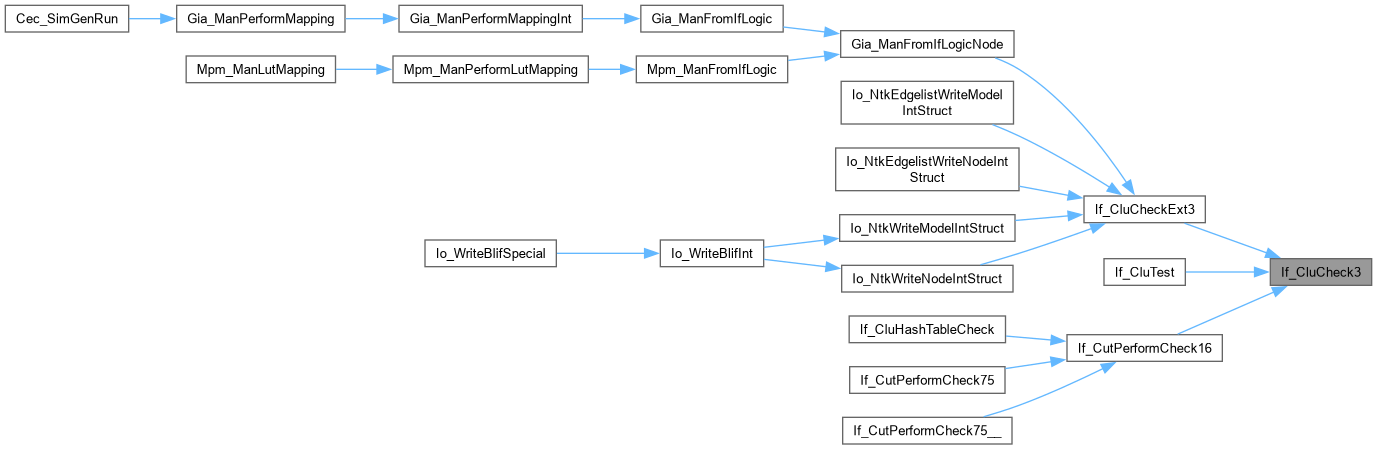
Here is the caller graph for this function:

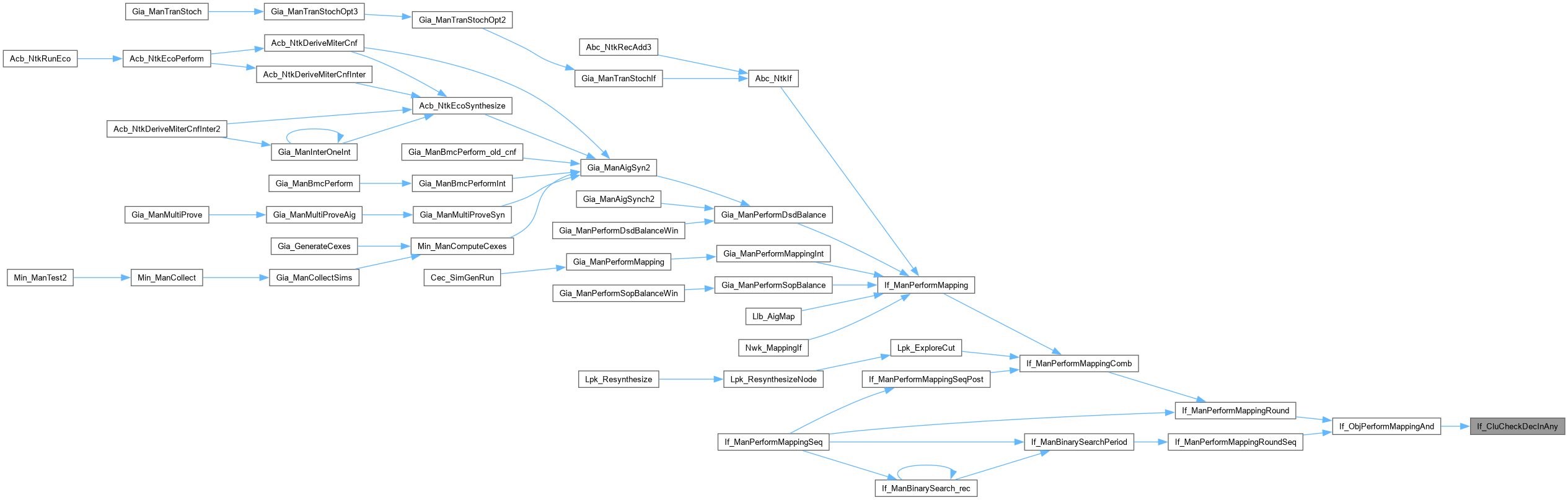
◆ If_CluCheckDecInAny()

int If_CluCheckDecInAny ( word t,
int nVars )

Definition at line 1767 of file ifDec16.c.
1768{
1769 int v, u, Cof2[2], Cof4[4];
1770 for ( v = 0; v < nVars; v++ )
1771 {
1772 Cof2[0] = Abc_Tt6Cofactor0( t, v );
1773 Cof2[1] = Abc_Tt6Cofactor1( t, v );
1774 for ( u = v+1; u < nVars; u++ )
1775 {
1776 Cof4[0] = Abc_Tt6Cofactor0( Cof2[0], u );
1777 Cof4[1] = Abc_Tt6Cofactor1( Cof2[0], u );
1778 Cof4[2] = Abc_Tt6Cofactor0( Cof2[1], u );
1779 Cof4[3] = Abc_Tt6Cofactor1( Cof2[1], u );
1780 if ( Cof4[0] == Cof4[1] && Cof4[0] == Cof4[2] )
1781 return 1;
1782 if ( Cof4[0] == Cof4[2] && Cof4[0] == Cof4[3] )
1783 return 1;
1784 if ( Cof4[0] == Cof4[1] && Cof4[0] == Cof4[3] )
1785 return 1;
1786 if ( Cof4[1] == Cof4[2] && Cof4[1] == Cof4[3] )
1787 return 1;
1788 }
1789 }
1790 return 0;
1791}
Here is the caller graph for this function:

◆ If_CluCheckDecInU()

int If_CluCheckDecInU ( word t,
int nVars )

Definition at line 1818 of file ifDec16.c.

1819{
1820 int v, u, Cof2[2], Cof4[4];
1821// for ( v = 0; v < nVars; v++ )
1822 for ( v = 0; v < 1; v++ ) // restrict to the first (decomposed) input
1823 {
1824 Cof2[0] = Abc_Tt6Cofactor0( t, v );
1825 Cof2[1] = Abc_Tt6Cofactor1( t, v );
1826 for ( u = v+1; u < nVars; u++ )
1827 {
1828 Cof4[0] = Abc_Tt6Cofactor0( Cof2[0], u ); // 00
1829 Cof4[1] = Abc_Tt6Cofactor1( Cof2[0], u ); // 01
1830 Cof4[2] = Abc_Tt6Cofactor0( Cof2[1], u ); // 10
1831 Cof4[3] = Abc_Tt6Cofactor1( Cof2[1], u ); // 11
1832 if ( Cof4[0] == Cof4[1] && Cof4[0] == Cof4[2] ) // F * a
1833 return 1;
1834 if ( Cof4[0] == Cof4[2] && Cof4[0] == Cof4[3] ) // !F * a
1835 return 1;
1836 }
1837 }
1838 return 0;
1839}
Here is the caller graph for this function:

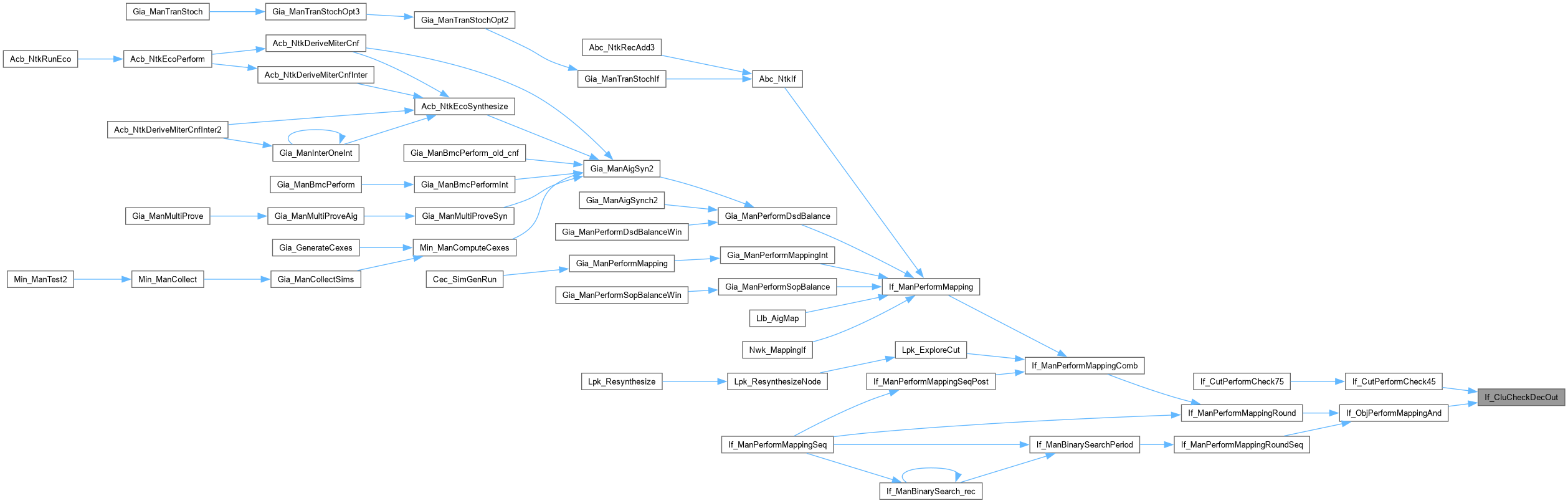
◆ If_CluCheckDecOut()

int If_CluCheckDecOut ( word t,
int nVars )

Definition at line 1840 of file ifDec16.c.
1841{
1842 int v;
1843 for ( v = 0; v < nVars; v++ )
1844 if (
1845 (t & Truth6[v]) == 0 || // F * !a
1846 (~t & Truth6[v]) == 0 || // !F * !a
1847 (t & ~Truth6[v]) == 0 || // F * a
1848 (~t & ~Truth6[v]) == 0 // !F * a
1849 )
1850 return 1;
1851 return 0;
1852}
Here is the caller graph for this function:

◆ If_CluCheckDecOutU()

int If_CluCheckDecOutU ( word t,
int nVars )

Definition at line 1853 of file ifDec16.c.

1854{
1855 int v;
1856 for ( v = 0; v < nVars; v++ )
1857 if (
1858 (t & ~Truth6[v]) == 0 || // F * a
1859 (~t & ~Truth6[v]) == 0 // !F * a
1860 )
1861 return 1;
1862 return 0;
1863}
Here is the caller graph for this function:

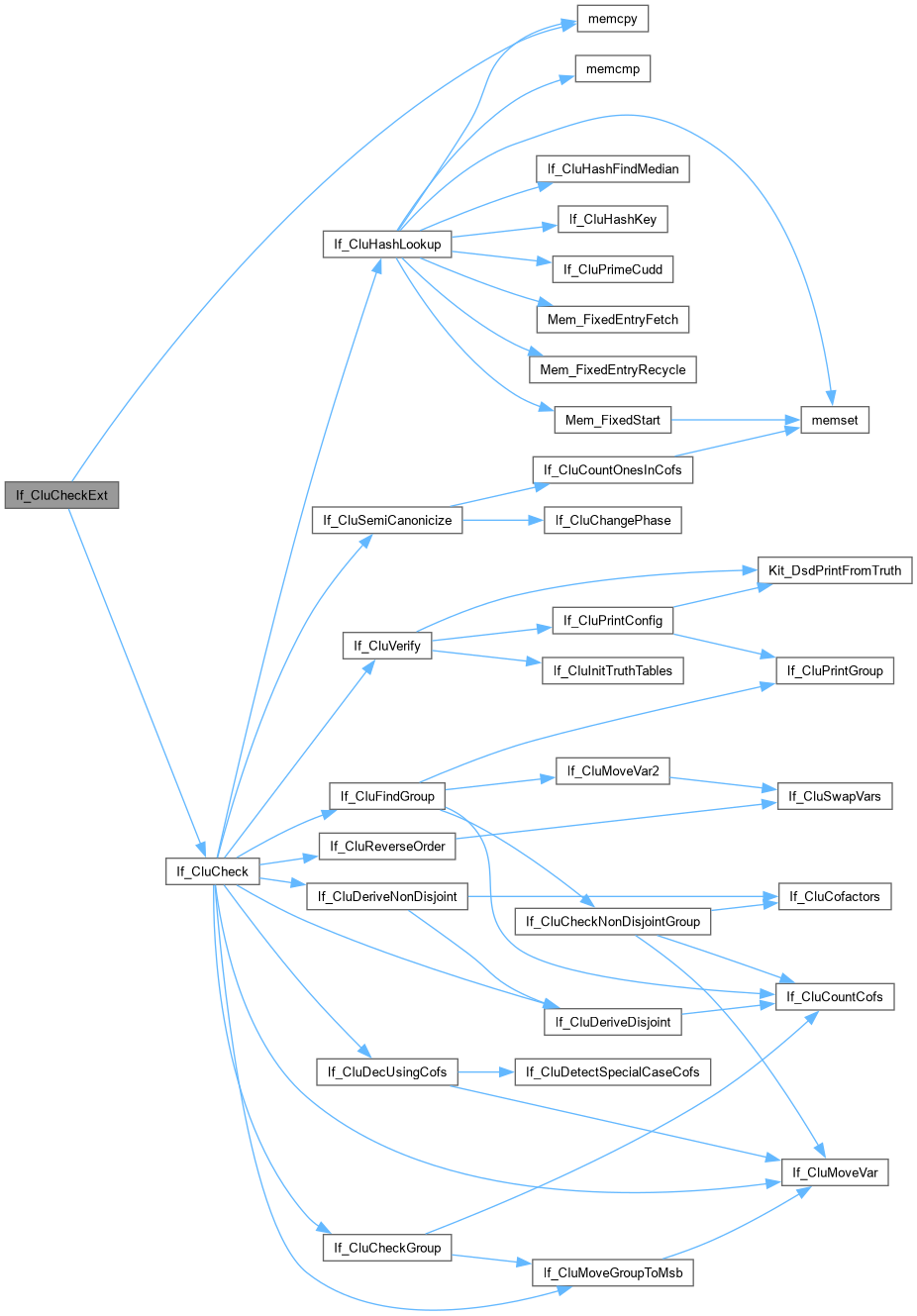
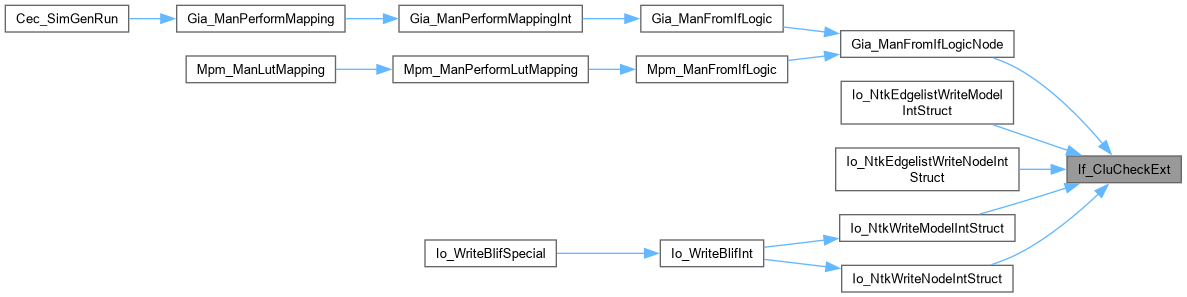
◆ If_CluCheckExt()

int If_CluCheckExt ( void * pMan,
word * pTruth,
int nVars,
int nLutLeaf,
int nLutRoot,
char * pLut0,
char * pLut1,
word * pFunc0,
word * pFunc1 )

Definition at line 2066 of file ifDec16.c.

2068{
2069 If_Man_t * p = (If_Man_t *)pMan;
2070 If_Grp_t G, R;
2071 G = If_CluCheck( p, pTruth, nVars, 0, 0, nLutLeaf, nLutRoot, &R, pFunc0, pFunc1, NULL, 0 );
2072 memcpy( pLut0, &R, sizeof(If_Grp_t) );
2073 memcpy( pLut1, &G, sizeof(If_Grp_t) );
2074// memcpy( pLut2, &G2, sizeof(If_Grp_t) );
2075 return (G.nVars > 0);
2076}
struct If_Man_t_ If_Man_t
BASIC TYPES ///.
Definition if.h:77
char * memcpy()
Here is the call graph for this function:
Here is the caller graph for this function:

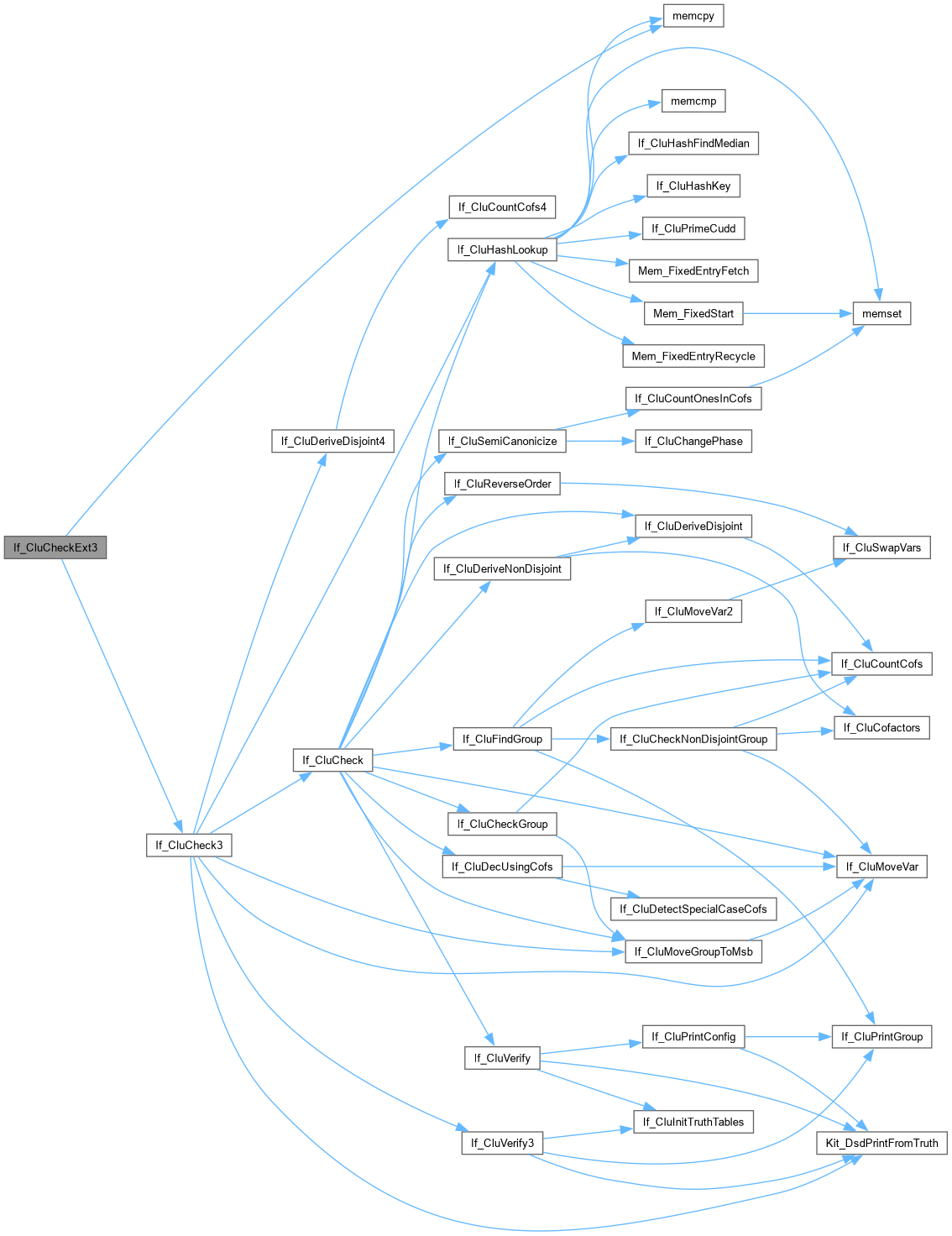
◆ If_CluCheckExt3()

int If_CluCheckExt3 ( void * pMan,
word * pTruth,
int nVars,
int nLutLeaf,
int nLutLeaf2,
int nLutRoot,
char * pLut0,
char * pLut1,
char * pLut2,
word * pFunc0,
word * pFunc1,
word * pFunc2 )

Definition at line 2079 of file ifDec16.c.
2081{
2082 If_Man_t * p = (If_Man_t *)pMan;
2083 If_Grp_t G, G2, R;
2084 G = If_CluCheck3( p, pTruth, nVars, nLutLeaf, nLutLeaf2, nLutRoot, &R, &G2, pFunc0, pFunc1, pFunc2 );
2085 memcpy( pLut0, &R, sizeof(If_Grp_t) );
2086 memcpy( pLut1, &G, sizeof(If_Grp_t) );
2087 memcpy( pLut2, &G2, sizeof(If_Grp_t) );
2088 return (G.nVars > 0);
2089}
If_Grp_t If_CluCheck3(If_Man_t *p, word *pTruth0, int nVars, int nLutLeaf, int nLutLeaf2, int nLutRoot, If_Grp_t *pR, If_Grp_t *pG2, word *pFunc0, word *pFunc1, word *pFunc2)
Definition ifDec16.c:1909
Here is the call graph for this function:
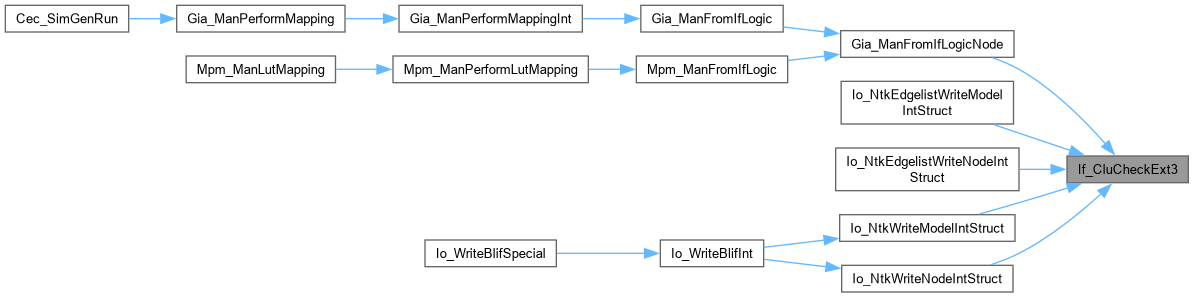
Here is the caller graph for this function:

◆ If_CluCheckGroup()

void If_CluCheckGroup ( word * pTruth,
int nVars,
If_Grp_t * g )

Definition at line 1420 of file ifDec16.c.

1421{
1422 word pF[CLU_WRD_MAX];
1423 int v, nCofs, V2P[CLU_VAR_MAX], P2V[CLU_VAR_MAX];
1424 assert( g->nVars >= 2 && g->nVars <= 6 ); // vars
1425 assert( g->nMyu >= 2 && g->nMyu <= 4 ); // cofs
1426 // create permutation
1427 for ( v = 0; v < nVars; v++ )
1428 V2P[v] = P2V[v] = v;
1429 // create truth table
1430 If_CluCopy( pF, pTruth, nVars );
1431 // move group up
1432 If_CluMoveGroupToMsb( pF, nVars, V2P, P2V, g );
1433 // check the number of cofactors
1434 nCofs = If_CluCountCofs( pF, nVars, g->nVars, 0, NULL );
1435 if ( nCofs != g->nMyu )
1436 printf( "Group check 0 has failed.\n" );
1437 // check compatible
1438 if ( nCofs > 2 )
1439 {
1440 nCofs = If_CluCountCofs( pF, nVars-1, g->nVars-1, 0, NULL );
1441 if ( nCofs > 2 )
1442 printf( "Group check 1 has failed.\n" );
1443 nCofs = If_CluCountCofs( pF, nVars-1, g->nVars-1, (1 << (nVars-1)), NULL );
1444 if ( nCofs > 2 )
1445 printf( "Group check 2 has failed.\n" );
1446 }
1447}
int If_CluCountCofs(word *pF, int nVars, int nBSsize, int iShift, word pCofs[3][CLU_WRD_MAX/4])
Definition ifDec16.c:903
Here is the call graph for this function:
Here is the caller graph for this function:

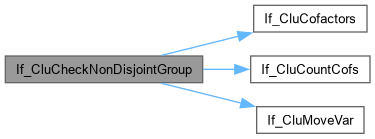
◆ If_CluCheckNonDisjointGroup()

int If_CluCheckNonDisjointGroup ( word * pF,
int nVars,
int * V2P,
int * P2V,
If_Grp_t * g )

Definition at line 1278 of file ifDec16.c.
1279{
1280 int v, i, nCofsBest2;
1281 if ( (g->nMyu == 3 || g->nMyu == 4) )
1282 {
1283 word pCofs[2][CLU_WRD_MAX];
1284 // try cofactoring w.r.t. each variable
1285 for ( v = 0; v < g->nVars; v++ )
1286 {
1287 If_CluCofactors( pF, nVars, V2P[(int)g->pVars[v]], pCofs[0], pCofs[1] );
1288 nCofsBest2 = If_CluCountCofs( pCofs[0], nVars, g->nVars, 0, NULL );
1289 if ( nCofsBest2 > 2 )
1290 continue;
1291 nCofsBest2 = If_CluCountCofs( pCofs[1], nVars, g->nVars, 0, NULL );
1292 if ( nCofsBest2 > 2 )
1293 continue;
1294 // found good shared variable - move to the end
1295 If_CluMoveVar( pF, nVars, V2P, P2V, g->pVars[v], nVars-1 );
1296 for ( i = 0; i < g->nVars; i++ )
1297 g->pVars[i] = P2V[nVars-g->nVars+i];
1298 return 1;
1299 }
1300 }
1301 return 0;
1302}
void If_CluCofactors(word *pF, int nVars, int iVar, word *pCof0, word *pCof1)
Definition ifDec16.c:1015
char pVars[CLU_VAR_MAX]
Definition ifDec16.c:42
Here is the call graph for this function:
Here is the caller graph for this function:

◆ If_CluCheckPerm()

void If_CluCheckPerm ( word * pTruth,
word * pF,
int nVars,
int * V2P,
int * P2V )

Definition at line 1451 of file ifDec16.c.

1452{
1453 int i;
1454 for ( i = 0; i < nVars; i++ )
1455 If_CluMoveVar( pF, nVars, V2P, P2V, i, i );
1456
1457 if ( !If_CluEqual( pTruth, pF, nVars ) )
1458 printf( "Permutation FAILED.\n" );
1459// else
1460// printf( "Permutation successful\n" );
1461}
Here is the call graph for this function:

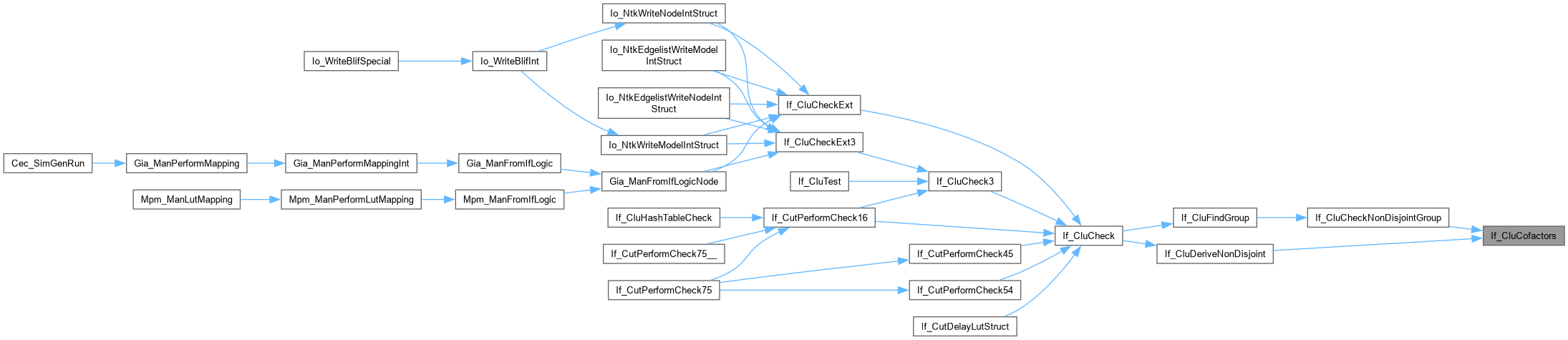
◆ If_CluCofactors()

void If_CluCofactors ( word * pF,
int nVars,
int iVar,
word * pCof0,
word * pCof1 )

Definition at line 1015 of file ifDec16.c.
1016{
1017 int nWords = If_CluWordNum( nVars );
1018 assert( iVar < nVars );
1019 if ( iVar < 6 )
1020 {
1021 int i, Shift = (1 << iVar);
1022 for ( i = 0; i < nWords; i++ )
1023 {
1024 pCof0[i] = (pF[i] & ~Truth6[iVar]) | ((pF[i] & ~Truth6[iVar]) << Shift);
1025 pCof1[i] = (pF[i] & Truth6[iVar]) | ((pF[i] & Truth6[iVar]) >> Shift);
1026 }
1027 }
1028 else
1029 {
1030 int i, k, Step = (1 << (iVar - 6));
1031 for ( k = 0; k < nWords; k += 2*Step )
1032 {
1033 for ( i = 0; i < Step; i++ )
1034 {
1035 pCof0[i] = pCof0[Step+i] = pF[i];
1036 pCof1[i] = pCof1[Step+i] = pF[Step+i];
1037 }
1038 pF += 2*Step;
1039 pCof0 += 2*Step;
1040 pCof1 += 2*Step;
1041 }
1042 }
1043}
Here is the caller graph for this function:

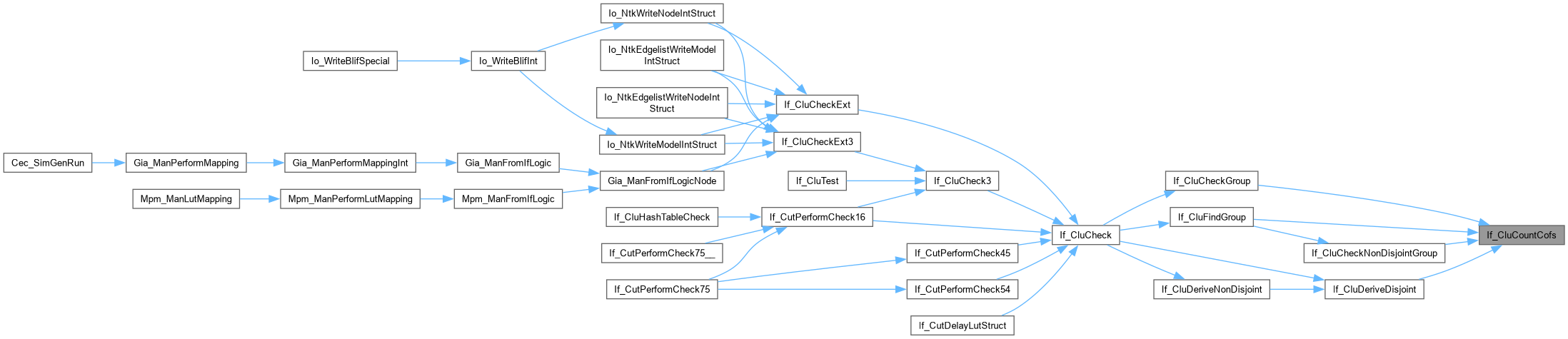
◆ If_CluCountCofs()

int If_CluCountCofs ( word * pF,
int nVars,
int nBSsize,
int iShift,
word pCofs[3][CLU_WRD_MAX/4] )

Definition at line 903 of file ifDec16.c.
904{
905 word iCofs[128] = {0}, iCof, Result = 0;
906 word * pCofA, * pCofB;
907 int nMints = (1 << nBSsize);
908 int i, c, w, nCofs;
909 assert( nBSsize >= 2 && nBSsize <= 7 && nBSsize < nVars );
910 if ( nVars - nBSsize < 6 )
911 {
912 int nShift = (1 << (nVars - nBSsize));
913 word Mask = ((((word)1) << nShift) - 1);
914 for ( nCofs = i = 0; i < nMints; i++ )
915 {
916 iCof = (pF[(iShift + i * nShift) / 64] >> ((iShift + i * nShift) & 63)) & Mask;
917 for ( c = 0; c < nCofs; c++ )
918 if ( iCof == iCofs[c] )
919 break;
920 if ( c == nCofs )
921 iCofs[nCofs++] = iCof;
922 if ( pCofs && iCof != iCofs[0] )
923 Result |= (((word)1) << i);
924 if ( nCofs == 5 )
925 break;
926 }
927 if ( nCofs <= 2 && pCofs )
928 {
929 assert( nBSsize <= 6 );
930 pCofs[0][0] = iCofs[0];
931 pCofs[1][0] = (nCofs == 2) ? iCofs[1] : iCofs[0];
932 pCofs[2][0] = Result;
933 }
934 }
935 else
936 {
937 int nWords = If_CluWordNum( nVars - nBSsize );
938 assert( nWords * nMints == If_CluWordNum(nVars) );
939 for ( nCofs = i = 0; i < nMints; i++ )
940 {
941 pCofA = pF + i * nWords;
942 for ( c = 0; c < nCofs; c++ )
943 {
944 pCofB = pF + iCofs[c] * nWords;
945 for ( w = 0; w < nWords; w++ )
946 if ( pCofA[w] != pCofB[w] )
947 break;
948 if ( w == nWords )
949 break;
950 }
951 if ( c == nCofs )
952 iCofs[nCofs++] = i;
953 if ( pCofs )
954 {
955 assert( nBSsize <= 6 );
956 pCofB = pF + iCofs[0] * nWords;
957 for ( w = 0; w < nWords; w++ )
958 if ( pCofA[w] != pCofB[w] )
959 break;
960 if ( w != nWords )
961 Result |= (((word)1) << i);
962 }
963 if ( nCofs == 5 )
964 break;
965 }
966 if ( nCofs <= 2 && pCofs )
967 {
968 If_CluCopy( pCofs[0], pF + iCofs[0] * nWords, nVars - nBSsize );
969 If_CluCopy( pCofs[1], pF + ((nCofs == 2) ? iCofs[1] : iCofs[0]) * nWords, nVars - nBSsize );
970 pCofs[2][0] = Result;
971 }
972 }
973 assert( nCofs >= 1 && nCofs <= 5 );
974 return nCofs;
975}
Here is the caller graph for this function:

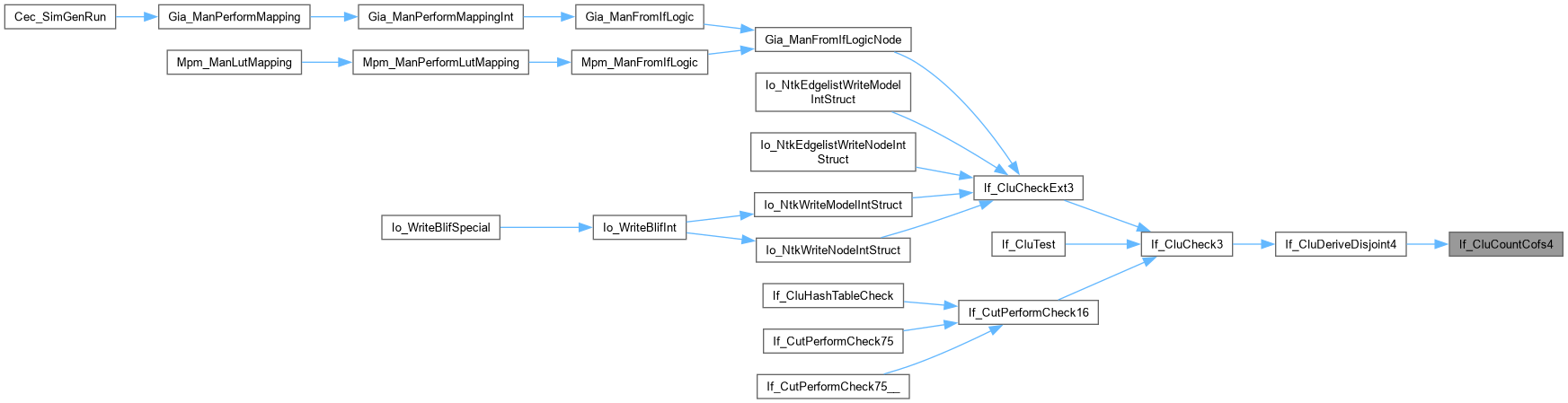
◆ If_CluCountCofs4()

int If_CluCountCofs4 ( word * pF,
int nVars,
int nBSsize,
word pCofs[6][CLU_WRD_MAX/4] )

Definition at line 978 of file ifDec16.c.
979{
980 word iCofs[128] = {0}, iCof, Result0 = 0, Result1 = 0;
981 int nMints = (1 << nBSsize);
982 int i, c, nCofs = 0;
983 assert( pCofs );
984 assert( nBSsize >= 2 && nBSsize <= 6 && nBSsize < nVars );
985 if ( nVars - nBSsize < 6 )
986 {
987 int nShift = (1 << (nVars - nBSsize));
988 word Mask = ((((word)1) << nShift) - 1);
989 for ( nCofs = i = 0; i < nMints; i++ )
990 {
991 iCof = (pF[(i * nShift) / 64] >> ((i * nShift) & 63)) & Mask;
992 for ( c = 0; c < nCofs; c++ )
993 if ( iCof == iCofs[c] )
994 break;
995 if ( c == nCofs )
996 iCofs[nCofs++] = iCof;
997 if ( c == 1 || c == 3 )
998 Result0 |= (((word)1) << i);
999 if ( c == 2 || c == 3 )
1000 Result1 |= (((word)1) << i);
1001 }
1002 assert( nCofs >= 3 && nCofs <= 4 );
1003 pCofs[0][0] = iCofs[0];
1004 pCofs[1][0] = iCofs[1];
1005 pCofs[2][0] = iCofs[2];
1006 pCofs[3][0] = (nCofs == 4) ? iCofs[3] : iCofs[2];
1007 pCofs[4][0] = Result0;
1008 pCofs[5][0] = Result1;
1009 }
1010 else
1011 assert( 0 );
1012 return nCofs;
1013}
Here is the caller graph for this function:

◆ If_CluCountOnesInCofs()

void If_CluCountOnesInCofs ( word * pTruth,
int nVars,
int * pStore )

Definition at line 465 of file ifDec16.c.

466{
467 int nWords = If_CluWordNum( nVars );
468 int i, k, nOnes = 0, Limit = Abc_MinInt( nVars, 6 );
469 memset( pStore, 0, sizeof(int) * 2 * nVars );
470 // compute positive cofactors
471 for ( k = 0; k < nWords; k++ )
472 for ( i = 0; i < Limit; i++ )
473 pStore[2*i+1] += If_CluCountOnes( pTruth[k] & Truth6[i] );
474 if ( nVars > 6 )
475 for ( k = 0; k < nWords; k++ )
476 for ( i = 6; i < nVars; i++ )
477 if ( k & (1 << (i-6)) )
478 pStore[2*i+1] += If_CluCountOnes( pTruth[k] );
479 // compute negative cofactors
480 for ( k = 0; k < nWords; k++ )
481 nOnes += If_CluCountOnes( pTruth[k] );
482 for ( i = 0; i < nVars; i++ )
483 pStore[2*i] = nOnes - pStore[2*i+1];
484}
char * memset()
Here is the call graph for this function:
Here is the caller graph for this function:

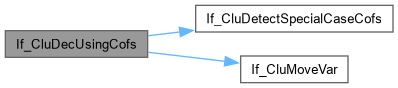
◆ If_CluDecUsingCofs()

If_Grp_t If_CluDecUsingCofs ( word * pTruth,
int nVars,
int nLutLeaf )

Definition at line 1112 of file ifDec16.c.
1113{
1114 If_Grp_t G = {0};
1115 word pF2[CLU_WRD_MAX], * pF = pF2;
1116 int Var2Pla[CLU_VAR_MAX+2], Pla2Var[CLU_VAR_MAX+2];
1117 int V2P[CLU_VAR_MAX+2], P2V[CLU_VAR_MAX+2];
1118 int nVarsNeeded = nVars - nLutLeaf;
1119 int v, i, k, iVar, State;
1120//Kit_DsdPrintFromTruth( (unsigned*)pTruth, nVars ); printf( "\n" );
1121 // create local copy
1122 If_CluCopy( pF, pTruth, nVars );
1123 for ( k = 0; k < nVars; k++ )
1124 Var2Pla[k] = Pla2Var[k] = k;
1125 // find decomposable vars
1126 for ( i = 0; i < nVarsNeeded; i++ )
1127 {
1128 for ( v = nVars - 1; v >= 0; v-- )
1129 {
1130 State = If_CluDetectSpecialCaseCofs( pF, nVars, v );
1131 if ( State == -1 )
1132 continue;
1133 // update the variable place
1134 iVar = Pla2Var[v];
1135 while ( Var2Pla[iVar] < nVars - 1 )
1136 {
1137 int iPlace0 = Var2Pla[iVar];
1138 int iPlace1 = Var2Pla[iVar]+1;
1139 Var2Pla[Pla2Var[iPlace0]]++;
1140 Var2Pla[Pla2Var[iPlace1]]--;
1141 Pla2Var[iPlace0] ^= Pla2Var[iPlace1];
1142 Pla2Var[iPlace1] ^= Pla2Var[iPlace0];
1143 Pla2Var[iPlace0] ^= Pla2Var[iPlace1];
1144 }
1145 // move this variable to the top
1146 for ( k = 0; k < nVars; k++ )
1147 V2P[k] = P2V[k] = k;
1148//Kit_DsdPrintFromTruth( (unsigned*)pF, nVars ); printf( "\n" );
1149 If_CluMoveVar( pF, nVars, V2P, P2V, v, nVars - 1 );
1150//Kit_DsdPrintFromTruth( (unsigned*)pF, nVars ); printf( "\n" );
1151 // choose cofactor to follow
1152 iVar = nVars - 1;
1153 if ( State == 0 || State == 1 ) // need cof1
1154 {
1155 if ( iVar < 6 )
1156 pF[0] = (pF[0] & Truth6[iVar]) | ((pF[0] & Truth6[iVar]) >> (1 << iVar));
1157 else
1158 pF += If_CluWordNum( nVars ) / 2;
1159 }
1160 else // need cof0
1161 {
1162 if ( iVar < 6 )
1163 pF[0] = (pF[0] & ~Truth6[iVar]) | ((pF[0] & ~Truth6[iVar]) << (1 << iVar));
1164 }
1165 // update the variable count
1166 nVars--;
1167 break;
1168 }
1169 if ( v == -1 )
1170 return G;
1171 }
1172 // create the resulting group
1173 G.nVars = nLutLeaf;
1174 G.nMyu = 2;
1175 for ( v = 0; v < G.nVars; v++ )
1176 G.pVars[v] = Pla2Var[v];
1177 return G;
1178}
int If_CluDetectSpecialCaseCofs(word *pF, int nVars, int iVar)
Definition ifDec16.c:1046
Here is the call graph for this function:
Here is the caller graph for this function:

◆ If_CluDelayMax()

float If_CluDelayMax ( If_Grp_t * g,
float * pDelays )

Definition at line 2093 of file ifDec16.c.

2094{
2095 float Delay = 0.0;
2096 int i;
2097 for ( i = 0; i < g->nVars; i++ )
2098 Delay = Abc_MaxFloat( Delay, pDelays[(int)g->pVars[i]] );
2099 return Delay;
2100}
Here is the caller graph for this function:

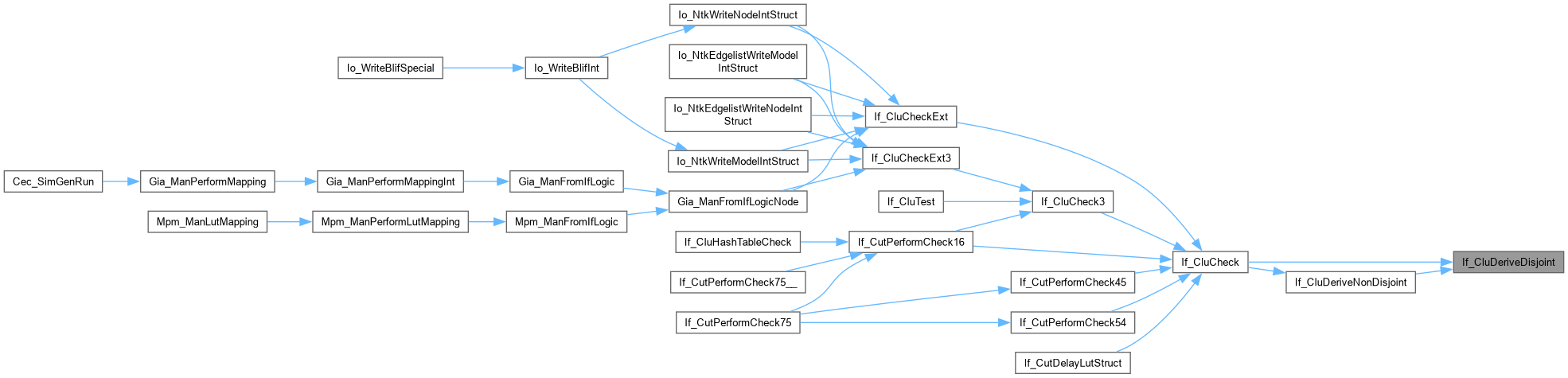
◆ If_CluDeriveDisjoint()

word If_CluDeriveDisjoint ( word * pF,
int nVars,
int * V2P,
int * P2V,
If_Grp_t * g,
If_Grp_t * r )

Definition at line 1183 of file ifDec16.c.

1184{
1185 word pCofs[3][CLU_WRD_MAX/4];
1186 int i, RetValue, nFSset = nVars - g->nVars;
1187 RetValue = If_CluCountCofs( pF, nVars, g->nVars, 0, pCofs );
1188// assert( RetValue == 2 );
1189
1190 if ( nFSset < 6 )
1191 pF[0] = (pCofs[1][0] << (1 << nFSset)) | pCofs[0][0];
1192 else
1193 {
1194 If_CluCopy( pF, pCofs[0], nFSset );
1195 If_CluCopy( pF + If_CluWordNum(nFSset), pCofs[1], nFSset );
1196 }
1197 // create the resulting group
1198 if ( r )
1199 {
1200 r->nVars = nFSset + 1;
1201 r->nMyu = 0;
1202 for ( i = 0; i < nFSset; i++ )
1203 r->pVars[i] = P2V[i];
1204 r->pVars[nFSset] = nVars;
1205 }
1206 return pCofs[2][0];
1207}
Here is the call graph for this function:
Here is the caller graph for this function:

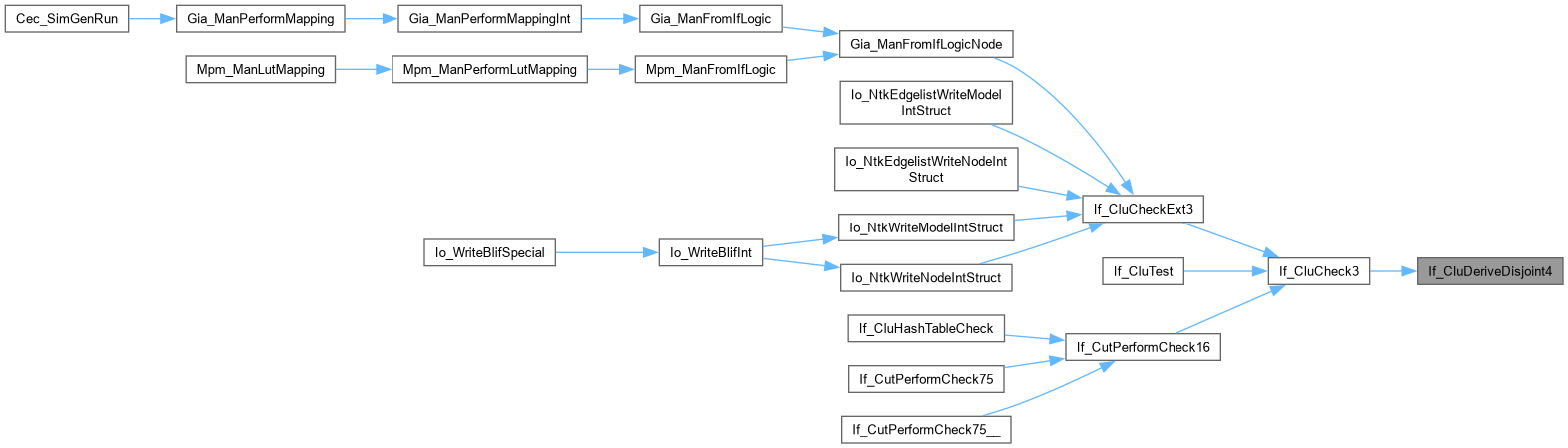
◆ If_CluDeriveDisjoint4()

void If_CluDeriveDisjoint4 ( word * pF,
int nVars,
int * V2P,
int * P2V,
If_Grp_t * g,
If_Grp_t * r,
word * pTruth0,
word * pTruth1 )

Definition at line 1208 of file ifDec16.c.

1209{
1210 word pCofs[6][CLU_WRD_MAX/4];
1211 word Cof0, Cof1;
1212 int i, RetValue, nFSset = nVars - g->nVars;
1213
1214 assert( g->nVars <= 6 && nFSset <= 4 );
1215
1216 RetValue = If_CluCountCofs4( pF, nVars, g->nVars, pCofs );
1217 if ( RetValue != 3 && RetValue != 4 )
1218 printf( "If_CluDeriveDisjoint4(): Error!!!\n" );
1219
1220 Cof0 = (pCofs[1][0] << (1 << nFSset)) | pCofs[0][0];
1221 Cof1 = (pCofs[3][0] << (1 << nFSset)) | pCofs[2][0];
1222 pF[0] = (Cof1 << (1 << (nFSset+1))) | Cof0;
1223 pF[0] = If_CluAdjust( pF[0], nFSset + 2 );
1224
1225 // create the resulting group
1226 r->nVars = nFSset + 2;
1227 r->nMyu = 0;
1228 for ( i = 0; i < nFSset; i++ )
1229 r->pVars[i] = P2V[i];
1230 r->pVars[nFSset] = nVars;
1231 r->pVars[nFSset+1] = nVars+1;
1232
1233 *pTruth0 = If_CluAdjust( pCofs[4][0], g->nVars );
1234 *pTruth1 = If_CluAdjust( pCofs[5][0], g->nVars );
1235}
int If_CluCountCofs4(word *pF, int nVars, int nBSsize, word pCofs[6][CLU_WRD_MAX/4])
Definition ifDec16.c:978
Here is the call graph for this function:
Here is the caller graph for this function:

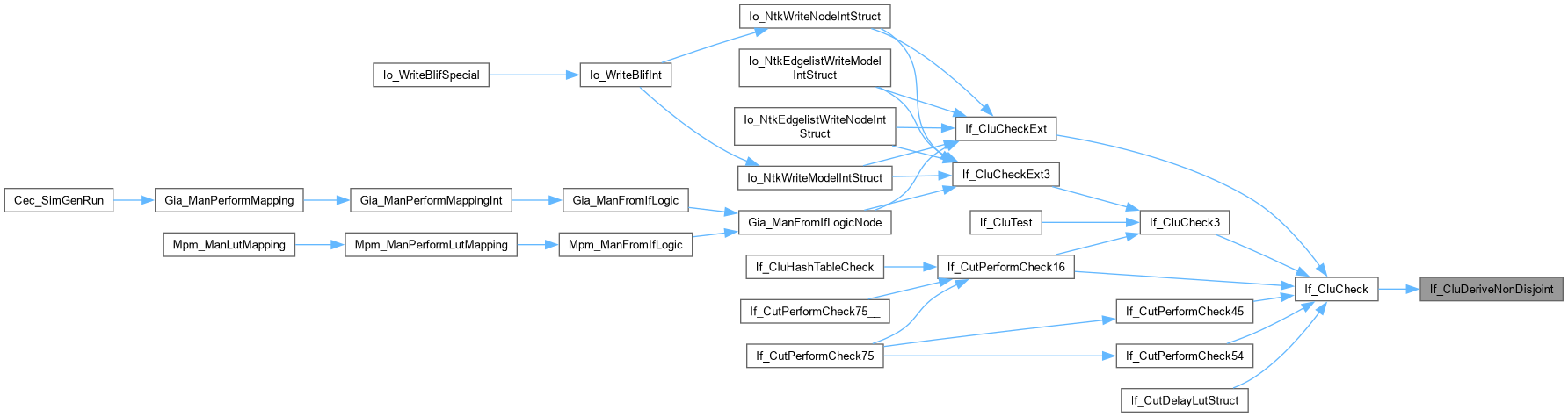
◆ If_CluDeriveNonDisjoint()

word If_CluDeriveNonDisjoint ( word * pF,
int nVars,
int * V2P,
int * P2V,
If_Grp_t * g,
If_Grp_t * r )

Definition at line 1237 of file ifDec16.c.

1238{
1239 word pCofs[2][CLU_WRD_MAX];
1240 word Truth0, Truth1, Truth;
1241 int i, nFSset = nVars - g->nVars, nFSset1 = nFSset + 1;
1242 If_CluCofactors( pF, nVars, nVars - 1, pCofs[0], pCofs[1] );
1243
1244// Extra_PrintHex( stdout, (unsigned *)pCofs[0], nVars ); printf( "\n" );
1245// Extra_PrintHex( stdout, (unsigned *)pCofs[1], nVars ); printf( "\n" );
1246
1247 g->nVars--;
1248 Truth0 = If_CluDeriveDisjoint( pCofs[0], nVars - 1, V2P, P2V, g, NULL );
1249 Truth1 = If_CluDeriveDisjoint( pCofs[1], nVars - 1, V2P, P2V, g, NULL );
1250 Truth = (Truth1 << (1 << g->nVars)) | Truth0;
1251 g->nVars++;
1252 if ( nFSset1 < 6 )
1253 pF[0] = (pCofs[1][0] << (1 << nFSset1)) | pCofs[0][0];
1254 else
1255 {
1256 If_CluCopy( pF, pCofs[0], nFSset1 );
1257 If_CluCopy( pF + If_CluWordNum(nFSset1), pCofs[1], nFSset1 );
1258 }
1259
1260// Extra_PrintHex( stdout, (unsigned *)&Truth0, 6 ); printf( "\n" );
1261// Extra_PrintHex( stdout, (unsigned *)&Truth1, 6 ); printf( "\n" );
1262// Extra_PrintHex( stdout, (unsigned *)&pCofs[0][0], 6 ); printf( "\n" );
1263// Extra_PrintHex( stdout, (unsigned *)&pCofs[1][0], 6 ); printf( "\n" );
1264// Extra_PrintHex( stdout, (unsigned *)&Truth, 6 ); printf( "\n" );
1265// Extra_PrintHex( stdout, (unsigned *)&pF[0], 6 ); printf( "\n" );
1266
1267 // create the resulting group
1268 r->nVars = nFSset + 2;
1269 r->nMyu = 0;
1270 for ( i = 0; i < nFSset; i++ )
1271 r->pVars[i] = P2V[i];
1272 r->pVars[nFSset] = nVars;
1273 r->pVars[nFSset+1] = g->pVars[g->nVars - 1];
1274 return Truth;
1275}
Here is the call graph for this function:
Here is the caller graph for this function:

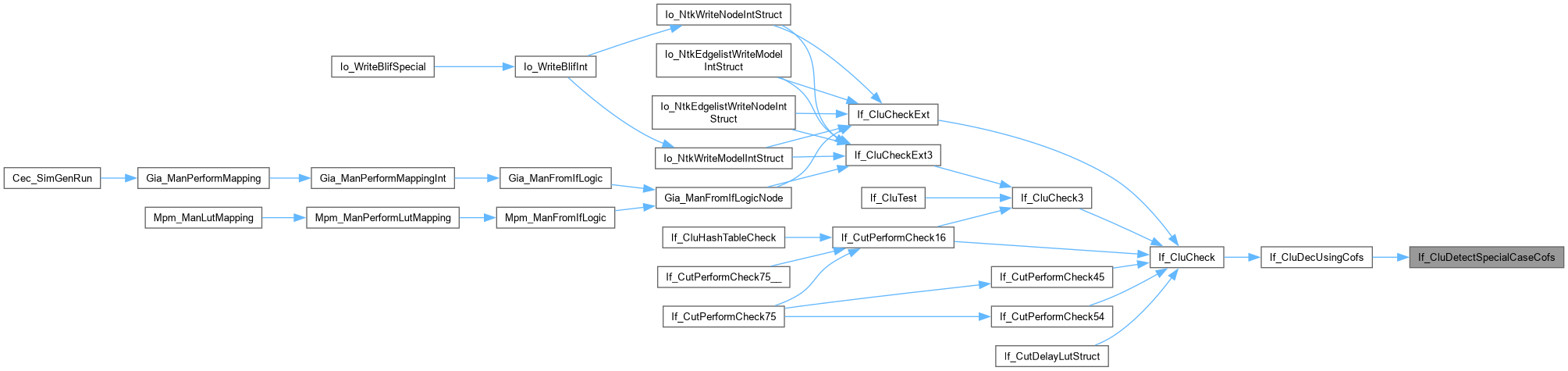
◆ If_CluDetectSpecialCaseCofs()

int If_CluDetectSpecialCaseCofs ( word * pF,
int nVars,
int iVar )

Definition at line 1046 of file ifDec16.c.
1047{
1048 word Cof0, Cof1;
1049 int State[6] = {0};
1050 int i, nWords = If_CluWordNum( nVars );
1051 assert( iVar < nVars );
1052 if ( iVar < 6 )
1053 {
1054 int Shift = (1 << iVar);
1055 for ( i = 0; i < nWords; i++ )
1056 {
1057 Cof0 = (pF[i] & ~Truth6[iVar]);
1058 Cof1 = ((pF[i] & Truth6[iVar]) >> Shift);
1059
1060 if ( Cof0 == 0 )
1061 State[0]++;
1062 else if ( Cof0 == ~Truth6[iVar] )
1063 State[1]++;
1064 else if ( Cof1 == 0 )
1065 State[2]++;
1066 else if ( Cof1 == ~Truth6[iVar] )
1067 State[3]++;
1068 else if ( Cof0 == ~Cof1 )
1069 State[4]++;
1070 else if ( Cof0 == Cof1 )
1071 State[5]++;
1072 }
1073 }
1074 else
1075 {
1076 int k, Step = (1 << (iVar - 6));
1077 for ( k = 0; k < nWords; k += 2*Step )
1078 {
1079 for ( i = 0; i < Step; i++ )
1080 {
1081 Cof0 = pF[i];
1082 Cof1 = pF[Step+i];
1083
1084 if ( Cof0 == 0 )
1085 State[0]++;
1086 else if ( Cof0 == ~(word)0 )
1087 State[1]++;
1088 else if ( Cof1 == 0 )
1089 State[2]++;
1090 else if ( Cof1 == ~(word)0 )
1091 State[3]++;
1092 else if ( Cof0 == ~Cof1 )
1093 State[4]++;
1094 else if ( Cof0 == Cof1 )
1095 State[5]++;
1096 }
1097 pF += 2*Step;
1098 }
1099 nWords /= 2;
1100 }
1101 assert( State[5] != nWords );
1102 for ( i = 0; i < 5; i++ )
1103 {
1104 assert( State[i] <= nWords );
1105 if ( State[i] == nWords )
1106 return i;
1107 }
1108 return -1;
1109}
Here is the caller graph for this function:

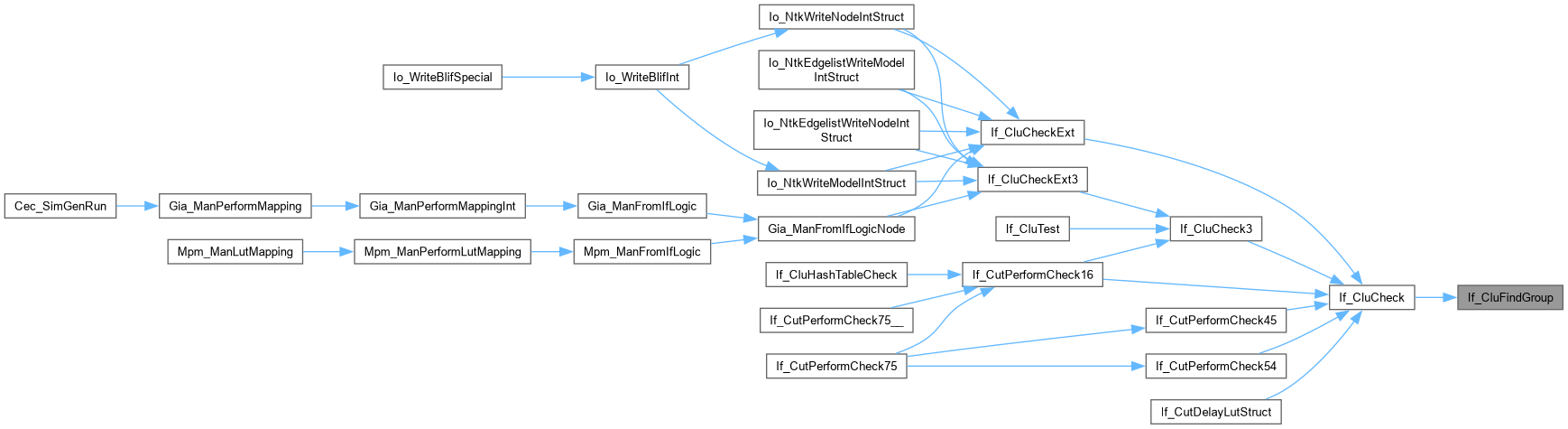
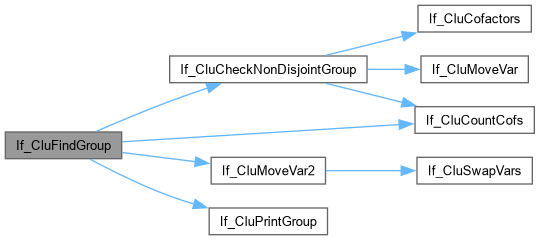
◆ If_CluFindGroup()

If_Grp_t If_CluFindGroup ( word * pF,
int nVars,
int iVarStart,
int iVarStop,
int * V2P,
int * P2V,
int nBSsize,
int fDisjoint )

Definition at line 1306 of file ifDec16.c.
1307{
1308 int fVerbose = 0;
1309 int nRounds = 2;//nBSsize;
1310 If_Grp_t G = {0}, * g = &G;//, BestG = {0};
1311 int i, r, v, nCofs, VarBest, nCofsBest2;
1312 assert( nVars > nBSsize && nVars >= nBSsize + iVarStart && nVars <= CLU_VAR_MAX );
1313 assert( nBSsize >= 2 && nBSsize <= 6 );
1314 assert( !iVarStart || !iVarStop );
1315 // start with the default group
1316 g->nVars = nBSsize;
1317 g->nMyu = If_CluCountCofs( pF, nVars, nBSsize, 0, NULL );
1318 for ( i = 0; i < nBSsize; i++ )
1319 g->pVars[i] = P2V[nVars-nBSsize+i];
1320 // check if good enough
1321 if ( g->nMyu == 2 )
1322 return G;
1323 if ( !fDisjoint && If_CluCheckNonDisjointGroup( pF, nVars, V2P, P2V, g ) )
1324 {
1325// BestG = G;
1326 return G;
1327 }
1328 if ( nVars == nBSsize + iVarStart )
1329 {
1330 g->nVars = 0;
1331 return G;
1332 }
1333
1334 if ( fVerbose )
1335 {
1336 printf( "Iter %2d ", -1 );
1337 If_CluPrintGroup( g );
1338 }
1339
1340 // try to find better group
1341 for ( r = 0; r < nRounds; r++ )
1342 {
1343 if ( nBSsize < nVars-1 )
1344 {
1345 // find the best var to add
1346 VarBest = P2V[nVars-1-nBSsize];
1347 nCofsBest2 = If_CluCountCofs( pF, nVars, nBSsize+1, 0, NULL );
1348 for ( v = nVars-2-nBSsize; v >= iVarStart; v-- )
1349 {
1350// If_CluMoveVar( pF, nVars, V2P, P2V, P2V[v], nVars-1-nBSsize );
1351 If_CluMoveVar2( pF, nVars, V2P, P2V, P2V[v], nVars-1-nBSsize );
1352 nCofs = If_CluCountCofs( pF, nVars, nBSsize+1, 0, NULL );
1353 if ( nCofsBest2 >= nCofs )
1354 {
1355 nCofsBest2 = nCofs;
1356 VarBest = P2V[nVars-1-nBSsize];
1357 }
1358 }
1359 // go back
1360// If_CluMoveVar( pF, nVars, V2P, P2V, VarBest, nVars-1-nBSsize );
1361 If_CluMoveVar2( pF, nVars, V2P, P2V, VarBest, nVars-1-nBSsize );
1362 // update best bound set
1363 nCofs = If_CluCountCofs( pF, nVars, nBSsize+1, 0, NULL );
1364 assert( nCofs == nCofsBest2 );
1365 }
1366
1367 // find the best var to remove
1368 VarBest = P2V[nVars-1-nBSsize];
1369 nCofsBest2 = If_CluCountCofs( pF, nVars, nBSsize, 0, NULL );
1370 for ( v = nVars-nBSsize; v < nVars-iVarStop; v++ )
1371 {
1372// If_CluMoveVar( pF, nVars, V2P, P2V, P2V[v], nVars-1-nBSsize );
1373 If_CluMoveVar2( pF, nVars, V2P, P2V, P2V[v], nVars-1-nBSsize );
1374 nCofs = If_CluCountCofs( pF, nVars, nBSsize, 0, NULL );
1375 if ( nCofsBest2 >= nCofs )
1376 {
1377 nCofsBest2 = nCofs;
1378 VarBest = P2V[nVars-1-nBSsize];
1379 }
1380 }
1381
1382 // go back
1383// If_CluMoveVar( pF, nVars, V2P, P2V, VarBest, nVars-1-nBSsize );
1384 If_CluMoveVar2( pF, nVars, V2P, P2V, VarBest, nVars-1-nBSsize );
1385 // update best bound set
1386 nCofs = If_CluCountCofs( pF, nVars, nBSsize, 0, NULL );
1387 assert( nCofs == nCofsBest2 );
1388 if ( g->nMyu >= nCofs )
1389 {
1390 g->nVars = nBSsize;
1391 g->nMyu = nCofs;
1392 for ( i = 0; i < nBSsize; i++ )
1393 g->pVars[i] = P2V[nVars-nBSsize+i];
1394 }
1395
1396 if ( fVerbose )
1397 {
1398 printf( "Iter %2d ", r );
1399 If_CluPrintGroup( g );
1400 }
1401
1402 // check if good enough
1403 if ( g->nMyu == 2 )
1404 return G;
1405 if ( !fDisjoint && If_CluCheckNonDisjointGroup( pF, nVars, V2P, P2V, g ) )
1406 {
1407// BestG = G;
1408 return G;
1409 }
1410 }
1411
1412 assert( r == nRounds );
1413 g->nVars = 0;
1414 return G;
1415// return BestG;
1416}
void If_CluPrintGroup(If_Grp_t *g)
Definition ifDec16.c:580
void If_CluMoveVar2(word *pF, int nVars, int *Var2Pla, int *Pla2Var, int v, int p)
Definition ifDec16.c:812
int If_CluCheckNonDisjointGroup(word *pF, int nVars, int *V2P, int *P2V, If_Grp_t *g)
Definition ifDec16.c:1278
Here is the call graph for this function:
Here is the caller graph for this function:

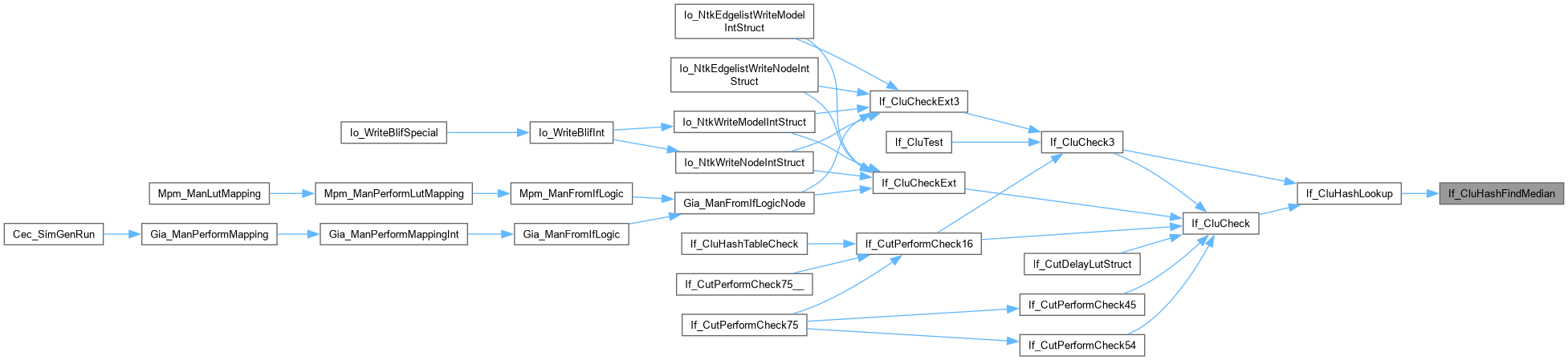
◆ If_CluHashFindMedian()

int If_CluHashFindMedian ( If_Man_t * p,
int t )

Definition at line 180 of file ifDec16.c.
181{
182 If_Hte_t * pEntry;
183 Vec_Int_t * vCounters;
184 int i, Max = 0, Total = 0, Half = 0;
185 vCounters = Vec_IntStart( 1000 );
186 for ( i = 0; i < p->nTableSize[t]; i++ )
187 {
188 for ( pEntry = ((If_Hte_t **)p->pHashTable[t])[i]; pEntry; pEntry = pEntry->pNext )
189 {
190 if ( Max < (int)pEntry->Counter )
191 {
192 Max = pEntry->Counter;
193 Vec_IntSetEntry( vCounters, pEntry->Counter, 0 );
194 }
195 Vec_IntAddToEntry( vCounters, pEntry->Counter, 1 );
196 Total++;
197 }
198 }
199 for ( i = Max; i > 0; i-- )
200 {
201 Half += Vec_IntEntry( vCounters, i );
202 if ( Half > Total/2 )
203 break;
204 }
205/*
206 printf( "total = %d ", Total );
207 printf( "half = %d ", Half );
208 printf( "i = %d ", i );
209 printf( "Max = %d.\n", Max );
210*/
211 Vec_IntFree( vCounters );
212 return Abc_MaxInt( i, 1 );
213}
typedefABC_NAMESPACE_IMPL_START struct Vec_Int_t_ Vec_Int_t
DECLARATIONS ///.
Definition bblif.c:37
struct If_Hte_t_ If_Hte_t
Definition ifDec16.c:46
If_Hte_t * pNext
Definition ifDec16.c:49
unsigned Counter
Definition ifDec16.c:51
Here is the caller graph for this function:

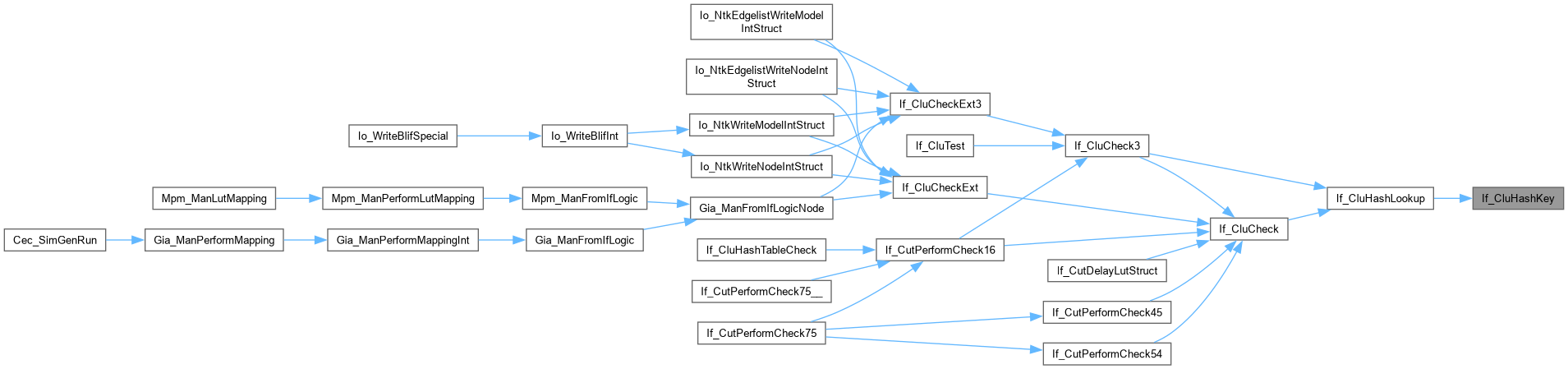
◆ If_CluHashKey()

int If_CluHashKey ( word * pTruth,
int nWords,
int Size )

Definition at line 214 of file ifDec16.c.
215{
216 static unsigned BigPrimes[8] = {12582917, 25165843, 50331653, 100663319, 201326611, 402653189, 805306457, 1610612741};
217 unsigned Value = 0;
218 int i;
219 if ( nWords < 4 )
220 {
221 unsigned char * s = (unsigned char *)pTruth;
222 for ( i = 0; i < 8 * nWords; i++ )
223 Value ^= BigPrimes[i % 7] * s[i];
224 }
225 else
226 {
227 unsigned * s = (unsigned *)pTruth;
228 for ( i = 0; i < 2 * nWords; i++ )
229 Value ^= BigPrimes[i % 7] * s[i];
230 }
231 return Value % Size;
232}
Here is the caller graph for this function:

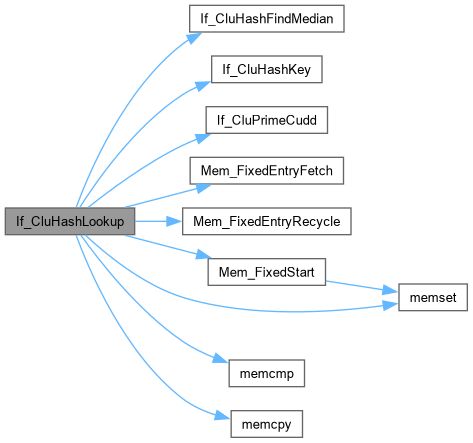
◆ If_CluHashLookup()

unsigned * If_CluHashLookup ( If_Man_t * p,
word * pTruth,
int t )

Definition at line 233 of file ifDec16.c.
234{
235 If_Hte_t * pEntry, * pPrev;
236 int nWords, HashKey;
237 if ( p == NULL )
238 return NULL;
239 nWords = If_CluWordNum(p->pPars->nLutSize);
240 if ( p->pMemEntries == NULL )
241 p->pMemEntries = Mem_FixedStart( sizeof(If_Hte_t) + sizeof(word) * (If_CluWordNum(p->pPars->nLutSize) - 1) );
242 if ( p->pHashTable[t] == NULL )
243 {
244 // decide how large should be the table
245 int nEntriesMax1 = 4 * If_CluPrimeCudd( Vec_PtrSize(p->vObjs) * p->pPars->nCutsMax );
246 int nEntriesMax2 = (int)(((double)CLU_MEM_MAX * (1 << 20)) / If_CluWordNum(p->pPars->nLutSize) / 8);
247// int nEntriesMax2 = 10000;
248 // create table
249 p->nTableSize[t] = If_CluPrimeCudd( Abc_MinInt(nEntriesMax1, nEntriesMax2)/2 );
250 p->pHashTable[t] = ABC_CALLOC( void *, p->nTableSize[t] );
251 }
252 // check if this entry exists
253 HashKey = If_CluHashKey( pTruth, nWords, p->nTableSize[t] );
254 for ( pEntry = ((If_Hte_t **)p->pHashTable[t])[HashKey]; pEntry; pEntry = pEntry->pNext )
255 if ( memcmp(pEntry->pTruth, pTruth, sizeof(word) * nWords) == 0 )
256 {
257 pEntry->Counter++;
258 return &pEntry->Group;
259 }
260 // resize the hash table
261 if ( p->nTableEntries[t] >= 2 * p->nTableSize[t] )
262 {
263 // collect useful entries
264 If_Hte_t * pPrev;
265 Vec_Ptr_t * vUseful = Vec_PtrAlloc( p->nTableEntries[t] );
266 int i, Median = If_CluHashFindMedian( p, t );
267 for ( i = 0; i < p->nTableSize[t]; i++ )
268 {
269 for ( pEntry = ((If_Hte_t **)p->pHashTable[t])[i]; pEntry; )
270 {
271 if ( (int)pEntry->Counter > Median )
272 {
273 Vec_PtrPush( vUseful, pEntry );
274 pEntry = pEntry->pNext;
275 }
276 else
277 {
278 pPrev = pEntry->pNext;
279 Mem_FixedEntryRecycle( p->pMemEntries, (char *)pEntry );
280 pEntry = pPrev;
281 }
282 }
283 }
284 // add useful entries
285 memset( p->pHashTable[t], 0, sizeof(void *) * p->nTableSize[t] );
286 Vec_PtrForEachEntry( If_Hte_t *, vUseful, pEntry, i )
287 {
288 HashKey = If_CluHashKey( pEntry->pTruth, nWords, p->nTableSize[t] );
289 pPrev = ((If_Hte_t **)p->pHashTable[t])[HashKey];
290 if ( pPrev == NULL || pEntry->Counter >= pPrev->Counter )
291 {
292 pEntry->pNext = pPrev;
293 ((If_Hte_t **)p->pHashTable[t])[HashKey] = pEntry;
294 }
295 else
296 {
297 while ( pPrev->pNext && pEntry->Counter < pPrev->pNext->Counter )
298 pPrev = pPrev->pNext;
299 pEntry->pNext = pPrev->pNext;
300 pPrev->pNext = pEntry;
301 }
302 }
303 p->nTableEntries[t] = Vec_PtrSize( vUseful );
304 Vec_PtrFree( vUseful );
305 }
306 // create entry
307 p->nTableEntries[t]++;
308 pEntry = (If_Hte_t *)Mem_FixedEntryFetch( p->pMemEntries );
309 memcpy( pEntry->pTruth, pTruth, sizeof(word) * nWords );
310 pEntry->Group = CLU_UNUSED;
311 pEntry->Counter = 1;
312 // insert at the beginning
313// pEntry->pNext = ((If_Hte_t **)p->pHashTable[t])[HashKey];
314// ((If_Hte_t **)p->pHashTable[t])[HashKey] = pEntry;
315 // insert at the end
316 pEntry->pNext = NULL;
317 for ( pPrev = ((If_Hte_t **)p->pHashTable[t])[HashKey]; pPrev && pPrev->pNext; pPrev = pPrev->pNext );
318 if ( pPrev == NULL )
319 ((If_Hte_t **)p->pHashTable[t])[HashKey] = pEntry;
320 else
321 pPrev->pNext = pEntry;
322 return &pEntry->Group;
323}
#define ABC_CALLOC(type, num)
Definition abc_global.h:265
unsigned int If_CluPrimeCudd(unsigned int p)
Definition ifDec16.c:104
int If_CluHashKey(word *pTruth, int nWords, int Size)
Definition ifDec16.c:214
int If_CluHashFindMedian(If_Man_t *p, int t)
Definition ifDec16.c:180
#define CLU_MEM_MAX
Definition ifDec16.c:33
char * Mem_FixedEntryFetch(Mem_Fixed_t *p)
Definition mem.c:184
Mem_Fixed_t * Mem_FixedStart(int nEntrySize)
FUNCTION DEFINITIONS ///.
Definition mem.c:100
void Mem_FixedEntryRecycle(Mem_Fixed_t *p, char *pEntry)
Definition mem.c:235
unsigned Group
Definition ifDec16.c:50
word pTruth[1]
Definition ifDec16.c:52
int memcmp()
typedefABC_NAMESPACE_HEADER_START struct Vec_Ptr_t_ Vec_Ptr_t
INCLUDES ///.
Definition vecPtr.h:42
#define Vec_PtrForEachEntry(Type, vVec, pEntry, i)
MACRO DEFINITIONS ///.
Definition vecPtr.h:55
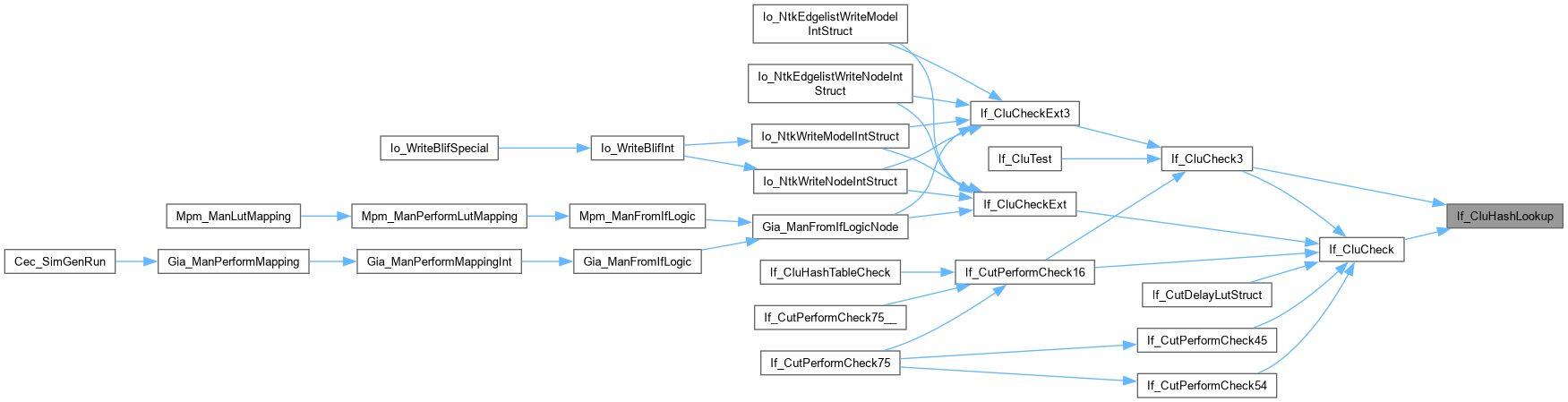
Here is the call graph for this function:
Here is the caller graph for this function:

◆ If_CluHashPrintStats()

void If_CluHashPrintStats ( If_Man_t * p,
int t )

Definition at line 164 of file ifDec16.c.

165{
166 If_Hte_t * pEntry;
167 int i, Counter;
168 for ( i = 0; i < p->nTableSize[t]; i++ )
169 {
170 Counter = 0;
171 for ( pEntry = ((If_Hte_t **)p->pHashTable[t])[i]; pEntry; pEntry = pEntry->pNext )
172 Counter++;
173 if ( Counter == 0 )
174 continue;
175 if ( Counter < 10 )
176 continue;
177 printf( "%d=%d ", i, Counter );
178 }
179}

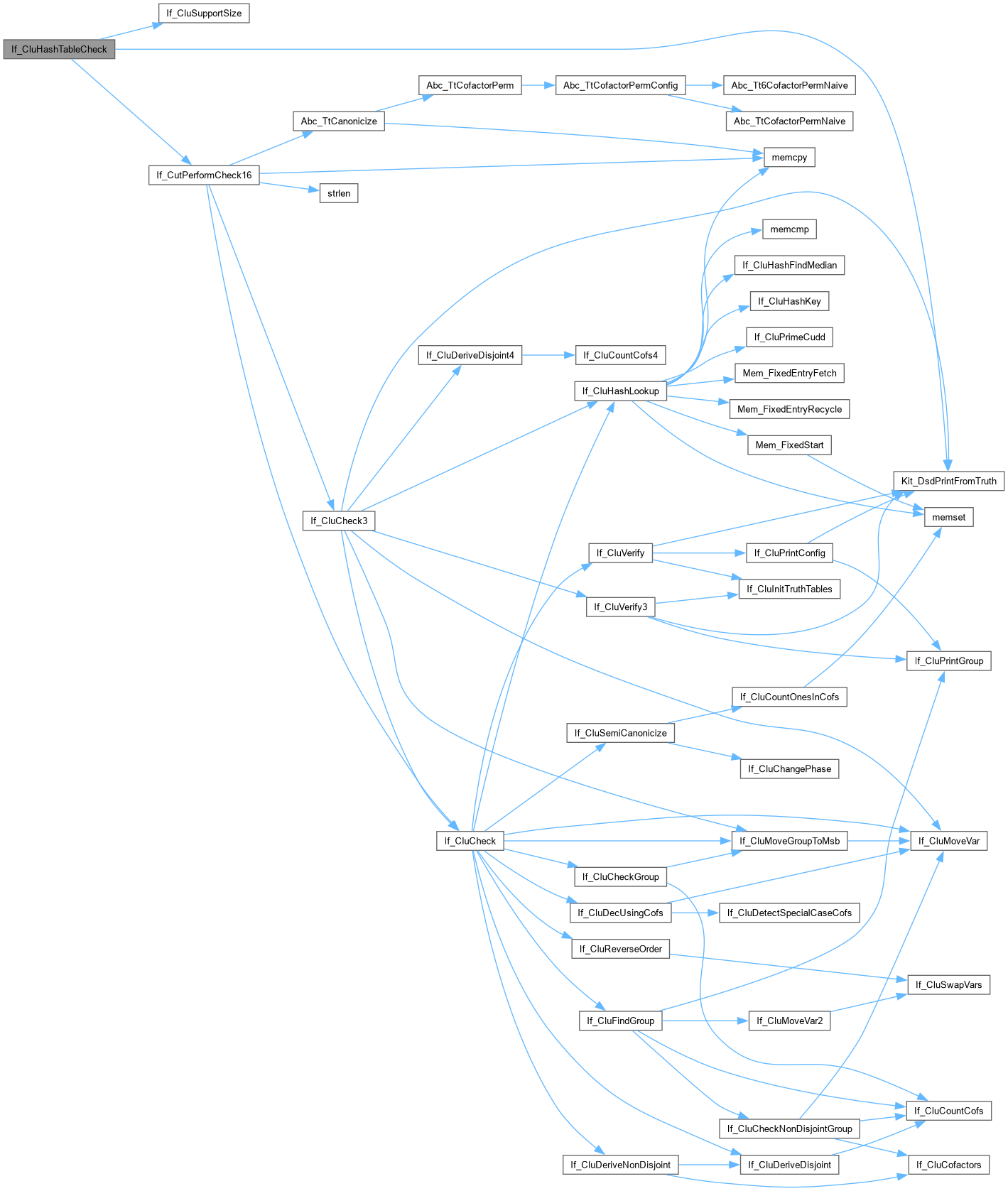
◆ If_CluHashTableCheck()

void If_CluHashTableCheck ( If_Man_t * p)

Definition at line 144 of file ifDec16.c.
145{
146 int t = 1;
147 If_Hte_t * pEntry;
148 int i, RetValue, Status;
149 for ( i = 0; i < p->nTableSize[t]; i++ )
150 {
151 for ( pEntry = ((If_Hte_t **)p->pHashTable[t])[i]; pEntry; pEntry = pEntry->pNext )
152 {
153 Status = ((pEntry->Group & 15) > 0);
154 RetValue = If_CutPerformCheck16( NULL, (unsigned *)pEntry->pTruth, 13, If_CluSupportSize(pEntry->pTruth, 13), "555" );
155 if ( RetValue != Status )
156 {
157 Kit_DsdPrintFromTruth( (unsigned*)pEntry->pTruth, 13 ); printf( "\n" );
158 RetValue = If_CutPerformCheck16( NULL, (unsigned *)pEntry->pTruth, 13, If_CluSupportSize(pEntry->pTruth, 13), "555" );
159 printf( "Hash table problem!!!\n" );
160 }
161 }
162 }
163}
int If_CutPerformCheck16(If_Man_t *p, unsigned *pTruth0, int nVars, int nLeaves, char *pStr)
Definition ifDec16.c:2216
int If_CluSupportSize(word *t, int nVars)
Definition ifDec16.c:1503
Here is the call graph for this function:

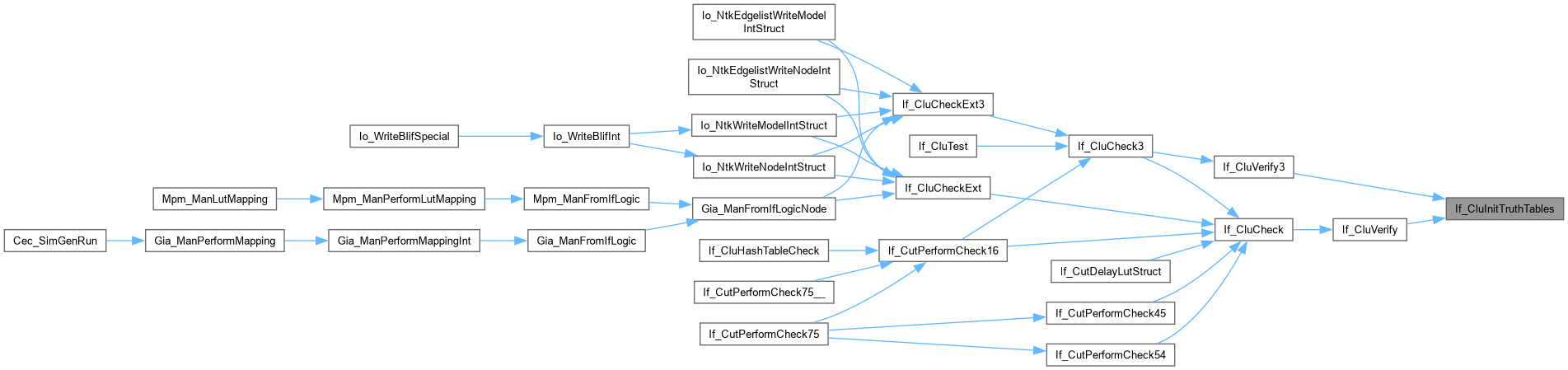
◆ If_CluInitTruthTables()

void If_CluInitTruthTables ( )

Definition at line 606 of file ifDec16.c.
607{
608 int i, k;
609 assert( CLU_VAR_MAX <= 16 );
610 for ( i = 0; i < 6; i++ )
611 for ( k = 0; k < CLU_WRD_MAX; k++ )
612 TruthAll[i][k] = Truth6[i];
613 for ( i = 6; i < CLU_VAR_MAX; i++ )
614 for ( k = 0; k < CLU_WRD_MAX; k++ )
615 TruthAll[i][k] = ((k >> (i-6)) & 1) ? ~(word)0 : 0;
616
617// Extra_PrintHex( stdout, TruthAll[6], 8 ); printf( "\n" );
618// Extra_PrintHex( stdout, TruthAll[7], 8 ); printf( "\n" );
619}
Here is the caller graph for this function:

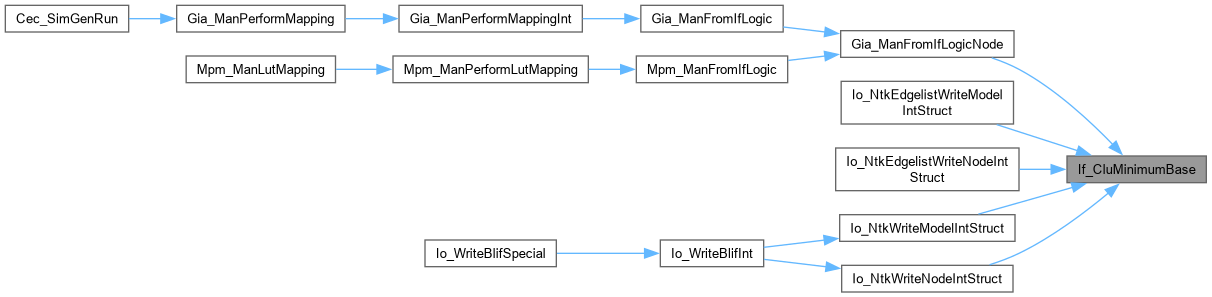
◆ If_CluMinimumBase()

int If_CluMinimumBase ( word * t,
int * pSupp,
int nVarsAll,
int * pnVars )

Definition at line 1532 of file ifDec16.c.
1533{
1534 int v, iVar = 0, uSupp = 0;
1535 assert( nVarsAll <= 16 );
1536 for ( v = 0; v < nVarsAll; v++ )
1537 if ( If_CluHasVar( t, nVarsAll, v ) )
1538 {
1539 uSupp |= (1 << v);
1540 if ( pSupp )
1541 pSupp[iVar] = pSupp[v];
1542 iVar++;
1543 }
1544 if ( pnVars )
1545 *pnVars = iVar;
1546 if ( If_CluSuppIsMinBase( uSupp ) )
1547 return 0;
1548 If_CluTruthShrink( t, iVar, nVarsAll, uSupp );
1549 return 1;
1550}
Here is the caller graph for this function:

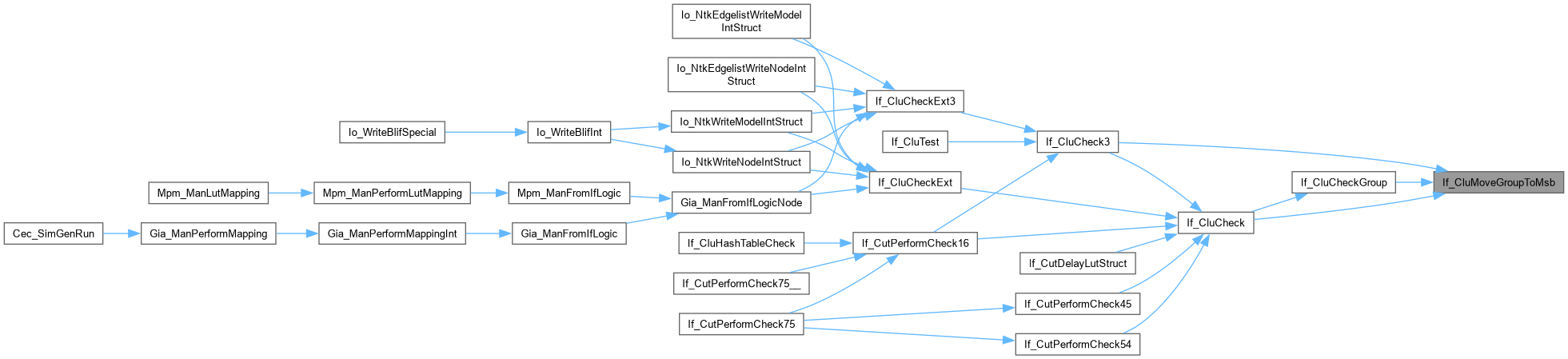
◆ If_CluMoveGroupToMsb()

void If_CluMoveGroupToMsb ( word * pF,
int nVars,
int * V2P,
int * P2V,
If_Grp_t * g )

Definition at line 855 of file ifDec16.c.

856{
857 int v;
858 for ( v = 0; v < g->nVars; v++ )
859 If_CluMoveVar( pF, nVars, V2P, P2V, g->pVars[g->nVars - 1 - v], nVars - 1 - v );
860}
Here is the call graph for this function:
Here is the caller graph for this function:

◆ If_CluMoveVar()

void If_CluMoveVar ( word * pF,
int nVars,
int * Var2Pla,
int * Pla2Var,
int v,
int p )

Definition at line 818 of file ifDec16.c.
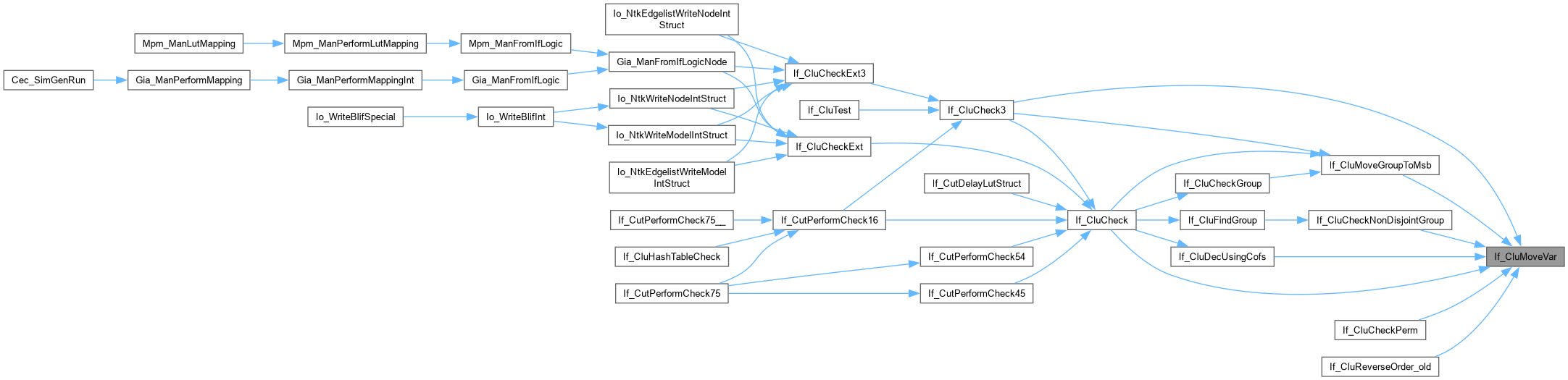
819{
820 word pG[CLU_WRD_MAX], * pIn = pF, * pOut = pG, * pTemp;
821 int iPlace0, iPlace1, Count = 0;
822 assert( v >= 0 && v < nVars );
823 while ( Var2Pla[v] < p )
824 {
825 iPlace0 = Var2Pla[v];
826 iPlace1 = Var2Pla[v]+1;
827 If_CluSwapAdjacent( pOut, pIn, iPlace0, nVars );
828 pTemp = pIn; pIn = pOut, pOut = pTemp;
829 Var2Pla[Pla2Var[iPlace0]]++;
830 Var2Pla[Pla2Var[iPlace1]]--;
831 Pla2Var[iPlace0] ^= Pla2Var[iPlace1];
832 Pla2Var[iPlace1] ^= Pla2Var[iPlace0];
833 Pla2Var[iPlace0] ^= Pla2Var[iPlace1];
834 Count++;
835 }
836 while ( Var2Pla[v] > p )
837 {
838 iPlace0 = Var2Pla[v]-1;
839 iPlace1 = Var2Pla[v];
840 If_CluSwapAdjacent( pOut, pIn, iPlace0, nVars );
841 pTemp = pIn; pIn = pOut, pOut = pTemp;
842 Var2Pla[Pla2Var[iPlace0]]++;
843 Var2Pla[Pla2Var[iPlace1]]--;
844 Pla2Var[iPlace0] ^= Pla2Var[iPlace1];
845 Pla2Var[iPlace1] ^= Pla2Var[iPlace0];
846 Pla2Var[iPlace0] ^= Pla2Var[iPlace1];
847 Count++;
848 }
849 if ( Count & 1 )
850 If_CluCopy( pF, pIn, nVars );
851 assert( Pla2Var[p] == v );
852}
Here is the caller graph for this function:

◆ If_CluMoveVar2()

void If_CluMoveVar2 ( word * pF,
int nVars,
int * Var2Pla,
int * Pla2Var,
int v,
int p )

Definition at line 812 of file ifDec16.c.

813{
814 If_CluSwapVars( pF, nVars, Var2Pla, Pla2Var, Var2Pla[v], p );
815}
void If_CluSwapVars(word *pTruth, int nVars, int *V2P, int *P2V, int iVar, int jVar)
Definition ifDec16.c:723
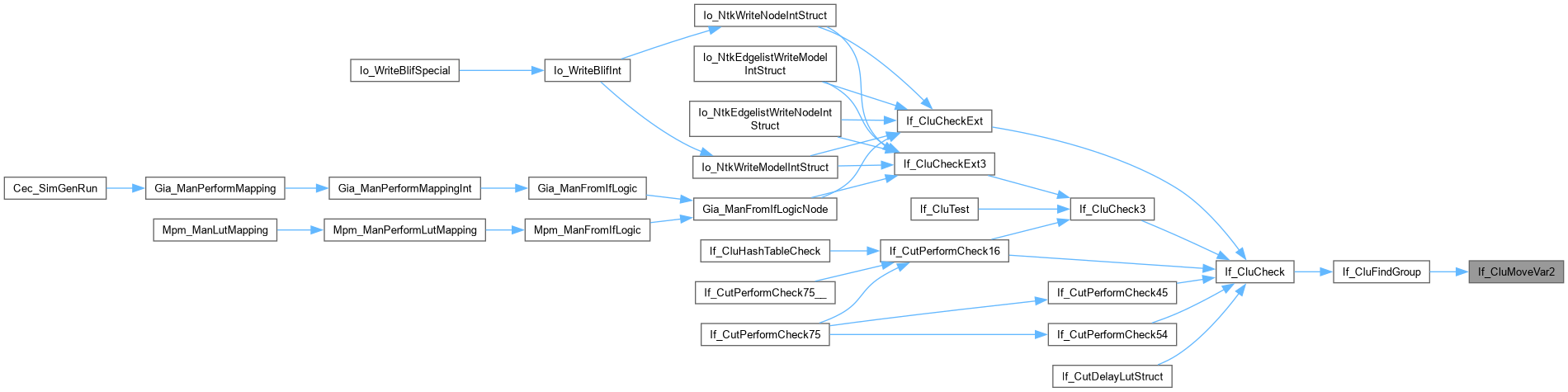
Here is the call graph for this function:
Here is the caller graph for this function:

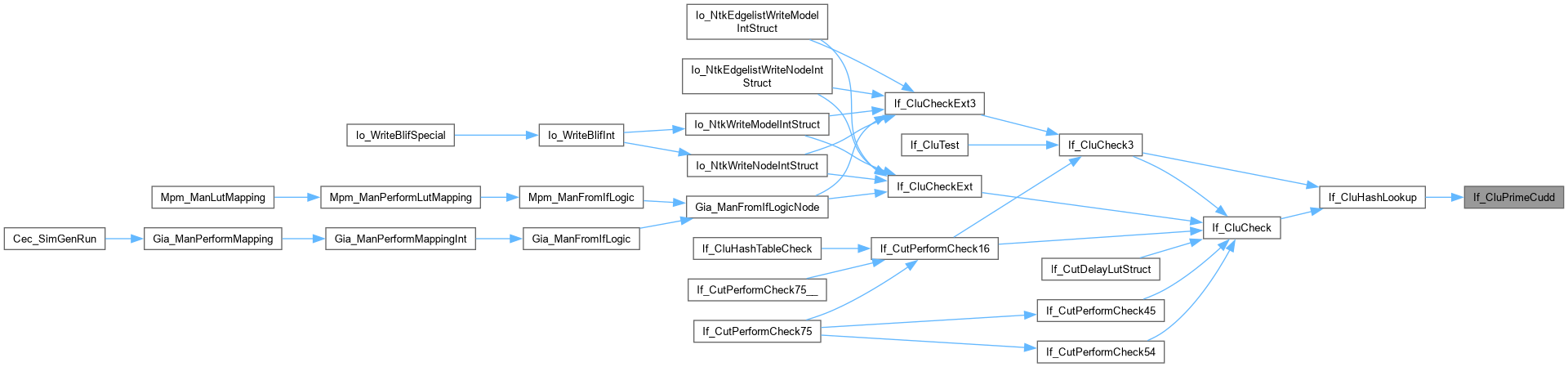
◆ If_CluPrimeCudd()

unsigned int If_CluPrimeCudd ( unsigned int p)

Definition at line 104 of file ifDec16.c.

105{
106 int i,pn;
107
108 p--;
109 do {
110 p++;
111 if (p&1) {
112 pn = 1;
113 i = 3;
114 while ((unsigned) (i * i) <= p) {
115 if (p % i == 0) {
116 pn = 0;
117 break;
118 }
119 i += 2;
120 }
121 } else {
122 pn = 0;
123 }
124 } while (!pn);
125 return(p);
126
127} /* end of Cudd_Prime */
Here is the caller graph for this function:

◆ If_CluPrintConfig()

void If_CluPrintConfig ( int nVars,
If_Grp_t * g,
If_Grp_t * r,
word BStruth,
word * pFStruth )

Definition at line 590 of file ifDec16.c.
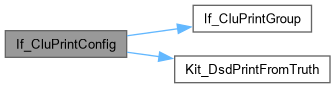
591{
592 assert( r->nVars == nVars - g->nVars + 1 + (g->nMyu > 2) );
593 If_CluPrintGroup( g );
594 if ( g->nVars < 6 )
595 BStruth = If_CluAdjust( BStruth, g->nVars );
596 Kit_DsdPrintFromTruth( (unsigned *)&BStruth, g->nVars );
597 printf( "\n" );
598 If_CluPrintGroup( r );
599 if ( r->nVars < 6 )
600 pFStruth[0] = If_CluAdjust( pFStruth[0], r->nVars );
601 Kit_DsdPrintFromTruth( (unsigned *)pFStruth, r->nVars );
602 printf( "\n" );
603}
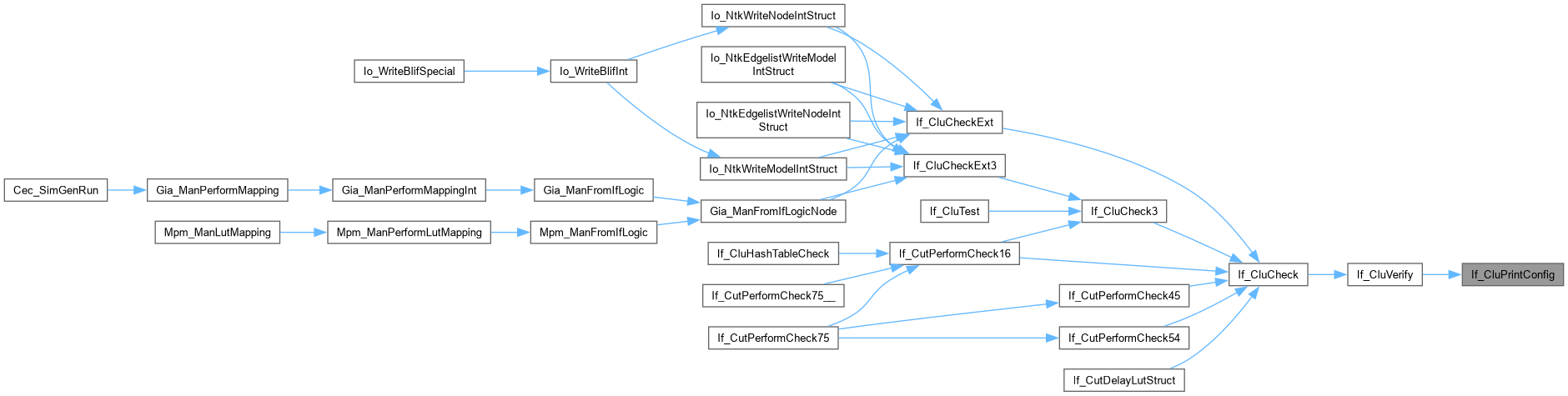
Here is the call graph for this function:
Here is the caller graph for this function:

◆ If_CluPrintGroup()

void If_CluPrintGroup ( If_Grp_t * g)

Definition at line 580 of file ifDec16.c.

581{
582 int i;
583 printf( "Vars = %d ", g->nVars );
584 printf( "Myu = %d {", g->nMyu );
585 for ( i = 0; i < g->nVars; i++ )
586 printf( " %c", 'a' + g->pVars[i] );
587 printf( " }\n" );
588}
Here is the caller graph for this function:

◆ If_CluReverseOrder()

void If_CluReverseOrder ( word * pTruth,
int nVars,
int * V2P,
int * P2V,
int iVarStart )

Definition at line 800 of file ifDec16.c.

801{
802 int i, j, k;
803 for ( k = 0; k < (nVars-iVarStart)/2 ; k++ )
804 {
805 i = iVarStart + k;
806 j = nVars - 1 - k;
807 If_CluSwapVars( pTruth, nVars, V2P, P2V, i, j );
808 }
809}
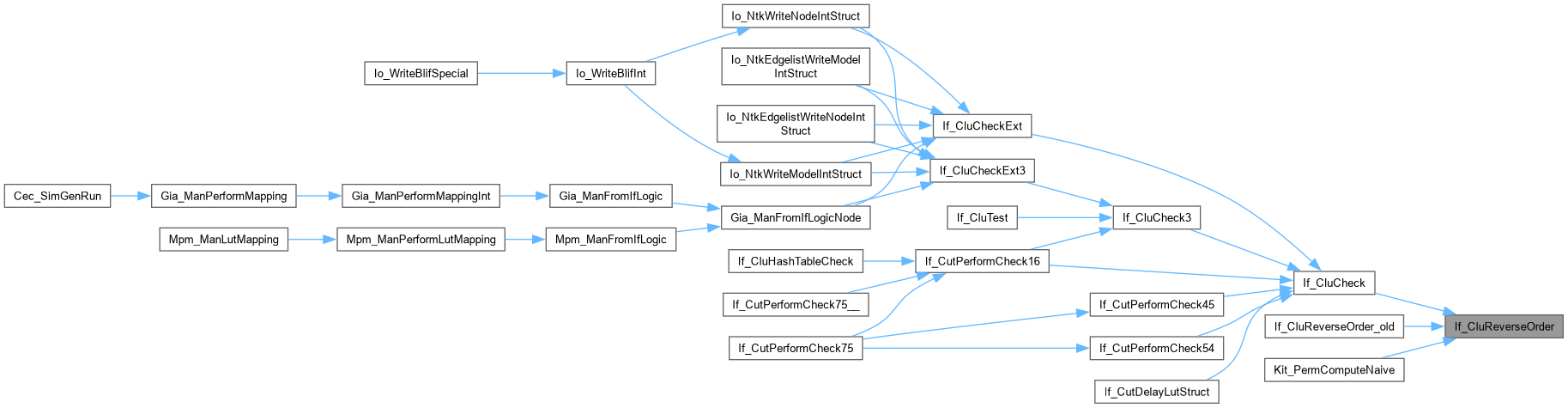
Here is the call graph for this function:
Here is the caller graph for this function:

◆ If_CluReverseOrder_old()

void If_CluReverseOrder_old ( word * pF,
int nVars,
int * V2P,
int * P2V,
int iVarStart )

Definition at line 864 of file ifDec16.c.

865{
866 word pG[CLU_WRD_MAX];
867 int v;
868
869 If_CluCopy( pG, pF, nVars );
870
871// for ( v = 0; v < nVars; v++ )
872// printf( "%c ", 'a' + P2V[v] );
873// printf( " --- " );
874
875 for ( v = iVarStart; v < nVars; v++ )
876 If_CluMoveVar( pF, nVars, V2P, P2V, P2V[iVarStart], nVars - 1 - (v - iVarStart) );
877
878// for ( v = 0; v < nVars; v++ )
879// printf( "%c ", 'a' + P2V[v] );
880// printf( "\n" );
881
882// if ( iVarStart > 0 )
883// return;
884
885 If_CluReverseOrder( pG, nVars, NULL, NULL, iVarStart );
886 if ( If_CluEqual( pG, pF, nVars ) )
887 {
888// printf( "+" );
889 }
890 else
891 {
892/*
893 printf( "\n" );
894 Kit_DsdPrintFromTruth( (unsigned*)pF, nVars ); printf( "\n" );
895 Kit_DsdPrintFromTruth( (unsigned*)pG, nVars );
896 printf( "\n" );
897*/
898 printf( "%d ", nVars );
899 }
900}
Here is the call graph for this function:

◆ If_CluSemiCanonicize()

unsigned If_CluSemiCanonicize ( word * pTruth,
int nVars,
int * pCanonPerm )

Definition at line 485 of file ifDec16.c.

486{
487 word pFunc[CLU_WRD_MAX], * pIn = pTruth, * pOut = pFunc, * pTemp;
488 int pStore[CLU_VAR_MAX*2];
489 unsigned uCanonPhase = 0;
490 int i, Temp, fChange, Counter = 0;
491//Kit_DsdPrintFromTruth( (unsigned*)pTruth, nVars ); printf( "\n" );
492
493 // collect signatures
494 If_CluCountOnesInCofs( pTruth, nVars, pStore );
495 // canonicize phase
496 for ( i = 0; i < nVars; i++ )
497 {
498 if ( pStore[2*i+0] <= pStore[2*i+1] )
499 continue;
500 uCanonPhase |= (1 << i);
501 Temp = pStore[2*i+0];
502 pStore[2*i+0] = pStore[2*i+1];
503 pStore[2*i+1] = Temp;
504 If_CluChangePhase( pIn, nVars, i );
505 }
506 // compute permutation
507 for ( i = 0; i < nVars; i++ )
508 pCanonPerm[i] = i;
509 do {
510 fChange = 0;
511 for ( i = 0; i < nVars-1; i++ )
512 {
513 if ( pStore[2*i] <= pStore[2*(i+1)] )
514 continue;
515 Counter++;
516 fChange = 1;
517
518 Temp = pCanonPerm[i];
519 pCanonPerm[i] = pCanonPerm[i+1];
520 pCanonPerm[i+1] = Temp;
521
522 Temp = pStore[2*i];
523 pStore[2*i] = pStore[2*(i+1)];
524 pStore[2*(i+1)] = Temp;
525
526 Temp = pStore[2*i+1];
527 pStore[2*i+1] = pStore[2*(i+1)+1];
528 pStore[2*(i+1)+1] = Temp;
529
530 If_CluSwapAdjacent( pOut, pIn, i, nVars );
531 pTemp = pIn; pIn = pOut; pOut = pTemp;
532 }
533 } while ( fChange );
534 // swap if it was moved an odd number of times
535 if ( Counter & 1 )
536 If_CluCopy( pOut, pIn, nVars );
537 return uCanonPhase;
538}
void If_CluChangePhase(word *pF, int nVars, int iVar)
Definition ifDec16.c:439
void If_CluCountOnesInCofs(word *pTruth, int nVars, int *pStore)
Definition ifDec16.c:465
Here is the call graph for this function:
Here is the caller graph for this function:

◆ If_CluSemiCanonicizeVerify()

void If_CluSemiCanonicizeVerify ( word * pTruth,
word * pTruth0,
int nVars,
int * pCanonPerm,
unsigned uCanonPhase )

Definition at line 539 of file ifDec16.c.
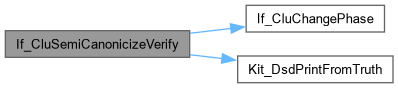
540{
541 word pFunc[CLU_WRD_MAX], pGunc[CLU_WRD_MAX], * pIn = pTruth, * pOut = pFunc, * pTemp;
542 int i, Temp, fChange, Counter = 0;
543 If_CluCopy( pGunc, pTruth, nVars );
544 // undo permutation
545 do {
546 fChange = 0;
547 for ( i = 0; i < nVars-1; i++ )
548 {
549 if ( pCanonPerm[i] < pCanonPerm[i+1] )
550 continue;
551
552 Counter++;
553 fChange = 1;
554
555 Temp = pCanonPerm[i];
556 pCanonPerm[i] = pCanonPerm[i+1];
557 pCanonPerm[i+1] = Temp;
558
559 If_CluSwapAdjacent( pOut, pIn, i, nVars );
560 pTemp = pIn; pIn = pOut; pOut = pTemp;
561 }
562 } while ( fChange );
563 if ( Counter & 1 )
564 If_CluCopy( pOut, pIn, nVars );
565 // undo phase
566 for ( i = 0; i < nVars; i++ )
567 if ( (uCanonPhase >> i) & 1 )
568 If_CluChangePhase( pTruth, nVars, i );
569 // compare
570 if ( !If_CluEqual(pTruth0, pTruth, nVars) )
571 {
572 Kit_DsdPrintFromTruth( (unsigned*)pTruth0, nVars ); printf( "\n" );
573 Kit_DsdPrintFromTruth( (unsigned*)pGunc, nVars ); printf( "\n" );
574 Kit_DsdPrintFromTruth( (unsigned*)pTruth, nVars ); printf( "\n" );
575 printf( "SemiCanonical verification FAILED!\n" );
576 }
577}
Here is the call graph for this function:

◆ If_CluSupportSize()

int If_CluSupportSize ( word * t,
int nVars )
extern

Definition at line 1503 of file ifDec16.c.

1504{
1505 int v, SuppSize = 0;
1506 for ( v = 0; v < nVars; v++ )
1507 if ( If_CluHasVar( t, nVars, v ) )
1508 SuppSize++;
1509 return SuppSize;
1510}
Here is the caller graph for this function:

◆ If_CluSwapVars()

void If_CluSwapVars ( word * pTruth,
int nVars,
int * V2P,
int * P2V,
int iVar,
int jVar )

Definition at line 723 of file ifDec16.c.
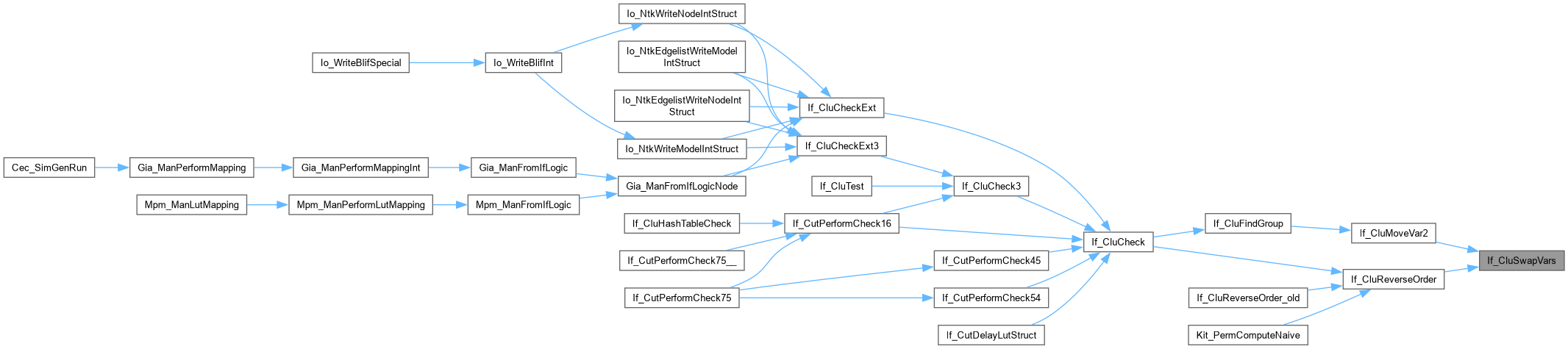
724{
725 word low2High, high2Low, temp;
726 int nWords = If_CluWordNum(nVars);
727 int shift, step, iStep, jStep;
728 int w = 0, i = 0, j = 0;
729 static word PPMasks[6][6] = {
730 { ABC_CONST(0x2222222222222222), ABC_CONST(0x0A0A0A0A0A0A0A0A), ABC_CONST(0x00AA00AA00AA00AA), ABC_CONST(0x0000AAAA0000AAAA), ABC_CONST(0x00000000AAAAAAAA), ABC_CONST(0xAAAAAAAAAAAAAAAA) },
731 { ABC_CONST(0x0000000000000000), ABC_CONST(0x0C0C0C0C0C0C0C0C), ABC_CONST(0x00CC00CC00CC00CC), ABC_CONST(0x0000CCCC0000CCCC), ABC_CONST(0x00000000CCCCCCCC), ABC_CONST(0xCCCCCCCCCCCCCCCC) },
732 { ABC_CONST(0x0000000000000000), ABC_CONST(0x0000000000000000), ABC_CONST(0x00F000F000F000F0), ABC_CONST(0x0000F0F00000F0F0), ABC_CONST(0x00000000F0F0F0F0), ABC_CONST(0xF0F0F0F0F0F0F0F0) },
733 { ABC_CONST(0x0000000000000000), ABC_CONST(0x0000000000000000), ABC_CONST(0x0000000000000000), ABC_CONST(0x0000FF000000FF00), ABC_CONST(0x00000000FF00FF00), ABC_CONST(0xFF00FF00FF00FF00) },
734 { ABC_CONST(0x0000000000000000), ABC_CONST(0x0000000000000000), ABC_CONST(0x0000000000000000), ABC_CONST(0x0000000000000000), ABC_CONST(0x00000000FFFF0000), ABC_CONST(0xFFFF0000FFFF0000) },
735 { ABC_CONST(0x0000000000000000), ABC_CONST(0x0000000000000000), ABC_CONST(0x0000000000000000), ABC_CONST(0x0000000000000000), ABC_CONST(0x0000000000000000), ABC_CONST(0xFFFFFFFF00000000) }
736 };
737 if( iVar == jVar )
738 return;
739 if( jVar < iVar )
740 {
741 int varTemp = jVar;
742 jVar = iVar;
743 iVar = varTemp;
744 }
745 if ( iVar <= 5 && jVar <= 5 )
746 {
747 shift = (1 << jVar) - (1 << iVar);
748 for ( w = 0; w < nWords; w++ )
749 {
750 low2High = (pTruth[w] & PPMasks[iVar][jVar - 1] ) << shift;
751 pTruth[w] &= ~PPMasks[iVar][jVar - 1];
752 high2Low = (pTruth[w] & (PPMasks[iVar][jVar - 1] << shift )) >> shift;
753 pTruth[w] &= ~ (PPMasks[iVar][jVar - 1] << shift);
754 pTruth[w] = pTruth[w] | low2High | high2Low;
755 }
756 }
757 else if( iVar <= 5 && jVar > 5 )
758 {
759 step = If_CluWordNum(jVar + 1)/2;
760 shift = 1 << iVar;
761 for ( w = 0; w < nWords; w += 2*step )
762 {
763 for (j = 0; j < step; j++)
764 {
765 low2High = (pTruth[w + j] & PPMasks[iVar][5]) >> shift;
766 pTruth[w + j] &= ~PPMasks[iVar][5];
767 high2Low = (pTruth[w + step + j] & (PPMasks[iVar][5] >> shift)) << shift;
768 pTruth[w + step + j] &= ~(PPMasks[iVar][5] >> shift);
769 pTruth[w + j] |= high2Low;
770 pTruth[w + step + j] |= low2High;
771 }
772 }
773 }
774 else
775 {
776 iStep = If_CluWordNum(iVar + 1)/2;
777 jStep = If_CluWordNum(jVar + 1)/2;
778 for (w = 0; w < nWords; w += 2*jStep)
779 {
780 for (i = 0; i < jStep; i += 2*iStep)
781 {
782 for (j = 0; j < iStep; j++)
783 {
784 temp = pTruth[w + iStep + i + j];
785 pTruth[w + iStep + i + j] = pTruth[w + jStep + i + j];
786 pTruth[w + jStep + i + j] = temp;
787 }
788 }
789 }
790 }
791 if ( V2P && P2V )
792 {
793 V2P[P2V[iVar]] = jVar;
794 V2P[P2V[jVar]] = iVar;
795 P2V[iVar] ^= P2V[jVar];
796 P2V[jVar] ^= P2V[iVar];
797 P2V[iVar] ^= P2V[jVar];
798 }
799}
#define ABC_CONST(number)
PARAMETERS ///.
Definition abc_global.h:240
Here is the caller graph for this function:

◆ If_CluTest()

void If_CluTest ( )

Definition at line 2301 of file ifDec16.c.
2302{
2303// word t = 0xff00f0f0ccccaaaa;
2304// word t = 0xfedcba9876543210;
2305// word t = 0xec64000000000000;
2306// word t = 0x0100200000000001;
2307// word t2[4] = { 0x0000800080008000, 0x8000000000008000, 0x8000000080008000, 0x0000000080008000 };
2308// word t = 0x07770FFF07770FFF;
2309// word t = 0x002000D000D00020;
2310// word t = 0x000F000E000F000F;
2311// word t = 0xF7FFF7F7F7F7F7F7;
2312// word t = 0x0234AFDE23400BCE;
2313// word t = 0x0080008880A088FF;
2314// word s = t;
2315// word t = 0xFFBBBBFFF0B0B0F0;
2316 word t = ABC_CONST(0x6DD9926D962D6996);
2317 int nVars = 6;
2318 int nLutLeaf = 4;
2319 int nLutLeaf2 = 4;
2320 int nLutRoot = 4;
2321/*
2322 word t2[2] = { 0x7f807f807f80807f, 0x7f807f807f807f80 };
2323 int nVars = 7;
2324 int nLutLeaf = 3;
2325 int nLutLeaf2 = 3;
2326 int nLutRoot = 3;
2327*/
2328
2329 If_Grp_t G;
2330 If_Grp_t G2, R;
2331 word Func0, Func1, Func2;
2332
2333
2334 return;
2335
2336/*
2337 int pCanonPerm[CLU_VAR_MAX];
2338 int uCanonPhase;
2339
2340 Kit_DsdPrintFromTruth( (unsigned*)&s, nVars ); printf( "\n" );
2341 uCanonPhase = If_CluSemiCanonicize( &s, nVars, pCanonPerm );
2342 Kit_DsdPrintFromTruth( (unsigned*)&s, nVars ); printf( "\n" );
2343
2344 If_CluSemiCanonicizeVerify( &s, &t, nVars, pCanonPerm, uCanonPhase );
2345*/
2346
2347 Kit_DsdPrintFromTruth( (unsigned*)&t, nVars ); printf( "\n" );
2348 G = If_CluCheck3( NULL, &t, nVars, nLutLeaf, nLutLeaf2, nLutRoot, &R, &G2, &Func0, &Func1, &Func2 );
2349 If_CluPrintGroup( &G );
2350 If_CluPrintGroup( &G2 );
2351 If_CluPrintGroup( &R );
2352
2353// If_CluVerify3( &t, nVars, &G, &G2, &R, Func1, Func2, Func0 );
2354
2355 return;
2356
2357// If_CutPerformCheck07( NULL, (unsigned *)&t, 6, 6, NULL );
2358// return;
2359
2360// Kit_DsdPrintFromTruth( (unsigned*)&t, nVars ); printf( "\n" );
2361// G = If_CluCheck( NULL, &t, nVars, 0, nLutLeaf, nLutRoot, NULL, NULL, NULL, NULL, 0 );
2362// If_CluPrintGroup( &G );
2363}
Here is the call graph for this function:

◆ If_CluVerify()

void If_CluVerify ( word * pF,
int nVars,
If_Grp_t * g,
If_Grp_t * r,
word BStruth,
word * pFStruth )

Definition at line 641 of file ifDec16.c.
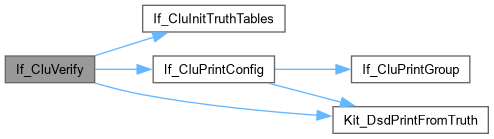
642{
643 word pTTFans[6][CLU_WRD_MAX], pTTWire[CLU_WRD_MAX], pTTRes[CLU_WRD_MAX];
644 int i;
645 assert( g->nVars <= 6 && r->nVars <= 6 );
646
647 if ( TruthAll[0][0] == 0 )
649
650 for ( i = 0; i < g->nVars; i++ )
651 If_CluCopy( pTTFans[i], TruthAll[(int)g->pVars[i]], nVars );
652 If_CluComposeLut( nVars, g, &BStruth, pTTFans, pTTWire );
653
654 for ( i = 0; i < r->nVars; i++ )
655 if ( r->pVars[i] == nVars )
656 If_CluCopy( pTTFans[i], pTTWire, nVars );
657 else
658 If_CluCopy( pTTFans[i], TruthAll[(int)r->pVars[i]], nVars );
659 If_CluComposeLut( nVars, r, pFStruth, pTTFans, pTTRes );
660
661 if ( !If_CluEqual(pTTRes, pF, nVars) )
662 {
663 printf( "\n" );
664 If_CluPrintConfig( nVars, g, r, BStruth, pFStruth );
665 Kit_DsdPrintFromTruth( (unsigned*)pTTRes, nVars ); printf( "\n" );
666 Kit_DsdPrintFromTruth( (unsigned*)pF, nVars ); printf( "\n" );
667// Extra_PrintHex( stdout, (unsigned *)pF, nVars ); printf( "\n" );
668 printf( "Verification FAILED!\n" );
669 }
670// else
671// printf( "Verification succeed!\n" );
672}
void If_CluInitTruthTables()
Definition ifDec16.c:606
void If_CluPrintConfig(int nVars, If_Grp_t *g, If_Grp_t *r, word BStruth, word *pFStruth)
Definition ifDec16.c:590
Here is the call graph for this function:
Here is the caller graph for this function:

◆ If_CluVerify3()

void If_CluVerify3 ( word * pF,
int nVars,
If_Grp_t * g,
If_Grp_t * g2,
If_Grp_t * r,
word BStruth,
word BStruth2,
word FStruth )

Definition at line 673 of file ifDec16.c.
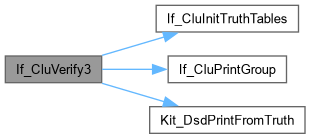
674{
675 word pTTFans[6][CLU_WRD_MAX], pTTWire[CLU_WRD_MAX], pTTWire2[CLU_WRD_MAX], pTTRes[CLU_WRD_MAX];
676 int i;
677 assert( g->nVars >= 2 && g2->nVars >= 2 && r->nVars >= 2 );
678 assert( g->nVars <= 6 && g2->nVars <= 6 && r->nVars <= 6 );
679
680 if ( TruthAll[0][0] == 0 )
682
683 for ( i = 0; i < g->nVars; i++ )
684 If_CluCopy( pTTFans[i], TruthAll[(int)g->pVars[i]], nVars );
685 If_CluComposeLut( nVars, g, &BStruth, pTTFans, pTTWire );
686
687 for ( i = 0; i < g2->nVars; i++ )
688 If_CluCopy( pTTFans[i], TruthAll[(int)g2->pVars[i]], nVars );
689 If_CluComposeLut( nVars, g2, &BStruth2, pTTFans, pTTWire2 );
690
691 for ( i = 0; i < r->nVars; i++ )
692 if ( r->pVars[i] == nVars )
693 If_CluCopy( pTTFans[i], pTTWire, nVars );
694 else if ( r->pVars[i] == nVars + 1 )
695 If_CluCopy( pTTFans[i], pTTWire2, nVars );
696 else
697 If_CluCopy( pTTFans[i], TruthAll[(int)r->pVars[i]], nVars );
698 If_CluComposeLut( nVars, r, &FStruth, pTTFans, pTTRes );
699
700 if ( !If_CluEqual(pTTRes, pF, nVars) )
701 {
702 printf( "%d\n", nVars );
703// If_CluPrintConfig( nVars, g, r, BStruth, pFStruth );
704// Extra_PrintHex( stdout, (unsigned *)pF, nVars ); printf( "\n" );
705
706 Kit_DsdPrintFromTruth( (unsigned*)&BStruth, g->nVars ); printf( " " ); If_CluPrintGroup(g); // printf( "\n" );
707 Kit_DsdPrintFromTruth( (unsigned*)&BStruth2, g2->nVars ); printf( " " ); If_CluPrintGroup(g2); // printf( "\n" );
708 Kit_DsdPrintFromTruth( (unsigned*)&FStruth, r->nVars ); printf( " " ); If_CluPrintGroup(r); // printf( "\n" );
709
710 Kit_DsdPrintFromTruth( (unsigned*)pTTWire, nVars ); printf( "\n" );
711 Kit_DsdPrintFromTruth( (unsigned*)pTTWire2, nVars ); printf( "\n" );
712 Kit_DsdPrintFromTruth( (unsigned*)pTTRes, nVars ); printf( "\n" );
713 Kit_DsdPrintFromTruth( (unsigned*)pF, nVars ); printf( "\n" );
714// Extra_PrintHex( stdout, (unsigned *)pF, nVars ); printf( "\n" );
715 printf( "Verification FAILED!\n" );
716 }
717// else
718// printf( "Verification succeed!\n" );
719}
Here is the call graph for this function:
Here is the caller graph for this function:

◆ If_CutDelayLutStruct()

float If_CutDelayLutStruct ( If_Man_t * p,
If_Cut_t * pCut,
char * pStr,
float WireDelay )

Definition at line 2103 of file ifDec16.c.
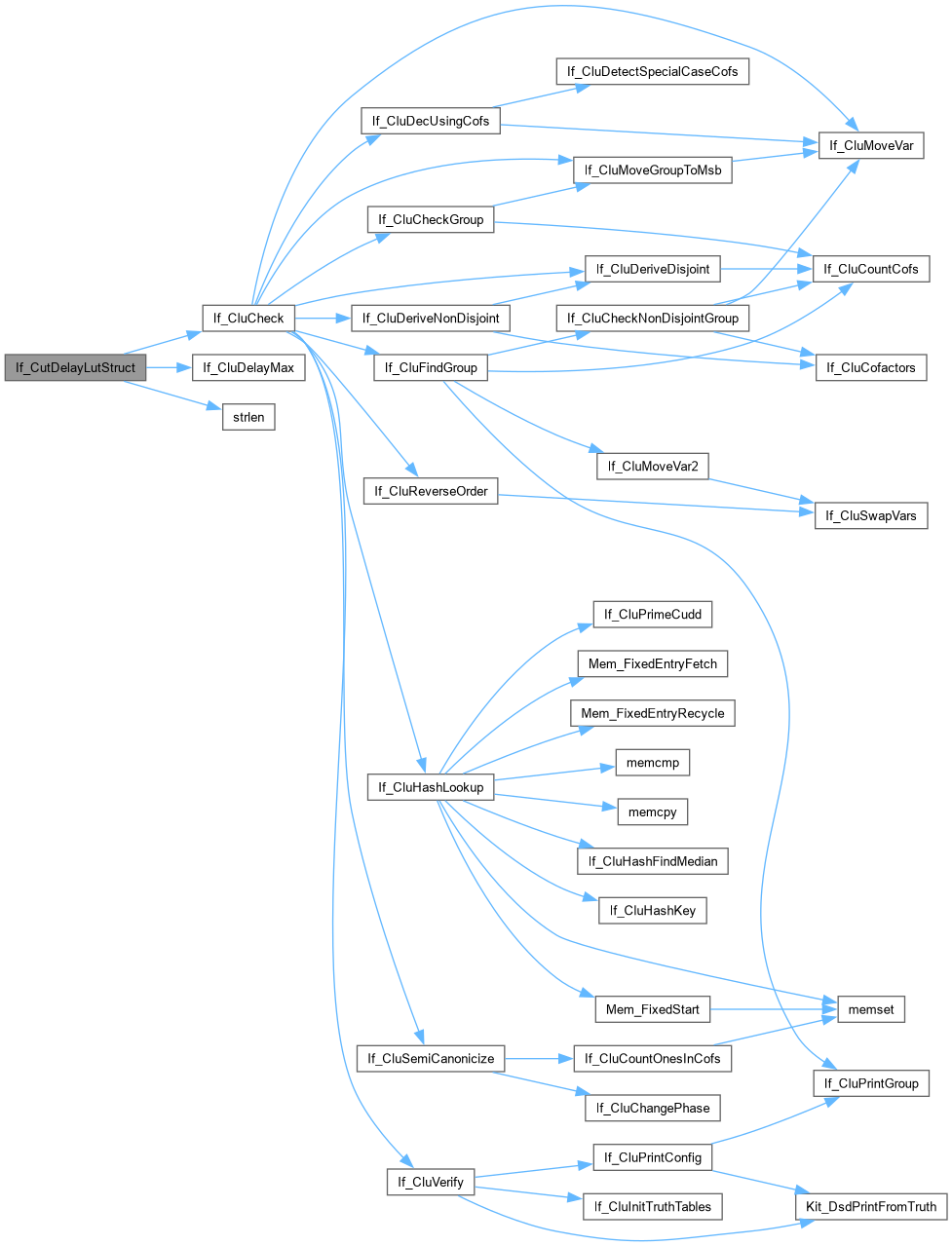
2104{
2105 float Delays[CLU_VAR_MAX+2];
2106 int fUsed[CLU_VAR_MAX+2] = {0};
2107 If_Obj_t * pLeaf;
2108 If_Grp_t G1 = {0}, G2 = {0}, G3 = {0};
2109 int nLeaves = If_CutLeaveNum(pCut);
2110 int i, nLutLeaf, nLutRoot;
2111 // mark the cut as user cut
2112// pCut->fUser = 1;
2113 // quit if parameters are wrong
2114 if ( strlen(pStr) != 2 )
2115 {
2116 printf( "Wrong LUT struct (%s)\n", pStr );
2117 return ABC_INFINITY;
2118 }
2119 nLutLeaf = pStr[0] - '0';
2120 if ( nLutLeaf < 3 || nLutLeaf > 6 )
2121 {
2122 printf( "Leaf size (%d) should belong to {3,4,5,6}.\n", nLutLeaf );
2123 return ABC_INFINITY;
2124 }
2125 nLutRoot = pStr[1] - '0';
2126 if ( nLutRoot < 3 || nLutRoot > 6 )
2127 {
2128 printf( "Root size (%d) should belong to {3,4,5,6}.\n", nLutRoot );
2129 return ABC_INFINITY;
2130 }
2131 if ( nLeaves > nLutLeaf + nLutRoot - 1 )
2132 {
2133 printf( "The cut size (%d) is too large for the LUT structure %d%d.\n", If_CutLeaveNum(pCut), nLutLeaf, nLutRoot );
2134 return ABC_INFINITY;
2135 }
2136
2137 // remember the delays
2138 If_CutForEachLeaf( p, pCut, pLeaf, i )
2139 Delays[i] = If_ObjCutBest(pLeaf)->Delay;
2140
2141 // consider easy case
2142 if ( nLeaves <= Abc_MaxInt( nLutLeaf, nLutRoot ) )
2143 {
2144 char * pPerm = If_CutPerm( pCut );
2145 assert( nLeaves <= 6 );
2146 for ( i = 0; i < nLeaves; i++ )
2147 {
2148 pPerm[i] = 1;
2149 G1.pVars[i] = i;
2150 }
2151 G1.nVars = nLeaves;
2152 return 1.0 + If_CluDelayMax( &G1, Delays );
2153 }
2154
2155 // derive the first group
2156 G1 = If_CluCheck( p, If_CutTruthW(p, pCut), nLeaves, 0, 0, nLutLeaf, nLutRoot, NULL, NULL, NULL, NULL, 1 );
2157 if ( G1.nVars == 0 )
2158 return ABC_INFINITY;
2159
2160 // compute the delay
2161 Delays[nLeaves] = If_CluDelayMax( &G1, Delays ) + ((WireDelay == 0.0)?1.0:WireDelay);
2162 if ( G2.nVars )
2163 Delays[nLeaves+1] = If_CluDelayMax( &G2, Delays ) + ((WireDelay == 0.0)?1.0:WireDelay);
2164
2165 // mark used groups
2166 for ( i = 0; i < G1.nVars; i++ )
2167 fUsed[(int)G1.pVars[i]] = 1;
2168 for ( i = 0; i < G2.nVars; i++ )
2169 fUsed[(int)G2.pVars[i]] = 1;
2170 // mark unused groups
2171 assert( G1.nMyu >= 2 && G1.nMyu <= 4 );
2172 if ( G1.nMyu > 2 )
2173 fUsed[(int)G1.pVars[G1.nVars-1]] = 0;
2174 assert( !G2.nVars || (G2.nMyu >= 2 && G2.nMyu <= 4) );
2175 if ( G2.nMyu > 2 )
2176 fUsed[(int)G2.pVars[G2.nVars-1]] = 0;
2177
2178 // create remaining group
2179 assert( G3.nVars == 0 );
2180 for ( i = 0; i < nLeaves; i++ )
2181 if ( !fUsed[i] )
2182 G3.pVars[(int)G3.nVars++] = i;
2183 G3.pVars[(int)G3.nVars++] = nLeaves;
2184 if ( G2.nVars )
2185 G3.pVars[(int)G3.nVars++] = nLeaves+1;
2186 assert( G1.nVars + G2.nVars + G3.nVars == nLeaves +
2187 (G1.nVars > 0) + (G2.nVars > 0) + (G1.nMyu > 2) + (G2.nMyu > 2) );
2188 // what if both non-disjoint vars are the same???
2189
2190 pCut->Cost = 2 + (G2.nVars > 0);
2191 return 1.0 + If_CluDelayMax( &G3, Delays );
2192}
#define ABC_INFINITY
MACRO DEFINITIONS ///.
Definition abc_global.h:250
float If_CluDelayMax(If_Grp_t *g, float *pDelays)
Definition ifDec16.c:2093
#define If_CutForEachLeaf(p, pCut, pLeaf, i)
Definition if.h:503
struct If_Obj_t_ If_Obj_t
Definition if.h:79
unsigned Cost
Definition if.h:310
int strlen()
Here is the call graph for this function:

◆ If_CutPerformCheck16()

int If_CutPerformCheck16 ( If_Man_t * p,
unsigned * pTruth0,
int nVars,
int nLeaves,
char * pStr )

Function*************************************************************

Synopsis [Performs additional check.]

Description []

SideEffects []

SeeAlso []

Definition at line 2216 of file ifDec16.c.
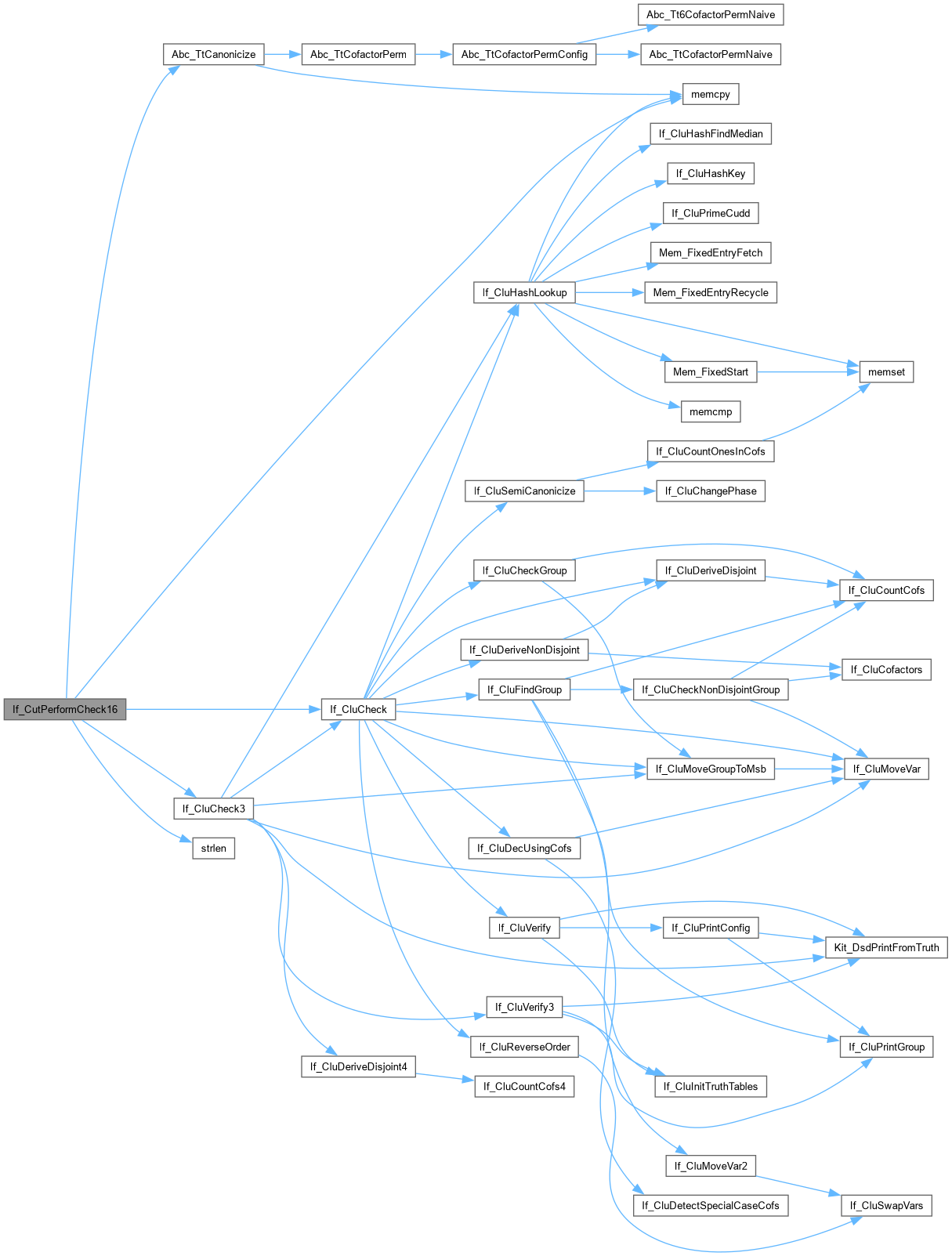
2217{
2218 unsigned pTruth[IF_MAX_FUNC_LUTSIZE > 5 ? 1 << (IF_MAX_FUNC_LUTSIZE - 5) : 1];
2219 If_Grp_t G1 = {0};//, G3 = {0};
2220 int i, nLutLeaf, nLutLeaf2, nLutRoot, Length;
2221 // stretch the truth table
2222 assert( nVars >= 6 );
2223 memcpy( pTruth, pTruth0, sizeof(word) * Abc_TtWordNum(nVars) );
2224 Abc_TtStretch6( (word *)pTruth, nLeaves, p->pPars->nLutSize );
2225
2226#ifdef IF_TRY_NEW
2227 {
2228 word pCopy[1024];
2229 int nWords = Abc_TruthWordNum(nVars);
2230 int iNum;
2231 if ( s_vTtMem == NULL )
2232 {
2233 s_vTtMem = Vec_MemAlloc( Abc_Truth6WordNum(nVars), 12 ); // 32 KB/page for 6-var functions
2234 Vec_MemHashAlloc( s_vTtMem, 10000 );
2235 }
2236 if ( s_vTtMem2 == NULL )
2237 {
2238 s_vTtMem2 = Vec_MemAlloc( Abc_Truth6WordNum(nVars), 12 ); // 32 KB/page for 6-var functions
2239 Vec_MemHashAlloc( s_vTtMem2, 10000 );
2240 }
2241 memcpy( pCopy, pTruth, sizeof(word) * Abc_Truth6WordNum(nVars) );
2242 if ( pCopy[0] & 1 )
2243 for ( i = 0; i < nWords; i++ )
2244 pCopy[i] = ~pCopy[i];
2245 iNum = Vec_MemHashInsert( s_vTtMem, pCopy );
2246 if ( iNum == Vec_MemEntryNum(s_vTtMem) - 1 )
2247 {
2248 int pCanonPerm[16];
2249 char pCanonPermC[16];
2250 Abc_TtCanonicize( pCopy, nVars, pCanonPermC );
2251// If_CluSemiCanonicize( pCopy, nVars, pCanonPerm );
2252 Vec_MemHashInsert( s_vTtMem2, pCopy );
2253 }
2254 }
2255#endif
2256
2257 // if cutmin is disabled, minimize the function
2258 if ( !p->pPars->fCutMin )
2259 nLeaves = Abc_TtMinBase( (word *)pTruth, NULL, nLeaves, nVars );
2260
2261 // quit if parameters are wrong
2262 Length = strlen(pStr);
2263 if ( Length != 2 && Length != 3 )
2264 {
2265 printf( "Wrong LUT struct (%s)\n", pStr );
2266 return 0;
2267 }
2268 for ( i = 0; i < Length; i++ )
2269 if ( pStr[i] - '0' < 3 || pStr[i] - '0' > 6 )
2270 {
2271 printf( "The LUT size (%d) should belong to {3,4,5,6}.\n", pStr[i] - '0' );
2272 return 0;
2273 }
2274
2275 nLutLeaf = pStr[0] - '0';
2276 nLutLeaf2 = ( Length == 3 ) ? pStr[1] - '0' : 0;
2277 nLutRoot = pStr[Length-1] - '0';
2278 if ( nLeaves > nLutLeaf - 1 + (nLutLeaf2 ? nLutLeaf2 - 1 : 0) + nLutRoot )
2279 {
2280 printf( "The cut size (%d) is too large for the LUT structure %s.\n", nLeaves, pStr );
2281 return 0;
2282 }
2283 // consider easy case
2284 if ( nLeaves <= Abc_MaxInt( nLutLeaf2, Abc_MaxInt(nLutLeaf, nLutRoot) ) )
2285 return 1;
2286
2287 // derive the first group
2288 if ( Length == 2 )
2289 G1 = If_CluCheck( p, (word *)pTruth, nLeaves, 0, 0, nLutLeaf, nLutRoot, NULL, NULL, NULL, NULL, 1 );
2290 else
2291 G1 = If_CluCheck3( p, (word *)pTruth, nLeaves, nLutLeaf, nLutLeaf2, nLutRoot, NULL, NULL, NULL, NULL, NULL );
2292
2293// if ( G1.nVars > 0 )
2294// If_CluPrintGroup( &G1 );
2295
2296 return (int)(G1.nVars > 0);
2297}
unsigned Abc_TtCanonicize(word *pTruth, int nVars, char *pCanonPerm)
FUNCTION DECLARATIONS ///.
Definition dauCanon.c:1036
#define IF_MAX_FUNC_LUTSIZE
Definition if.h:55
Here is the call graph for this function:
Here is the caller graph for this function:

◆ If_CutPerformCheck45()

int If_CutPerformCheck45 ( If_Man_t * p,
unsigned * pTruth,
int nVars,
int nLeaves,
char * pStr )

Definition at line 1865 of file ifDec16.c.
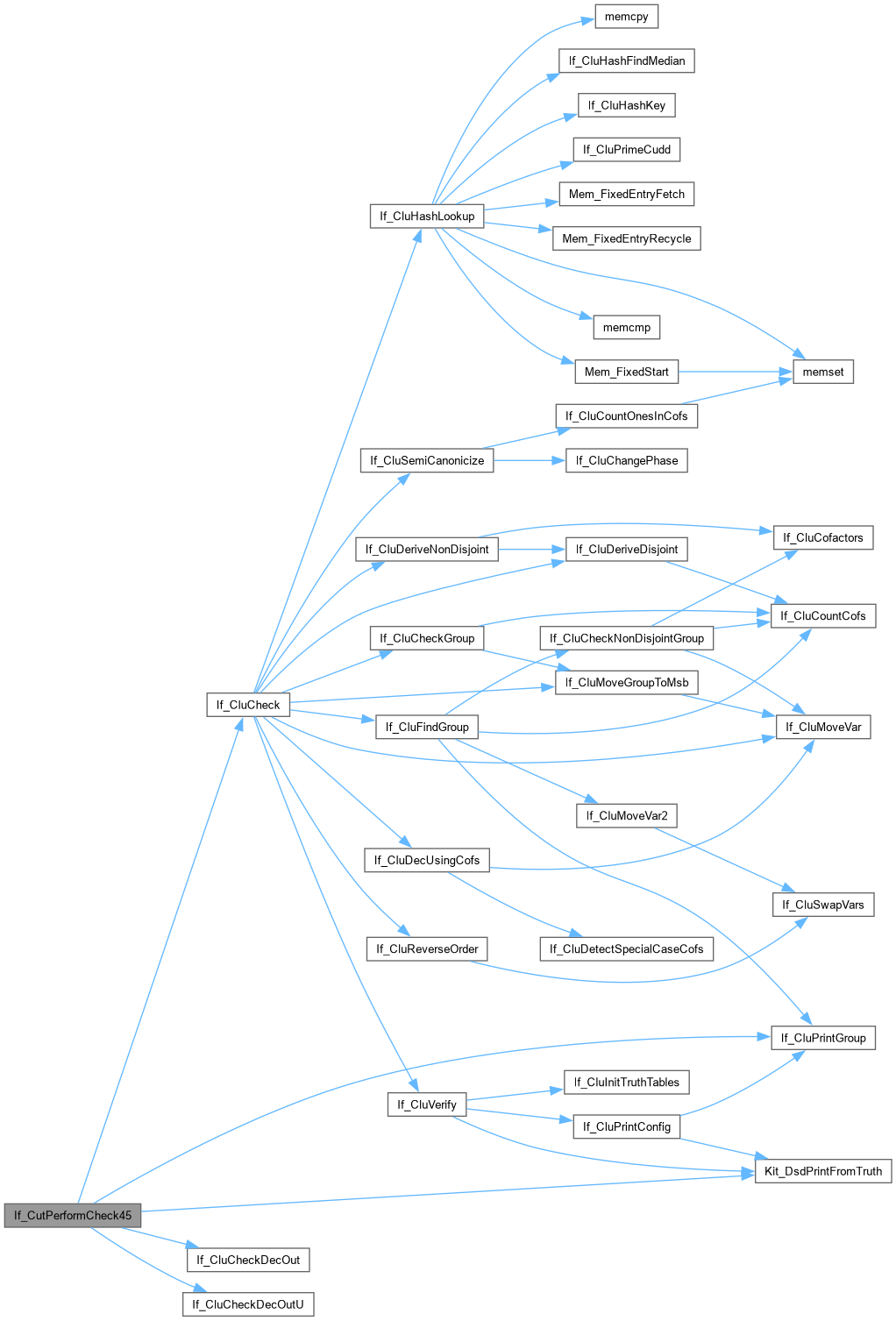
1866{
1867 // 5LUT -> 4LUT
1868 If_Grp_t G, R;
1869 word Func0, Func1;
1870 G = If_CluCheck( p, (word *)pTruth, nLeaves, 0, 0, 5, 4, &R, &Func0, &Func1, NULL, 0 );
1871 if ( G.nVars == 0 )
1872 return 0;
1873 Func0 = If_CluAdjust( Func0, R.nVars );
1874 Func1 = If_CluAdjust( Func1, G.nVars );
1875#if 0
1876 Kit_DsdPrintFromTruth( pTruth, nVars ); printf( "\n" );
1877 Kit_DsdPrintFromTruth( (unsigned*)&Func0, R.nVars ); printf( "\n" );
1878 Kit_DsdPrintFromTruth( (unsigned*)&Func1, G.nVars ); printf( "\n" );
1879 If_CluPrintGroup( &R );
1880 If_CluPrintGroup( &G );
1881#endif
1882 if ( G.nVars < 5 || (p->pPars->fEnableCheck75 && If_CluCheckDecOut(Func1, 5)) || (p->pPars->fEnableCheck75u && If_CluCheckDecOutU(Func1, 5)) )
1883 return 1;
1884 return 0;
1885}
int If_CluCheckDecOut(word t, int nVars)
Definition ifDec16.c:1840
int If_CluCheckDecOutU(word t, int nVars)
Definition ifDec16.c:1853
Here is the call graph for this function:
Here is the caller graph for this function:

◆ If_CutPerformCheck54()

int If_CutPerformCheck54 ( If_Man_t * p,
unsigned * pTruth,
int nVars,
int nLeaves,
char * pStr )

Definition at line 1886 of file ifDec16.c.
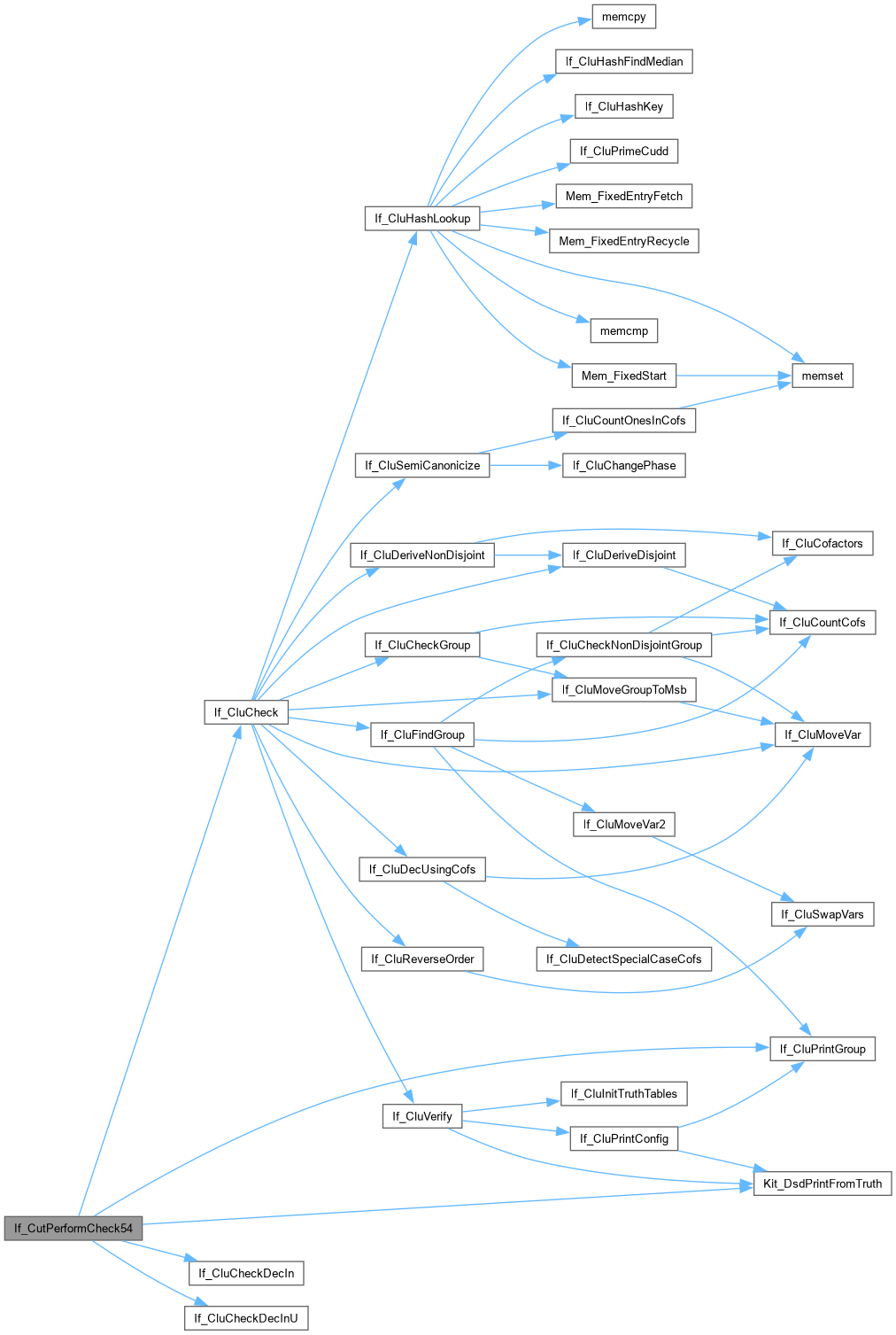
1887{
1888 // 4LUT -> 5LUT
1889 If_Grp_t G, R;
1890 word Func0, Func1;
1891 G = If_CluCheck( p, (word *)pTruth, nLeaves, 0, 0, 4, 5, &R, &Func0, &Func1, NULL, 0 );
1892 if ( G.nVars == 0 )
1893 return 0;
1894 Func0 = If_CluAdjust( Func0, R.nVars );
1895 Func1 = If_CluAdjust( Func1, G.nVars );
1896#if 0
1897 Kit_DsdPrintFromTruth( pTruth, nVars ); printf( "\n" );
1898 Kit_DsdPrintFromTruth( (unsigned*)&Func0, R.nVars ); printf( "\n" );
1899 Kit_DsdPrintFromTruth( (unsigned*)&Func1, G.nVars ); printf( "\n" );
1900 If_CluPrintGroup( &R );
1901 If_CluPrintGroup( &G );
1902#endif
1903 if ( R.nVars < 5 || (p->pPars->fEnableCheck75 && If_CluCheckDecIn(Func0, 5)) || (p->pPars->fEnableCheck75u && If_CluCheckDecInU(Func0, 5)) )
1904 return 1;
1905 return 0;
1906}
int If_CluCheckDecIn(word t, int nVars)
Definition ifDec16.c:1792
int If_CluCheckDecInU(word t, int nVars)
Definition ifDec16.c:1818
Here is the call graph for this function:
Here is the caller graph for this function:

◆ Kit_DsdPrintFromTruth()

void Kit_DsdPrintFromTruth ( unsigned * pTruth,
int nVars )
extern

Function*************************************************************

Synopsis [Print the DSD formula.]

Description []

SideEffects []

SeeAlso []

Definition at line 491 of file kitDsd.c.
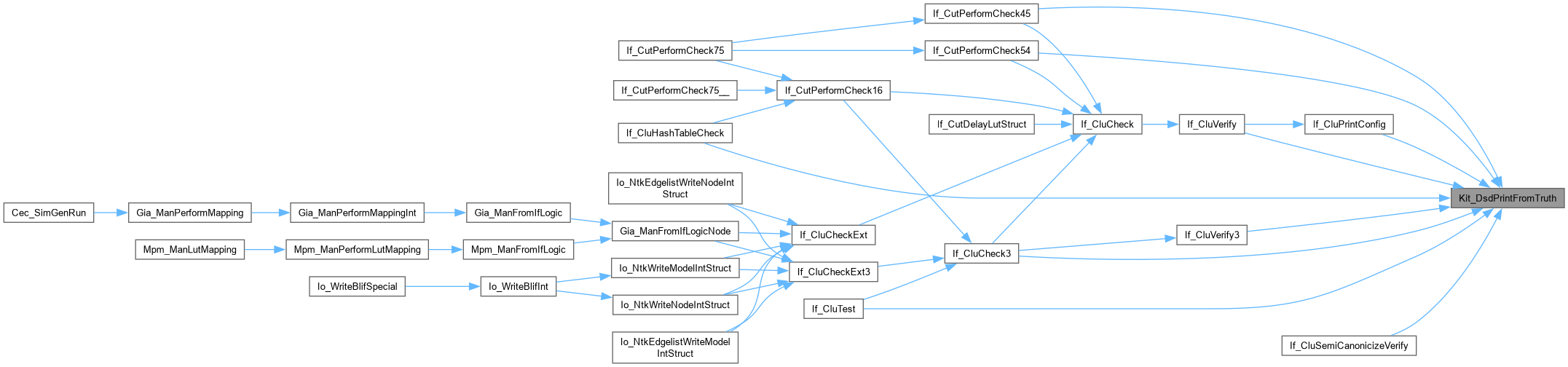
492{
493 Kit_DsdNtk_t * pTemp, * pTemp2;
494// pTemp = Kit_DsdDecomposeMux( pTruth, nVars, 5 );
495 pTemp = Kit_DsdDecomposeMux( pTruth, nVars, 8 );
496// Kit_DsdPrintExpanded( pTemp );
497 pTemp2 = Kit_DsdExpand( pTemp );
498 Kit_DsdPrint( stdout, pTemp2 );
499 Kit_DsdVerify( pTemp2, pTruth, nVars );
500 Kit_DsdNtkFree( pTemp2 );
501 Kit_DsdNtkFree( pTemp );
502}
void Kit_DsdVerify(Kit_DsdNtk_t *pNtk, unsigned *pTruth, int nVars)
Definition kitDsd.c:2493
void Kit_DsdPrint(FILE *pFile, Kit_DsdNtk_t *pNtk)
Definition kitDsd.c:375
void Kit_DsdNtkFree(Kit_DsdNtk_t *pNtk)
Definition kitDsd.c:164
Kit_DsdNtk_t * Kit_DsdDecomposeMux(unsigned *pTruth, int nVars, int nDecMux)
Definition kitDsd.c:2351
Kit_DsdNtk_t * Kit_DsdExpand(Kit_DsdNtk_t *p)
Definition kitDsd.c:1452
struct Kit_DsdNtk_t_ Kit_DsdNtk_t
Definition kit.h:124
Here is the caller graph for this function:

Variable Documentation

◆ s_Count2

int s_Count2 = 0

Definition at line 79 of file ifDec16.c.

◆ s_Count3

int s_Count3 = 0

Definition at line 80 of file ifDec16.c.