ABC: A System for Sequential Synthesis and Verification
 
Loading...
Searching...
No Matches
unate.c File Reference
#include "espresso.h"
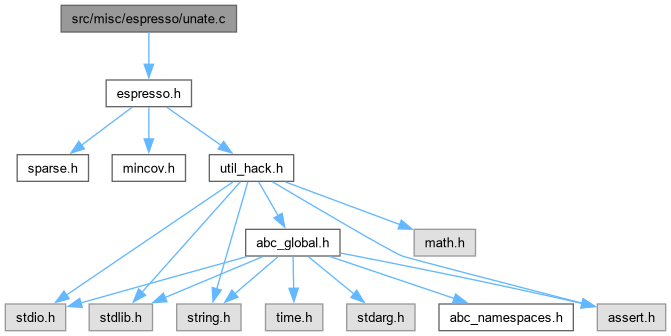
Include dependency graph for unate.c:

Go to the source code of this file.

Macros

#define MAGIC   500 /* save 500 cubes before containment */
 

Functions

pcover map_cover_to_unate (pcube *T)
 
pcover map_unate_to_cover (pset_family A)
 
pset_family unate_compl (pset_family A)
 
pset_family unate_complement (pset_family A)
 
pset_family exact_minimum_cover (IN pset_family T)
 
pset_family unate_intersect (pset_family A, pset_family B, bool largest_only)
 

Macro Definition Documentation

◆ MAGIC

#define MAGIC   500 /* save 500 cubes before containment */

Definition at line 303 of file unate.c.

Function Documentation

◆ exact_minimum_cover()

pset_family exact_minimum_cover ( IN pset_family T)

Definition at line 226 of file unate.c.
228{
229 register pset p, last, p1;
230 register int i, n;
231 int lev, lvl;
232 pset nlast;
233 pset_family temp;
234 long start = ptime();
235 struct {
236 pset_family sf;
237 int level;
238 } stack[32]; /* 32 suffices for 2 ** 32 cubes ! */
239
240 if (T->count <= 0)
241 return sf_new(1, T->sf_size);
242 for(n = T->count, lev = 0; n != 0; n >>= 1, lev++) ;
243
244 /* A simple heuristic ordering */
245 T = lex_sort(sf_save(T));
246
247 /* Push a full set on the stack to get things started */
248 n = 1;
249 stack[0].sf = sf_new(1, T->sf_size);
250 stack[0].level = lev;
251 set_fill(GETSET(stack[0].sf, stack[0].sf->count++), T->sf_size);
252
253 nlast = GETSET(T, T->count - 1);
254 foreach_set(T, last, p) {
255
256 /* "unstack" the set into a family */
257 temp = sf_new(set_ord(p), T->sf_size);
258 for(i = 0; i < T->sf_size; i++)
259 if (is_in_set(p, i)) {
260 p1 = set_fill(GETSET(temp, temp->count++), T->sf_size);
261 set_remove(p1, i);
262 }
263 stack[n].sf = temp;
264 stack[n++].level = lev;
265
266 /* Pop the stack and perform (leveled) intersections */
267 while (n > 1 && (stack[n-1].level==stack[n-2].level || p == nlast)) {
268 temp = unate_intersect(stack[n-1].sf, stack[n-2].sf, FALSE);
269 lvl = MIN(stack[n-1].level, stack[n-2].level) - 1;
270 if (debug & MINCOV && lvl < 10) {
271 printf("# EXACT_MINCOV[%d]: %4d = %4d x %4d, time = %s\n",
272 lvl, temp->count, stack[n-1].sf->count,
273 stack[n-2].sf->count, print_time(ptime() - start));
274 (void) fflush(stdout);
275 }
276 sf_free(stack[n-2].sf);
277 sf_free(stack[n-1].sf);
278 stack[n-2].sf = temp;
279 stack[n-2].level = lvl;
280 n--;
281 }
282 }
283
284 temp = stack[0].sf;
285 p1 = set_fill(set_new(T->sf_size), T->sf_size);
286 foreach_set(temp, last, p)
287 INLINEset_diff(p, p1, p);
288 set_free(p1);
289 if (debug & MINCOV1) {
290 printf("MINCOV: family of all minimal coverings is\n");
291 sf_print(temp);
292 }
293 sf_free(T); /* this is the copy of T we made ... */
294 return temp;
295}
#define FALSE
Definition abcBm.c:37
#define INLINEset_diff(r, a, b)
Definition espresso.h:208
#define is_in_set(set, e)
Definition espresso.h:170
#define set_free(r)
Definition espresso.h:167
pset_family sf_new()
#define set_new(size)
Definition espresso.h:164
#define MINCOV
Definition espresso.h:362
void sf_print()
#define print_time(t)
Definition espresso.h:22
void sf_free()
#define GETSET(family, index)
Definition espresso.h:161
pset_family sf_save()
#define set_remove(set, e)
Definition espresso.h:171
pset set_fill()
struct set_family * pset_family
#define MINCOV1
Definition espresso.h:363
#define foreach_set(R, last, p)
Definition espresso.h:135
unsigned int debug
Definition globals.c:19
int set_ord()
pcover lex_sort()
unsigned int * pset
Definition espresso.h:73
pset_family unate_intersect()
Cube * p
Definition exorList.c:222
int count
Definition espresso.h:80
#define ptime()
Definition util_old.h:283
#define MIN(a, b)
Definition util_old.h:256
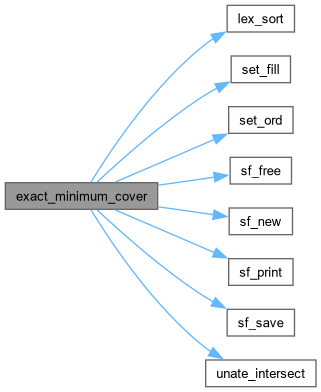
Here is the call graph for this function:

◆ map_cover_to_unate()

pcover map_cover_to_unate ( pcube * T)

Definition at line 23 of file unate.c.
25{
26 register unsigned int word_test, word_set, bit_test, bit_set;
27 register pcube p, pA;
29 pcube *T1;
30 int ncol, i;
31
32 A = sf_new(CUBELISTSIZE(T), cdata.vars_unate);
33 A->count = CUBELISTSIZE(T);
34 foreachi_set(A, i, p) {
35 (void) set_clear(p, A->sf_size);
36 }
37 ncol = 0;
38
39 for(i = 0; i < cube.size; i++) {
40 if (cdata.part_zeros[i] > 0) {
41 assert(ncol <= cdata.vars_unate);
42
43 /* Copy a column from T to A */
44 word_test = WHICH_WORD(i);
45 bit_test = 1 << WHICH_BIT(i);
46 word_set = WHICH_WORD(ncol);
47 bit_set = 1 << WHICH_BIT(ncol);
48
49 pA = A->data;
50 for(T1 = T+2; (p = *T1++) != 0; ) {
51 if ((p[word_test] & bit_test) == 0) {
52 pA[word_set] |= bit_set;
53 }
54 pA += A->wsize;
55 }
56
57 ncol++;
58 }
59 }
60
61 return A;
62}
#define foreachi_set(R, i, p)
Definition espresso.h:143
#define pcube
Definition espresso.h:261
#define WHICH_WORD(element)
Definition espresso.h:87
pset set_clear()
#define WHICH_BIT(element)
Definition espresso.h:88
#define CUBELISTSIZE(T)
Definition espresso.h:329
Definition exor.h:123
pset data
Definition espresso.h:82
int wsize
Definition espresso.h:77
int sf_size
Definition espresso.h:78
#define assert(ex)
Definition util_old.h:213
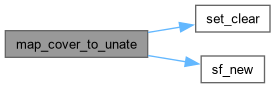
Here is the call graph for this function:

◆ map_unate_to_cover()

pcover map_unate_to_cover ( pset_family A)

Definition at line 64 of file unate.c.

66{
67 register int i, ncol, lp;
68 register pcube p, pB;
69 int var, nunate, *unate;
70 pcube last;
72
73 B = sf_new(A->count, cube.size);
74 B->count = A->count;
75
76 /* Find the unate variables */
77 unate = ALLOC(int, cube.num_vars);
78 nunate = 0;
79 for(var = 0; var < cube.num_vars; var++) {
80 if (cdata.is_unate[var]) {
81 unate[nunate++] = var;
82 }
83 }
84
85 /* Loop for each set of A */
86 pB = B->data;
87 foreach_set(A, last, p) {
88
89 /* Initialize this set of B */
90 INLINEset_fill(pB, cube.size);
91
92 /* Now loop for the unate variables; if the part is in A,
93 * then this variable of B should be a single 1 in the unate
94 * part.
95 */
96 for(ncol = 0; ncol < nunate; ncol++) {
97 if (is_in_set(p, ncol)) {
98 lp = cube.last_part[unate[ncol]];
99 for(i = cube.first_part[unate[ncol]]; i <= lp; i++) {
100 if (cdata.part_zeros[i] == 0) {
101 set_remove(pB, i);
102 }
103 }
104 }
105 }
106 pB += B->wsize;
107 }
108
109 FREE(unate);
110 return B;
111}
#define ALLOC(type, num)
Definition avl.h:27
#define FREE(obj)
Definition avl.h:31
#define INLINEset_fill(r, size)
Definition espresso.h:199
unsigned short var
Definition giaNewBdd.h:35
Here is the call graph for this function:

◆ unate_compl()

pset_family unate_compl ( pset_family A)

Definition at line 117 of file unate.c.

119{
120 register pset p, last;
121
122 /* Make sure A is single-cube containment minimal */
123/* A = sf_rev_contain(A);*/
124
125 foreach_set(A, last, p) {
126 PUTSIZE(p, set_ord(p));
127 }
128
129 /* Recursively find the complement */
130 A = unate_complement(A);
131
132 /* Now, we can guarantee a minimal result by containing the result */
133 A = sf_rev_contain(A);
134 return A;
135}
pset_family unate_complement()
#define PUTSIZE(set, size)
Definition espresso.h:113
pset_family sf_rev_contain()
Here is the call graph for this function:

◆ unate_complement()

pset_family unate_complement ( pset_family A)

Definition at line 141 of file unate.c.
143{
144 pset_family Abar;
145 register pset p, p1, restrict;
146 register int i;
147 int max_i, min_set_ord, j;
148
149 /* Check for no sets in the matrix -- complement is the universe */
150 if (A->count == 0) {
151 sf_free(A);
152 Abar = sf_new(1, A->sf_size);
153 (void) set_clear(GETSET(Abar, Abar->count++), A->sf_size);
154
155 /* Check for a single set in the maxtrix -- compute de Morgan complement */
156 } else if (A->count == 1) {
157 p = A->data;
158 Abar = sf_new(A->sf_size, A->sf_size);
159 for(i = 0; i < A->sf_size; i++) {
160 if (is_in_set(p, i)) {
161 p1 = set_clear(GETSET(Abar, Abar->count++), A->sf_size);
162 set_insert(p1, i);
163 }
164 }
165 sf_free(A);
166
167 } else {
168
169 /* Select splitting variable as the variable which belongs to a set
170 * of the smallest size, and which has greatest column count
171 */
172 restrict = set_new(A->sf_size);
173 min_set_ord = A->sf_size + 1;
174 foreachi_set(A, i, p) {
175 if (SIZE(p) < min_set_ord) {
176 set_copy(restrict, p);
177 min_set_ord = SIZE(p);
178 } else if (SIZE(p) == min_set_ord) {
179 set_or(restrict, restrict, p);
180 }
181 }
182
183 /* Check for no data (shouldn't happen ?) */
184 if (min_set_ord == 0) {
185 A->count = 0;
186 Abar = A;
187
188 /* Check for "essential" columns */
189 } else if (min_set_ord == 1) {
190 Abar = unate_complement(abs_covered_many(A, restrict));
191 sf_free(A);
192 foreachi_set(Abar, i, p) {
193 set_or(p, p, restrict);
194 }
195
196 /* else, recur as usual */
197 } else {
198 max_i = abs_select_restricted(A, restrict);
199
200 /* Select those rows of A which are not covered by max_i,
201 * recursively find all minimal covers of these rows, and
202 * then add back in max_i
203 */
204 Abar = unate_complement(abs_covered(A, max_i));
205 foreachi_set(Abar, i, p) {
206 set_insert(p, max_i);
207 }
208
209 /* Now recur on A with all zero's on column max_i */
210 foreachi_set(A, i, p) {
211 if (is_in_set(p, max_i)) {
212 set_remove(p, max_i);
213 j = SIZE(p) - 1;
214 PUTSIZE(p, j);
215 }
216 }
217
218 Abar = sf_append(Abar, unate_complement(A));
219 }
220 set_free(restrict);
221 }
222
223 return Abar;
224}
#define set_insert(set, e)
Definition espresso.h:172
#define SIZE(set)
Definition espresso.h:112
pset set_or()
pset_family sf_append()
pset set_copy()
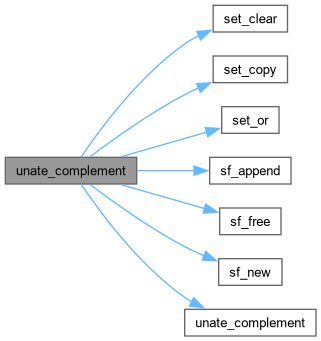
Here is the call graph for this function:

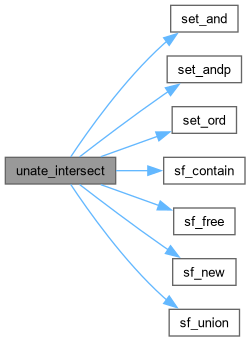
◆ unate_intersect()

pset_family unate_intersect ( pset_family A,
pset_family B,
bool largest_only )

Definition at line 305 of file unate.c.
308{
309 register pset pi, pj, lasti, lastj, pt;
310 pset_family T, Tsave;
311 bool save;
312 int maxord, ord;
313
314 /* How large should each temporary result cover be ? */
315 T = sf_new(MAGIC, A->sf_size);
316 Tsave = NULL;
317 maxord = 0;
318 pt = T->data;
319
320 /* Form pairwise intersection of each set of A with each cube of B */
321 foreach_set(A, lasti, pi) {
322
323 foreach_set(B, lastj, pj) {
324
325 save = set_andp(pt, pi, pj);
326
327 /* Check if we want the largest only */
328 if (save && largest_only) {
329 if ((ord = set_ord(pt)) > maxord) {
330 /* discard Tsave and T */
331 if (Tsave != NULL) {
332 sf_free(Tsave);
333 Tsave = NULL;
334 }
335 pt = T->data;
336 T->count = 0;
337 /* Re-create pt (which was just thrown away) */
338 (void) set_and(pt, pi, pj);
339 maxord = ord;
340 } else if (ord < maxord) {
341 save = FALSE;
342 }
343 }
344
345 if (save) {
346 if (++T->count >= T->capacity) {
347 T = sf_contain(T);
348 Tsave = (Tsave == NULL) ? T : sf_union(Tsave, T);
349 T = sf_new(MAGIC, A->sf_size);
350 pt = T->data;
351 } else {
352 pt += T->wsize;
353 }
354 }
355 }
356 }
357
358
359 /* Contain the final result and merge it into Tsave */
360 T = sf_contain(T);
361 Tsave = (Tsave == NULL) ? T : sf_union(Tsave, T);
362
363 return Tsave;
364}
pset_family sf_union(INOUT pset_family A, INOUT pset_family B)
Definition contain.c:121
pset set_and()
pset_family sf_contain()
bool set_andp()
#define MAGIC
Definition sharp.c:214
int capacity
Definition espresso.h:79
Here is the call graph for this function: