ABC: A System for Sequential Synthesis and Verification
 
Loading...
Searching...
No Matches
fraigNode.c File Reference
#include "fraigInt.h"
Include dependency graph for fraigNode.c:

Go to the source code of this file.

Macros

#define Fraig_NodeIsSimComplement(p)
 DECLARATIONS ///.
 

Functions

Fraig_Node_tFraig_NodeCreateConst (Fraig_Man_t *p)
 FUNCTION DEFINITIONS ///.
 
Fraig_Node_tFraig_NodeCreatePi (Fraig_Man_t *p)
 
Fraig_Node_tFraig_NodeCreate (Fraig_Man_t *p, Fraig_Node_t *p1, Fraig_Node_t *p2)
 
void Fraig_NodeSimulate (Fraig_Node_t *pNode, int iWordStart, int iWordStop, int fUseRand)
 

Macro Definition Documentation

◆ Fraig_NodeIsSimComplement

#define Fraig_NodeIsSimComplement ( p)
Value:
(Fraig_IsComplement(p)? !(Fraig_Regular(p)->fInv) : (p)->fInv)
Cube * p
Definition exorList.c:222
#define Fraig_IsComplement(p)
GLOBAL VARIABLES ///.
Definition fraig.h:107
#define Fraig_Regular(p)
Definition fraig.h:108

DECLARATIONS ///.

CFile****************************************************************

FileName [fraigNode.c]

PackageName [FRAIG: Functionally reduced AND-INV graphs.]

Synopsis [Implementation of the FRAIG node.]

Author [Alan Mishchenko alanm.nosp@m.i@ee.nosp@m.cs.be.nosp@m.rkel.nosp@m.ey.ed.nosp@m.u]

Affiliation [UC Berkeley]

Date [Ver. 2.0. Started - October 1, 2004]

Revision [

Id
fraigNode.c,v 1.3 2005/07/08 01:01:32 alanmi Exp

]

Definition at line 29 of file fraigNode.c.

Function Documentation

◆ Fraig_NodeCreate()

Fraig_Node_t * Fraig_NodeCreate ( Fraig_Man_t * p,
Fraig_Node_t * p1,
Fraig_Node_t * p2 )

Function*************************************************************

Synopsis [Creates a new node.]

Description [This procedure should be called to create the constant node and the PI nodes first.]

SideEffects []

SeeAlso []

Definition at line 160 of file fraigNode.c.
161{
162 Fraig_Node_t * pNode;
163 abctime clk;
164
165 // create the node
166 pNode = (Fraig_Node_t *)Fraig_MemFixedEntryFetch( p->mmNodes );
167 memset( pNode, 0, sizeof(Fraig_Node_t) );
168
169 // assign the children
170 pNode->p1 = p1; Fraig_Ref(p1); Fraig_Regular(p1)->nRefs++;
171 pNode->p2 = p2; Fraig_Ref(p2); Fraig_Regular(p2)->nRefs++;
172
173 // assign the number and add to the array of nodes
174 pNode->Num = p->vNodes->nSize;
175 Fraig_NodeVecPush( p->vNodes, pNode );
176
177 // assign the PI number
178 pNode->NumPi = -1;
179
180 // compute the level of this node
181 pNode->Level = 1 + Abc_MaxInt(Fraig_Regular(p1)->Level, Fraig_Regular(p2)->Level);
183 pNode->fFailTfo = Fraig_Regular(p1)->fFailTfo | Fraig_Regular(p2)->fFailTfo;
184
185 // derive the simulation info
186clk = Abc_Clock();
187 // allocate memory for the simulation info
188 pNode->puSimR = (unsigned *)Fraig_MemFixedEntryFetch( p->mmSims );
189 pNode->puSimD = pNode->puSimR + p->nWordsRand;
190 // derive random simulation info
191 pNode->uHashR = 0;
192 Fraig_NodeSimulate( pNode, 0, p->nWordsRand, 1 );
193 // derive dynamic simulation info
194 pNode->uHashD = 0;
195 Fraig_NodeSimulate( pNode, 0, p->iWordStart, 0 );
196 // count the number of ones in the random simulation info
197 pNode->nOnes = Fraig_BitStringCountOnes( pNode->puSimR, p->nWordsRand );
198 if ( pNode->fInv )
199 pNode->nOnes = p->nWordsRand * 32 - pNode->nOnes;
200 // add to the runtime of simulation
201p->timeSims += Abc_Clock() - clk;
202
203#ifdef FRAIG_ENABLE_FANOUTS
204 // create the fanout info
207#endif
208 return pNode;
209}
ABC_INT64_T abctime
Definition abc_global.h:332
ABC_NAMESPACE_IMPL_START void Fraig_NodeAddFaninFanout(Fraig_Node_t *pFanin, Fraig_Node_t *pFanout)
DECLARATIONS ///.
Definition fraigFanout.c:45
int Fraig_BitStringCountOnes(unsigned *pString, int nWords)
Definition fraigUtil.c:288
char * Fraig_MemFixedEntryFetch(Fraig_MemFixed_t *p)
Definition fraigMem.c:131
#define Fraig_NodeIsSimComplement(p)
DECLARATIONS ///.
Definition fraigNode.c:29
void Fraig_NodeSimulate(Fraig_Node_t *pNode, int iWordStart, int iWordStop, int fUseRand)
Definition fraigNode.c:226
#define Fraig_Ref(p)
Definition fraig.h:113
struct Fraig_NodeStruct_t_ Fraig_Node_t
Definition fraig.h:41
void Fraig_NodeVecPush(Fraig_NodeVec_t *p, Fraig_Node_t *Entry)
Definition fraigVec.c:189
Fraig_Node_t * p2
Definition fraigInt.h:233
unsigned * puSimR
Definition fraigInt.h:247
Fraig_Node_t * p1
Definition fraigInt.h:232
unsigned * puSimD
Definition fraigInt.h:248
char * memset()
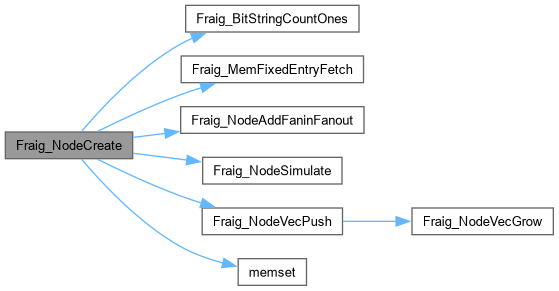
Here is the call graph for this function:
Here is the caller graph for this function:

◆ Fraig_NodeCreateConst()

Fraig_Node_t * Fraig_NodeCreateConst ( Fraig_Man_t * p)

FUNCTION DEFINITIONS ///.

Function*************************************************************

Synopsis [Creates the constant 1 node.]

Description []

SideEffects []

SeeAlso []

Definition at line 46 of file fraigNode.c.
47{
48 Fraig_Node_t * pNode;
49
50 // create the node
51 pNode = (Fraig_Node_t *)Fraig_MemFixedEntryFetch( p->mmNodes );
52 memset( pNode, 0, sizeof(Fraig_Node_t) );
53
54 // assign the number and add to the array of nodes
55 pNode->Num = p->vNodes->nSize;
56 Fraig_NodeVecPush( p->vNodes, pNode );
57 pNode->NumPi = -1; // this is not a PI, so its number is -1
58 pNode->Level = 0; // just like a PI, it has 0 level
59 pNode->nRefs = 1; // it is a persistent node, which comes referenced
60 pNode->fInv = 1; // the simulation info is complemented
61
62 // create the simulation info
63 pNode->puSimR = (unsigned *)Fraig_MemFixedEntryFetch( p->mmSims );
64 pNode->puSimD = pNode->puSimR + p->nWordsRand;
65 memset( pNode->puSimR, 0, sizeof(unsigned) * p->nWordsRand );
66 memset( pNode->puSimD, 0, sizeof(unsigned) * p->nWordsDyna );
67
68 // count the number of ones in the simulation vector
69 pNode->nOnes = p->nWordsRand * sizeof(unsigned) * 8;
70
71 // insert it into the hash table
72 Fraig_HashTableLookupF0( p, pNode );
73 return pNode;
74}
Fraig_Node_t * Fraig_HashTableLookupF0(Fraig_Man_t *pMan, Fraig_Node_t *pNode)
Definition fraigTable.c:193
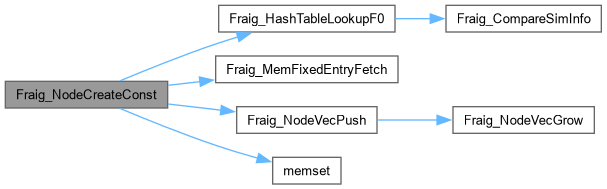
Here is the call graph for this function:
Here is the caller graph for this function:

◆ Fraig_NodeCreatePi()

Fraig_Node_t * Fraig_NodeCreatePi ( Fraig_Man_t * p)

Function*************************************************************

Synopsis [Creates a primary input node.]

Description []

SideEffects []

SeeAlso []

Definition at line 87 of file fraigNode.c.
88{
89 Fraig_Node_t * pNode, * pNodeRes;
90 int i;
91 abctime clk;
92
93 // create the node
94 pNode = (Fraig_Node_t *)Fraig_MemFixedEntryFetch( p->mmNodes );
95 memset( pNode, 0, sizeof(Fraig_Node_t) );
96 pNode->puSimR = (unsigned *)Fraig_MemFixedEntryFetch( p->mmSims );
97 pNode->puSimD = pNode->puSimR + p->nWordsRand;
98 memset( pNode->puSimD, 0, sizeof(unsigned) * p->nWordsDyna );
99
100 // assign the number and add to the array of nodes
101 pNode->Num = p->vNodes->nSize;
102 Fraig_NodeVecPush( p->vNodes, pNode );
103
104 // assign the PI number and add to the array of primary inputs
105 pNode->NumPi = p->vInputs->nSize;
106 Fraig_NodeVecPush( p->vInputs, pNode );
107
108 pNode->Level = 0; // PI has 0 level
109 pNode->nRefs = 1; // it is a persistent node, which comes referenced
110 pNode->fInv = 0; // the simulation info of the PI is not complemented
111
112 // derive the simulation info for the new node
113clk = Abc_Clock();
114 // set the random simulation info for the primary input
115 pNode->uHashR = 0;
116 for ( i = 0; i < p->nWordsRand; i++ )
117 {
118 // generate the simulation info
119 pNode->puSimR[i] = FRAIG_RANDOM_UNSIGNED;
120 // for reasons that take very long to explain, it makes sense to have (0000000...)
121 // pattern in the set (this helps if we need to return the counter-examples)
122 if ( i == 0 )
123 pNode->puSimR[i] <<= 1;
124 // compute the hash key
125 pNode->uHashR ^= pNode->puSimR[i] * s_FraigPrimes[i];
126 }
127 // count the number of ones in the simulation vector
128 pNode->nOnes = Fraig_BitStringCountOnes( pNode->puSimR, p->nWordsRand );
129
130 // set the systematic simulation info for the primary input
131 pNode->uHashD = 0;
132 for ( i = 0; i < p->iWordStart; i++ )
133 {
134 // generate the simulation info
135 pNode->puSimD[i] = FRAIG_RANDOM_UNSIGNED;
136 // compute the hash key
137 pNode->uHashD ^= pNode->puSimD[i] * s_FraigPrimes[i];
138 }
139p->timeSims += Abc_Clock() - clk;
140
141 // insert it into the hash table
142 pNodeRes = Fraig_HashTableLookupF( p, pNode );
143 assert( pNodeRes == NULL );
144 // add to the runtime of simulation
145 return pNode;
146}
Fraig_Node_t * Fraig_HashTableLookupF(Fraig_Man_t *pMan, Fraig_Node_t *pNode)
Definition fraigTable.c:136
#define FRAIG_RANDOM_UNSIGNED
Definition fraigInt.h:76
int s_FraigPrimes[FRAIG_MAX_PRIMES]
DECLARATIONS ///.
Definition fraigPrime.c:30
#define assert(ex)
Definition util_old.h:213
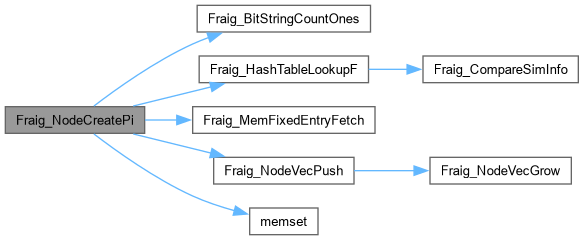
Here is the call graph for this function:
Here is the caller graph for this function:

◆ Fraig_NodeSimulate()

void Fraig_NodeSimulate ( Fraig_Node_t * pNode,
int iWordStart,
int iWordStop,
int fUseRand )

Function*************************************************************

Synopsis [Simulates the node.]

Description [Simulates the random or dynamic simulation info through the node. Uses phases of the children to determine their real simulation info. Uses phase of the node to determine the way its simulation info is stored. The resulting info is guaranteed to be 0 for the first pattern.]

SideEffects [This procedure modified the hash value of the simulation info.]

SeeAlso []

Definition at line 226 of file fraigNode.c.

227{
228 unsigned * pSims, * pSims1, * pSims2;
229 unsigned uHash;
230 int fCompl, fCompl1, fCompl2, i;
231
232 assert( !Fraig_IsComplement(pNode) );
233
234 // get hold of the simulation information
235 pSims = fUseRand? pNode->puSimR : pNode->puSimD;
236 pSims1 = fUseRand? Fraig_Regular(pNode->p1)->puSimR : Fraig_Regular(pNode->p1)->puSimD;
237 pSims2 = fUseRand? Fraig_Regular(pNode->p2)->puSimR : Fraig_Regular(pNode->p2)->puSimD;
238
239 // get complemented attributes of the children using their random info
240 fCompl = pNode->fInv;
241 fCompl1 = Fraig_NodeIsSimComplement(pNode->p1);
242 fCompl2 = Fraig_NodeIsSimComplement(pNode->p2);
243
244 // simulate
245 uHash = 0;
246 if ( fCompl1 && fCompl2 )
247 {
248 if ( fCompl )
249 for ( i = iWordStart; i < iWordStop; i++ )
250 {
251 pSims[i] = (pSims1[i] | pSims2[i]);
252 uHash ^= pSims[i] * s_FraigPrimes[i];
253 }
254 else
255 for ( i = iWordStart; i < iWordStop; i++ )
256 {
257 pSims[i] = ~(pSims1[i] | pSims2[i]);
258 uHash ^= pSims[i] * s_FraigPrimes[i];
259 }
260 }
261 else if ( fCompl1 && !fCompl2 )
262 {
263 if ( fCompl )
264 for ( i = iWordStart; i < iWordStop; i++ )
265 {
266 pSims[i] = (pSims1[i] | ~pSims2[i]);
267 uHash ^= pSims[i] * s_FraigPrimes[i];
268 }
269 else
270 for ( i = iWordStart; i < iWordStop; i++ )
271 {
272 pSims[i] = (~pSims1[i] & pSims2[i]);
273 uHash ^= pSims[i] * s_FraigPrimes[i];
274 }
275 }
276 else if ( !fCompl1 && fCompl2 )
277 {
278 if ( fCompl )
279 for ( i = iWordStart; i < iWordStop; i++ )
280 {
281 pSims[i] = (~pSims1[i] | pSims2[i]);
282 uHash ^= pSims[i] * s_FraigPrimes[i];
283 }
284 else
285 for ( i = iWordStart; i < iWordStop; i++ )
286 {
287 pSims[i] = (pSims1[i] & ~pSims2[i]);
288 uHash ^= pSims[i] * s_FraigPrimes[i];
289 }
290 }
291 else // if ( !fCompl1 && !fCompl2 )
292 {
293 if ( fCompl )
294 for ( i = iWordStart; i < iWordStop; i++ )
295 {
296 pSims[i] = ~(pSims1[i] & pSims2[i]);
297 uHash ^= pSims[i] * s_FraigPrimes[i];
298 }
299 else
300 for ( i = iWordStart; i < iWordStop; i++ )
301 {
302 pSims[i] = (pSims1[i] & pSims2[i]);
303 uHash ^= pSims[i] * s_FraigPrimes[i];
304 }
305 }
306
307 if ( fUseRand )
308 pNode->uHashR ^= uHash;
309 else
310 pNode->uHashD ^= uHash;
311}
Here is the caller graph for this function: