ABC: A System for Sequential Synthesis and Verification
 
Loading...
Searching...
No Matches
fraig.h File Reference
This graph shows which files directly or indirectly include this file:

Go to the source code of this file.

Classes

struct  Fraig_ParamsStruct_t_
 
struct  Prove_ParamsStruct_t_
 

Macros

#define Fraig_IsComplement(p)
 GLOBAL VARIABLES ///.
 
#define Fraig_Regular(p)
 
#define Fraig_Not(p)
 
#define Fraig_NotCond(p, c)
 
#define Fraig_Ref(p)
 
#define Fraig_Deref(p)
 
#define Fraig_RecursiveDeref(p, c)
 

Typedefs

typedef typedefABC_NAMESPACE_HEADER_START struct Fraig_ManStruct_t_ Fraig_Man_t
 INCLUDES ///.
 
typedef struct Fraig_NodeStruct_t_ Fraig_Node_t
 
typedef struct Fraig_NodeVecStruct_t_ Fraig_NodeVec_t
 
typedef struct Fraig_HashTableStruct_t_ Fraig_HashTable_t
 
typedef struct Fraig_ParamsStruct_t_ Fraig_Params_t
 
typedef struct Fraig_PatternsStruct_t_ Fraig_Patterns_t
 

Functions

Fraig_NodeVec_tFraig_ManReadVecInputs (Fraig_Man_t *p)
 FUNCTION DEFINITIONS ///.
 
Fraig_NodeVec_tFraig_ManReadVecOutputs (Fraig_Man_t *p)
 
Fraig_NodeVec_tFraig_ManReadVecNodes (Fraig_Man_t *p)
 
Fraig_Node_t ** Fraig_ManReadInputs (Fraig_Man_t *p)
 
Fraig_Node_t ** Fraig_ManReadOutputs (Fraig_Man_t *p)
 
Fraig_Node_t ** Fraig_ManReadNodes (Fraig_Man_t *p)
 
int Fraig_ManReadInputNum (Fraig_Man_t *p)
 
int Fraig_ManReadOutputNum (Fraig_Man_t *p)
 
int Fraig_ManReadNodeNum (Fraig_Man_t *p)
 
Fraig_Node_tFraig_ManReadConst1 (Fraig_Man_t *p)
 
Fraig_Node_tFraig_ManReadIthVar (Fraig_Man_t *p, int i)
 
Fraig_Node_tFraig_ManReadIthNode (Fraig_Man_t *p, int i)
 
char ** Fraig_ManReadInputNames (Fraig_Man_t *p)
 
char ** Fraig_ManReadOutputNames (Fraig_Man_t *p)
 
char * Fraig_ManReadVarsInt (Fraig_Man_t *p)
 
char * Fraig_ManReadSat (Fraig_Man_t *p)
 
int Fraig_ManReadFuncRed (Fraig_Man_t *p)
 
int Fraig_ManReadFeedBack (Fraig_Man_t *p)
 
int Fraig_ManReadDoSparse (Fraig_Man_t *p)
 
int Fraig_ManReadChoicing (Fraig_Man_t *p)
 
int Fraig_ManReadVerbose (Fraig_Man_t *p)
 
int * Fraig_ManReadModel (Fraig_Man_t *p)
 
int Fraig_ManReadPatternNumRandom (Fraig_Man_t *p)
 
int Fraig_ManReadPatternNumDynamic (Fraig_Man_t *p)
 
int Fraig_ManReadPatternNumDynamicFiltered (Fraig_Man_t *p)
 
int Fraig_ManReadSatFails (Fraig_Man_t *p)
 
int Fraig_ManReadConflicts (Fraig_Man_t *p)
 
int Fraig_ManReadInspects (Fraig_Man_t *p)
 
void Fraig_ManSetFuncRed (Fraig_Man_t *p, int fFuncRed)
 
void Fraig_ManSetFeedBack (Fraig_Man_t *p, int fFeedBack)
 
void Fraig_ManSetDoSparse (Fraig_Man_t *p, int fDoSparse)
 
void Fraig_ManSetChoicing (Fraig_Man_t *p, int fChoicing)
 
void Fraig_ManSetTryProve (Fraig_Man_t *p, int fTryProve)
 
void Fraig_ManSetVerbose (Fraig_Man_t *p, int fVerbose)
 
void Fraig_ManSetOutputNames (Fraig_Man_t *p, char **ppNames)
 
void Fraig_ManSetInputNames (Fraig_Man_t *p, char **ppNames)
 
void Fraig_ManSetPo (Fraig_Man_t *p, Fraig_Node_t *pNode)
 
Fraig_Node_tFraig_NodeReadData0 (Fraig_Node_t *p)
 
Fraig_Node_tFraig_NodeReadData1 (Fraig_Node_t *p)
 
int Fraig_NodeReadNum (Fraig_Node_t *p)
 
Fraig_Node_tFraig_NodeReadOne (Fraig_Node_t *p)
 
Fraig_Node_tFraig_NodeReadTwo (Fraig_Node_t *p)
 
Fraig_Node_tFraig_NodeReadNextE (Fraig_Node_t *p)
 
Fraig_Node_tFraig_NodeReadRepr (Fraig_Node_t *p)
 
int Fraig_NodeReadNumRefs (Fraig_Node_t *p)
 
int Fraig_NodeReadNumFanouts (Fraig_Node_t *p)
 
int Fraig_NodeReadSimInv (Fraig_Node_t *p)
 
int Fraig_NodeReadNumOnes (Fraig_Node_t *p)
 
unsigned * Fraig_NodeReadPatternsRandom (Fraig_Node_t *p)
 
unsigned * Fraig_NodeReadPatternsDynamic (Fraig_Node_t *p)
 
void Fraig_NodeSetData0 (Fraig_Node_t *p, Fraig_Node_t *pData)
 
void Fraig_NodeSetData1 (Fraig_Node_t *p, Fraig_Node_t *pData)
 
int Fraig_NodeIsConst (Fraig_Node_t *p)
 
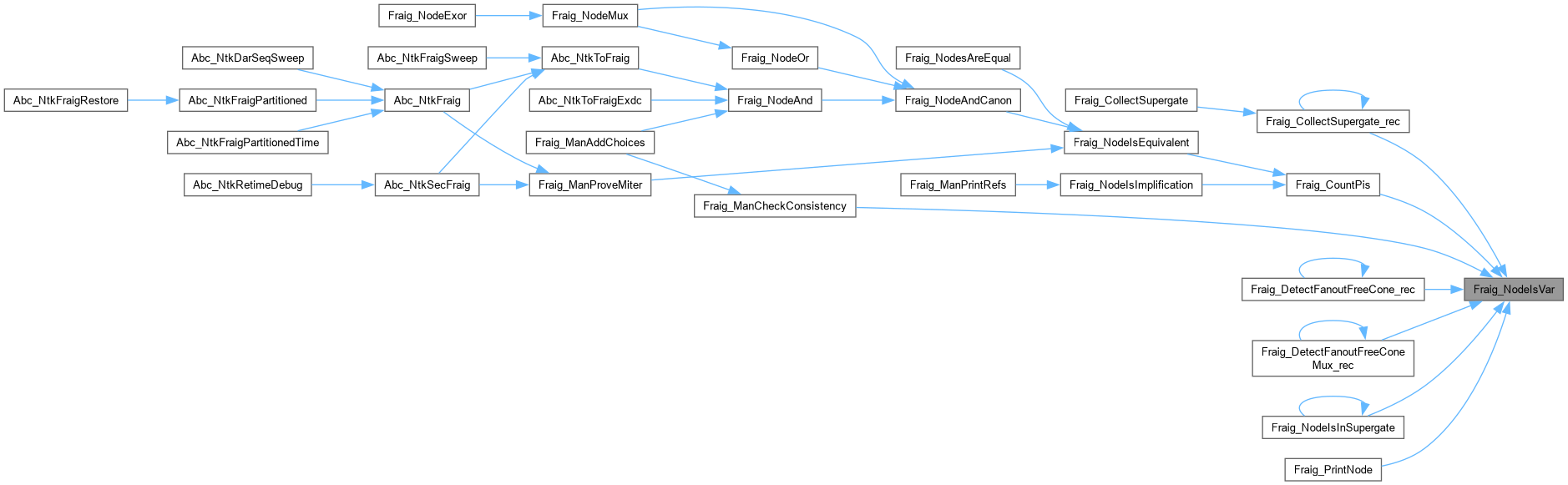
int Fraig_NodeIsVar (Fraig_Node_t *p)
 
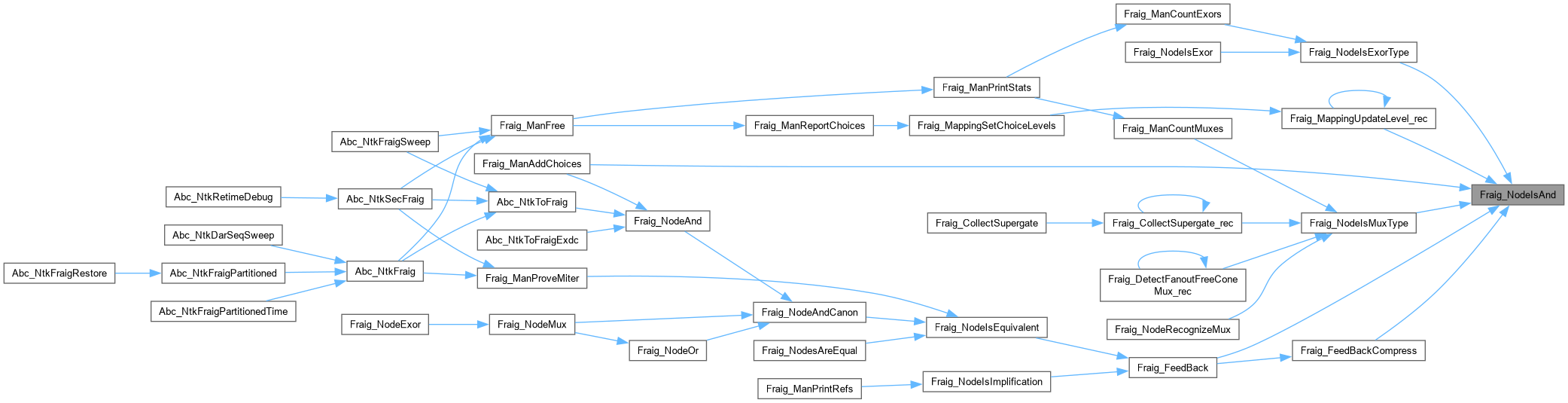
int Fraig_NodeIsAnd (Fraig_Node_t *p)
 
int Fraig_NodeComparePhase (Fraig_Node_t *p1, Fraig_Node_t *p2)
 
Fraig_Node_tFraig_NodeOr (Fraig_Man_t *p, Fraig_Node_t *p1, Fraig_Node_t *p2)
 
Fraig_Node_tFraig_NodeAnd (Fraig_Man_t *p, Fraig_Node_t *p1, Fraig_Node_t *p2)
 
Fraig_Node_tFraig_NodeExor (Fraig_Man_t *p, Fraig_Node_t *p1, Fraig_Node_t *p2)
 
Fraig_Node_tFraig_NodeMux (Fraig_Man_t *p, Fraig_Node_t *pNode, Fraig_Node_t *pNodeT, Fraig_Node_t *pNodeE)
 
void Fraig_NodeSetChoice (Fraig_Man_t *pMan, Fraig_Node_t *pNodeOld, Fraig_Node_t *pNodeNew)
 
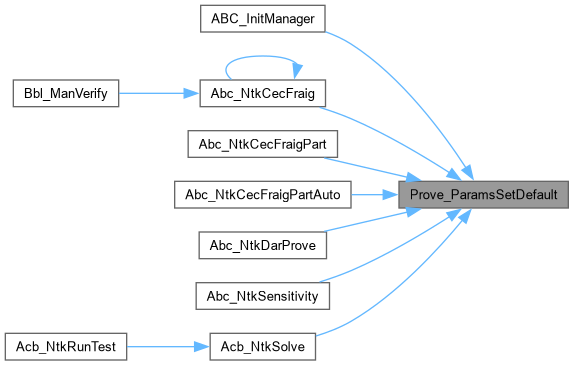
void Prove_ParamsSetDefault (Prove_Params_t *pParams)
 FUNCTION DEFINITIONS ///.
 
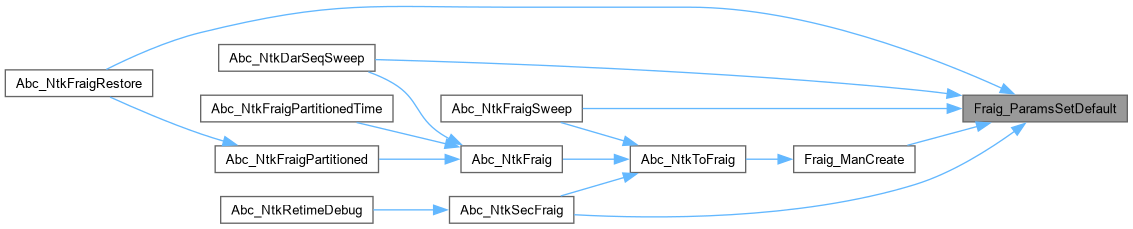
void Fraig_ParamsSetDefault (Fraig_Params_t *pParams)
 
void Fraig_ParamsSetDefaultFull (Fraig_Params_t *pParams)
 
Fraig_Man_tFraig_ManCreate (Fraig_Params_t *pParams)
 
void Fraig_ManFree (Fraig_Man_t *pMan)
 
void Fraig_ManPrintStats (Fraig_Man_t *p)
 
Fraig_NodeVec_tFraig_ManGetSimInfo (Fraig_Man_t *p)
 
int Fraig_ManCheckClauseUsingSimInfo (Fraig_Man_t *p, Fraig_Node_t *pNode1, Fraig_Node_t *pNode2)
 
void Fraig_ManAddClause (Fraig_Man_t *p, Fraig_Node_t **ppNodes, int nNodes)
 
Fraig_NodeVec_tFraig_Dfs (Fraig_Man_t *pMan, int fEquiv)
 FUNCTION DEFINITIONS ///.
 
Fraig_NodeVec_tFraig_DfsOne (Fraig_Man_t *pMan, Fraig_Node_t *pNode, int fEquiv)
 
Fraig_NodeVec_tFraig_DfsNodes (Fraig_Man_t *pMan, Fraig_Node_t **ppNodes, int nNodes, int fEquiv)
 
Fraig_NodeVec_tFraig_DfsReverse (Fraig_Man_t *pMan)
 
int Fraig_CountNodes (Fraig_Man_t *pMan, int fEquiv)
 
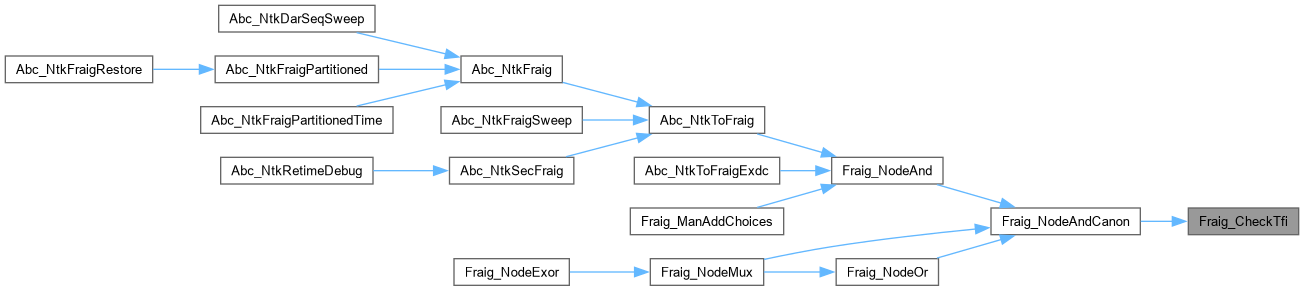
int Fraig_CheckTfi (Fraig_Man_t *pMan, Fraig_Node_t *pOld, Fraig_Node_t *pNew)
 
int Fraig_CountLevels (Fraig_Man_t *pMan)
 
int Fraig_NodesAreEqual (Fraig_Man_t *p, Fraig_Node_t *pNode1, Fraig_Node_t *pNode2, int nBTLimit, int nTimeLimit)
 FUNCTION DEFINITIONS ///.
 
int Fraig_NodeIsEquivalent (Fraig_Man_t *p, Fraig_Node_t *pOld, Fraig_Node_t *pNew, int nBTLimit, int nTimeLimit)
 
void Fraig_ManProveMiter (Fraig_Man_t *p)
 
int Fraig_ManCheckMiter (Fraig_Man_t *p)
 
int Fraig_ManCheckClauseUsingSat (Fraig_Man_t *p, Fraig_Node_t *pNode1, Fraig_Node_t *pNode2, int nBTLimit)
 
Fraig_NodeVec_tFraig_NodeVecAlloc (int nCap)
 DECLARATIONS ///.
 
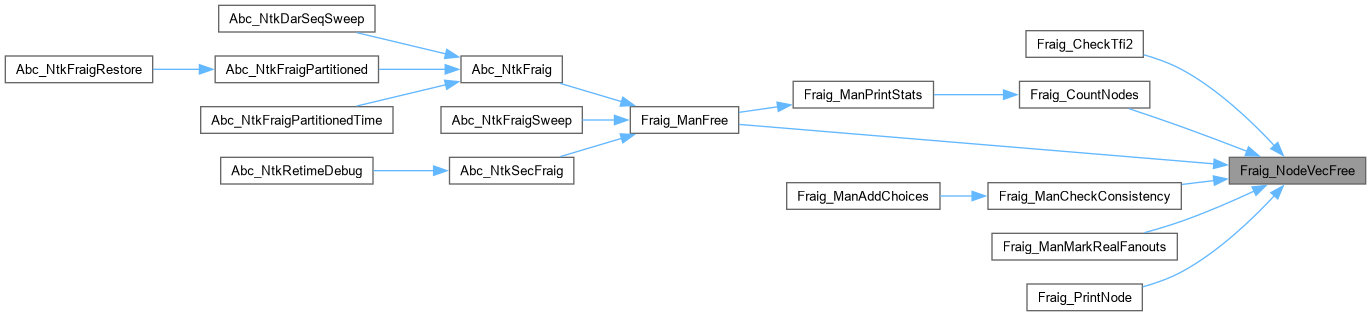
void Fraig_NodeVecFree (Fraig_NodeVec_t *p)
 
Fraig_NodeVec_tFraig_NodeVecDup (Fraig_NodeVec_t *p)
 
Fraig_Node_t ** Fraig_NodeVecReadArray (Fraig_NodeVec_t *p)
 
int Fraig_NodeVecReadSize (Fraig_NodeVec_t *p)
 
void Fraig_NodeVecGrow (Fraig_NodeVec_t *p, int nCapMin)
 
void Fraig_NodeVecShrink (Fraig_NodeVec_t *p, int nSizeNew)
 
void Fraig_NodeVecClear (Fraig_NodeVec_t *p)
 
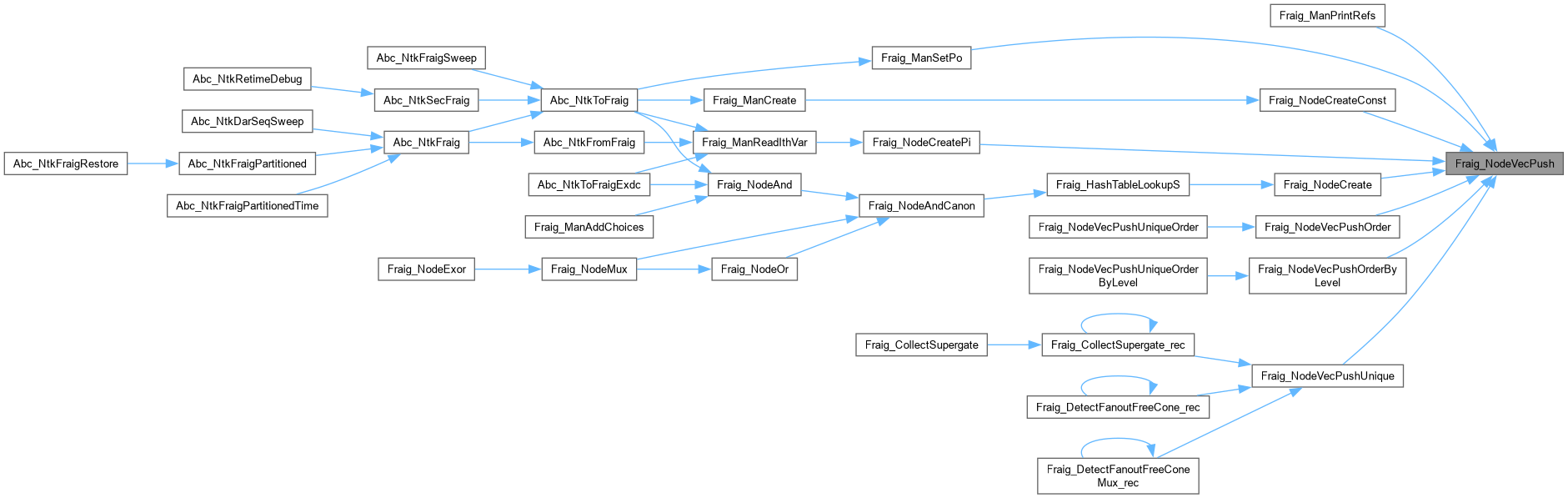
void Fraig_NodeVecPush (Fraig_NodeVec_t *p, Fraig_Node_t *Entry)
 
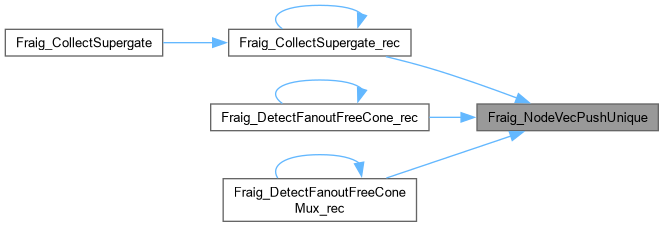
int Fraig_NodeVecPushUnique (Fraig_NodeVec_t *p, Fraig_Node_t *Entry)
 
void Fraig_NodeVecPushOrder (Fraig_NodeVec_t *p, Fraig_Node_t *pNode)
 
int Fraig_NodeVecPushUniqueOrder (Fraig_NodeVec_t *p, Fraig_Node_t *pNode)
 
void Fraig_NodeVecPushOrderByLevel (Fraig_NodeVec_t *p, Fraig_Node_t *pNode)
 
int Fraig_NodeVecPushUniqueOrderByLevel (Fraig_NodeVec_t *p, Fraig_Node_t *pNode)
 
Fraig_Node_tFraig_NodeVecPop (Fraig_NodeVec_t *p)
 
void Fraig_NodeVecRemove (Fraig_NodeVec_t *p, Fraig_Node_t *Entry)
 
void Fraig_NodeVecWriteEntry (Fraig_NodeVec_t *p, int i, Fraig_Node_t *Entry)
 
Fraig_Node_tFraig_NodeVecReadEntry (Fraig_NodeVec_t *p, int i)
 
void Fraig_NodeVecSortByLevel (Fraig_NodeVec_t *p, int fIncreasing)
 
void Fraig_NodeVecSortByNumber (Fraig_NodeVec_t *p)
 
void Fraig_ManMarkRealFanouts (Fraig_Man_t *p)
 
int Fraig_ManCheckConsistency (Fraig_Man_t *p)
 
int Fraig_GetMaxLevel (Fraig_Man_t *pMan)
 
void Fraig_ManReportChoices (Fraig_Man_t *pMan)
 
void Fraig_MappingSetChoiceLevels (Fraig_Man_t *pMan, int fMaximum)
 
Fraig_NodeVec_tFraig_CollectSupergate (Fraig_Node_t *pNode, int fStopAtMux)
 

Macro Definition Documentation

◆ Fraig_Deref

#define Fraig_Deref ( p)

Definition at line 114 of file fraig.h.

◆ Fraig_IsComplement

#define Fraig_IsComplement ( p)
Value:
(((int)((ABC_PTRUINT_T) (p) & 01)))
Cube * p
Definition exorList.c:222

GLOBAL VARIABLES ///.

MACRO DEFINITIONS ///

Definition at line 107 of file fraig.h.

◆ Fraig_Not

#define Fraig_Not ( p)
Value:
((Fraig_Node_t *)((ABC_PTRUINT_T)(p) ^ 01))
struct Fraig_NodeStruct_t_ Fraig_Node_t
Definition fraig.h:41

Definition at line 109 of file fraig.h.

◆ Fraig_NotCond

#define Fraig_NotCond ( p,
c )
Value:
((Fraig_Node_t *)((ABC_PTRUINT_T)(p) ^ (c)))

Definition at line 110 of file fraig.h.

◆ Fraig_RecursiveDeref

#define Fraig_RecursiveDeref ( p,
c )

Definition at line 115 of file fraig.h.

◆ Fraig_Ref

#define Fraig_Ref ( p)

Definition at line 113 of file fraig.h.

◆ Fraig_Regular

#define Fraig_Regular ( p)
Value:
((Fraig_Node_t *)((ABC_PTRUINT_T)(p) & ~01))

Definition at line 108 of file fraig.h.

Typedef Documentation

◆ Fraig_HashTable_t

Definition at line 43 of file fraig.h.

◆ Fraig_Man_t

typedef typedefABC_NAMESPACE_HEADER_START struct Fraig_ManStruct_t_ Fraig_Man_t

INCLUDES ///.

CFile****************************************************************

FileName [fraig.h]

PackageName [FRAIG: Functionally reduced AND-INV graphs.]

Synopsis [External declarations of the FRAIG package.]

Author [Alan Mishchenko alanm.nosp@m.i@ee.nosp@m.cs.be.nosp@m.rkel.nosp@m.ey.ed.nosp@m.u]

Affiliation [UC Berkeley]

Date [Ver. 2.0. Started - October 1, 2004]

Revision [

Id
fraig.h,v 1.18 2005/07/08 01:01:30 alanmi Exp

] PARAMETERS /// STRUCTURE DEFINITIONS ///

Definition at line 40 of file fraig.h.

◆ Fraig_Node_t

Definition at line 41 of file fraig.h.

◆ Fraig_NodeVec_t

Definition at line 42 of file fraig.h.

◆ Fraig_Params_t

Definition at line 44 of file fraig.h.

◆ Fraig_Patterns_t

typedef struct Fraig_PatternsStruct_t_ Fraig_Patterns_t

Definition at line 45 of file fraig.h.

Function Documentation

◆ Fraig_CheckTfi()

int Fraig_CheckTfi ( Fraig_Man_t * pMan,
Fraig_Node_t * pOld,
Fraig_Node_t * pNew )
extern

Function*************************************************************

Synopsis [Returns 1 if pOld is in the TFI of pNew.]

Description []

SideEffects []

SeeAlso []

Definition at line 173 of file fraigUtil.c.
174{
175 assert( !Fraig_IsComplement(pOld) );
176 assert( !Fraig_IsComplement(pNew) );
177 pMan->nTravIds++;
178 return Fraig_CheckTfi_rec( pMan, pNew, pOld );
179}
#define Fraig_IsComplement(p)
GLOBAL VARIABLES ///.
Definition fraig.h:107
#define assert(ex)
Definition util_old.h:213
Here is the caller graph for this function:

◆ Fraig_CollectSupergate()

Fraig_NodeVec_t * Fraig_CollectSupergate ( Fraig_Node_t * pNode,
int fStopAtMux )
extern

Function*************************************************************

Synopsis [Returns the array of nodes to be combined into one multi-input AND-gate.]

Description []

SideEffects []

SeeAlso []

Definition at line 960 of file fraigUtil.c.

961{
962 Fraig_NodeVec_t * vSuper;
963 vSuper = Fraig_NodeVecAlloc( 8 );
964 Fraig_CollectSupergate_rec( pNode, vSuper, 1, fStopAtMux );
965 return vSuper;
966}
void Fraig_CollectSupergate_rec(Fraig_Node_t *pNode, Fraig_NodeVec_t *vSuper, int fFirst, int fStopAtMux)
Definition fraigUtil.c:933
struct Fraig_NodeVecStruct_t_ Fraig_NodeVec_t
Definition fraig.h:42
Fraig_NodeVec_t * Fraig_NodeVecAlloc(int nCap)
DECLARATIONS ///.
Definition fraigVec.c:43
Here is the call graph for this function:

◆ Fraig_CountLevels()

int Fraig_CountLevels ( Fraig_Man_t * pMan)
extern

◆ Fraig_CountNodes()

int Fraig_CountNodes ( Fraig_Man_t * pMan,
int fEquiv )
extern

Function*************************************************************

Synopsis [Computes the DFS ordering of the nodes.]

Description []

SideEffects []

SeeAlso []

Definition at line 152 of file fraigUtil.c.

153{
154 Fraig_NodeVec_t * vNodes;
155 int RetValue;
156 vNodes = Fraig_Dfs( pMan, fEquiv );
157 RetValue = vNodes->nSize;
158 Fraig_NodeVecFree( vNodes );
159 return RetValue;
160}
Fraig_NodeVec_t * Fraig_Dfs(Fraig_Man_t *pMan, int fEquiv)
FUNCTION DEFINITIONS ///.
Definition fraigUtil.c:58
void Fraig_NodeVecFree(Fraig_NodeVec_t *p)
Definition fraigVec.c:66
Here is the call graph for this function:
Here is the caller graph for this function:

◆ Fraig_Dfs()

Fraig_NodeVec_t * Fraig_Dfs ( Fraig_Man_t * pMan,
int fEquiv )
extern

FUNCTION DEFINITIONS ///.

Function*************************************************************

Synopsis [Computes the DFS ordering of the nodes.]

Description []

SideEffects []

SeeAlso []

Definition at line 58 of file fraigUtil.c.

59{
60 Fraig_NodeVec_t * vNodes;
61 int i;
62 pMan->nTravIds++;
63 vNodes = Fraig_NodeVecAlloc( 100 );
64 for ( i = 0; i < pMan->vOutputs->nSize; i++ )
65 Fraig_Dfs_rec( pMan, Fraig_Regular(pMan->vOutputs->pArray[i]), vNodes, fEquiv );
66 return vNodes;
67}
#define Fraig_Regular(p)
Definition fraig.h:108
Here is the call graph for this function:
Here is the caller graph for this function:

◆ Fraig_DfsNodes()

Fraig_NodeVec_t * Fraig_DfsNodes ( Fraig_Man_t * pMan,
Fraig_Node_t ** ppNodes,
int nNodes,
int fEquiv )
extern

Function*************************************************************

Synopsis [Computes the DFS ordering of the nodes.]

Description []

SideEffects []

SeeAlso []

Definition at line 100 of file fraigUtil.c.

101{
102 Fraig_NodeVec_t * vNodes;
103 int i;
104 pMan->nTravIds++;
105 vNodes = Fraig_NodeVecAlloc( 100 );
106 for ( i = 0; i < nNodes; i++ )
107 Fraig_Dfs_rec( pMan, Fraig_Regular(ppNodes[i]), vNodes, fEquiv );
108 return vNodes;
109}
Here is the call graph for this function:

◆ Fraig_DfsOne()

Fraig_NodeVec_t * Fraig_DfsOne ( Fraig_Man_t * pMan,
Fraig_Node_t * pNode,
int fEquiv )
extern

Function*************************************************************

Synopsis [Computes the DFS ordering of the nodes.]

Description []

SideEffects []

SeeAlso []

Definition at line 80 of file fraigUtil.c.

81{
82 Fraig_NodeVec_t * vNodes;
83 pMan->nTravIds++;
84 vNodes = Fraig_NodeVecAlloc( 100 );
85 Fraig_Dfs_rec( pMan, Fraig_Regular(pNode), vNodes, fEquiv );
86 return vNodes;
87}
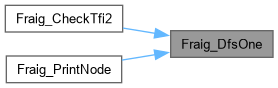
Here is the call graph for this function:
Here is the caller graph for this function:

◆ Fraig_DfsReverse()

Fraig_NodeVec_t * Fraig_DfsReverse ( Fraig_Man_t * pMan)
extern

◆ Fraig_GetMaxLevel()

int Fraig_GetMaxLevel ( Fraig_Man_t * pMan)
extern

Function*************************************************************

Synopsis [Sets up the mask.]

Description []

SideEffects []

SeeAlso []

Definition at line 428 of file fraigUtil.c.

429{
430 int nLevelMax, i;
431 nLevelMax = 0;
432 for ( i = 0; i < pMan->vOutputs->nSize; i++ )
433 nLevelMax = nLevelMax > Fraig_Regular(pMan->vOutputs->pArray[i])->Level?
434 nLevelMax : Fraig_Regular(pMan->vOutputs->pArray[i])->Level;
435 return nLevelMax;
436}
Here is the caller graph for this function:

◆ Fraig_ManAddClause()

void Fraig_ManAddClause ( Fraig_Man_t * p,
Fraig_Node_t ** ppNodes,
int nNodes )
extern

Function*************************************************************

Synopsis [Adds clauses to the solver.]

Description [This procedure is used to add external clauses to the solver. The clauses are given by sets of nodes. Each node stands for one literal. If the node is complemented, the literal is negated.]

SideEffects []

SeeAlso []

Definition at line 521 of file fraigMan.c.
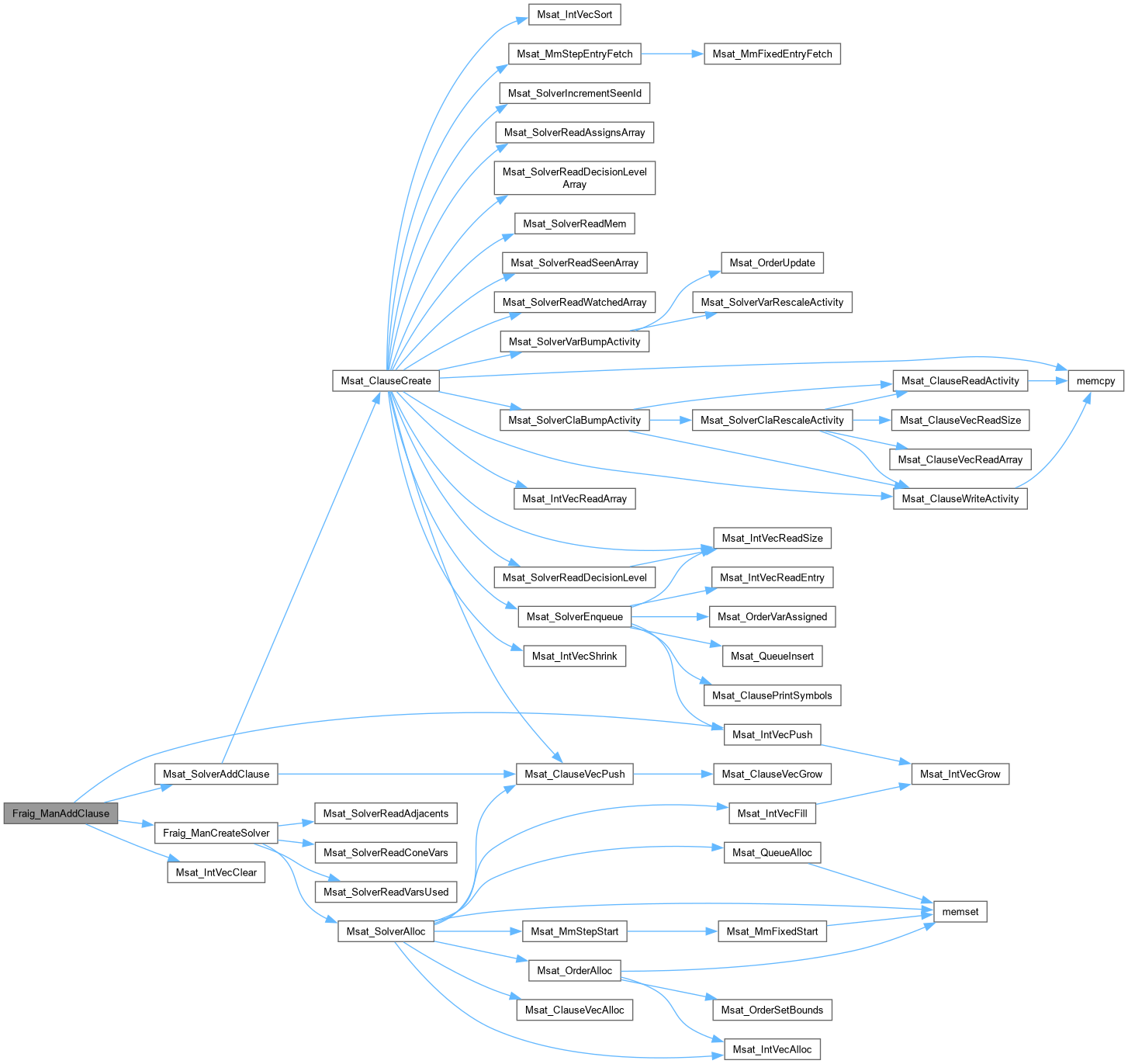
522{
523 Fraig_Node_t * pNode;
524 int i, fComp, RetValue;
525 if ( p->pSat == NULL )
527 // create four clauses
528 Msat_IntVecClear( p->vProj );
529 for ( i = 0; i < nNodes; i++ )
530 {
531 pNode = Fraig_Regular(ppNodes[i]);
532 fComp = Fraig_IsComplement(ppNodes[i]);
533 Msat_IntVecPush( p->vProj, MSAT_VAR2LIT(pNode->Num, fComp) );
534// printf( "%d(%d) ", pNode->Num, fComp );
535 }
536// printf( "\n" );
537 RetValue = Msat_SolverAddClause( p->pSat, p->vProj );
538 assert( RetValue );
539}
void Fraig_ManCreateSolver(Fraig_Man_t *p)
Definition fraigMan.c:325
int Msat_SolverAddClause(Msat_Solver_t *p, Msat_IntVec_t *pLits)
#define MSAT_VAR2LIT(v, s)
Definition msat.h:56
void Msat_IntVecClear(Msat_IntVec_t *p)
Definition msatVec.c:335
void Msat_IntVecPush(Msat_IntVec_t *p, int Entry)
Definition msatVec.c:351
Here is the call graph for this function:

◆ Fraig_ManCheckClauseUsingSat()

int Fraig_ManCheckClauseUsingSat ( Fraig_Man_t * p,
Fraig_Node_t * pNode1,
Fraig_Node_t * pNode2,
int nBTLimit )
extern

Function*************************************************************

Synopsis [Prepares the SAT solver to run on the two nodes.]

Description []

SideEffects []

SeeAlso []

Definition at line 653 of file fraigSat.c.
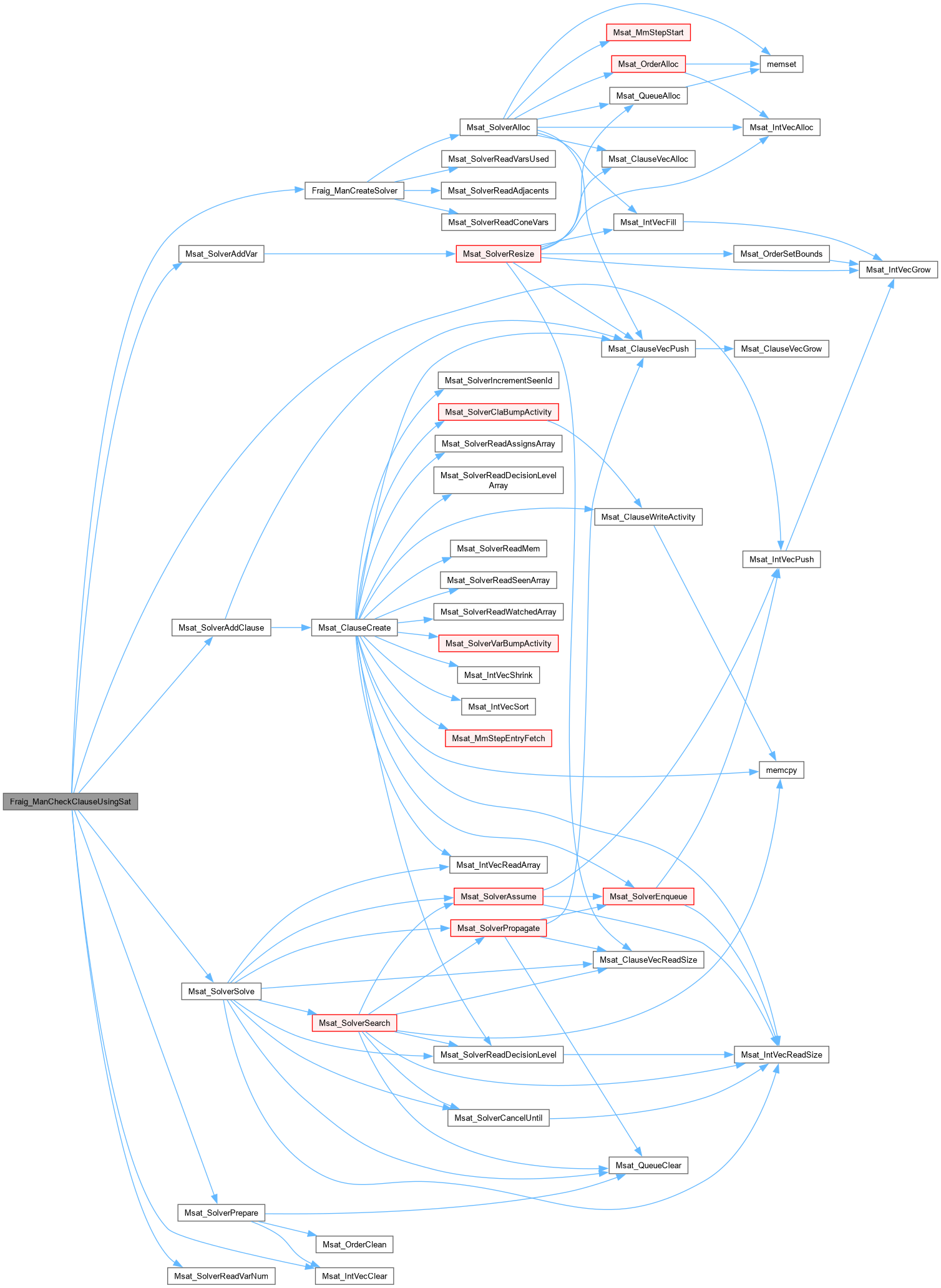
654{
655 Fraig_Node_t * pNode1R, * pNode2R;
656 int RetValue, RetValue1, i;
657 abctime clk;
658 int fVerbose = 0;
659
660 pNode1R = Fraig_Regular(pNode1);
661 pNode2R = Fraig_Regular(pNode2);
662 assert( pNode1R != pNode2R );
663
664 // make sure the solver is allocated and has enough variables
665 if ( p->pSat == NULL )
667 // make sure the SAT solver has enough variables
668 for ( i = Msat_SolverReadVarNum(p->pSat); i < p->vNodes->nSize; i++ )
669 Msat_SolverAddVar( p->pSat, p->vNodes->pArray[i]->Level );
670
671 // get the logic cone
672clk = Abc_Clock();
673 Fraig_OrderVariables( p, pNode1R, pNode2R );
674// Fraig_PrepareCones( p, pNode1R, pNode2R );
675p->timeTrav += Abc_Clock() - clk;
676
678 // prepare the solver to run incrementally on these variables
679//clk = Abc_Clock();
680 Msat_SolverPrepare( p->pSat, p->vVarsInt );
681//p->time3 += Abc_Clock() - clk;
682
683 // solve under assumptions
684 // A = 1; B = 0 OR A = 1; B = 1
685 Msat_IntVecClear( p->vProj );
686 Msat_IntVecPush( p->vProj, MSAT_VAR2LIT(pNode1R->Num, !Fraig_IsComplement(pNode1)) );
687 Msat_IntVecPush( p->vProj, MSAT_VAR2LIT(pNode2R->Num, !Fraig_IsComplement(pNode2)) );
688 // run the solver
689clk = Abc_Clock();
690 RetValue1 = Msat_SolverSolve( p->pSat, p->vProj, nBTLimit, 1000000 );
691p->timeSat += Abc_Clock() - clk;
692
693 if ( RetValue1 == MSAT_FALSE )
694 {
695//p->time1 += Abc_Clock() - clk;
696
697if ( fVerbose )
698{
699// printf( "unsat %d ", Msat_SolverReadBackTracks(p->pSat) );
700//ABC_PRT( "time", Abc_Clock() - clk );
701}
702
703 // add the clause
704 Msat_IntVecClear( p->vProj );
705 Msat_IntVecPush( p->vProj, MSAT_VAR2LIT(pNode1R->Num, Fraig_IsComplement(pNode1)) );
706 Msat_IntVecPush( p->vProj, MSAT_VAR2LIT(pNode2R->Num, Fraig_IsComplement(pNode2)) );
707 RetValue = Msat_SolverAddClause( p->pSat, p->vProj );
708 assert( RetValue );
709// p->nSatProofImp++;
710 return 1;
711 }
712 else if ( RetValue1 == MSAT_TRUE )
713 {
714//p->time2 += Abc_Clock() - clk;
715
716if ( fVerbose )
717{
718// printf( "sat %d ", Msat_SolverReadBackTracks(p->pSat) );
719//ABC_PRT( "time", Abc_Clock() - clk );
720}
721 // record the counter example
722// Fraig_FeedBack( p, Msat_SolverReadModelArray(p->pSat), p->vVarsInt, pNode1R, pNode2R );
723 p->nSatCounterImp++;
724 return 0;
725 }
726 else // if ( RetValue1 == MSAT_UNKNOWN )
727 {
728p->time3 += Abc_Clock() - clk;
729 p->nSatFailsImp++;
730 return 0;
731 }
732}
ABC_INT64_T abctime
Definition abc_global.h:332
void Fraig_ManCreateSolver(Fraig_Man_t *p)
Definition fraigMan.c:325
int Msat_SolverSolve(Msat_Solver_t *p, Msat_IntVec_t *pVecAssumps, int nBackTrackLimit, int nTimeLimit)
int Msat_SolverReadVarNum(Msat_Solver_t *p)
FUNCTION DEFINITIONS ///.
@ MSAT_TRUE
Definition msat.h:50
@ MSAT_FALSE
Definition msat.h:50
void Msat_SolverPrepare(Msat_Solver_t *pSat, Msat_IntVec_t *vVars)
int Msat_SolverAddVar(Msat_Solver_t *p, int Level)
DECLARATIONS ///.
Here is the call graph for this function:

◆ Fraig_ManCheckClauseUsingSimInfo()

int Fraig_ManCheckClauseUsingSimInfo ( Fraig_Man_t * p,
Fraig_Node_t * pNode1,
Fraig_Node_t * pNode2 )
extern

Function*************************************************************

Synopsis [Returns 1 if A v B is always true based on the siminfo.]

Description [A v B is always true iff A' * B' is always false.]

SideEffects []

SeeAlso []

Definition at line 454 of file fraigMan.c.

455{
456 int fCompl1, fCompl2, i;
457
458 fCompl1 = 1 ^ Fraig_IsComplement(pNode1) ^ Fraig_Regular(pNode1)->fInv;
459 fCompl2 = 1 ^ Fraig_IsComplement(pNode2) ^ Fraig_Regular(pNode2)->fInv;
460
461 pNode1 = Fraig_Regular(pNode1);
462 pNode2 = Fraig_Regular(pNode2);
463 assert( pNode1 != pNode2 );
464
465 // check the simulation info
466 if ( fCompl1 && fCompl2 )
467 {
468 for ( i = 0; i < p->nWordsRand; i++ )
469 if ( ~pNode1->puSimR[i] & ~pNode2->puSimR[i] )
470 return 0;
471 for ( i = 0; i < p->iWordStart; i++ )
472 if ( ~pNode1->puSimD[i] & ~pNode2->puSimD[i] )
473 return 0;
474 return 1;
475 }
476 if ( !fCompl1 && fCompl2 )
477 {
478 for ( i = 0; i < p->nWordsRand; i++ )
479 if ( pNode1->puSimR[i] & ~pNode2->puSimR[i] )
480 return 0;
481 for ( i = 0; i < p->iWordStart; i++ )
482 if ( pNode1->puSimD[i] & ~pNode2->puSimD[i] )
483 return 0;
484 return 1;
485 }
486 if ( fCompl1 && !fCompl2 )
487 {
488 for ( i = 0; i < p->nWordsRand; i++ )
489 if ( ~pNode1->puSimR[i] & pNode2->puSimR[i] )
490 return 0;
491 for ( i = 0; i < p->iWordStart; i++ )
492 if ( ~pNode1->puSimD[i] & pNode2->puSimD[i] )
493 return 0;
494 return 1;
495 }
496// if ( fCompl1 && fCompl2 )
497 {
498 for ( i = 0; i < p->nWordsRand; i++ )
499 if ( pNode1->puSimR[i] & pNode2->puSimR[i] )
500 return 0;
501 for ( i = 0; i < p->iWordStart; i++ )
502 if ( pNode1->puSimD[i] & pNode2->puSimD[i] )
503 return 0;
504 return 1;
505 }
506}
unsigned * puSimR
Definition fraigInt.h:247
unsigned * puSimD
Definition fraigInt.h:248

◆ Fraig_ManCheckConsistency()

int Fraig_ManCheckConsistency ( Fraig_Man_t * p)
extern

Function*************************************************************

Synopsis [Verify one useful property.]

Description [This procedure verifies one useful property. After the FRAIG construction with choice nodes is over, each primary node should have fanins that are primary nodes. The primary nodes is the one that does not have pNode->pRepr set to point to another node.]

SideEffects []

SeeAlso []

Definition at line 312 of file fraigUtil.c.
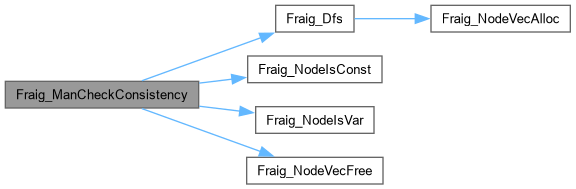
313{
314 Fraig_Node_t * pNode;
315 Fraig_NodeVec_t * pVec;
316 int i;
317 pVec = Fraig_Dfs( p, 0 );
318 for ( i = 0; i < pVec->nSize; i++ )
319 {
320 pNode = pVec->pArray[i];
321 if ( Fraig_NodeIsVar(pNode) )
322 {
323 if ( pNode->pRepr )
324 printf( "Primary input %d is a secondary node.\n", pNode->Num );
325 }
326 else if ( Fraig_NodeIsConst(pNode) )
327 {
328 if ( pNode->pRepr )
329 printf( "Constant 1 %d is a secondary node.\n", pNode->Num );
330 }
331 else
332 {
333 if ( pNode->pRepr )
334 printf( "Internal node %d is a secondary node.\n", pNode->Num );
335 if ( Fraig_Regular(pNode->p1)->pRepr )
336 printf( "Internal node %d has first fanin %d that is a secondary node.\n",
337 pNode->Num, Fraig_Regular(pNode->p1)->Num );
338 if ( Fraig_Regular(pNode->p2)->pRepr )
339 printf( "Internal node %d has second fanin %d that is a secondary node.\n",
340 pNode->Num, Fraig_Regular(pNode->p2)->Num );
341 }
342 }
343 Fraig_NodeVecFree( pVec );
344 return 1;
345}
int Fraig_NodeIsConst(Fraig_Node_t *p)
Definition fraigApi.c:151
int Fraig_NodeIsVar(Fraig_Node_t *p)
Definition fraigApi.c:152
Fraig_Node_t * p2
Definition fraigInt.h:233
Fraig_Node_t * pRepr
Definition fraigInt.h:242
Fraig_Node_t * p1
Definition fraigInt.h:232
Fraig_Node_t ** pArray
Definition fraigInt.h:267
Here is the call graph for this function:
Here is the caller graph for this function:

◆ Fraig_ManCheckMiter()

int Fraig_ManCheckMiter ( Fraig_Man_t * p)
extern

Function*************************************************************

Synopsis [Returns 1 if the miter is unsat; 0 if sat; -1 if undecided.]

Description []

SideEffects []

SeeAlso []

Definition at line 130 of file fraigSat.c.

131{
132 Fraig_Node_t * pNode;
133 int i;
134 ABC_FREE( p->pModel );
135 for ( i = 0; i < p->vOutputs->nSize; i++ )
136 {
137 // get the output node (it can be complemented!)
138 pNode = p->vOutputs->pArray[i];
139 // if the miter is constant 0, the problem is UNSAT
140 if ( pNode == Fraig_Not(p->pConst1) )
141 continue;
142 // consider the special case when the miter is constant 1
143 if ( pNode == p->pConst1 )
144 {
145 // in this case, any counter example will do to distinquish it from constant 0
146 // here we pick the counter example composed of all zeros
147 p->pModel = Fraig_ManAllocCounterExample( p );
148 return 0;
149 }
150 // save the counter example
151 p->pModel = Fraig_ManSaveCounterExample( p, pNode );
152 // if the model is not found, return undecided
153 if ( p->pModel == NULL )
154 return -1;
155 else
156 return 0;
157 }
158 return 1;
159}
#define ABC_FREE(obj)
Definition abc_global.h:267
int * Fraig_ManAllocCounterExample(Fraig_Man_t *p)
Definition fraigFeed.c:787
int * Fraig_ManSaveCounterExample(Fraig_Man_t *p, Fraig_Node_t *pNode)
Definition fraigFeed.c:860
#define Fraig_Not(p)
Definition fraig.h:109
Here is the call graph for this function:
Here is the caller graph for this function:

◆ Fraig_ManCreate()

Fraig_Man_t * Fraig_ManCreate ( Fraig_Params_t * pParams)
extern

Function*************************************************************

Synopsis [Creates the new FRAIG manager.]

Description []

SideEffects []

SeeAlso []

Definition at line 184 of file fraigMan.c.
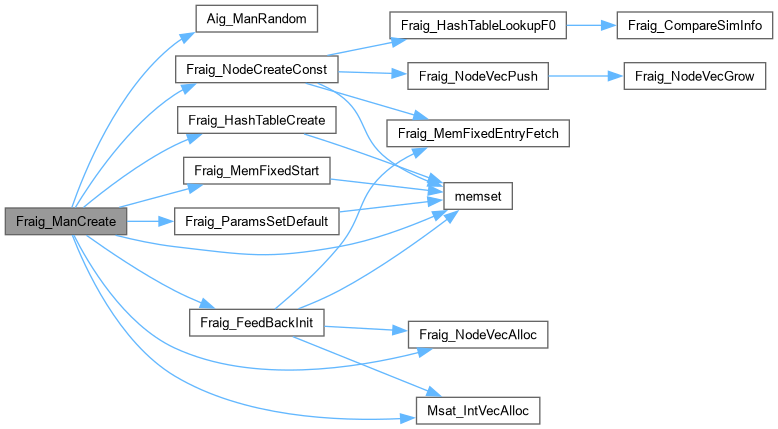
185{
186 Fraig_Params_t Params;
187 Fraig_Man_t * p;
188
189 // set the random seed for simulation
190// srand( 0xFEEDDEAF );
191// srand( 0xDEADCAFE );
192 Aig_ManRandom( 1 );
193
194 // set parameters for equivalence checking
195 if ( pParams == NULL )
196 Fraig_ParamsSetDefault( pParams = &Params );
197 // adjust the amount of simulation info
198 if ( pParams->nPatsRand < 128 )
199 pParams->nPatsRand = 128;
200 if ( pParams->nPatsRand > 32768 )
201 pParams->nPatsRand = 32768;
202 if ( pParams->nPatsDyna < 128 )
203 pParams->nPatsDyna = 128;
204 if ( pParams->nPatsDyna > 32768 )
205 pParams->nPatsDyna = 32768;
206 // if reduction is not performed, allocate minimum simulation info
207 if ( !pParams->fFuncRed )
208 pParams->nPatsRand = pParams->nPatsDyna = 128;
209
210 // start the manager
211 p = ABC_ALLOC( Fraig_Man_t, 1 );
212 memset( p, 0, sizeof(Fraig_Man_t) );
213
214 // set the default parameters
215 p->nWordsRand = FRAIG_NUM_WORDS( pParams->nPatsRand ); // the number of words of random simulation info
216 p->nWordsDyna = FRAIG_NUM_WORDS( pParams->nPatsDyna ); // the number of patterns for dynamic simulation info
217 p->nBTLimit = pParams->nBTLimit; // -1 means infinite backtrack limit
218 p->nSeconds = pParams->nSeconds; // the timeout for the final miter
219 p->fFuncRed = pParams->fFuncRed; // enables functional reduction (otherwise, only one-level hashing is performed)
220 p->fFeedBack = pParams->fFeedBack; // enables solver feedback (the use of counter-examples in simulation)
221 p->fDist1Pats = pParams->fDist1Pats; // enables solver feedback (the use of counter-examples in simulation)
222 p->fDoSparse = pParams->fDoSparse; // performs equivalence checking for sparse functions (whose sim-info is 0)
223 p->fChoicing = pParams->fChoicing; // disable accumulation of structural choices (keeps only the first choice)
224 p->fTryProve = pParams->fTryProve; // disable accumulation of structural choices (keeps only the first choice)
225 p->fVerbose = pParams->fVerbose; // disable verbose output
226 p->fVerboseP = pParams->fVerboseP; // disable verbose output
227 p->nInspLimit = pParams->nInspLimit; // the limit on the number of inspections
228
229 // start memory managers
230 p->mmNodes = Fraig_MemFixedStart( sizeof(Fraig_Node_t) );
231 p->mmSims = Fraig_MemFixedStart( sizeof(unsigned) * (p->nWordsRand + p->nWordsDyna) );
232 // allocate node arrays
233 p->vInputs = Fraig_NodeVecAlloc( 1000 ); // the array of primary inputs
234 p->vOutputs = Fraig_NodeVecAlloc( 1000 ); // the array of primary outputs
235 p->vNodes = Fraig_NodeVecAlloc( 1000 ); // the array of internal nodes
236 // start the tables
237 p->pTableS = Fraig_HashTableCreate( 1000 ); // hashing by structure
238 p->pTableF = Fraig_HashTableCreate( 1000 ); // hashing by function
239 p->pTableF0 = Fraig_HashTableCreate( 1000 ); // hashing by function (for sparse functions)
240 // create the constant node
241 p->pConst1 = Fraig_NodeCreateConst( p );
242 // initialize SAT solver feedback data structures
244 // initialize other variables
245 p->vProj = Msat_IntVecAlloc( 10 );
246 p->nTravIds = 1;
247 p->nTravIds2 = 1;
248 return p;
249}
#define ABC_ALLOC(type, num)
Definition abc_global.h:264
unsigned Aig_ManRandom(int fReset)
Definition aigUtil.c:1170
void Fraig_FeedBackInit(Fraig_Man_t *p)
FUNCTION DEFINITIONS ///.
Definition fraigFeed.c:57
Fraig_Node_t * Fraig_NodeCreateConst(Fraig_Man_t *p)
FUNCTION DEFINITIONS ///.
Definition fraigNode.c:46
Fraig_MemFixed_t * Fraig_MemFixedStart(int nEntrySize)
FUNCTION DEFINITIONS ///.
Definition fraigMem.c:63
#define FRAIG_NUM_WORDS(n)
Definition fraigInt.h:72
Fraig_HashTable_t * Fraig_HashTableCreate(int nSize)
FUNCTION DEFINITIONS ///.
Definition fraigTable.c:46
void Fraig_ParamsSetDefault(Fraig_Params_t *pParams)
Definition fraigMan.c:122
typedefABC_NAMESPACE_HEADER_START struct Fraig_ManStruct_t_ Fraig_Man_t
INCLUDES ///.
Definition fraig.h:40
struct Fraig_ParamsStruct_t_ Fraig_Params_t
Definition fraig.h:44
Msat_IntVec_t * Msat_IntVecAlloc(int nCap)
FUNCTION DEFINITIONS ///.
Definition msatVec.c:48
ABC_INT64_T nInspLimit
Definition fraig.h:64
char * memset()
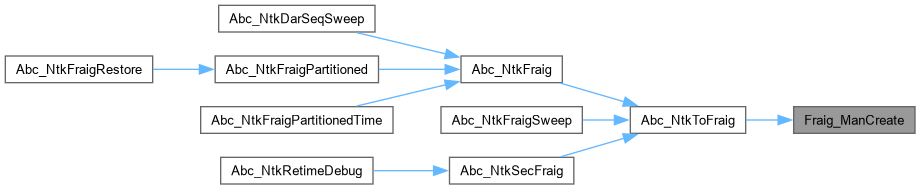
Here is the call graph for this function:
Here is the caller graph for this function:

◆ Fraig_ManFree()

void Fraig_ManFree ( Fraig_Man_t * p)
extern

Function*************************************************************

Synopsis [Deallocates the mapping manager.]

Description []

SideEffects []

SeeAlso []

Definition at line 262 of file fraigMan.c.
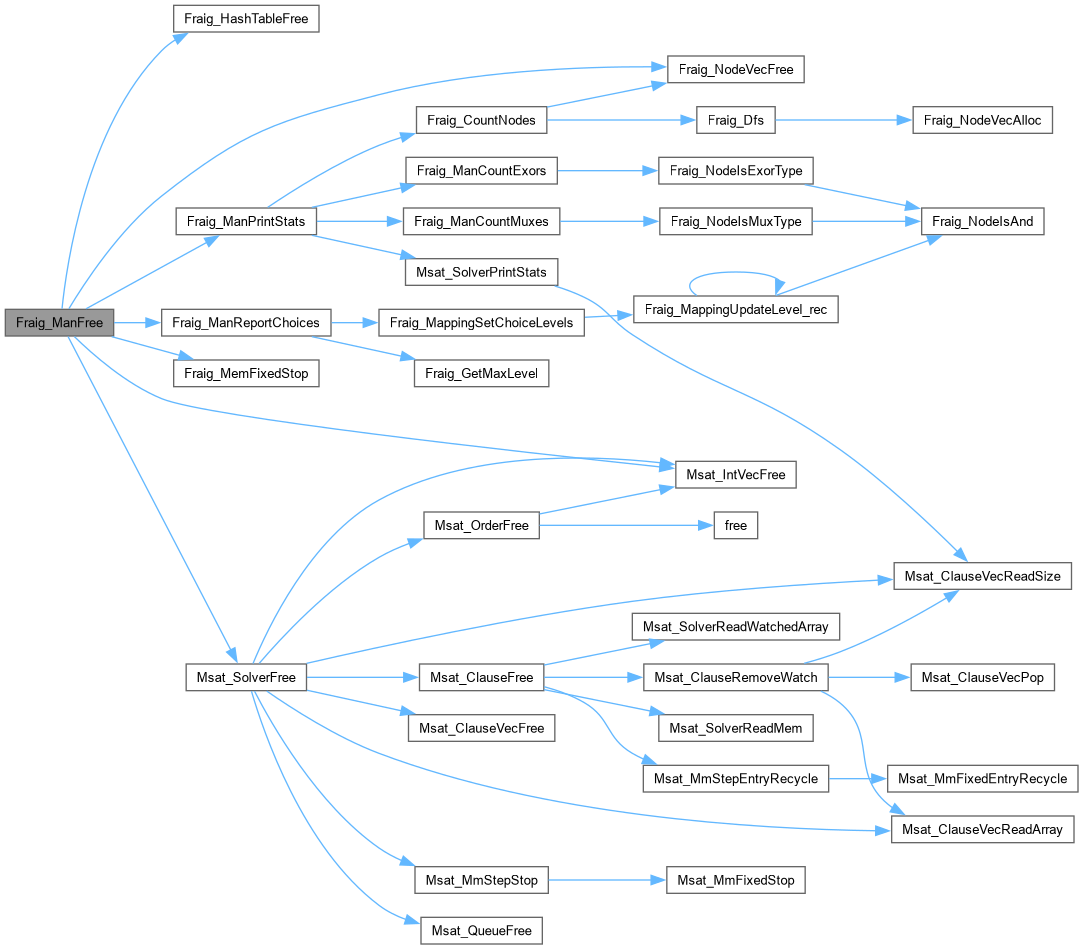
263{
264 int i;
265 if ( p->fVerbose )
266 {
267 if ( p->fChoicing ) Fraig_ManReportChoices( p );
269// Fraig_TablePrintStatsS( p );
270// Fraig_TablePrintStatsF( p );
271// Fraig_TablePrintStatsF0( p );
272 }
273
274 for ( i = 0; i < p->vNodes->nSize; i++ )
275 if ( p->vNodes->pArray[i]->vFanins )
276 {
277 Fraig_NodeVecFree( p->vNodes->pArray[i]->vFanins );
278 p->vNodes->pArray[i]->vFanins = NULL;
279 }
280
281 if ( p->vInputs ) Fraig_NodeVecFree( p->vInputs );
282 if ( p->vNodes ) Fraig_NodeVecFree( p->vNodes );
283 if ( p->vOutputs ) Fraig_NodeVecFree( p->vOutputs );
284
285 if ( p->pTableS ) Fraig_HashTableFree( p->pTableS );
286 if ( p->pTableF ) Fraig_HashTableFree( p->pTableF );
287 if ( p->pTableF0 ) Fraig_HashTableFree( p->pTableF0 );
288
289 if ( p->pSat ) Msat_SolverFree( p->pSat );
290 if ( p->vProj ) Msat_IntVecFree( p->vProj );
291 if ( p->vCones ) Fraig_NodeVecFree( p->vCones );
292 if ( p->vPatsReal ) Msat_IntVecFree( p->vPatsReal );
293 if ( p->pModel ) ABC_FREE( p->pModel );
294
295 Fraig_MemFixedStop( p->mmNodes, 0 );
296 Fraig_MemFixedStop( p->mmSims, 0 );
297
298 if ( p->pSuppS )
299 {
300 ABC_FREE( p->pSuppS[0] );
301 ABC_FREE( p->pSuppS );
302 }
303 if ( p->pSuppF )
304 {
305 ABC_FREE( p->pSuppF[0] );
306 ABC_FREE( p->pSuppF );
307 }
308
309 ABC_FREE( p->ppOutputNames );
310 ABC_FREE( p->ppInputNames );
311 ABC_FREE( p );
312}
void Fraig_HashTableFree(Fraig_HashTable_t *p)
Definition fraigTable.c:70
void Fraig_MemFixedStop(Fraig_MemFixed_t *p, int fVerbose)
Definition fraigMem.c:102
void Fraig_ManPrintStats(Fraig_Man_t *p)
Definition fraigMan.c:351
void Fraig_ManReportChoices(Fraig_Man_t *pMan)
Definition fraigUtil.c:520
void Msat_SolverFree(Msat_Solver_t *p)
void Msat_IntVecFree(Msat_IntVec_t *p)
Definition msatVec.c:160
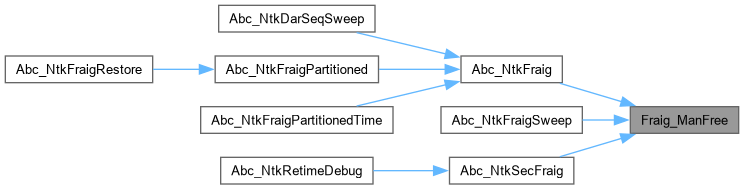
Here is the call graph for this function:
Here is the caller graph for this function:

◆ Fraig_ManGetSimInfo()

Fraig_NodeVec_t * Fraig_ManGetSimInfo ( Fraig_Man_t * p)
extern

Function*************************************************************

Synopsis [Returns simulation info of all nodes.]

Description []

SideEffects []

SeeAlso []

Definition at line 417 of file fraigMan.c.
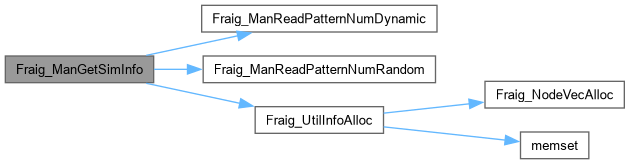
418{
419 Fraig_NodeVec_t * vInfo;
420 Fraig_Node_t * pNode;
421 unsigned * pUnsigned;
422 int nRandom, nDynamic;
423 int i, k, nWords;
424
425 nRandom = Fraig_ManReadPatternNumRandom( p );
426 nDynamic = Fraig_ManReadPatternNumDynamic( p );
427 nWords = nRandom / 32 + nDynamic / 32;
428
429 vInfo = Fraig_UtilInfoAlloc( p->vNodes->nSize, nWords, 0 );
430 for ( i = 0; i < p->vNodes->nSize; i++ )
431 {
432 pNode = p->vNodes->pArray[i];
433 assert( i == pNode->Num );
434 pUnsigned = (unsigned *)vInfo->pArray[i];
435 for ( k = 0; k < nRandom / 32; k++ )
436 pUnsigned[k] = pNode->puSimR[k];
437 for ( k = 0; k < nDynamic / 32; k++ )
438 pUnsigned[nRandom / 32 + k] = pNode->puSimD[k];
439 }
440 return vInfo;
441}
int nWords
Definition abcNpn.c:127
Fraig_NodeVec_t * Fraig_UtilInfoAlloc(int nSize, int nWords, int fClean)
Definition fraigMan.c:389
int Fraig_ManReadPatternNumRandom(Fraig_Man_t *p)
Definition fraigApi.c:65
int Fraig_ManReadPatternNumDynamic(Fraig_Man_t *p)
Definition fraigApi.c:67
Here is the call graph for this function:

◆ Fraig_ManMarkRealFanouts()

void Fraig_ManMarkRealFanouts ( Fraig_Man_t * p)
extern

Function*************************************************************

Synopsis [Sets the number of fanouts (none, one, or many).]

Description [This procedure collects the nodes reachable from the POs of the AIG and sets the type of fanout counter (none, one, or many) for each node. This procedure is useful to determine fanout-free cones of AND-nodes, which is helpful for rebalancing the AIG (see procedure Fraig_ManRebalance, or something like that).]

SideEffects []

SeeAlso []

Definition at line 251 of file fraigUtil.c.

252{
253 Fraig_NodeVec_t * vNodes;
254 Fraig_Node_t * pNodeR;
255 int i;
256 // collect the nodes reachable
257 vNodes = Fraig_Dfs( p, 0 );
258 // clean the fanouts field
259 for ( i = 0; i < vNodes->nSize; i++ )
260 {
261 vNodes->pArray[i]->nFanouts = 0;
262 vNodes->pArray[i]->pData0 = NULL;
263 }
264 // mark reachable nodes by setting the two-bit counter pNode->nFans
265 for ( i = 0; i < vNodes->nSize; i++ )
266 {
267 pNodeR = Fraig_Regular(vNodes->pArray[i]->p1);
268 if ( pNodeR && ++pNodeR->nFanouts == 3 )
269 pNodeR->nFanouts = 2;
270 pNodeR = Fraig_Regular(vNodes->pArray[i]->p2);
271 if ( pNodeR && ++pNodeR->nFanouts == 3 )
272 pNodeR->nFanouts = 2;
273 }
274 Fraig_NodeVecFree( vNodes );
275}
Fraig_Node_t * pData0
Definition fraigInt.h:251
Here is the call graph for this function:

◆ Fraig_ManPrintStats()

void Fraig_ManPrintStats ( Fraig_Man_t * p)
extern

Function*************************************************************

Synopsis [Deallocates the mapping manager.]

Description []

SideEffects []

SeeAlso []

Definition at line 351 of file fraigMan.c.
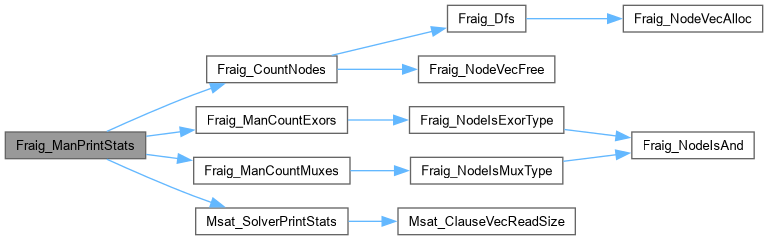
352{
353 double nMemory;
354 nMemory = ((double)(p->vInputs->nSize + p->vNodes->nSize) *
355 (sizeof(Fraig_Node_t) + sizeof(unsigned)*(p->nWordsRand + p->nWordsDyna) /*+ p->nSuppWords*sizeof(unsigned)*/))/(1<<20);
356 printf( "Words: Random = %d. Dynamic = %d. Used = %d. Memory = %0.2f MB.\n",
357 p->nWordsRand, p->nWordsDyna, p->iWordPerm, nMemory );
358 printf( "Proof = %d. Counter-example = %d. Fail = %d. FailReal = %d. Zero = %d.\n",
359 p->nSatProof, p->nSatCounter, p->nSatFails, p->nSatFailsReal, p->nSatZeros );
360 printf( "Nodes: Final = %d. Total = %d. Mux = %d. (Exor = %d.) ClaVars = %d.\n",
361 Fraig_CountNodes(p,0), p->vNodes->nSize, Fraig_ManCountMuxes(p), Fraig_ManCountExors(p), p->nVarsClauses );
362 if ( p->pSat ) Msat_SolverPrintStats( p->pSat );
363 Fraig_PrintTime( "AIG simulation ", p->timeSims );
364 Fraig_PrintTime( "AIG traversal ", p->timeTrav );
365 Fraig_PrintTime( "Solver feedback ", p->timeFeed );
366 Fraig_PrintTime( "SAT solving ", p->timeSat );
367 Fraig_PrintTime( "Network update ", p->timeToNet );
368 Fraig_PrintTime( "TOTAL RUNTIME ", p->timeTotal );
369 if ( p->time1 > 0 ) { Fraig_PrintTime( "time1", p->time1 ); }
370 if ( p->time2 > 0 ) { Fraig_PrintTime( "time2", p->time2 ); }
371 if ( p->time3 > 0 ) { Fraig_PrintTime( "time3", p->time3 ); }
372 if ( p->time4 > 0 ) { Fraig_PrintTime( "time4", p->time4 ); }
373// ABC_PRT( "Selection ", timeSelect );
374// ABC_PRT( "Assignment", timeAssign );
375 fflush( stdout );
376}
int Fraig_ManCountExors(Fraig_Man_t *pMan)
Definition fraigUtil.c:742
#define Fraig_PrintTime(a, t)
Definition fraigInt.h:90
int Fraig_ManCountMuxes(Fraig_Man_t *pMan)
Definition fraigUtil.c:763
int Fraig_CountNodes(Fraig_Man_t *pMan, int fEquiv)
Definition fraigUtil.c:152
void Msat_SolverPrintStats(Msat_Solver_t *p)
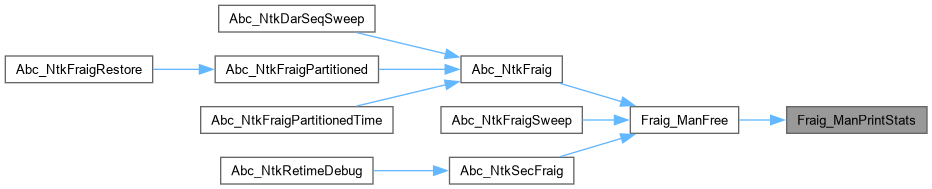
Here is the call graph for this function:
Here is the caller graph for this function:

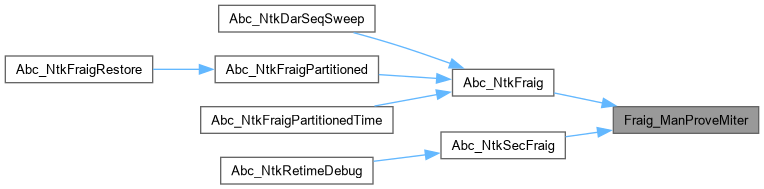
◆ Fraig_ManProveMiter()

void Fraig_ManProveMiter ( Fraig_Man_t * p)
extern

Function*************************************************************

Synopsis [Tries to prove the final miter.]

Description []

SideEffects []

SeeAlso []

Definition at line 85 of file fraigSat.c.
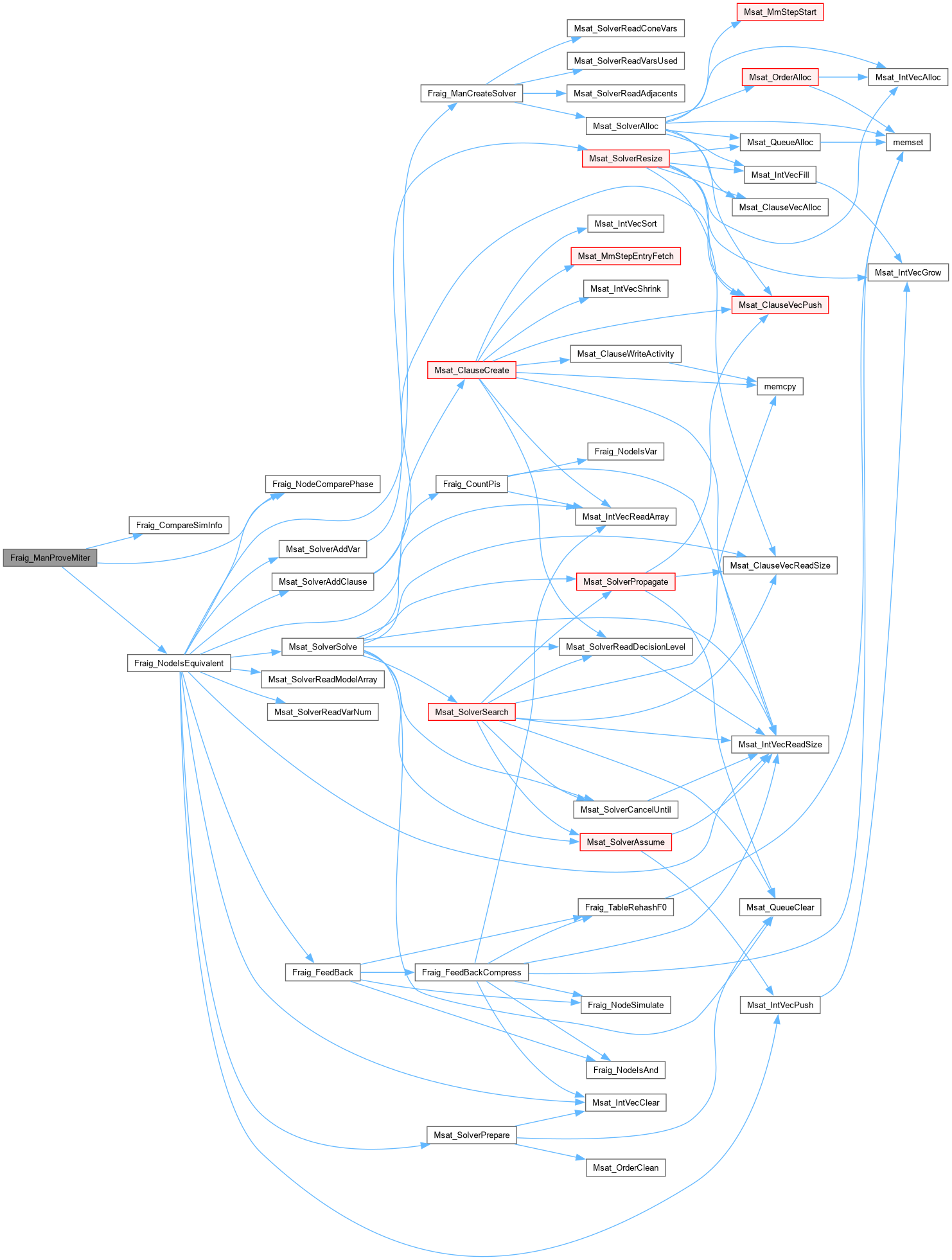
86{
87 Fraig_Node_t * pNode;
88 int i;
89 abctime clk;
90
91 if ( !p->fTryProve )
92 return;
93
94 clk = Abc_Clock();
95 // consider all outputs of the multi-output miter
96 for ( i = 0; i < p->vOutputs->nSize; i++ )
97 {
98 pNode = Fraig_Regular(p->vOutputs->pArray[i]);
99 // skip already constant nodes
100 if ( pNode == p->pConst1 )
101 continue;
102 // skip nodes that are different according to simulation
103 if ( !Fraig_CompareSimInfo( pNode, p->pConst1, p->nWordsRand, 1 ) )
104 continue;
105 if ( Fraig_NodeIsEquivalent( p, p->pConst1, pNode, -1, p->nSeconds ) )
106 {
107 if ( Fraig_IsComplement(p->vOutputs->pArray[i]) ^ Fraig_NodeComparePhase(p->pConst1, pNode) )
108 p->vOutputs->pArray[i] = Fraig_Not(p->pConst1);
109 else
110 p->vOutputs->pArray[i] = p->pConst1;
111 }
112 }
113 if ( p->fVerboseP )
114 {
115// ABC_PRT( "Final miter proof time", Abc_Clock() - clk );
116 }
117}
int Fraig_CompareSimInfo(Fraig_Node_t *pNode1, Fraig_Node_t *pNode2, int iWordLast, int fUseRand)
Definition fraigTable.c:351
int Fraig_NodeIsEquivalent(Fraig_Man_t *p, Fraig_Node_t *pOld, Fraig_Node_t *pNew, int nBTLimit, int nTimeLimit)
Definition fraigSat.c:302
int Fraig_NodeComparePhase(Fraig_Node_t *p1, Fraig_Node_t *p2)
Definition fraigApi.c:154
Here is the call graph for this function:
Here is the caller graph for this function:

◆ Fraig_ManReadChoicing()

int Fraig_ManReadChoicing ( Fraig_Man_t * p)
extern

Definition at line 61 of file fraigApi.c.

61{ return p->fChoicing; }

◆ Fraig_ManReadConflicts()

int Fraig_ManReadConflicts ( Fraig_Man_t * p)
extern

Definition at line 73 of file fraigApi.c.

73{ return p->pSat? Msat_SolverReadBackTracks(p->pSat) : 0; }
int Msat_SolverReadBackTracks(Msat_Solver_t *p)
Here is the call graph for this function:

◆ Fraig_ManReadConst1()

Fraig_Node_t * Fraig_ManReadConst1 ( Fraig_Man_t * p)
extern

Definition at line 52 of file fraigApi.c.

52{ return p->pConst1; }
Here is the caller graph for this function:

◆ Fraig_ManReadDoSparse()

int Fraig_ManReadDoSparse ( Fraig_Man_t * p)
extern

Definition at line 60 of file fraigApi.c.

60{ return p->fDoSparse; }

◆ Fraig_ManReadFeedBack()

int Fraig_ManReadFeedBack ( Fraig_Man_t * p)
extern

Definition at line 59 of file fraigApi.c.

59{ return p->fFeedBack; }

◆ Fraig_ManReadFuncRed()

int Fraig_ManReadFuncRed ( Fraig_Man_t * p)
extern

Definition at line 58 of file fraigApi.c.

58{ return p->fFuncRed; }

◆ Fraig_ManReadInputNames()

char ** Fraig_ManReadInputNames ( Fraig_Man_t * p)
extern

Definition at line 54 of file fraigApi.c.

54{ return p->ppInputNames; }

◆ Fraig_ManReadInputNum()

int Fraig_ManReadInputNum ( Fraig_Man_t * p)
extern

Definition at line 49 of file fraigApi.c.

49{ return p->vInputs->nSize; }
Here is the caller graph for this function:

◆ Fraig_ManReadInputs()

Fraig_Node_t ** Fraig_ManReadInputs ( Fraig_Man_t * p)
extern

Definition at line 46 of file fraigApi.c.

46{ return p->vInputs->pArray; }

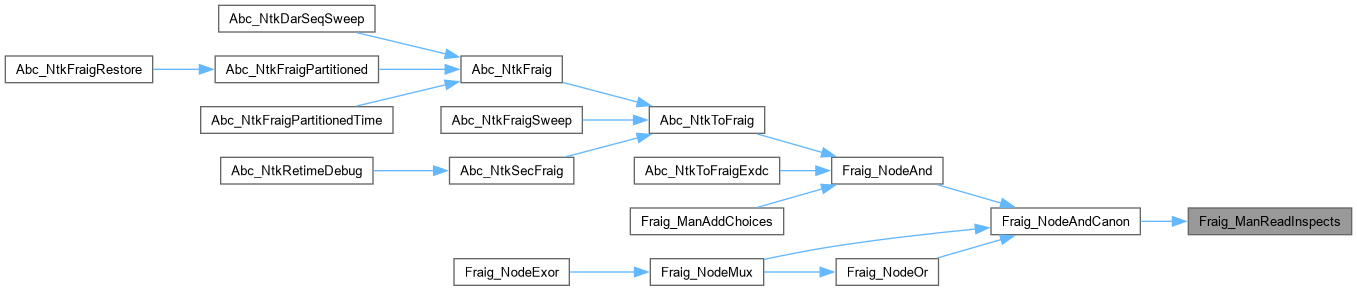
◆ Fraig_ManReadInspects()

int Fraig_ManReadInspects ( Fraig_Man_t * p)
extern

Definition at line 75 of file fraigApi.c.

75{ return p->pSat? Msat_SolverReadInspects(p->pSat) : 0; }
int Msat_SolverReadInspects(Msat_Solver_t *p)
Here is the call graph for this function:
Here is the caller graph for this function:

◆ Fraig_ManReadIthNode()

Fraig_Node_t * Fraig_ManReadIthNode ( Fraig_Man_t * p,
int i )
extern

Definition at line 53 of file fraigApi.c.

53{ assert ( i < p->vNodes->nSize ); return p->vNodes->pArray[i]; }
Here is the caller graph for this function:

◆ Fraig_ManReadIthVar()

Fraig_Node_t * Fraig_ManReadIthVar ( Fraig_Man_t * p,
int i )
extern

Function*************************************************************

Synopsis [Returns a new primary input node.]

Description [If the node with this number does not exist, create a new PI node with this number.]

SideEffects []

SeeAlso []

Definition at line 168 of file fraigApi.c.
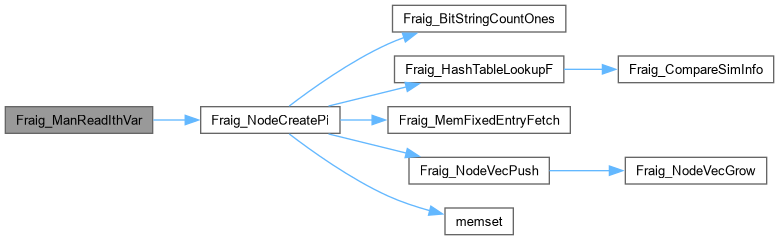
169{
170 int k;
171 if ( i < 0 )
172 {
173 printf( "Requesting a PI with a negative number\n" );
174 return NULL;
175 }
176 // create the PIs to fill in the interval
177 if ( i >= p->vInputs->nSize )
178 for ( k = p->vInputs->nSize; k <= i; k++ )
180 return p->vInputs->pArray[i];
181}
Fraig_Node_t * Fraig_NodeCreatePi(Fraig_Man_t *p)
Definition fraigNode.c:87
Here is the call graph for this function:
Here is the caller graph for this function:

◆ Fraig_ManReadModel()

int * Fraig_ManReadModel ( Fraig_Man_t * p)
extern

Definition at line 63 of file fraigApi.c.

63{ return p->pModel; }

◆ Fraig_ManReadNodeNum()

int Fraig_ManReadNodeNum ( Fraig_Man_t * p)
extern

Definition at line 51 of file fraigApi.c.

51{ return p->vNodes->nSize; }
Here is the caller graph for this function:

◆ Fraig_ManReadNodes()

Fraig_Node_t ** Fraig_ManReadNodes ( Fraig_Man_t * p)
extern

Definition at line 48 of file fraigApi.c.

48{ return p->vNodes->pArray; }

◆ Fraig_ManReadOutputNames()

char ** Fraig_ManReadOutputNames ( Fraig_Man_t * p)
extern

Definition at line 55 of file fraigApi.c.

55{ return p->ppOutputNames; }

◆ Fraig_ManReadOutputNum()

int Fraig_ManReadOutputNum ( Fraig_Man_t * p)
extern

Definition at line 50 of file fraigApi.c.

50{ return p->vOutputs->nSize; }

◆ Fraig_ManReadOutputs()

Fraig_Node_t ** Fraig_ManReadOutputs ( Fraig_Man_t * p)
extern

Definition at line 47 of file fraigApi.c.

47{ return p->vOutputs->pArray; }
Here is the caller graph for this function:

◆ Fraig_ManReadPatternNumDynamic()

int Fraig_ManReadPatternNumDynamic ( Fraig_Man_t * p)
extern

Definition at line 67 of file fraigApi.c.

67{ return p->iWordStart * 32; }
Here is the caller graph for this function:

◆ Fraig_ManReadPatternNumDynamicFiltered()

int Fraig_ManReadPatternNumDynamicFiltered ( Fraig_Man_t * p)
extern

Definition at line 69 of file fraigApi.c.

69{ return p->iPatsPerm; }

◆ Fraig_ManReadPatternNumRandom()

int Fraig_ManReadPatternNumRandom ( Fraig_Man_t * p)
extern

Definition at line 65 of file fraigApi.c.

65{ return p->nWordsRand * 32; }
Here is the caller graph for this function:

◆ Fraig_ManReadSat()

char * Fraig_ManReadSat ( Fraig_Man_t * p)
extern

Definition at line 57 of file fraigApi.c.

57{ return (char *)p->pSat; }

◆ Fraig_ManReadSatFails()

int Fraig_ManReadSatFails ( Fraig_Man_t * p)
extern

Definition at line 71 of file fraigApi.c.

71{ return p->nSatFailsReal; }

◆ Fraig_ManReadVarsInt()

char * Fraig_ManReadVarsInt ( Fraig_Man_t * p)
extern

Definition at line 56 of file fraigApi.c.

56{ return (char *)p->vVarsInt; }

◆ Fraig_ManReadVecInputs()

Fraig_NodeVec_t * Fraig_ManReadVecInputs ( Fraig_Man_t * p)
extern

FUNCTION DEFINITIONS ///.

FUNCTION DEFINITIONS ///.

CFile****************************************************************

FileName [fraigApi.c]

PackageName [FRAIG: Functionally reduced AND-INV graphs.]

Synopsis [Access APIs for the FRAIG manager and node.]

Author [Alan Mishchenko alanm.nosp@m.i@ee.nosp@m.cs.be.nosp@m.rkel.nosp@m.ey.ed.nosp@m.u]

Affiliation [UC Berkeley]

Date [Ver. 2.0. Started - October 1, 2004]

Revision [

Id
fraigApi.c,v 1.2 2005/07/08 01:01:30 alanmi Exp

] FUNCTION DEFINITIONS /// Function*************************************************************

Synopsis [Access functions to read the data members of the manager.]

Description []

SideEffects []

SeeAlso []

Definition at line 43 of file fraigApi.c.

43{ return p->vInputs; }

◆ Fraig_ManReadVecNodes()

Fraig_NodeVec_t * Fraig_ManReadVecNodes ( Fraig_Man_t * p)
extern

Definition at line 45 of file fraigApi.c.

45{ return p->vNodes; }

◆ Fraig_ManReadVecOutputs()

Fraig_NodeVec_t * Fraig_ManReadVecOutputs ( Fraig_Man_t * p)
extern

Definition at line 44 of file fraigApi.c.

44{ return p->vOutputs; }

◆ Fraig_ManReadVerbose()

int Fraig_ManReadVerbose ( Fraig_Man_t * p)
extern

Definition at line 62 of file fraigApi.c.

62{ return p->fVerbose; }

◆ Fraig_ManReportChoices()

void Fraig_ManReportChoices ( Fraig_Man_t * pMan)
extern

Function*************************************************************

Synopsis [Reports statistics on choice nodes.]

Description [The number of choice nodes is the number of primary nodes, which has pNextE set to a pointer. The number of choices is the number of entries in the equivalent-node lists of the primary nodes.]

SideEffects []

SeeAlso []

Definition at line 520 of file fraigUtil.c.

521{
522 Fraig_Node_t * pNode, * pTemp;
523 int nChoiceNodes, nChoices;
524 int i, LevelMax1, LevelMax2;
525
526 // report the number of levels
527 LevelMax1 = Fraig_GetMaxLevel( pMan );
529 LevelMax2 = Fraig_GetMaxLevel( pMan );
530
531 // report statistics about choices
532 nChoiceNodes = nChoices = 0;
533 for ( i = 0; i < pMan->vNodes->nSize; i++ )
534 {
535 pNode = pMan->vNodes->pArray[i];
536 if ( pNode->pRepr == NULL && pNode->pNextE != NULL )
537 { // this is a choice node = the primary node that has equivalent nodes
538 nChoiceNodes++;
539 for ( pTemp = pNode; pTemp; pTemp = pTemp->pNextE )
540 nChoices++;
541 }
542 }
543 printf( "Maximum level: Original = %d. Reduced due to choices = %d.\n", LevelMax1, LevelMax2 );
544 printf( "Choice stats: Choice nodes = %d. Total choices = %d.\n", nChoiceNodes, nChoices );
545}
int Fraig_GetMaxLevel(Fraig_Man_t *pMan)
Definition fraigUtil.c:428
void Fraig_MappingSetChoiceLevels(Fraig_Man_t *pMan, int fMaximum)
Definition fraigUtil.c:499
Fraig_Node_t * pNextE
Definition fraigInt.h:241
Here is the call graph for this function:
Here is the caller graph for this function:

◆ Fraig_ManSetChoicing()

void Fraig_ManSetChoicing ( Fraig_Man_t * p,
int fChoicing )
extern

Definition at line 91 of file fraigApi.c.

91{ p->fChoicing = fChoicing; }

◆ Fraig_ManSetDoSparse()

void Fraig_ManSetDoSparse ( Fraig_Man_t * p,
int fDoSparse )
extern

Definition at line 90 of file fraigApi.c.

90{ p->fDoSparse = fDoSparse; }

◆ Fraig_ManSetFeedBack()

void Fraig_ManSetFeedBack ( Fraig_Man_t * p,
int fFeedBack )
extern

Definition at line 89 of file fraigApi.c.

89{ p->fFeedBack = fFeedBack; }

◆ Fraig_ManSetFuncRed()

void Fraig_ManSetFuncRed ( Fraig_Man_t * p,
int fFuncRed )
extern

Function*************************************************************

Synopsis [Access functions to set the data members of the manager.]

Description []

SideEffects []

SeeAlso []

Definition at line 88 of file fraigApi.c.

88{ p->fFuncRed = fFuncRed; }
Here is the caller graph for this function:

◆ Fraig_ManSetInputNames()

void Fraig_ManSetInputNames ( Fraig_Man_t * p,
char ** ppNames )
extern

Definition at line 95 of file fraigApi.c.

95{ p->ppInputNames = ppNames; }

◆ Fraig_ManSetOutputNames()

void Fraig_ManSetOutputNames ( Fraig_Man_t * p,
char ** ppNames )
extern

Definition at line 94 of file fraigApi.c.

94{ p->ppOutputNames = ppNames; }

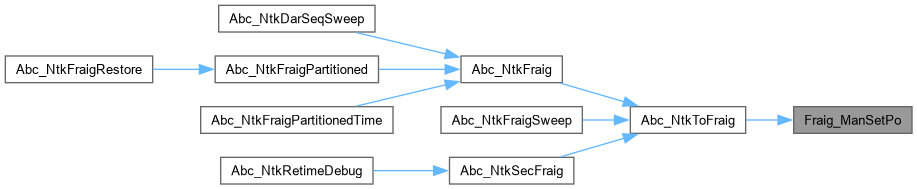
◆ Fraig_ManSetPo()

void Fraig_ManSetPo ( Fraig_Man_t * p,
Fraig_Node_t * pNode )
extern

Function*************************************************************

Synopsis [Creates a new PO node.]

Description [This procedure may take a complemented node.]

SideEffects []

SeeAlso []

Definition at line 194 of file fraigApi.c.

195{
196 // internal node may be a PO two times
197 Fraig_Regular(pNode)->fNodePo = 1;
198 Fraig_NodeVecPush( p->vOutputs, pNode );
199}
void Fraig_NodeVecPush(Fraig_NodeVec_t *p, Fraig_Node_t *Entry)
Definition fraigVec.c:189
Here is the call graph for this function:
Here is the caller graph for this function:

◆ Fraig_ManSetTryProve()

void Fraig_ManSetTryProve ( Fraig_Man_t * p,
int fTryProve )
extern

Definition at line 92 of file fraigApi.c.

92{ p->fTryProve = fTryProve; }

◆ Fraig_ManSetVerbose()

void Fraig_ManSetVerbose ( Fraig_Man_t * p,
int fVerbose )
extern

Definition at line 93 of file fraigApi.c.

93{ p->fVerbose = fVerbose; }

◆ Fraig_MappingSetChoiceLevels()

void Fraig_MappingSetChoiceLevels ( Fraig_Man_t * pMan,
int fMaximum )
extern

Function*************************************************************

Synopsis [Resets the levels of the nodes in the choice graph.]

Description [Makes the level of the choice nodes to be equal to the maximum of the level of the nodes in the equivalence class. This way sorting by level leads to the reverse topological order, which is needed for the required time computation.]

SideEffects []

SeeAlso []

Definition at line 499 of file fraigUtil.c.

500{
501 int i;
502 pMan->nTravIds++;
503 for ( i = 0; i < pMan->vOutputs->nSize; i++ )
504 Fraig_MappingUpdateLevel_rec( pMan, Fraig_Regular(pMan->vOutputs->pArray[i]), fMaximum );
505}
int Fraig_MappingUpdateLevel_rec(Fraig_Man_t *pMan, Fraig_Node_t *pNode, int fMaximum)
Definition fraigUtil.c:449
Here is the call graph for this function:
Here is the caller graph for this function:

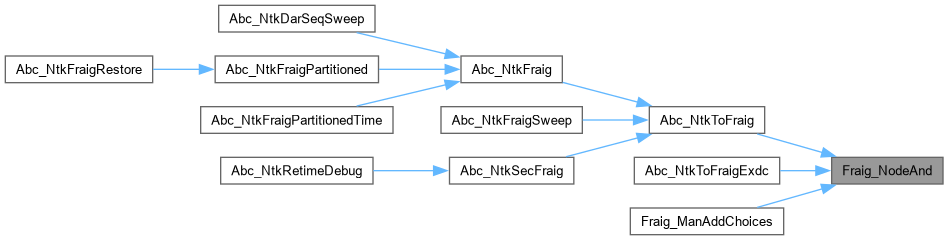
◆ Fraig_NodeAnd()

Fraig_Node_t * Fraig_NodeAnd ( Fraig_Man_t * p,
Fraig_Node_t * p1,
Fraig_Node_t * p2 )
extern

Function*************************************************************

Synopsis [Perfoms the AND operation with functional hashing.]

Description []

SideEffects []

SeeAlso []

Definition at line 212 of file fraigApi.c.
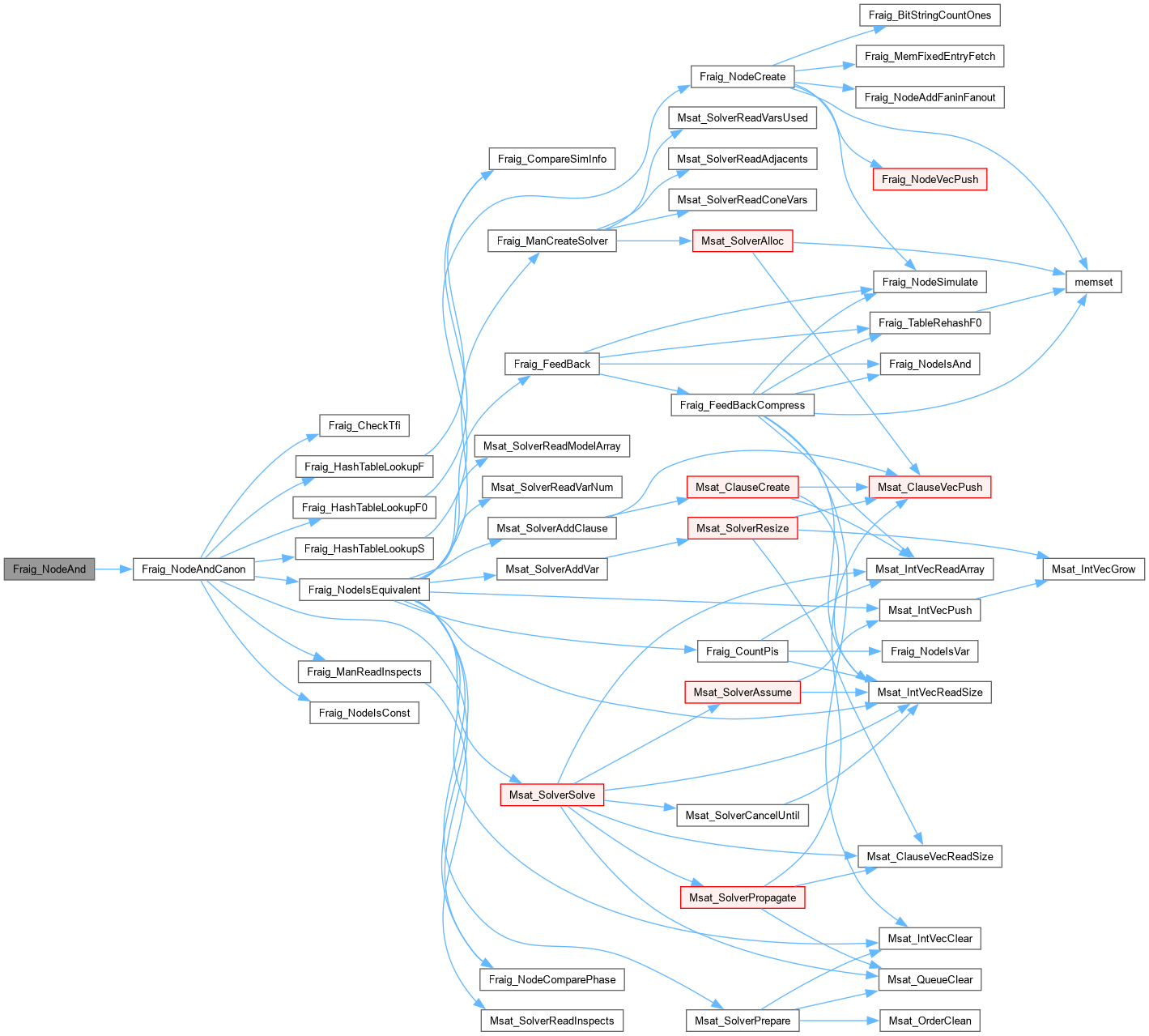
213{
214 return Fraig_NodeAndCanon( p, p1, p2 );
215}
ABC_NAMESPACE_IMPL_START Fraig_Node_t * Fraig_NodeAndCanon(Fraig_Man_t *pMan, Fraig_Node_t *p1, Fraig_Node_t *p2)
DECLARATIONS ///.
Definition fraigCanon.c:52
Here is the call graph for this function:
Here is the caller graph for this function:

◆ Fraig_NodeComparePhase()

int Fraig_NodeComparePhase ( Fraig_Node_t * p1,
Fraig_Node_t * p2 )
extern

Definition at line 154 of file fraigApi.c.
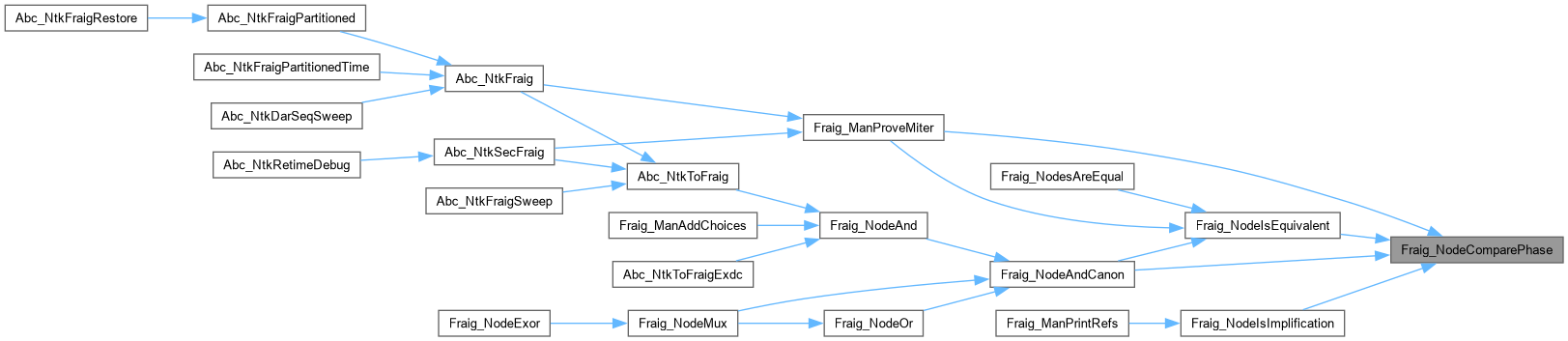
154{ assert( !Fraig_IsComplement(p1) ); assert( !Fraig_IsComplement(p2) ); return p1->fInv ^ p2->fInv; }
Here is the caller graph for this function:

◆ Fraig_NodeExor()

Fraig_Node_t * Fraig_NodeExor ( Fraig_Man_t * p,
Fraig_Node_t * p1,
Fraig_Node_t * p2 )
extern

Function*************************************************************

Synopsis [Perfoms the EXOR operation with functional hashing.]

Description []

SideEffects []

SeeAlso []

Definition at line 244 of file fraigApi.c.
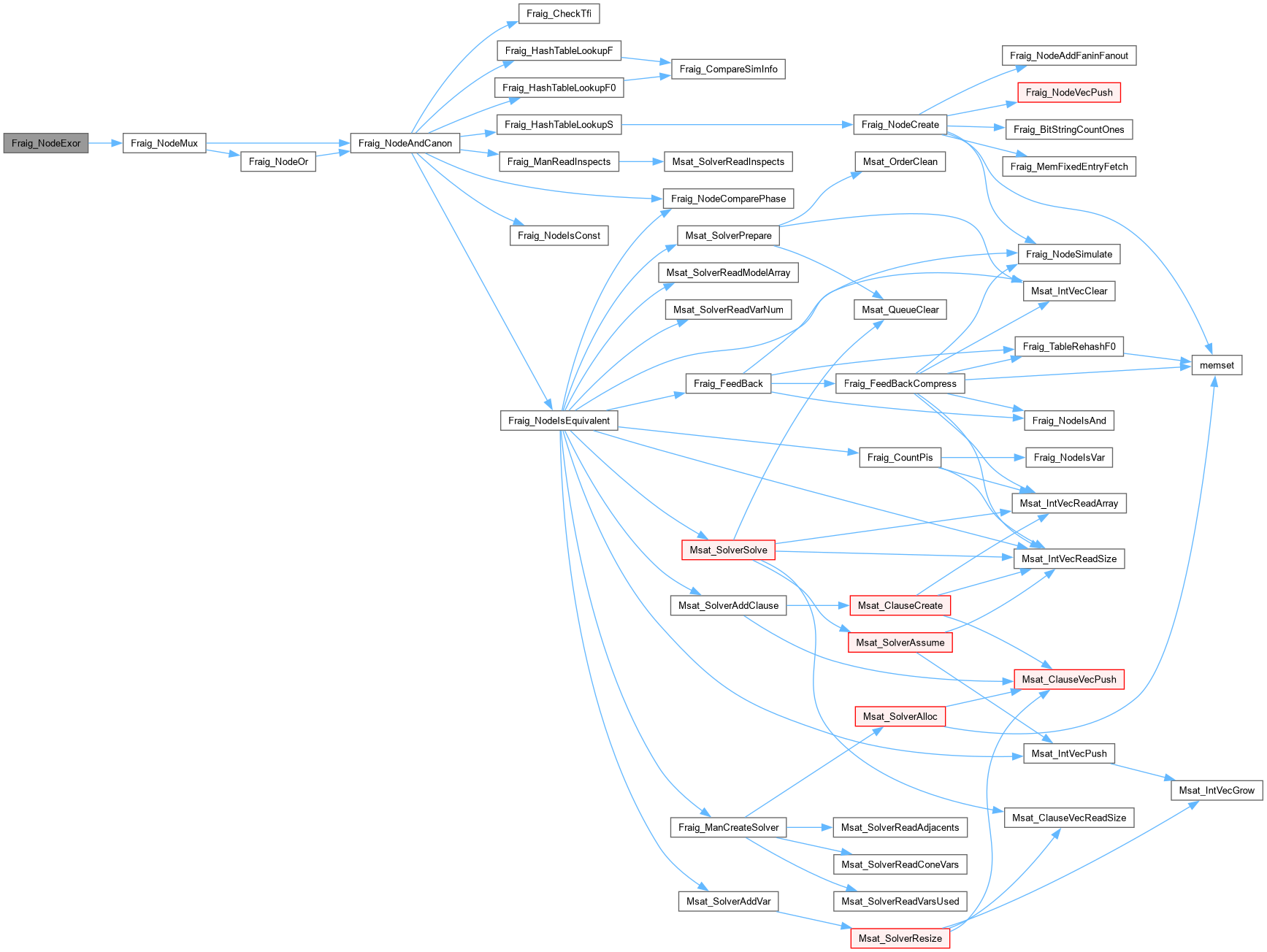
245{
246 return Fraig_NodeMux( p, p1, Fraig_Not(p2), p2 );
247}
Fraig_Node_t * Fraig_NodeMux(Fraig_Man_t *p, Fraig_Node_t *pC, Fraig_Node_t *pT, Fraig_Node_t *pE)
Definition fraigApi.c:260
Here is the call graph for this function:

◆ Fraig_NodeIsAnd()

int Fraig_NodeIsAnd ( Fraig_Node_t * p)
extern

Definition at line 153 of file fraigApi.c.

153{ return (Fraig_Regular(p))->NumPi < 0 && (Fraig_Regular(p))->Num > 0; }
Here is the caller graph for this function:

◆ Fraig_NodeIsConst()

int Fraig_NodeIsConst ( Fraig_Node_t * p)
extern

Function*************************************************************

Synopsis [Checks the type of the node.]

Description []

SideEffects []

SeeAlso []

Definition at line 151 of file fraigApi.c.

151{ return (Fraig_Regular(p))->Num == 0; }
Here is the caller graph for this function:

◆ Fraig_NodeIsEquivalent()

int Fraig_NodeIsEquivalent ( Fraig_Man_t * p,
Fraig_Node_t * pOld,
Fraig_Node_t * pNew,
int nBTLimit,
int nTimeLimit )
extern

Function*************************************************************

Synopsis [Checks whether two nodes are functinally equivalent.]

Description [The flag (fComp) tells whether the nodes to be checked are in the opposite polarity. The second flag (fSkipZeros) tells whether the checking should be performed if the simulation vectors are zeros. Returns 1 if the nodes are equivalent; 0 othewise.]

SideEffects []

SeeAlso []

Definition at line 302 of file fraigSat.c.
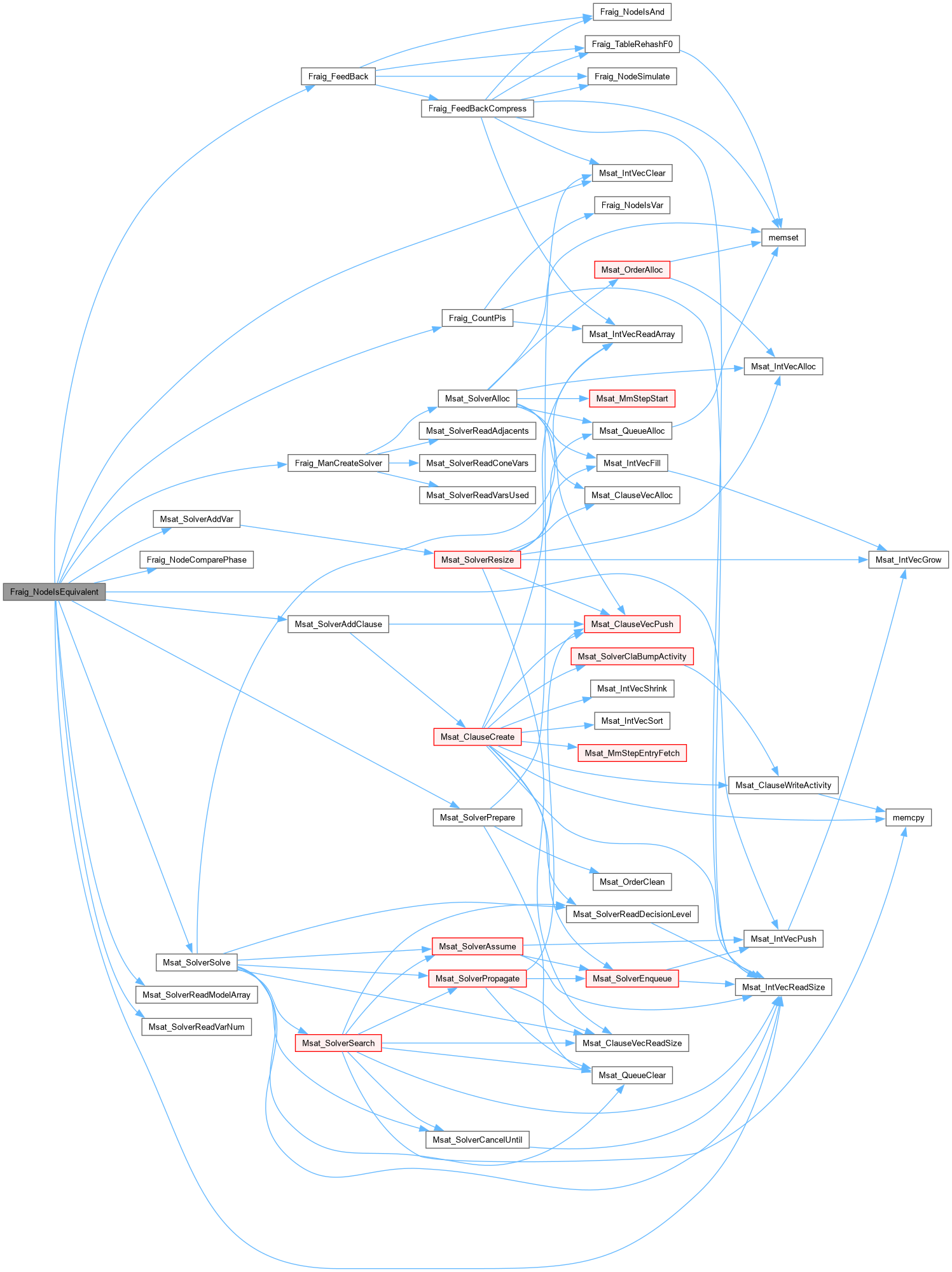
303{
304 int RetValue, RetValue1, i, fComp;
305 abctime clk;
306 int fVerbose = 0;
307 int fSwitch = 0;
308
309 // make sure the nodes are not complemented
310 assert( !Fraig_IsComplement(pNew) );
311 assert( !Fraig_IsComplement(pOld) );
312 assert( pNew != pOld );
313
314 // if at least one of the nodes is a failed node, perform adjustments:
315 // if the backtrack limit is small, simply skip this node
316 // if the backtrack limit is > 10, take the quare root of the limit
317 if ( nBTLimit > 0 && (pOld->fFailTfo || pNew->fFailTfo) )
318 {
319 p->nSatFails++;
320// return 0;
321// if ( nBTLimit > 10 )
322// nBTLimit /= 10;
323 if ( nBTLimit <= 10 )
324 return 0;
325 nBTLimit = (int)sqrt((double)nBTLimit);
326// fSwitch = 1;
327 }
328
329 p->nSatCalls++;
330
331 // make sure the solver is allocated and has enough variables
332 if ( p->pSat == NULL )
334 // make sure the SAT solver has enough variables
335 for ( i = Msat_SolverReadVarNum(p->pSat); i < p->vNodes->nSize; i++ )
336 Msat_SolverAddVar( p->pSat, p->vNodes->pArray[i]->Level );
337
338
339
340/*
341 {
342 Fraig_Node_t * ppNodes[2] = { pOld, pNew };
343 extern void Fraig_MappingShowNodes( Fraig_Man_t * pMan, Fraig_Node_t ** ppRoots, int nRoots, char * pFileName );
344 Fraig_MappingShowNodes( p, ppNodes, 2, "temp_aig" );
345 }
346*/
347
348 nMuxes = 0;
349
350
351 // get the logic cone
352clk = Abc_Clock();
353// Fraig_VarsStudy( p, pOld, pNew );
354 Fraig_OrderVariables( p, pOld, pNew );
355// Fraig_PrepareCones( p, pOld, pNew );
356p->timeTrav += Abc_Clock() - clk;
357
358// printf( "The number of MUXes detected = %d (%5.2f %% of logic). ", nMuxes, 300.0*nMuxes/(p->vNodes->nSize - p->vInputs->nSize) );
359// ABC_PRT( "Time", Abc_Clock() - clk );
360
361 if ( fVerbose )
362 printf( "%d(%d) - ", Fraig_CountPis(p,p->vVarsInt), Msat_IntVecReadSize(p->vVarsInt) );
363
364
365 // prepare variable activity
366 Fraig_SetActivity( p, pOld, pNew );
367
368 // get the complemented attribute
369 fComp = Fraig_NodeComparePhase( pOld, pNew );
370//Msat_SolverPrintClauses( p->pSat );
371
373 // prepare the solver to run incrementally on these variables
374//clk = Abc_Clock();
375 Msat_SolverPrepare( p->pSat, p->vVarsInt );
376//p->time3 += Abc_Clock() - clk;
377
378
379 // solve under assumptions
380 // A = 1; B = 0 OR A = 1; B = 1
381 Msat_IntVecClear( p->vProj );
382 Msat_IntVecPush( p->vProj, MSAT_VAR2LIT(pOld->Num, 0) );
383 Msat_IntVecPush( p->vProj, MSAT_VAR2LIT(pNew->Num, !fComp) );
384
385//Msat_SolverWriteDimacs( p->pSat, "temp_fraig.cnf" );
386
387 // run the solver
388clk = Abc_Clock();
389 RetValue1 = Msat_SolverSolve( p->pSat, p->vProj, nBTLimit, nTimeLimit );
390p->timeSat += Abc_Clock() - clk;
391
392 if ( RetValue1 == MSAT_FALSE )
393 {
394//p->time1 += Abc_Clock() - clk;
395
396if ( fVerbose )
397{
398// printf( "unsat %d ", Msat_SolverReadBackTracks(p->pSat) );
399//ABC_PRT( "time", Abc_Clock() - clk );
400}
401
402 // add the clause
403 Msat_IntVecClear( p->vProj );
404 Msat_IntVecPush( p->vProj, MSAT_VAR2LIT(pOld->Num, 1) );
405 Msat_IntVecPush( p->vProj, MSAT_VAR2LIT(pNew->Num, fComp) );
406 RetValue = Msat_SolverAddClause( p->pSat, p->vProj );
407 assert( RetValue );
408 // continue solving the other implication
409 }
410 else if ( RetValue1 == MSAT_TRUE )
411 {
412//p->time2 += Abc_Clock() - clk;
413
414if ( fVerbose )
415{
416// printf( "sat %d ", Msat_SolverReadBackTracks(p->pSat) );
417//ABC_PRT( "time", Abc_Clock() - clk );
418}
419
420 // record the counter example
421 Fraig_FeedBack( p, Msat_SolverReadModelArray(p->pSat), p->vVarsInt, pOld, pNew );
422
423// if ( pOld->fFailTfo || pNew->fFailTfo )
424// printf( "*" );
425// printf( "s(%d)", pNew->Level );
426 if ( fSwitch )
427 printf( "s(%d)", pNew->Level );
428 p->nSatCounter++;
429 return 0;
430 }
431 else // if ( RetValue1 == MSAT_UNKNOWN )
432 {
433p->time3 += Abc_Clock() - clk;
434
435// if ( pOld->fFailTfo || pNew->fFailTfo )
436// printf( "*" );
437// printf( "T(%d)", pNew->Level );
438
439 // mark the node as the failed node
440 if ( pOld != p->pConst1 )
441 pOld->fFailTfo = 1;
442 pNew->fFailTfo = 1;
443// p->nSatFails++;
444 if ( fSwitch )
445 printf( "T(%d)", pNew->Level );
446 p->nSatFailsReal++;
447 return 0;
448 }
449
450 // if the old node was constant 0, we already know the answer
451 if ( pOld == p->pConst1 )
452 return 1;
453
455 // prepare the solver to run incrementally
456//clk = Abc_Clock();
457 Msat_SolverPrepare( p->pSat, p->vVarsInt );
458//p->time3 += Abc_Clock() - clk;
459 // solve under assumptions
460 // A = 0; B = 1 OR A = 0; B = 0
461 Msat_IntVecClear( p->vProj );
462 Msat_IntVecPush( p->vProj, MSAT_VAR2LIT(pOld->Num, 1) );
463 Msat_IntVecPush( p->vProj, MSAT_VAR2LIT(pNew->Num, fComp) );
464 // run the solver
465clk = Abc_Clock();
466 RetValue1 = Msat_SolverSolve( p->pSat, p->vProj, nBTLimit, nTimeLimit );
467p->timeSat += Abc_Clock() - clk;
468
469 if ( RetValue1 == MSAT_FALSE )
470 {
471//p->time1 += Abc_Clock() - clk;
472
473if ( fVerbose )
474{
475// printf( "unsat %d ", Msat_SolverReadBackTracks(p->pSat) );
476//ABC_PRT( "time", Abc_Clock() - clk );
477}
478
479 // add the clause
480 Msat_IntVecClear( p->vProj );
481 Msat_IntVecPush( p->vProj, MSAT_VAR2LIT(pOld->Num, 0) );
482 Msat_IntVecPush( p->vProj, MSAT_VAR2LIT(pNew->Num, !fComp) );
483 RetValue = Msat_SolverAddClause( p->pSat, p->vProj );
484 assert( RetValue );
485 // continue solving the other implication
486 }
487 else if ( RetValue1 == MSAT_TRUE )
488 {
489//p->time2 += Abc_Clock() - clk;
490
491if ( fVerbose )
492{
493// printf( "sat %d ", Msat_SolverReadBackTracks(p->pSat) );
494//ABC_PRT( "time", Abc_Clock() - clk );
495}
496
497 // record the counter example
498 Fraig_FeedBack( p, Msat_SolverReadModelArray(p->pSat), p->vVarsInt, pOld, pNew );
499 p->nSatCounter++;
500
501// if ( pOld->fFailTfo || pNew->fFailTfo )
502// printf( "*" );
503// printf( "s(%d)", pNew->Level );
504 if ( fSwitch )
505 printf( "s(%d)", pNew->Level );
506 return 0;
507 }
508 else // if ( RetValue1 == MSAT_UNKNOWN )
509 {
510p->time3 += Abc_Clock() - clk;
511
512// if ( pOld->fFailTfo || pNew->fFailTfo )
513// printf( "*" );
514// printf( "T(%d)", pNew->Level );
515 if ( fSwitch )
516 printf( "T(%d)", pNew->Level );
517
518 // mark the node as the failed node
519 pOld->fFailTfo = 1;
520 pNew->fFailTfo = 1;
521// p->nSatFails++;
522 p->nSatFailsReal++;
523 return 0;
524 }
525
526 // return SAT proof
527 p->nSatProof++;
528
529// if ( pOld->fFailTfo || pNew->fFailTfo )
530// printf( "*" );
531// printf( "u(%d)", pNew->Level );
532
533 if ( fSwitch )
534 printf( "u(%d)", pNew->Level );
535
536 return 1;
537}
void Fraig_FeedBack(Fraig_Man_t *p, int *pModel, Msat_IntVec_t *vVars, Fraig_Node_t *pOld, Fraig_Node_t *pNew)
Definition fraigFeed.c:80
int Fraig_CountPis(Fraig_Man_t *p, Msat_IntVec_t *vVarNums)
Definition fraigUtil.c:817
int * Msat_SolverReadModelArray(Msat_Solver_t *p)
int Msat_IntVecReadSize(Msat_IntVec_t *p)
Definition msatVec.c:233
Here is the call graph for this function:
Here is the caller graph for this function:

◆ Fraig_NodeIsVar()

int Fraig_NodeIsVar ( Fraig_Node_t * p)
extern

Definition at line 152 of file fraigApi.c.

152{ return (Fraig_Regular(p))->NumPi >= 0; }
Here is the caller graph for this function:

◆ Fraig_NodeMux()

Fraig_Node_t * Fraig_NodeMux ( Fraig_Man_t * p,
Fraig_Node_t * pC,
Fraig_Node_t * pT,
Fraig_Node_t * pE )
extern

Function*************************************************************

Synopsis [Perfoms the MUX operation with functional hashing.]

Description []

SideEffects []

SeeAlso []

Definition at line 260 of file fraigApi.c.
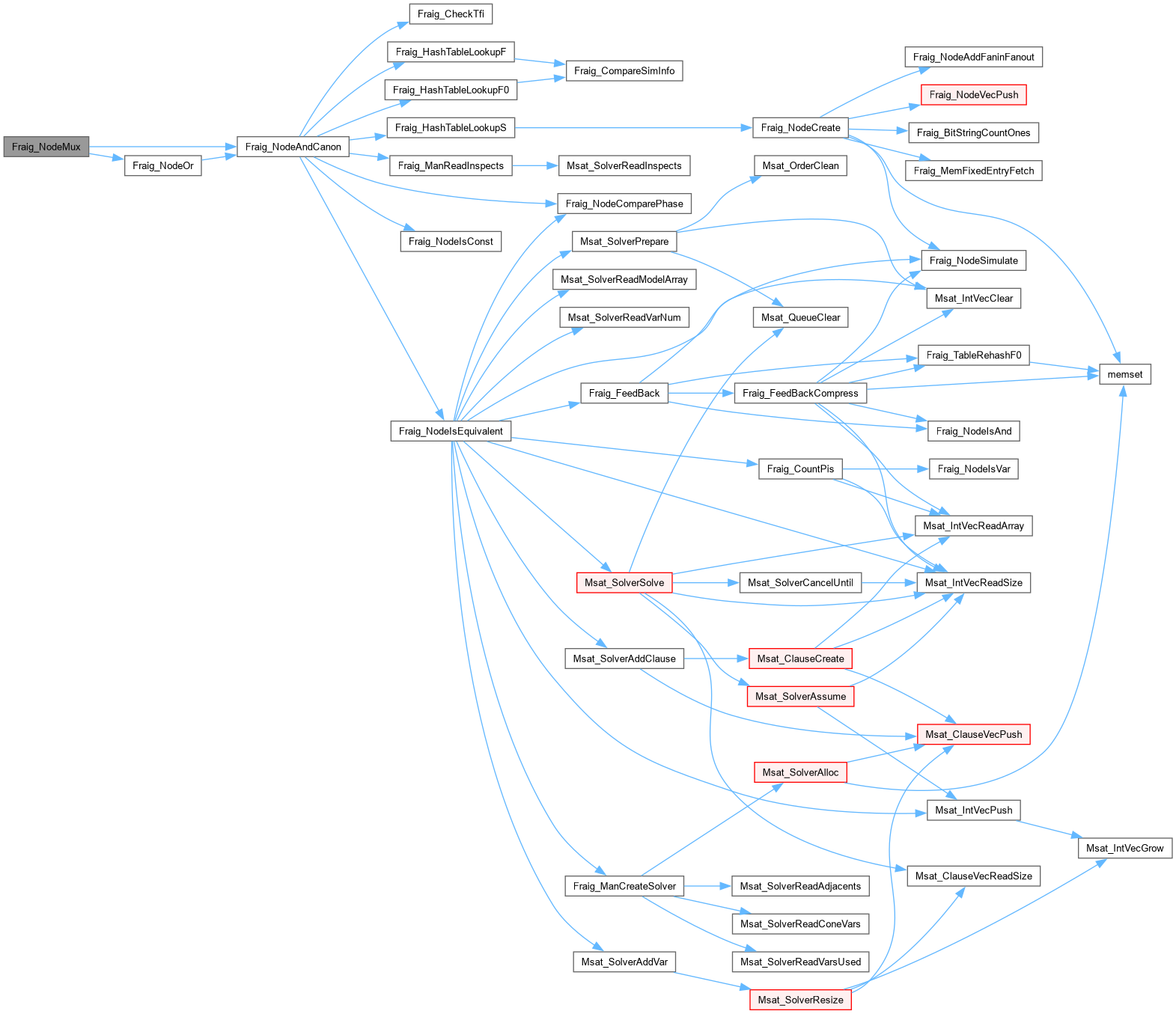
261{
262 Fraig_Node_t * pAnd1, * pAnd2, * pRes;
263 pAnd1 = Fraig_NodeAndCanon( p, pC, pT ); Fraig_Ref( pAnd1 );
264 pAnd2 = Fraig_NodeAndCanon( p, Fraig_Not(pC), pE ); Fraig_Ref( pAnd2 );
265 pRes = Fraig_NodeOr( p, pAnd1, pAnd2 );
266 Fraig_RecursiveDeref( p, pAnd1 );
267 Fraig_RecursiveDeref( p, pAnd2 );
268 Fraig_Deref( pRes );
269 return pRes;
270}
Fraig_Node_t * Fraig_NodeOr(Fraig_Man_t *p, Fraig_Node_t *p1, Fraig_Node_t *p2)
Definition fraigApi.c:228
#define Fraig_Deref(p)
Definition fraig.h:114
#define Fraig_Ref(p)
Definition fraig.h:113
#define Fraig_RecursiveDeref(p, c)
Definition fraig.h:115
Here is the call graph for this function:
Here is the caller graph for this function:

◆ Fraig_NodeOr()

Fraig_Node_t * Fraig_NodeOr ( Fraig_Man_t * p,
Fraig_Node_t * p1,
Fraig_Node_t * p2 )
extern

Function*************************************************************

Synopsis [Perfoms the OR operation with functional hashing.]

Description []

SideEffects []

SeeAlso []

Definition at line 228 of file fraigApi.c.
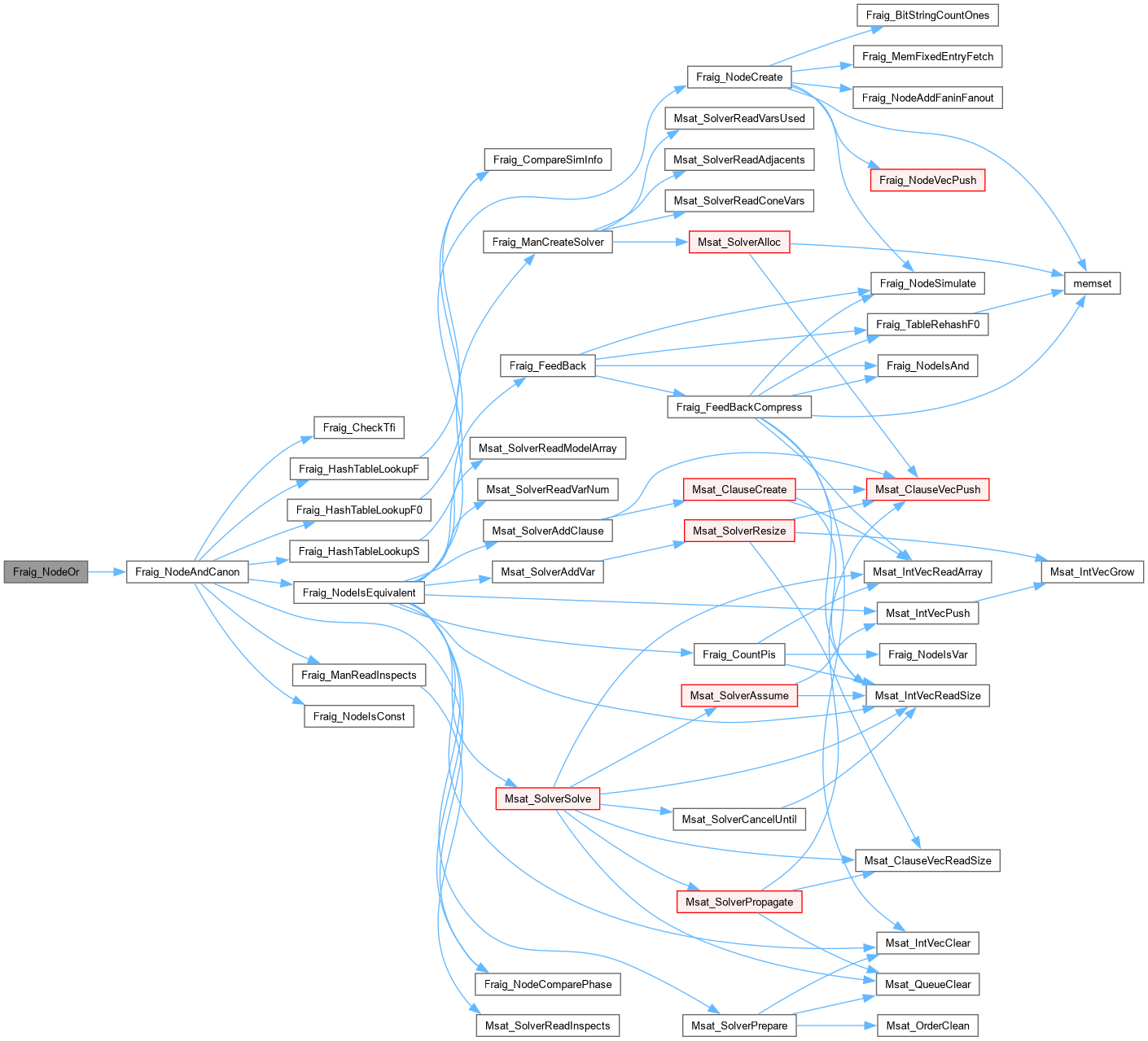
229{
230 return Fraig_Not( Fraig_NodeAndCanon( p, Fraig_Not(p1), Fraig_Not(p2) ) );
231}
Here is the call graph for this function:
Here is the caller graph for this function:

◆ Fraig_NodeReadData0()

Fraig_Node_t * Fraig_NodeReadData0 ( Fraig_Node_t * p)
extern

Function*************************************************************

Synopsis [Access functions to read the data members of the node.]

Description []

SideEffects []

SeeAlso []

Definition at line 108 of file fraigApi.c.

108{ return p->pData0; }

◆ Fraig_NodeReadData1()

Fraig_Node_t * Fraig_NodeReadData1 ( Fraig_Node_t * p)
extern

Definition at line 109 of file fraigApi.c.

109{ return p->pData1; }

◆ Fraig_NodeReadNextE()

Fraig_Node_t * Fraig_NodeReadNextE ( Fraig_Node_t * p)
extern

Definition at line 113 of file fraigApi.c.

113{ return p->pNextE; }

◆ Fraig_NodeReadNum()

int Fraig_NodeReadNum ( Fraig_Node_t * p)
extern

Definition at line 110 of file fraigApi.c.

110{ return p->Num; }

◆ Fraig_NodeReadNumFanouts()

int Fraig_NodeReadNumFanouts ( Fraig_Node_t * p)
extern

Definition at line 116 of file fraigApi.c.

116{ return p->nFanouts; }

◆ Fraig_NodeReadNumOnes()

int Fraig_NodeReadNumOnes ( Fraig_Node_t * p)
extern

Definition at line 118 of file fraigApi.c.

118{ return p->nOnes; }

◆ Fraig_NodeReadNumRefs()

int Fraig_NodeReadNumRefs ( Fraig_Node_t * p)
extern

Definition at line 115 of file fraigApi.c.

115{ return p->nRefs; }

◆ Fraig_NodeReadOne()

Fraig_Node_t * Fraig_NodeReadOne ( Fraig_Node_t * p)
extern

Definition at line 111 of file fraigApi.c.

111{ assert (!Fraig_IsComplement(p)); return p->p1; }
Here is the caller graph for this function:

◆ Fraig_NodeReadPatternsDynamic()

unsigned * Fraig_NodeReadPatternsDynamic ( Fraig_Node_t * p)
extern

Definition at line 124 of file fraigApi.c.

124{ return p->puSimD; }

◆ Fraig_NodeReadPatternsRandom()

unsigned * Fraig_NodeReadPatternsRandom ( Fraig_Node_t * p)
extern

Definition at line 121 of file fraigApi.c.

121{ return p->puSimR; }

◆ Fraig_NodeReadRepr()

Fraig_Node_t * Fraig_NodeReadRepr ( Fraig_Node_t * p)
extern

Definition at line 114 of file fraigApi.c.

114{ return p->pRepr; }

◆ Fraig_NodeReadSimInv()

int Fraig_NodeReadSimInv ( Fraig_Node_t * p)
extern

Definition at line 117 of file fraigApi.c.

117{ return p->fInv; }

◆ Fraig_NodeReadTwo()

Fraig_Node_t * Fraig_NodeReadTwo ( Fraig_Node_t * p)
extern

Definition at line 112 of file fraigApi.c.

112{ assert (!Fraig_IsComplement(p)); return p->p2; }
Here is the caller graph for this function:

◆ Fraig_NodesAreEqual()

int Fraig_NodesAreEqual ( Fraig_Man_t * p,
Fraig_Node_t * pNode1,
Fraig_Node_t * pNode2,
int nBTLimit,
int nTimeLimit )
extern

FUNCTION DEFINITIONS ///.

Function*************************************************************

Synopsis [Checks equivalence of two nodes.]

Description [Returns 1 iff the nodes are equivalent.]

SideEffects []

SeeAlso []

Definition at line 65 of file fraigSat.c.
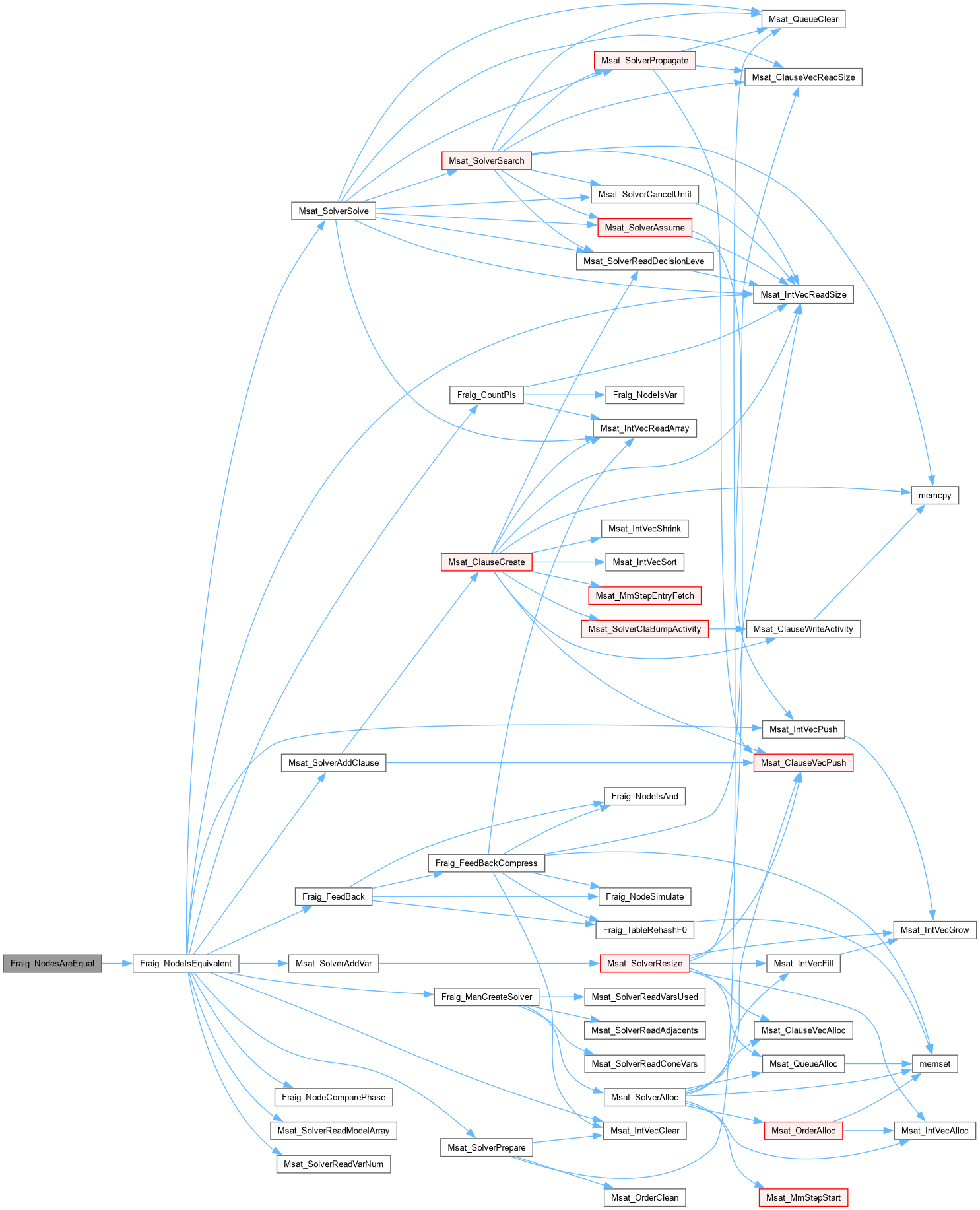
66{
67 if ( pNode1 == pNode2 )
68 return 1;
69 if ( pNode1 == Fraig_Not(pNode2) )
70 return 0;
71 return Fraig_NodeIsEquivalent( p, Fraig_Regular(pNode1), Fraig_Regular(pNode2), nBTLimit, nTimeLimit );
72}
Here is the call graph for this function:

◆ Fraig_NodeSetChoice()

void Fraig_NodeSetChoice ( Fraig_Man_t * pMan,
Fraig_Node_t * pNodeOld,
Fraig_Node_t * pNodeNew )
extern

Function*************************************************************

Synopsis [Sets the node to be equivalent to the given one.]

Description [This procedure is a work-around for the equivalence check. Does not verify the equivalence. Use at the user's risk.]

SideEffects []

SeeAlso []

Definition at line 285 of file fraigApi.c.

286{
287// assert( pMan->fChoicing );
288 pNodeNew->pNextE = pNodeOld->pNextE;
289 pNodeOld->pNextE = pNodeNew;
290 pNodeNew->pRepr = pNodeOld;
291}

◆ Fraig_NodeSetData0()

void Fraig_NodeSetData0 ( Fraig_Node_t * p,
Fraig_Node_t * pData )
extern

Function*************************************************************

Synopsis [Access functions to set the data members of the node.]

Description []

SideEffects []

SeeAlso []

Definition at line 137 of file fraigApi.c.

137{ p->pData0 = pData; }

◆ Fraig_NodeSetData1()

void Fraig_NodeSetData1 ( Fraig_Node_t * p,
Fraig_Node_t * pData )
extern

Definition at line 138 of file fraigApi.c.

138{ p->pData1 = pData; }
Here is the caller graph for this function:

◆ Fraig_NodeVecAlloc()

Fraig_NodeVec_t * Fraig_NodeVecAlloc ( int nCap)
extern

DECLARATIONS ///.

CFile****************************************************************

FileName [fraigVec.c]

PackageName [FRAIG: Functionally reduced AND-INV graphs.]

Synopsis [Vector of FRAIG nodes.]

Author [Alan Mishchenko alanm.nosp@m.i@ee.nosp@m.cs.be.nosp@m.rkel.nosp@m.ey.ed.nosp@m.u]

Affiliation [UC Berkeley]

Date [Ver. 2.0. Started - October 1, 2004]

Revision [

Id
fraigVec.c,v 1.7 2005/07/08 01:01:34 alanmi Exp

] FUNCTION DEFINITIONS /// Function*************************************************************

Synopsis [Allocates a vector with the given capacity.]

Description []

SideEffects []

SeeAlso []

Definition at line 43 of file fraigVec.c.
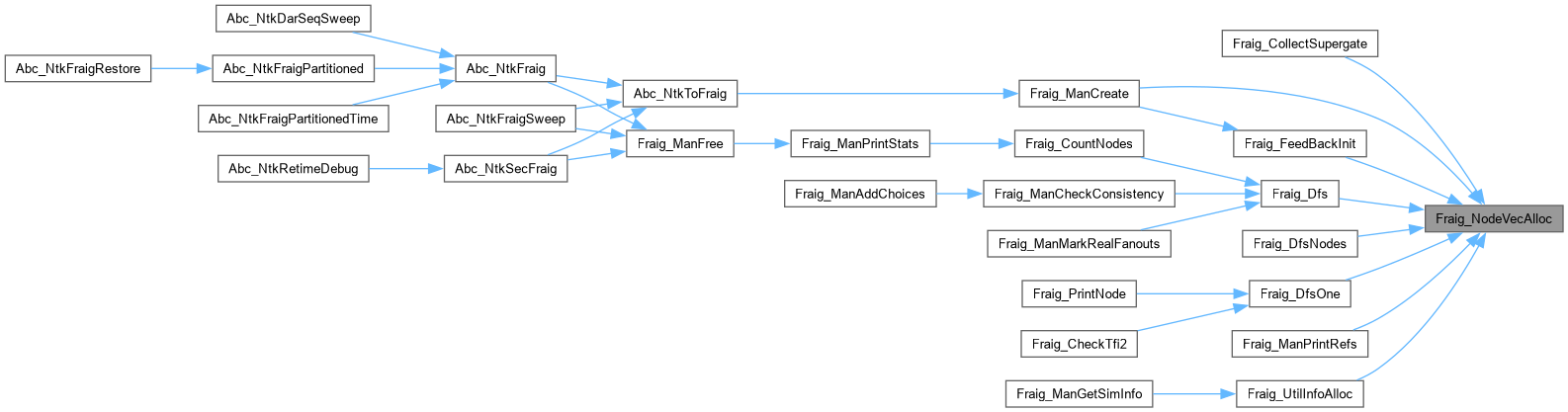
44{
47 if ( nCap > 0 && nCap < 8 )
48 nCap = 8;
49 p->nSize = 0;
50 p->nCap = nCap;
51 p->pArray = p->nCap? ABC_ALLOC( Fraig_Node_t *, p->nCap ) : NULL;
52 return p;
53}
Here is the caller graph for this function:

◆ Fraig_NodeVecClear()

void Fraig_NodeVecClear ( Fraig_NodeVec_t * p)
extern

Function*************************************************************

Synopsis []

Description []

SideEffects []

SeeAlso []

Definition at line 173 of file fraigVec.c.

174{
175 p->nSize = 0;
176}

◆ Fraig_NodeVecDup()

Fraig_NodeVec_t * Fraig_NodeVecDup ( Fraig_NodeVec_t * pVec)
extern

Function*************************************************************

Synopsis [Duplicates the integer array.]

Description []

SideEffects []

SeeAlso []

Definition at line 83 of file fraigVec.c.

84{
87 p->nSize = pVec->nSize;
88 p->nCap = pVec->nCap;
89 p->pArray = p->nCap? ABC_ALLOC( Fraig_Node_t *, p->nCap ) : NULL;
90 memcpy( p->pArray, pVec->pArray, sizeof(Fraig_Node_t *) * pVec->nSize );
91 return p;
92}
char * memcpy()
Here is the call graph for this function:

◆ Fraig_NodeVecFree()

void Fraig_NodeVecFree ( Fraig_NodeVec_t * p)
extern

Function*************************************************************

Synopsis []

Description []

SideEffects []

SeeAlso []

Definition at line 66 of file fraigVec.c.

67{
68 ABC_FREE( p->pArray );
69 ABC_FREE( p );
70}
Here is the caller graph for this function:

◆ Fraig_NodeVecGrow()

void Fraig_NodeVecGrow ( Fraig_NodeVec_t * p,
int nCapMin )
extern

Function*************************************************************

Synopsis [Resizes the vector to the given capacity.]

Description []

SideEffects []

SeeAlso []

Definition at line 137 of file fraigVec.c.
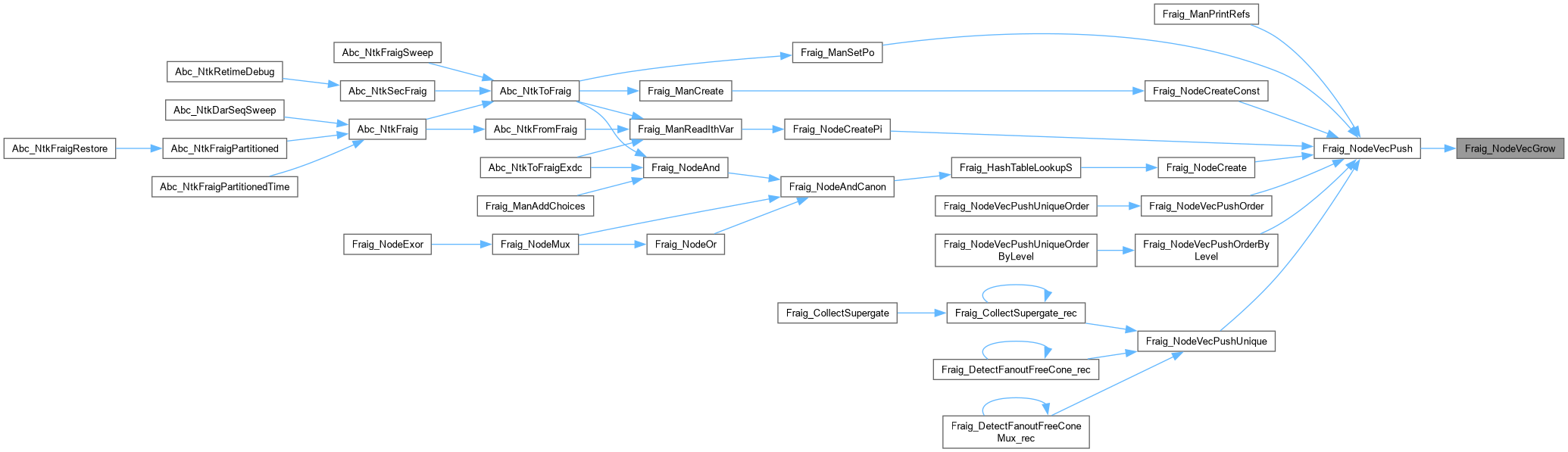
138{
139 if ( p->nCap >= nCapMin )
140 return;
141 p->pArray = ABC_REALLOC( Fraig_Node_t *, p->pArray, nCapMin );
142 p->nCap = nCapMin;
143}
#define ABC_REALLOC(type, obj, num)
Definition abc_global.h:268
Here is the caller graph for this function:

◆ Fraig_NodeVecPop()

Fraig_Node_t * Fraig_NodeVecPop ( Fraig_NodeVec_t * p)
extern

Function*************************************************************

Synopsis []

Description []

SideEffects []

SeeAlso []

Definition at line 331 of file fraigVec.c.

332{
333 return p->pArray[--p->nSize];
334}

◆ Fraig_NodeVecPush()

void Fraig_NodeVecPush ( Fraig_NodeVec_t * p,
Fraig_Node_t * Entry )
extern

Function*************************************************************

Synopsis []

Description []

SideEffects []

SeeAlso []

Definition at line 189 of file fraigVec.c.

190{
191 if ( p->nSize == p->nCap )
192 {
193 if ( p->nCap < 16 )
194 Fraig_NodeVecGrow( p, 16 );
195 else
196 Fraig_NodeVecGrow( p, 2 * p->nCap );
197 }
198 p->pArray[p->nSize++] = Entry;
199}
void Fraig_NodeVecGrow(Fraig_NodeVec_t *p, int nCapMin)
Definition fraigVec.c:137
Here is the call graph for this function:
Here is the caller graph for this function:

◆ Fraig_NodeVecPushOrder()

void Fraig_NodeVecPushOrder ( Fraig_NodeVec_t * p,
Fraig_Node_t * pNode )
extern

Function*************************************************************

Synopsis [Inserts a new node in the order by arrival times.]

Description []

SideEffects []

SeeAlso []

Definition at line 233 of file fraigVec.c.

234{
235 Fraig_Node_t * pNode1, * pNode2;
236 int i;
237 Fraig_NodeVecPush( p, pNode );
238 // find the p of the node
239 for ( i = p->nSize-1; i > 0; i-- )
240 {
241 pNode1 = p->pArray[i ];
242 pNode2 = p->pArray[i-1];
243 if ( pNode1 >= pNode2 )
244 break;
245 p->pArray[i ] = pNode2;
246 p->pArray[i-1] = pNode1;
247 }
248}
void Fraig_NodeVecPush(Fraig_NodeVec_t *p, Fraig_Node_t *Entry)
Definition fraigVec.c:189
Here is the call graph for this function:
Here is the caller graph for this function:

◆ Fraig_NodeVecPushOrderByLevel()

void Fraig_NodeVecPushOrderByLevel ( Fraig_NodeVec_t * p,
Fraig_Node_t * pNode )
extern

Function*************************************************************

Synopsis [Inserts a new node in the order by arrival times.]

Description []

SideEffects []

SeeAlso []

Definition at line 282 of file fraigVec.c.

283{
284 Fraig_Node_t * pNode1, * pNode2;
285 int i;
286 Fraig_NodeVecPush( p, pNode );
287 // find the p of the node
288 for ( i = p->nSize-1; i > 0; i-- )
289 {
290 pNode1 = p->pArray[i ];
291 pNode2 = p->pArray[i-1];
292 if ( Fraig_Regular(pNode1)->Level <= Fraig_Regular(pNode2)->Level )
293 break;
294 p->pArray[i ] = pNode2;
295 p->pArray[i-1] = pNode1;
296 }
297}
Here is the call graph for this function:
Here is the caller graph for this function:

◆ Fraig_NodeVecPushUnique()

int Fraig_NodeVecPushUnique ( Fraig_NodeVec_t * p,
Fraig_Node_t * Entry )
extern

Function*************************************************************

Synopsis [Add the element while ensuring uniqueness.]

Description [Returns 1 if the element was found, and 0 if it was new. ]

SideEffects []

SeeAlso []

Definition at line 212 of file fraigVec.c.

213{
214 int i;
215 for ( i = 0; i < p->nSize; i++ )
216 if ( p->pArray[i] == Entry )
217 return 1;
218 Fraig_NodeVecPush( p, Entry );
219 return 0;
220}
Here is the call graph for this function:
Here is the caller graph for this function:

◆ Fraig_NodeVecPushUniqueOrder()

int Fraig_NodeVecPushUniqueOrder ( Fraig_NodeVec_t * p,
Fraig_Node_t * pNode )
extern

Function*************************************************************

Synopsis [Add the element while ensuring uniqueness in the order.]

Description [Returns 1 if the element was found, and 0 if it was new. ]

SideEffects []

SeeAlso []

Definition at line 261 of file fraigVec.c.

262{
263 int i;
264 for ( i = 0; i < p->nSize; i++ )
265 if ( p->pArray[i] == pNode )
266 return 1;
267 Fraig_NodeVecPushOrder( p, pNode );
268 return 0;
269}
void Fraig_NodeVecPushOrder(Fraig_NodeVec_t *p, Fraig_Node_t *pNode)
Definition fraigVec.c:233
Here is the call graph for this function:

◆ Fraig_NodeVecPushUniqueOrderByLevel()

int Fraig_NodeVecPushUniqueOrderByLevel ( Fraig_NodeVec_t * p,
Fraig_Node_t * pNode )
extern

Function*************************************************************

Synopsis [Add the element while ensuring uniqueness in the order.]

Description [Returns 1 if the element was found, and 0 if it was new. ]

SideEffects []

SeeAlso []

Definition at line 310 of file fraigVec.c.

311{
312 int i;
313 for ( i = 0; i < p->nSize; i++ )
314 if ( p->pArray[i] == pNode )
315 return 1;
317 return 0;
318}
void Fraig_NodeVecPushOrderByLevel(Fraig_NodeVec_t *p, Fraig_Node_t *pNode)
Definition fraigVec.c:282
Here is the call graph for this function:

◆ Fraig_NodeVecReadArray()

Fraig_Node_t ** Fraig_NodeVecReadArray ( Fraig_NodeVec_t * p)
extern

Function*************************************************************

Synopsis []

Description []

SideEffects []

SeeAlso []

Definition at line 105 of file fraigVec.c.

106{
107 return p->pArray;
108}

◆ Fraig_NodeVecReadEntry()

Fraig_Node_t * Fraig_NodeVecReadEntry ( Fraig_NodeVec_t * p,
int i )
extern

Function*************************************************************

Synopsis []

Description []

SideEffects []

SeeAlso []

Definition at line 387 of file fraigVec.c.

388{
389 assert( i >= 0 && i < p->nSize );
390 return p->pArray[i];
391}

◆ Fraig_NodeVecReadSize()

int Fraig_NodeVecReadSize ( Fraig_NodeVec_t * p)
extern

Function*************************************************************

Synopsis []

Description []

SideEffects []

SeeAlso []

Definition at line 121 of file fraigVec.c.

122{
123 return p->nSize;
124}

◆ Fraig_NodeVecRemove()

void Fraig_NodeVecRemove ( Fraig_NodeVec_t * p,
Fraig_Node_t * Entry )
extern

Function*************************************************************

Synopsis []

Description []

SideEffects []

SeeAlso []

Definition at line 347 of file fraigVec.c.

348{
349 int i;
350 for ( i = 0; i < p->nSize; i++ )
351 if ( p->pArray[i] == Entry )
352 break;
353 assert( i < p->nSize );
354 for ( i++; i < p->nSize; i++ )
355 p->pArray[i-1] = p->pArray[i];
356 p->nSize--;
357}

◆ Fraig_NodeVecShrink()

void Fraig_NodeVecShrink ( Fraig_NodeVec_t * p,
int nSizeNew )
extern

Function*************************************************************

Synopsis []

Description []

SideEffects []

SeeAlso []

Definition at line 156 of file fraigVec.c.

157{
158 assert( p->nSize >= nSizeNew );
159 p->nSize = nSizeNew;
160}

◆ Fraig_NodeVecSortByLevel()

void Fraig_NodeVecSortByLevel ( Fraig_NodeVec_t * p,
int fIncreasing )
extern

Function*************************************************************

Synopsis [Sorting the entries by their integer value.]

Description []

SideEffects []

SeeAlso []

Definition at line 501 of file fraigVec.c.
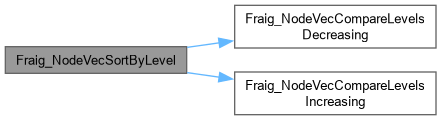
502{
503 if ( fIncreasing )
504 qsort( (void *)p->pArray, (size_t)p->nSize, sizeof(Fraig_Node_t *),
505 (int (*)(const void *, const void *)) Fraig_NodeVecCompareLevelsIncreasing );
506 else
507 qsort( (void *)p->pArray, (size_t)p->nSize, sizeof(Fraig_Node_t *),
508 (int (*)(const void *, const void *)) Fraig_NodeVecCompareLevelsDecreasing );
509}
int Fraig_NodeVecCompareLevelsIncreasing(Fraig_Node_t **pp1, Fraig_Node_t **pp2)
Definition fraigVec.c:404
int Fraig_NodeVecCompareLevelsDecreasing(Fraig_Node_t **pp1, Fraig_Node_t **pp2)
Definition fraigVec.c:426
Here is the call graph for this function:

◆ Fraig_NodeVecSortByNumber()

void Fraig_NodeVecSortByNumber ( Fraig_NodeVec_t * p)
extern

Function*************************************************************

Synopsis [Sorting the entries by their integer value.]

Description []

SideEffects []

SeeAlso []

Definition at line 522 of file fraigVec.c.

523{
524 qsort( (void *)p->pArray, (size_t)p->nSize, sizeof(Fraig_Node_t *),
525 (int (*)(const void *, const void *)) Fraig_NodeVecCompareNumbers );
526}
int Fraig_NodeVecCompareNumbers(Fraig_Node_t **pp1, Fraig_Node_t **pp2)
Definition fraigVec.c:448
Here is the call graph for this function:

◆ Fraig_NodeVecWriteEntry()

void Fraig_NodeVecWriteEntry ( Fraig_NodeVec_t * p,
int i,
Fraig_Node_t * Entry )
extern

Function*************************************************************

Synopsis []

Description []

SideEffects []

SeeAlso []

Definition at line 370 of file fraigVec.c.

371{
372 assert( i >= 0 && i < p->nSize );
373 p->pArray[i] = Entry;
374}

◆ Fraig_ParamsSetDefault()

void Fraig_ParamsSetDefault ( Fraig_Params_t * pParams)
extern

Function*************************************************************

Synopsis [Sets the default parameters of the package.]

Description [This set of parameters is tuned for equivalence checking.]

SideEffects []

SeeAlso []

Definition at line 122 of file fraigMan.c.

123{
124 memset( pParams, 0, sizeof(Fraig_Params_t) );
125 pParams->nPatsRand = FRAIG_PATTERNS_RANDOM; // the number of words of random simulation info
126 pParams->nPatsDyna = FRAIG_PATTERNS_DYNAMIC; // the number of words of dynamic simulation info
127 pParams->nBTLimit = 99; // the max number of backtracks to perform
128 pParams->nSeconds = 20; // the max number of seconds to solve the miter
129 pParams->fFuncRed = 1; // performs only one level hashing
130 pParams->fFeedBack = 1; // enables solver feedback
131 pParams->fDist1Pats = 1; // enables distance-1 patterns
132 pParams->fDoSparse = 0; // performs equiv tests for sparse functions
133 pParams->fChoicing = 0; // enables recording structural choices
134 pParams->fTryProve = 1; // tries to solve the final miter
135 pParams->fVerbose = 0; // the verbosiness flag
136 pParams->fVerboseP = 0; // the verbose flag for reporting the proof
137 pParams->fInternal = 0; // the flag indicates the internal run
138 pParams->nConfLimit = 0; // the limit on the number of conflicts
139 pParams->nInspLimit = 0; // the limit on the number of inspections
140}
#define FRAIG_PATTERNS_DYNAMIC
Definition fraigInt.h:59
#define FRAIG_PATTERNS_RANDOM
Definition fraigInt.h:58
Here is the call graph for this function:
Here is the caller graph for this function:

◆ Fraig_ParamsSetDefaultFull()

void Fraig_ParamsSetDefaultFull ( Fraig_Params_t * pParams)
extern

Function*************************************************************

Synopsis [Sets the default parameters of the package.]

Description [This set of parameters is tuned for complete FRAIGing.]

SideEffects []

SeeAlso []

Definition at line 153 of file fraigMan.c.

154{
155 memset( pParams, 0, sizeof(Fraig_Params_t) );
156 pParams->nPatsRand = FRAIG_PATTERNS_RANDOM; // the number of words of random simulation info
157 pParams->nPatsDyna = FRAIG_PATTERNS_DYNAMIC; // the number of words of dynamic simulation info
158 pParams->nBTLimit = -1; // the max number of backtracks to perform
159 pParams->nSeconds = 20; // the max number of seconds to solve the miter
160 pParams->fFuncRed = 1; // performs only one level hashing
161 pParams->fFeedBack = 1; // enables solver feedback
162 pParams->fDist1Pats = 1; // enables distance-1 patterns
163 pParams->fDoSparse = 1; // performs equiv tests for sparse functions
164 pParams->fChoicing = 0; // enables recording structural choices
165 pParams->fTryProve = 0; // tries to solve the final miter
166 pParams->fVerbose = 0; // the verbosiness flag
167 pParams->fVerboseP = 0; // the verbose flag for reporting the proof
168 pParams->fInternal = 0; // the flag indicates the internal run
169 pParams->nConfLimit = 0; // the limit on the number of conflicts
170 pParams->nInspLimit = 0; // the limit on the number of inspections
171}
Here is the call graph for this function:

◆ Prove_ParamsSetDefault()

void Prove_ParamsSetDefault ( Prove_Params_t * pParams)
extern

FUNCTION DEFINITIONS ///.

Function*************************************************************

Synopsis [Sets the default parameters of the package.]

Description [This set of parameters is tuned for equivalence checking.]

SideEffects []

SeeAlso []

Definition at line 46 of file fraigMan.c.

47{
48 // clean the parameter structure
49 memset( pParams, 0, sizeof(Prove_Params_t) );
50 // general parameters
51 pParams->fUseFraiging = 1; // enables fraiging
52 pParams->fUseRewriting = 1; // enables rewriting
53 pParams->fUseBdds = 0; // enables BDD construction when other methods fail
54 pParams->fVerbose = 0; // prints verbose stats
55 // iterations
56 pParams->nItersMax = 6; // the number of iterations
57 // mitering
58 pParams->nMiteringLimitStart = 5000; // starting mitering limit
59 pParams->nMiteringLimitMulti = 2.0; // multiplicative coefficient to increase the limit in each iteration
60 // rewriting (currently not used)
61 pParams->nRewritingLimitStart = 3; // the number of rewriting iterations
62 pParams->nRewritingLimitMulti = 1.0; // multiplicative coefficient to increase the limit in each iteration
63 // fraiging
64 pParams->nFraigingLimitStart = 2; // starting backtrack(conflict) limit
65 pParams->nFraigingLimitMulti = 8.0; // multiplicative coefficient to increase the limit in each iteration
66 // last-gasp BDD construction
67 pParams->nBddSizeLimit = 1000000; // the number of BDD nodes when construction is aborted
68 pParams->fBddReorder = 1; // enables dynamic BDD variable reordering
69 // last-gasp mitering
70// pParams->nMiteringLimitLast = 1000000; // final mitering limit
71 pParams->nMiteringLimitLast = 0; // final mitering limit
72 // global SAT solver limits
73 pParams->nTotalBacktrackLimit = 0; // global limit on the number of backtracks
74 pParams->nTotalInspectLimit = 0; // global limit on the number of clause inspects
75// pParams->nTotalInspectLimit = 100000000; // global limit on the number of clause inspects
76}
struct Prove_ParamsStruct_t_ Prove_Params_t
Definition ivyFraig.c:108
ABC_INT64_T nTotalBacktrackLimit
Definition ivyFraig.c:133
ABC_INT64_T nTotalInspectLimit
Definition ivyFraig.c:134
Here is the call graph for this function:
Here is the caller graph for this function: