ABC: A System for Sequential Synthesis and Verification
 
Loading...
Searching...
No Matches
msatClause.c File Reference
#include "msatInt.h"
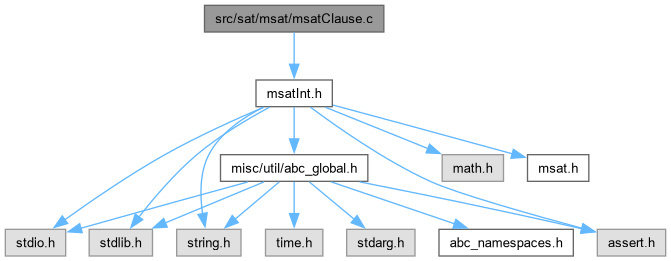
Include dependency graph for msatClause.c:

Go to the source code of this file.

Classes

struct  Msat_Clause_t_
 DECLARATIONS ///. More...
 

Functions

int Msat_ClauseCreate (Msat_Solver_t *p, Msat_IntVec_t *vLits, int fLearned, Msat_Clause_t **pClause_out)
 FUNCTION DEFINITIONS ///.
 
void Msat_ClauseFree (Msat_Solver_t *p, Msat_Clause_t *pC, int fRemoveWatched)
 
int Msat_ClauseReadLearned (Msat_Clause_t *pC)
 
int Msat_ClauseReadSize (Msat_Clause_t *pC)
 
int * Msat_ClauseReadLits (Msat_Clause_t *pC)
 
int Msat_ClauseReadMark (Msat_Clause_t *pC)
 
int Msat_ClauseReadNum (Msat_Clause_t *pC)
 
int Msat_ClauseReadTypeA (Msat_Clause_t *pC)
 
void Msat_ClauseSetMark (Msat_Clause_t *pC, int fMark)
 
void Msat_ClauseSetNum (Msat_Clause_t *pC, int Num)
 
void Msat_ClauseSetTypeA (Msat_Clause_t *pC, int fTypeA)
 
int Msat_ClauseIsLocked (Msat_Solver_t *p, Msat_Clause_t *pC)
 
float Msat_ClauseReadActivity (Msat_Clause_t *pC)
 
void Msat_ClauseWriteActivity (Msat_Clause_t *pC, float Num)
 
int Msat_ClausePropagate (Msat_Clause_t *pC, Msat_Lit_t Lit, int *pAssigns, Msat_Lit_t *pLit_out)
 
int Msat_ClauseSimplify (Msat_Clause_t *pC, int *pAssigns)
 
void Msat_ClauseCalcReason (Msat_Solver_t *p, Msat_Clause_t *pC, Msat_Lit_t Lit, Msat_IntVec_t *vLits_out)
 
void Msat_ClauseRemoveWatch (Msat_ClauseVec_t *vClauses, Msat_Clause_t *pC)
 
void Msat_ClausePrint (Msat_Clause_t *pC)
 
void Msat_ClauseWriteDimacs (FILE *pFile, Msat_Clause_t *pC, int fIncrement)
 
void Msat_ClausePrintSymbols (Msat_Clause_t *pC)
 

Function Documentation

◆ Msat_ClauseCalcReason()

void Msat_ClauseCalcReason ( Msat_Solver_t * p,
Msat_Clause_t * pC,
Msat_Lit_t Lit,
Msat_IntVec_t * vLits_out )

Function*************************************************************

Synopsis [Computes reason of conflict in the given clause.]

Description [If the literal is unassigned, finds the reason by complementing literals in the given cluase (pC). If the literal is assigned, makes sure that this literal is the first one in the clause and computes the complement of all other literals in the clause. Returns the reason in the given array (vLits_out). If the clause is learned, bumps its activity.]

SideEffects []

SeeAlso []

Definition at line 418 of file msatClause.c.
419{
420 int i;
421 // clear the reason
422 Msat_IntVecClear( vLits_out );
423 assert( Lit == MSAT_LIT_UNASSIGNED || Lit == pC->pData[0] );
424 for ( i = (Lit != MSAT_LIT_UNASSIGNED); i < (int)pC->nSize; i++ )
425 {
426 assert( Msat_SolverReadAssignsArray(p)[MSAT_LIT2VAR(pC->pData[i])] == MSAT_LITNOT(pC->pData[i]) );
427 Msat_IntVecPush( vLits_out, MSAT_LITNOT(pC->pData[i]) );
428 }
429 if ( pC->fLearned )
431}
Cube * p
Definition exorList.c:222
void Msat_SolverClaBumpActivity(Msat_Solver_t *p, Msat_Clause_t *pC)
#define MSAT_LIT_UNASSIGNED
Definition msatInt.h:69
int * Msat_SolverReadAssignsArray(Msat_Solver_t *p)
#define MSAT_LITNOT(l)
Definition msat.h:57
#define MSAT_LIT2VAR(l)
Definition msat.h:59
void Msat_IntVecClear(Msat_IntVec_t *p)
Definition msatVec.c:335
void Msat_IntVecPush(Msat_IntVec_t *p, int Entry)
Definition msatVec.c:351
#define assert(ex)
Definition util_old.h:213
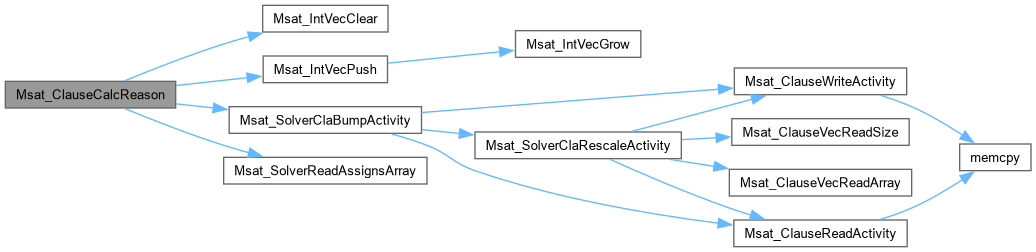
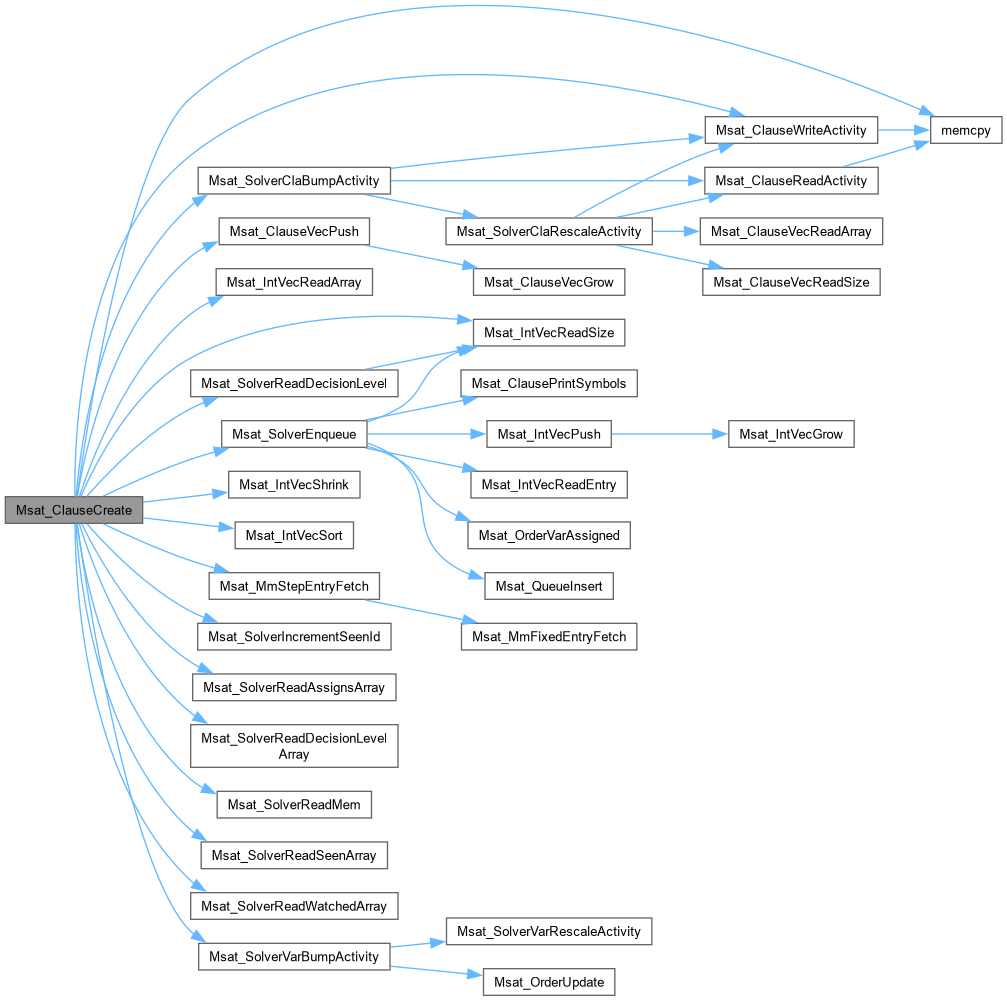
Here is the call graph for this function:

◆ Msat_ClauseCreate()

int Msat_ClauseCreate ( Msat_Solver_t * p,
Msat_IntVec_t * vLits,
int fLearned,
Msat_Clause_t ** pClause_out )

FUNCTION DEFINITIONS ///.

Function*************************************************************

Synopsis [Creates a new clause.]

Description [Returns FALSE if top-level conflict detected (must be handled); TRUE otherwise. 'pClause_out' may be set to NULL if clause is already satisfied by the top-level assignment.]

SideEffects []

SeeAlso []

Definition at line 58 of file msatClause.c.
59{
60 int * pAssigns = Msat_SolverReadAssignsArray(p);
61 Msat_ClauseVec_t ** pvWatched;
62 Msat_Clause_t * pC;
63 int * pLits;
64 int nLits, i, j;
65 int nBytes;
67 int Sign;
68
69 *pClause_out = NULL;
70
71 nLits = Msat_IntVecReadSize(vLits);
72 pLits = Msat_IntVecReadArray(vLits);
73
74 if ( !fLearned )
75 {
76 int * pSeen = Msat_SolverReadSeenArray( p );
77 int nSeenId;
79 // sorting literals makes the code trace-equivalent
80 // with to the original C++ solver
81 Msat_IntVecSort( vLits, 0 );
82 // increment the counter of seen twice
83 nSeenId = Msat_SolverIncrementSeenId( p );
84 nSeenId = Msat_SolverIncrementSeenId( p );
85 // nSeenId - 1 stands for negative
86 // nSeenId stands for positive
87 // Remove false literals
88
89 // there is a bug here!!!!
90 // when the same var in opposite polarities is given, it drops one polarity!!!
91
92 for ( i = j = 0; i < nLits; i++ ) {
93 // get the corresponding variable
94 Var = MSAT_LIT2VAR(pLits[i]);
95 Sign = MSAT_LITSIGN(pLits[i]); // Sign=0 for positive
96 // check if we already saw this variable in the this clause
97 if ( pSeen[Var] >= nSeenId - 1 )
98 {
99 if ( (pSeen[Var] != nSeenId) == Sign ) // the same lit
100 continue;
101 return 1; // two opposite polarity lits -- don't add the clause
102 }
103 // mark the variable as seen
104 pSeen[Var] = nSeenId - !Sign;
105
106 // analize the value of this literal
107 if ( pAssigns[Var] != MSAT_VAR_UNASSIGNED )
108 {
109 if ( pAssigns[Var] == pLits[i] )
110 return 1; // the clause is always true -- don't add anything
111 // the literal has no impact - skip it
112 continue;
113 }
114 // otherwise, add this literal to the clause
115 pLits[j++] = pLits[i];
116 }
117 Msat_IntVecShrink( vLits, j );
118 nLits = j;
119/*
120 // the problem with this code is that performance is very
121 // sensitive to the ordering of adjacency lits
122 // the best ordering requires fanins first, next fanouts
123 // this ordering is more convenient to make from FRAIG
124
125 // create the adjacency information
126 if ( nLits > 2 )
127 {
128 Msat_Var_t VarI, VarJ;
129 Msat_IntVec_t * pAdjI, * pAdjJ;
130
131 for ( i = 0; i < nLits; i++ )
132 {
133 VarI = MSAT_LIT2VAR(pLits[i]);
134 pAdjI = (Msat_IntVec_t *)p->vAdjacents->pArray[VarI];
135
136 for ( j = i+1; j < nLits; j++ )
137 {
138 VarJ = MSAT_LIT2VAR(pLits[j]);
139 pAdjJ = (Msat_IntVec_t *)p->vAdjacents->pArray[VarJ];
140
141 Msat_IntVecPushUniqueOrder( pAdjI, VarJ, 1 );
142 Msat_IntVecPushUniqueOrder( pAdjJ, VarI, 1 );
143 }
144 }
145 }
146*/
147 }
148 // 'vLits' is now the (possibly) reduced vector of literals.
149 if ( nLits == 0 )
150 return 0;
151 if ( nLits == 1 )
152 return Msat_SolverEnqueue( p, pLits[0], NULL );
153
154 // Allocate clause:
155// nBytes = sizeof(unsigned)*(nLits + 1 + (int)fLearned);
156 nBytes = sizeof(unsigned)*(nLits + 2 + (int)fLearned);
157#ifdef USE_SYSTEM_MEMORY_MANAGEMENT
158 pC = (Msat_Clause_t *)ABC_ALLOC( char, nBytes );
159#else
161#endif
162 pC->Num = p->nClauses++;
163 pC->fTypeA = 0;
164 pC->fMark = 0;
165 pC->fLearned = fLearned;
166 pC->nSize = nLits;
167 pC->nSizeAlloc = nBytes;
168 memcpy( pC->pData, pLits, sizeof(int)*nLits );
169
170 // For learnt clauses only:
171 if ( fLearned )
172 {
173 int * pLevel = Msat_SolverReadDecisionLevelArray( p );
174 int iLevelMax, iLevelCur, iLitMax;
175
176 // Put the second watch on the literal with highest decision level:
177 iLitMax = 1;
178 iLevelMax = pLevel[ MSAT_LIT2VAR(pLits[1]) ];
179 for ( i = 2; i < nLits; i++ )
180 {
181 iLevelCur = pLevel[ MSAT_LIT2VAR(pLits[i]) ];
182 assert( iLevelCur != -1 );
183 if ( iLevelMax < iLevelCur )
184 // this is very strange - shouldn't it be???
185 // if ( iLevelMax > iLevelCur )
186 iLevelMax = iLevelCur, iLitMax = i;
187 }
188 pC->pData[1] = pLits[iLitMax];
189 pC->pData[iLitMax] = pLits[1];
190
191 // Bumping:
192 // (newly learnt clauses should be considered active)
193 Msat_ClauseWriteActivity( pC, 0.0 );
195// if ( nLits < 20 )
196 for ( i = 0; i < nLits; i++ )
197 {
198 Msat_SolverVarBumpActivity( p, pLits[i] );
199// Msat_SolverVarBumpActivity( p, pLits[i] );
200// p->pFreq[ MSAT_LIT2VAR(pLits[i]) ]++;
201 }
202 }
203
204 // Store clause:
205 pvWatched = Msat_SolverReadWatchedArray( p );
206 Msat_ClauseVecPush( pvWatched[ MSAT_LITNOT(pC->pData[0]) ], pC );
207 Msat_ClauseVecPush( pvWatched[ MSAT_LITNOT(pC->pData[1]) ], pC );
208 *pClause_out = pC;
209 return 1;
210}
#define ABC_ALLOC(type, num)
Definition abc_global.h:264
int Var
Definition exorList.c:228
ABC_NAMESPACE_IMPL_START void Msat_SolverVarBumpActivity(Msat_Solver_t *p, Msat_Lit_t Lit)
DECLARATIONS ///.
void Msat_ClauseVecPush(Msat_ClauseVec_t *p, Msat_Clause_t *Entry)
void Msat_ClauseWriteActivity(Msat_Clause_t *pC, float Num)
Definition msatClause.c:314
#define MSAT_VAR_UNASSIGNED
Definition msatInt.h:68
char * Msat_MmStepEntryFetch(Msat_MmStep_t *p, int nBytes)
Definition msatMem.c:479
int Msat_SolverReadDecisionLevel(Msat_Solver_t *p)
Msat_MmStep_t * Msat_SolverReadMem(Msat_Solver_t *p)
typedefABC_NAMESPACE_HEADER_START struct Msat_Clause_t_ Msat_Clause_t
INCLUDES ///.
Definition msatInt.h:57
Msat_ClauseVec_t ** Msat_SolverReadWatchedArray(Msat_Solver_t *p)
int Msat_Var_t
Definition msatInt.h:66
int * Msat_SolverReadDecisionLevelArray(Msat_Solver_t *p)
int * Msat_SolverReadSeenArray(Msat_Solver_t *p)
int Msat_SolverIncrementSeenId(Msat_Solver_t *p)
int Msat_SolverEnqueue(Msat_Solver_t *p, Msat_Lit_t Lit, Msat_Clause_t *pC)
struct Msat_ClauseVec_t_ Msat_ClauseVec_t
Definition msat.h:46
void Msat_IntVecSort(Msat_IntVec_t *p, int fReverse)
Definition msatVec.c:442
void Msat_IntVecShrink(Msat_IntVec_t *p, int nSizeNew)
Definition msatVec.c:318
int Msat_IntVecReadSize(Msat_IntVec_t *p)
Definition msatVec.c:233
#define MSAT_LITSIGN(l)
Definition msat.h:58
int * Msat_IntVecReadArray(Msat_IntVec_t *p)
Definition msatVec.c:217
char * memcpy()
Here is the call graph for this function:
Here is the caller graph for this function:

◆ Msat_ClauseFree()

void Msat_ClauseFree ( Msat_Solver_t * p,
Msat_Clause_t * pC,
int fRemoveWatched )

Function*************************************************************

Synopsis [Deallocates the clause.]

Description []

SideEffects []

SeeAlso []

Definition at line 223 of file msatClause.c.
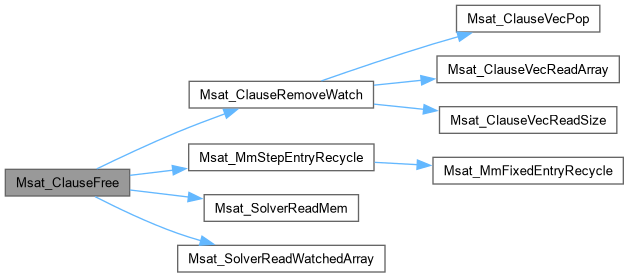
224{
225 if ( fRemoveWatched )
226 {
227 Msat_Lit_t Lit;
228 Msat_ClauseVec_t ** pvWatched;
229 pvWatched = Msat_SolverReadWatchedArray( p );
230 Lit = MSAT_LITNOT( pC->pData[0] );
231 Msat_ClauseRemoveWatch( pvWatched[Lit], pC );
232 Lit = MSAT_LITNOT( pC->pData[1] );
233 Msat_ClauseRemoveWatch( pvWatched[Lit], pC );
234 }
235
236#ifdef USE_SYSTEM_MEMORY_MANAGEMENT
237 ABC_FREE( pC );
238#else
239 Msat_MmStepEntryRecycle( Msat_SolverReadMem(p), (char *)pC, pC->nSizeAlloc );
240#endif
241
242}
#define ABC_FREE(obj)
Definition abc_global.h:267
void Msat_ClauseRemoveWatch(Msat_ClauseVec_t *vClauses, Msat_Clause_t *pC)
Definition msatClause.c:444
void Msat_MmStepEntryRecycle(Msat_MmStep_t *p, char *pEntry, int nBytes)
Definition msatMem.c:503
int Msat_Lit_t
Definition msatInt.h:65
Here is the call graph for this function:
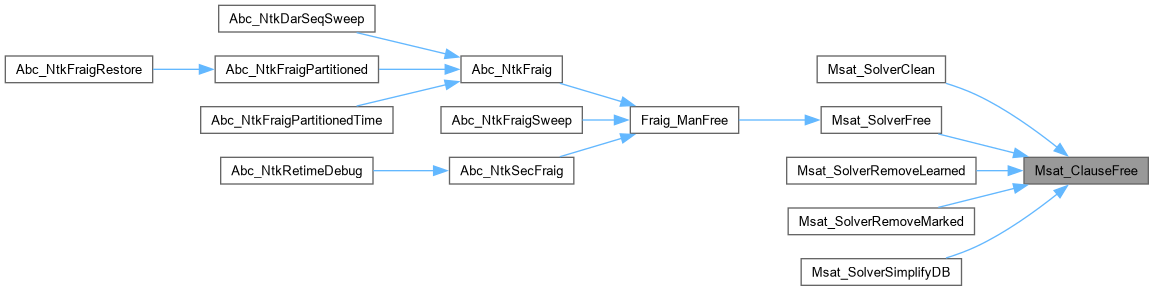
Here is the caller graph for this function:

◆ Msat_ClauseIsLocked()

int Msat_ClauseIsLocked ( Msat_Solver_t * p,
Msat_Clause_t * pC )

Function*************************************************************

Synopsis [Checks whether the learned clause is locked.]

Description [The clause may be locked if it is the reason of a recent conflict. Such clause cannot be removed from the database.]

SideEffects []

SeeAlso []

Definition at line 278 of file msatClause.c.

279{
281 return (int )(pReasons[MSAT_LIT2VAR(pC->pData[0])] == pC);
282}
Msat_Clause_t ** Msat_SolverReadReasonArray(Msat_Solver_t *p)
Here is the call graph for this function:
Here is the caller graph for this function:

◆ Msat_ClausePrint()

void Msat_ClausePrint ( Msat_Clause_t * pC)

Function*************************************************************

Synopsis [Prints the given clause.]

Description []

SideEffects []

SeeAlso []

Definition at line 468 of file msatClause.c.

469{
470 int i;
471 if ( pC == NULL )
472 printf( "NULL pointer" );
473 else
474 {
475 if ( pC->fLearned )
476 printf( "Act = %.4f ", Msat_ClauseReadActivity(pC) );
477 for ( i = 0; i < (int)pC->nSize; i++ )
478 printf( " %s%d", ((pC->pData[i]&1)? "-": ""), pC->pData[i]/2 + 1 );
479 }
480 printf( "\n" );
481}
float Msat_ClauseReadActivity(Msat_Clause_t *pC)
Definition msatClause.c:295
Here is the call graph for this function:
Here is the caller graph for this function:

◆ Msat_ClausePrintSymbols()

void Msat_ClausePrintSymbols ( Msat_Clause_t * pC)

Function*************************************************************

Synopsis [Prints the given clause.]

Description []

SideEffects []

SeeAlso []

Definition at line 515 of file msatClause.c.

516{
517 int i;
518 if ( pC == NULL )
519 printf( "NULL pointer" );
520 else
521 {
522// if ( pC->fLearned )
523// printf( "Act = %.4f ", Msat_ClauseReadActivity(pC) );
524 for ( i = 0; i < (int)pC->nSize; i++ )
525 printf(" " L_LIT, L_lit(pC->pData[i]));
526 }
527 printf( "\n" );
528}
#define L_lit(p)
Definition satSolver.c:43
#define L_LIT
Definition satSolver.c:42
Here is the caller graph for this function:

◆ Msat_ClausePropagate()

int Msat_ClausePropagate ( Msat_Clause_t * pC,
Msat_Lit_t Lit,
int * pAssigns,
Msat_Lit_t * pLit_out )

Function*************************************************************

Synopsis [Propages the assignment.]

Description [The literal that has become true (Lit) is given to this procedure. The array of current variable assignments is given for efficiency. The output literal (pLit_out) can be the second watched literal (if TRUE is returned) or the conflict literal (if FALSE is returned). This messy interface is used to improve performance. This procedure accounts for ~50% of the runtime of the solver.]

SideEffects []

SeeAlso []

Definition at line 335 of file msatClause.c.

336{
337 // make sure the false literal is pC->pData[1]
338 Msat_Lit_t LitF = MSAT_LITNOT(Lit);
339 if ( pC->pData[0] == LitF )
340 pC->pData[0] = pC->pData[1], pC->pData[1] = LitF;
341 assert( pC->pData[1] == LitF );
342 // if the 0-th watch is true, clause is already satisfied
343 if ( pAssigns[MSAT_LIT2VAR(pC->pData[0])] == pC->pData[0] )
344 return 1;
345 // look for a new watch
346 if ( pC->nSize > 2 )
347 {
348 int i;
349 for ( i = 2; i < (int)pC->nSize; i++ )
350 if ( pAssigns[MSAT_LIT2VAR(pC->pData[i])] != MSAT_LITNOT(pC->pData[i]) )
351 {
352 pC->pData[1] = pC->pData[i], pC->pData[i] = LitF;
353 *pLit_out = MSAT_LITNOT(pC->pData[1]);
354 return 1;
355 }
356 }
357 // clause is unit under assignment
358 *pLit_out = pC->pData[0];
359 return 0;
360}
Here is the caller graph for this function:

◆ Msat_ClauseReadActivity()

float Msat_ClauseReadActivity ( Msat_Clause_t * pC)

Function*************************************************************

Synopsis [Reads the activity of the given clause.]

Description []

SideEffects []

SeeAlso []

Definition at line 295 of file msatClause.c.

296{
297 float f;
298
299 memcpy( &f, pC->pData + pC->nSize, sizeof (f));
300 return f;
301}
Here is the call graph for this function:
Here is the caller graph for this function:

◆ Msat_ClauseReadLearned()

int Msat_ClauseReadLearned ( Msat_Clause_t * pC)

Function*************************************************************

Synopsis [Access the data field of the clause.]

Description []

SideEffects []

SeeAlso []

Definition at line 255 of file msatClause.c.

255{ return pC->fLearned; }

◆ Msat_ClauseReadLits()

int * Msat_ClauseReadLits ( Msat_Clause_t * pC)

Definition at line 257 of file msatClause.c.

257{ return pC->pData; }

◆ Msat_ClauseReadMark()

int Msat_ClauseReadMark ( Msat_Clause_t * pC)

Definition at line 258 of file msatClause.c.

258{ return pC->fMark; }

◆ Msat_ClauseReadNum()

int Msat_ClauseReadNum ( Msat_Clause_t * pC)

Definition at line 259 of file msatClause.c.

259{ return pC->Num; }

◆ Msat_ClauseReadSize()

int Msat_ClauseReadSize ( Msat_Clause_t * pC)

Definition at line 256 of file msatClause.c.

256{ return pC->nSize; }

◆ Msat_ClauseReadTypeA()

int Msat_ClauseReadTypeA ( Msat_Clause_t * pC)

Definition at line 260 of file msatClause.c.

260{ return pC->fTypeA; }

◆ Msat_ClauseRemoveWatch()

void Msat_ClauseRemoveWatch ( Msat_ClauseVec_t * vClauses,
Msat_Clause_t * pC )

Function*************************************************************

Synopsis [Removes the given clause from the watched list.]

Description []

SideEffects []

SeeAlso []

Definition at line 444 of file msatClause.c.
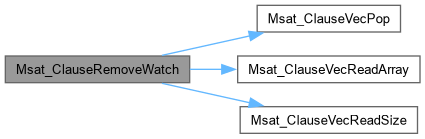
445{
446 Msat_Clause_t ** pClauses;
447 int nClauses, i;
448 nClauses = Msat_ClauseVecReadSize( vClauses );
449 pClauses = Msat_ClauseVecReadArray( vClauses );
450 for ( i = 0; pClauses[i] != pC; i++ )
451 assert( i < nClauses );
452 for ( ; i < nClauses - 1; i++ )
453 pClauses[i] = pClauses[i+1];
454 Msat_ClauseVecPop( vClauses );
455}
int Msat_ClauseVecReadSize(Msat_ClauseVec_t *p)
Msat_Clause_t ** Msat_ClauseVecReadArray(Msat_ClauseVec_t *p)
Msat_Clause_t * Msat_ClauseVecPop(Msat_ClauseVec_t *p)
Here is the call graph for this function:
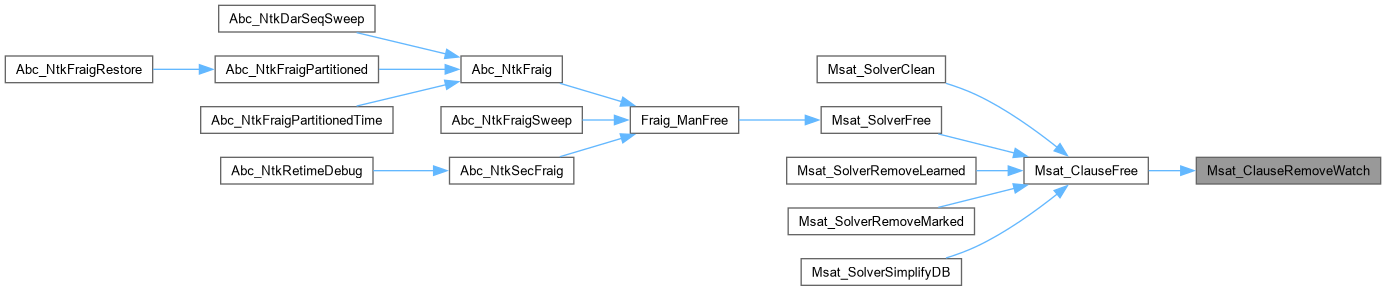
Here is the caller graph for this function:

◆ Msat_ClauseSetMark()

void Msat_ClauseSetMark ( Msat_Clause_t * pC,
int fMark )

Definition at line 262 of file msatClause.c.

262{ pC->fMark = fMark; }

◆ Msat_ClauseSetNum()

void Msat_ClauseSetNum ( Msat_Clause_t * pC,
int Num )

Definition at line 263 of file msatClause.c.

263{ pC->Num = Num; }
Here is the caller graph for this function:

◆ Msat_ClauseSetTypeA()

void Msat_ClauseSetTypeA ( Msat_Clause_t * pC,
int fTypeA )

Definition at line 264 of file msatClause.c.

264{ pC->fTypeA = fTypeA; }
Here is the caller graph for this function:

◆ Msat_ClauseSimplify()

int Msat_ClauseSimplify ( Msat_Clause_t * pC,
int * pAssigns )

Function*************************************************************

Synopsis [Simplifies the clause.]

Description [Assumes everything has been propagated! (esp. watches in clauses are NOT unsatisfied)]

SideEffects []

SeeAlso []

Definition at line 374 of file msatClause.c.

375{
377 int i, j;
378 for ( i = j = 0; i < (int)pC->nSize; i++ )
379 {
380 Var = MSAT_LIT2VAR(pC->pData[i]);
381 if ( pAssigns[Var] == MSAT_VAR_UNASSIGNED )
382 {
383 pC->pData[j++] = pC->pData[i];
384 continue;
385 }
386 if ( pAssigns[Var] == pC->pData[i] )
387 return 1;
388 // otherwise, the value of the literal is false
389 // make sure, this literal is not watched
390 assert( i >= 2 );
391 }
392 // if the size has changed, update it and move activity
393 if ( j < (int)pC->nSize )
394 {
395 float Activ = Msat_ClauseReadActivity(pC);
396 pC->nSize = j;
397 Msat_ClauseWriteActivity(pC, Activ);
398 }
399 return 0;
400}
Here is the call graph for this function:
Here is the caller graph for this function:

◆ Msat_ClauseWriteActivity()

void Msat_ClauseWriteActivity ( Msat_Clause_t * pC,
float Num )

Function*************************************************************

Synopsis [Sets the activity of the clause.]

Description []

SideEffects []

SeeAlso []

Definition at line 314 of file msatClause.c.

315{
316 memcpy( pC->pData + pC->nSize, &Num, sizeof (Num) );
317}
Here is the call graph for this function:
Here is the caller graph for this function:

◆ Msat_ClauseWriteDimacs()

void Msat_ClauseWriteDimacs ( FILE * pFile,
Msat_Clause_t * pC,
int fIncrement )

Function*************************************************************

Synopsis [Writes the given clause in a file in DIMACS format.]

Description []

SideEffects []

SeeAlso []

Definition at line 494 of file msatClause.c.

495{
496 int i;
497 for ( i = 0; i < (int)pC->nSize; i++ )
498 fprintf( pFile, "%s%d ", ((pC->pData[i]&1)? "-": ""), pC->pData[i]/2 + (int)(fIncrement>0) );
499 if ( fIncrement )
500 fprintf( pFile, "0" );
501 fprintf( pFile, "\n" );
502}
Here is the caller graph for this function: