ABC: A System for Sequential Synthesis and Verification
 
Loading...
Searching...
No Matches
msatInt.h File Reference
#include <stdio.h>
#include <stdlib.h>
#include <string.h>
#include <assert.h>
#include <math.h>
#include "misc/util/abc_global.h"
#include "msat.h"
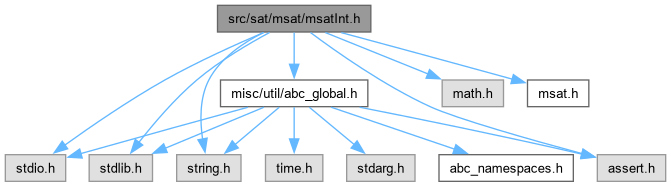
Include dependency graph for msatInt.h:
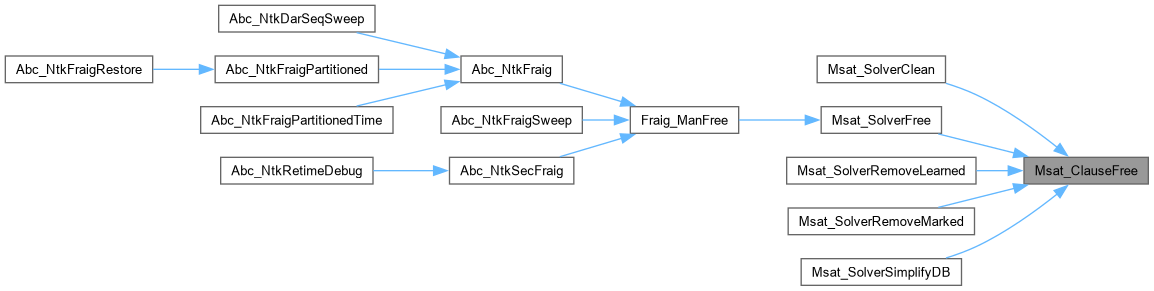
This graph shows which files directly or indirectly include this file:

Go to the source code of this file.

Classes

struct  Msat_SolverStats_t_
 
struct  Msat_SearchParams_t_
 
struct  Msat_Solver_t_
 
struct  Msat_ClauseVec_t_
 
struct  Msat_IntVec_t_
 

Macros

#define MSAT_VAR_UNASSIGNED   (-1)
 
#define MSAT_LIT_UNASSIGNED   (-2)
 
#define MSAT_ORDER_UNKNOWN   (-3)
 
#define L_IND   "%-*d"
 
#define L_ind   Msat_SolverReadDecisionLevel(p)*3+3,Msat_SolverReadDecisionLevel(p)
 
#define L_LIT   "%s%d"
 
#define L_lit(Lit)
 

Typedefs

typedef typedefABC_NAMESPACE_HEADER_START struct Msat_Clause_t_ Msat_Clause_t
 INCLUDES ///.
 
typedef struct Msat_Queue_t_ Msat_Queue_t
 
typedef struct Msat_Order_t_ Msat_Order_t
 
typedef struct Msat_MmFixed_t_ Msat_MmFixed_t
 
typedef struct Msat_MmFlex_t_ Msat_MmFlex_t
 
typedef struct Msat_MmStep_t_ Msat_MmStep_t
 
typedef int Msat_Lit_t
 
typedef int Msat_Var_t
 
typedef struct Msat_SolverStats_t_ Msat_SolverStats_t
 
typedef struct Msat_SearchParams_t_ Msat_SearchParams_t
 

Functions

void Msat_SolverVarDecayActivity (Msat_Solver_t *p)
 GLOBAL VARIABLES ///.
 
void Msat_SolverVarRescaleActivity (Msat_Solver_t *p)
 
void Msat_SolverClaDecayActivity (Msat_Solver_t *p)
 
void Msat_SolverClaRescaleActivity (Msat_Solver_t *p)
 
Msat_Clause_tMsat_SolverReadClause (Msat_Solver_t *p, int Num)
 
int Msat_SolverReadDecisionLevel (Msat_Solver_t *p)
 
int * Msat_SolverReadDecisionLevelArray (Msat_Solver_t *p)
 
Msat_Clause_t ** Msat_SolverReadReasonArray (Msat_Solver_t *p)
 
Msat_Type_t Msat_SolverReadVarValue (Msat_Solver_t *p, Msat_Var_t Var)
 
Msat_ClauseVec_tMsat_SolverReadLearned (Msat_Solver_t *p)
 
Msat_ClauseVec_t ** Msat_SolverReadWatchedArray (Msat_Solver_t *p)
 
int * Msat_SolverReadSeenArray (Msat_Solver_t *p)
 
int Msat_SolverIncrementSeenId (Msat_Solver_t *p)
 
Msat_MmStep_tMsat_SolverReadMem (Msat_Solver_t *p)
 
void Msat_SolverClausesIncrement (Msat_Solver_t *p)
 
void Msat_SolverClausesDecrement (Msat_Solver_t *p)
 
void Msat_SolverClausesIncrementL (Msat_Solver_t *p)
 
void Msat_SolverClausesDecrementL (Msat_Solver_t *p)
 
void Msat_SolverVarBumpActivity (Msat_Solver_t *p, Msat_Lit_t Lit)
 DECLARATIONS ///.
 
void Msat_SolverClaBumpActivity (Msat_Solver_t *p, Msat_Clause_t *pC)
 
int Msat_SolverEnqueue (Msat_Solver_t *p, Msat_Lit_t Lit, Msat_Clause_t *pC)
 
double Msat_SolverProgressEstimate (Msat_Solver_t *p)
 
int Msat_SolverAssume (Msat_Solver_t *p, Msat_Lit_t Lit)
 FUNCTION DEFINITIONS ///.
 
Msat_Clause_tMsat_SolverPropagate (Msat_Solver_t *p)
 
void Msat_SolverCancelUntil (Msat_Solver_t *p, int Level)
 
Msat_Type_t Msat_SolverSearch (Msat_Solver_t *p, int nConfLimit, int nLearnedLimit, int nBackTrackLimit, Msat_SearchParams_t *pPars)
 
Msat_Queue_tMsat_QueueAlloc (int nVars)
 FUNCTION DEFINITIONS ///.
 
void Msat_QueueFree (Msat_Queue_t *p)
 
int Msat_QueueReadSize (Msat_Queue_t *p)
 
void Msat_QueueInsert (Msat_Queue_t *p, int Lit)
 
int Msat_QueueExtract (Msat_Queue_t *p)
 
void Msat_QueueClear (Msat_Queue_t *p)
 
Msat_Order_tMsat_OrderAlloc (Msat_Solver_t *pSat)
 FUNCTION DEFINITIONS ///.
 
void Msat_OrderSetBounds (Msat_Order_t *p, int nVarsMax)
 
void Msat_OrderClean (Msat_Order_t *p, Msat_IntVec_t *vCone)
 
int Msat_OrderCheck (Msat_Order_t *p)
 
void Msat_OrderFree (Msat_Order_t *p)
 
int Msat_OrderVarSelect (Msat_Order_t *p)
 
void Msat_OrderVarAssigned (Msat_Order_t *p, int Var)
 
void Msat_OrderVarUnassigned (Msat_Order_t *p, int Var)
 
void Msat_OrderUpdate (Msat_Order_t *p, int Var)
 
int Msat_ClauseCreate (Msat_Solver_t *p, Msat_IntVec_t *vLits, int fLearnt, Msat_Clause_t **pClause_out)
 FUNCTION DEFINITIONS ///.
 
Msat_Clause_tMsat_ClauseCreateFake (Msat_Solver_t *p, Msat_IntVec_t *vLits)
 
Msat_Clause_tMsat_ClauseCreateFakeLit (Msat_Solver_t *p, Msat_Lit_t Lit)
 
int Msat_ClauseReadLearned (Msat_Clause_t *pC)
 
int Msat_ClauseReadSize (Msat_Clause_t *pC)
 
int * Msat_ClauseReadLits (Msat_Clause_t *pC)
 
int Msat_ClauseReadMark (Msat_Clause_t *pC)
 
void Msat_ClauseSetMark (Msat_Clause_t *pC, int fMark)
 
int Msat_ClauseReadNum (Msat_Clause_t *pC)
 
void Msat_ClauseSetNum (Msat_Clause_t *pC, int Num)
 
int Msat_ClauseReadTypeA (Msat_Clause_t *pC)
 
void Msat_ClauseSetTypeA (Msat_Clause_t *pC, int fTypeA)
 
int Msat_ClauseIsLocked (Msat_Solver_t *p, Msat_Clause_t *pC)
 
float Msat_ClauseReadActivity (Msat_Clause_t *pC)
 
void Msat_ClauseWriteActivity (Msat_Clause_t *pC, float Num)
 
void Msat_ClauseFree (Msat_Solver_t *p, Msat_Clause_t *pC, int fRemoveWatched)
 
int Msat_ClausePropagate (Msat_Clause_t *pC, Msat_Lit_t Lit, int *pAssigns, Msat_Lit_t *pLit_out)
 
int Msat_ClauseSimplify (Msat_Clause_t *pC, int *pAssigns)
 
void Msat_ClauseCalcReason (Msat_Solver_t *p, Msat_Clause_t *pC, Msat_Lit_t Lit, Msat_IntVec_t *vLits_out)
 
void Msat_ClauseRemoveWatch (Msat_ClauseVec_t *vClauses, Msat_Clause_t *pC)
 
void Msat_ClausePrint (Msat_Clause_t *pC)
 
void Msat_ClausePrintSymbols (Msat_Clause_t *pC)
 
void Msat_ClauseWriteDimacs (FILE *pFile, Msat_Clause_t *pC, int fIncrement)
 
unsigned Msat_ClauseComputeTruth (Msat_Solver_t *p, Msat_Clause_t *pC)
 
void Msat_SolverSortDB (Msat_Solver_t *p)
 FUNCTION DEFINITIONS ///.
 
Msat_ClauseVec_tMsat_ClauseVecAlloc (int nCap)
 DECLARATIONS ///.
 
void Msat_ClauseVecFree (Msat_ClauseVec_t *p)
 
Msat_Clause_t ** Msat_ClauseVecReadArray (Msat_ClauseVec_t *p)
 
int Msat_ClauseVecReadSize (Msat_ClauseVec_t *p)
 
void Msat_ClauseVecGrow (Msat_ClauseVec_t *p, int nCapMin)
 
void Msat_ClauseVecShrink (Msat_ClauseVec_t *p, int nSizeNew)
 
void Msat_ClauseVecClear (Msat_ClauseVec_t *p)
 
void Msat_ClauseVecPush (Msat_ClauseVec_t *p, Msat_Clause_t *Entry)
 
Msat_Clause_tMsat_ClauseVecPop (Msat_ClauseVec_t *p)
 
void Msat_ClauseVecWriteEntry (Msat_ClauseVec_t *p, int i, Msat_Clause_t *Entry)
 
Msat_Clause_tMsat_ClauseVecReadEntry (Msat_ClauseVec_t *p, int i)
 
Msat_MmFixed_tMsat_MmFixedStart (int nEntrySize)
 FUNCTION DEFINITIONS ///.
 
void Msat_MmFixedStop (Msat_MmFixed_t *p, int fVerbose)
 
char * Msat_MmFixedEntryFetch (Msat_MmFixed_t *p)
 
void Msat_MmFixedEntryRecycle (Msat_MmFixed_t *p, char *pEntry)
 
void Msat_MmFixedRestart (Msat_MmFixed_t *p)
 
int Msat_MmFixedReadMemUsage (Msat_MmFixed_t *p)
 
Msat_MmFlex_tMsat_MmFlexStart ()
 
void Msat_MmFlexStop (Msat_MmFlex_t *p, int fVerbose)
 
char * Msat_MmFlexEntryFetch (Msat_MmFlex_t *p, int nBytes)
 
int Msat_MmFlexReadMemUsage (Msat_MmFlex_t *p)
 
Msat_MmStep_tMsat_MmStepStart (int nSteps)
 
void Msat_MmStepStop (Msat_MmStep_t *p, int fVerbose)
 
char * Msat_MmStepEntryFetch (Msat_MmStep_t *p, int nBytes)
 
void Msat_MmStepEntryRecycle (Msat_MmStep_t *p, char *pEntry, int nBytes)
 
int Msat_MmStepReadMemUsage (Msat_MmStep_t *p)
 

Macro Definition Documentation

◆ L_IND

#define L_IND   "%-*d"

Definition at line 73 of file msatInt.h.

◆ L_ind

Definition at line 74 of file msatInt.h.

◆ L_LIT

#define L_LIT   "%s%d"

Definition at line 75 of file msatInt.h.

◆ L_lit

#define L_lit ( Lit)
Value:
MSAT_LITSIGN(Lit)?"-":"", MSAT_LIT2VAR(Lit)+1
#define MSAT_LIT2VAR(l)
Definition msat.h:59
#define MSAT_LITSIGN(l)
Definition msat.h:58

Definition at line 76 of file msatInt.h.

◆ MSAT_LIT_UNASSIGNED

#define MSAT_LIT_UNASSIGNED   (-2)

Definition at line 69 of file msatInt.h.

◆ MSAT_ORDER_UNKNOWN

#define MSAT_ORDER_UNKNOWN   (-3)

Definition at line 70 of file msatInt.h.

◆ MSAT_VAR_UNASSIGNED

#define MSAT_VAR_UNASSIGNED   (-1)

Definition at line 68 of file msatInt.h.

Typedef Documentation

◆ Msat_Clause_t

typedef typedefABC_NAMESPACE_HEADER_START struct Msat_Clause_t_ Msat_Clause_t

INCLUDES ///.

CFile****************************************************************

FileName [msatInt.c]

PackageName [A C version of SAT solver MINISAT, originally developed in C++ by Niklas Een and Niklas Sorensson, Chalmers University of Technology, Sweden: http://www.cs.chalmers.se/~een/Satzoo.]

Synopsis [Internal definitions of the solver.]

Author [Alan Mishchenko alanm.nosp@m.i@ee.nosp@m.cs.be.nosp@m.rkel.nosp@m.ey.ed.nosp@m.u]

Affiliation [UC Berkeley]

Date [Ver. 1.0. Started - January 1, 2004.]

Revision [

Id
msatInt.c,v 1.0 2004/01/01 1:00:00 alanmi Exp

] PARAMETERS /// STRUCTURE DEFINITIONS ///

Definition at line 57 of file msatInt.h.

◆ Msat_Lit_t

typedef int Msat_Lit_t

Definition at line 65 of file msatInt.h.

◆ Msat_MmFixed_t

Definition at line 61 of file msatInt.h.

◆ Msat_MmFlex_t

typedef struct Msat_MmFlex_t_ Msat_MmFlex_t

Definition at line 62 of file msatInt.h.

◆ Msat_MmStep_t

typedef struct Msat_MmStep_t_ Msat_MmStep_t

Definition at line 63 of file msatInt.h.

◆ Msat_Order_t

typedef struct Msat_Order_t_ Msat_Order_t

Definition at line 59 of file msatInt.h.

◆ Msat_Queue_t

typedef struct Msat_Queue_t_ Msat_Queue_t

Definition at line 58 of file msatInt.h.

◆ Msat_SearchParams_t

Definition at line 89 of file msatInt.h.

◆ Msat_SolverStats_t

Definition at line 78 of file msatInt.h.

◆ Msat_Var_t

typedef int Msat_Var_t

Definition at line 66 of file msatInt.h.

Function Documentation

◆ Msat_ClauseCalcReason()

void Msat_ClauseCalcReason ( Msat_Solver_t * p,
Msat_Clause_t * pC,
Msat_Lit_t Lit,
Msat_IntVec_t * vLits_out )
extern

Function*************************************************************

Synopsis [Computes reason of conflict in the given clause.]

Description [If the literal is unassigned, finds the reason by complementing literals in the given cluase (pC). If the literal is assigned, makes sure that this literal is the first one in the clause and computes the complement of all other literals in the clause. Returns the reason in the given array (vLits_out). If the clause is learned, bumps its activity.]

SideEffects []

SeeAlso []

Definition at line 418 of file msatClause.c.
419{
420 int i;
421 // clear the reason
422 Msat_IntVecClear( vLits_out );
423 assert( Lit == MSAT_LIT_UNASSIGNED || Lit == pC->pData[0] );
424 for ( i = (Lit != MSAT_LIT_UNASSIGNED); i < (int)pC->nSize; i++ )
425 {
426 assert( Msat_SolverReadAssignsArray(p)[MSAT_LIT2VAR(pC->pData[i])] == MSAT_LITNOT(pC->pData[i]) );
427 Msat_IntVecPush( vLits_out, MSAT_LITNOT(pC->pData[i]) );
428 }
429 if ( pC->fLearned )
431}
Cube * p
Definition exorList.c:222
void Msat_SolverClaBumpActivity(Msat_Solver_t *p, Msat_Clause_t *pC)
#define MSAT_LIT_UNASSIGNED
Definition msatInt.h:69
int * Msat_SolverReadAssignsArray(Msat_Solver_t *p)
#define MSAT_LITNOT(l)
Definition msat.h:57
void Msat_IntVecClear(Msat_IntVec_t *p)
Definition msatVec.c:335
void Msat_IntVecPush(Msat_IntVec_t *p, int Entry)
Definition msatVec.c:351
#define assert(ex)
Definition util_old.h:213
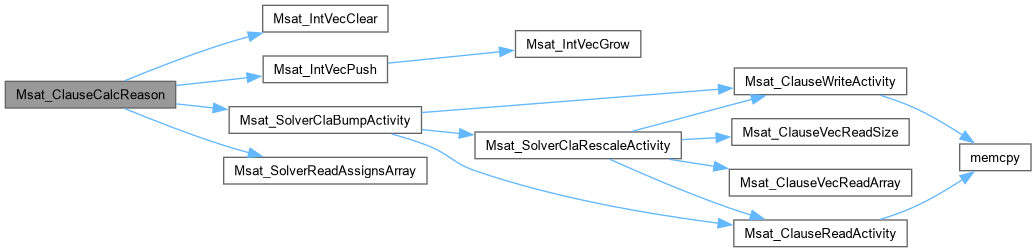
Here is the call graph for this function:

◆ Msat_ClauseComputeTruth()

unsigned Msat_ClauseComputeTruth ( Msat_Solver_t * p,
Msat_Clause_t * pC )
extern

◆ Msat_ClauseCreate()

int Msat_ClauseCreate ( Msat_Solver_t * p,
Msat_IntVec_t * vLits,
int fLearned,
Msat_Clause_t ** pClause_out )
extern

FUNCTION DEFINITIONS ///.

Function*************************************************************

Synopsis [Creates a new clause.]

Description [Returns FALSE if top-level conflict detected (must be handled); TRUE otherwise. 'pClause_out' may be set to NULL if clause is already satisfied by the top-level assignment.]

SideEffects []

SeeAlso []

Definition at line 58 of file msatClause.c.
59{
60 int * pAssigns = Msat_SolverReadAssignsArray(p);
61 Msat_ClauseVec_t ** pvWatched;
62 Msat_Clause_t * pC;
63 int * pLits;
64 int nLits, i, j;
65 int nBytes;
67 int Sign;
68
69 *pClause_out = NULL;
70
71 nLits = Msat_IntVecReadSize(vLits);
72 pLits = Msat_IntVecReadArray(vLits);
73
74 if ( !fLearned )
75 {
76 int * pSeen = Msat_SolverReadSeenArray( p );
77 int nSeenId;
79 // sorting literals makes the code trace-equivalent
80 // with to the original C++ solver
81 Msat_IntVecSort( vLits, 0 );
82 // increment the counter of seen twice
83 nSeenId = Msat_SolverIncrementSeenId( p );
84 nSeenId = Msat_SolverIncrementSeenId( p );
85 // nSeenId - 1 stands for negative
86 // nSeenId stands for positive
87 // Remove false literals
88
89 // there is a bug here!!!!
90 // when the same var in opposite polarities is given, it drops one polarity!!!
91
92 for ( i = j = 0; i < nLits; i++ ) {
93 // get the corresponding variable
94 Var = MSAT_LIT2VAR(pLits[i]);
95 Sign = MSAT_LITSIGN(pLits[i]); // Sign=0 for positive
96 // check if we already saw this variable in the this clause
97 if ( pSeen[Var] >= nSeenId - 1 )
98 {
99 if ( (pSeen[Var] != nSeenId) == Sign ) // the same lit
100 continue;
101 return 1; // two opposite polarity lits -- don't add the clause
102 }
103 // mark the variable as seen
104 pSeen[Var] = nSeenId - !Sign;
105
106 // analize the value of this literal
107 if ( pAssigns[Var] != MSAT_VAR_UNASSIGNED )
108 {
109 if ( pAssigns[Var] == pLits[i] )
110 return 1; // the clause is always true -- don't add anything
111 // the literal has no impact - skip it
112 continue;
113 }
114 // otherwise, add this literal to the clause
115 pLits[j++] = pLits[i];
116 }
117 Msat_IntVecShrink( vLits, j );
118 nLits = j;
119/*
120 // the problem with this code is that performance is very
121 // sensitive to the ordering of adjacency lits
122 // the best ordering requires fanins first, next fanouts
123 // this ordering is more convenient to make from FRAIG
124
125 // create the adjacency information
126 if ( nLits > 2 )
127 {
128 Msat_Var_t VarI, VarJ;
129 Msat_IntVec_t * pAdjI, * pAdjJ;
130
131 for ( i = 0; i < nLits; i++ )
132 {
133 VarI = MSAT_LIT2VAR(pLits[i]);
134 pAdjI = (Msat_IntVec_t *)p->vAdjacents->pArray[VarI];
135
136 for ( j = i+1; j < nLits; j++ )
137 {
138 VarJ = MSAT_LIT2VAR(pLits[j]);
139 pAdjJ = (Msat_IntVec_t *)p->vAdjacents->pArray[VarJ];
140
141 Msat_IntVecPushUniqueOrder( pAdjI, VarJ, 1 );
142 Msat_IntVecPushUniqueOrder( pAdjJ, VarI, 1 );
143 }
144 }
145 }
146*/
147 }
148 // 'vLits' is now the (possibly) reduced vector of literals.
149 if ( nLits == 0 )
150 return 0;
151 if ( nLits == 1 )
152 return Msat_SolverEnqueue( p, pLits[0], NULL );
153
154 // Allocate clause:
155// nBytes = sizeof(unsigned)*(nLits + 1 + (int)fLearned);
156 nBytes = sizeof(unsigned)*(nLits + 2 + (int)fLearned);
157#ifdef USE_SYSTEM_MEMORY_MANAGEMENT
158 pC = (Msat_Clause_t *)ABC_ALLOC( char, nBytes );
159#else
161#endif
162 pC->Num = p->nClauses++;
163 pC->fTypeA = 0;
164 pC->fMark = 0;
165 pC->fLearned = fLearned;
166 pC->nSize = nLits;
167 pC->nSizeAlloc = nBytes;
168 memcpy( pC->pData, pLits, sizeof(int)*nLits );
169
170 // For learnt clauses only:
171 if ( fLearned )
172 {
173 int * pLevel = Msat_SolverReadDecisionLevelArray( p );
174 int iLevelMax, iLevelCur, iLitMax;
175
176 // Put the second watch on the literal with highest decision level:
177 iLitMax = 1;
178 iLevelMax = pLevel[ MSAT_LIT2VAR(pLits[1]) ];
179 for ( i = 2; i < nLits; i++ )
180 {
181 iLevelCur = pLevel[ MSAT_LIT2VAR(pLits[i]) ];
182 assert( iLevelCur != -1 );
183 if ( iLevelMax < iLevelCur )
184 // this is very strange - shouldn't it be???
185 // if ( iLevelMax > iLevelCur )
186 iLevelMax = iLevelCur, iLitMax = i;
187 }
188 pC->pData[1] = pLits[iLitMax];
189 pC->pData[iLitMax] = pLits[1];
190
191 // Bumping:
192 // (newly learnt clauses should be considered active)
193 Msat_ClauseWriteActivity( pC, 0.0 );
195// if ( nLits < 20 )
196 for ( i = 0; i < nLits; i++ )
197 {
198 Msat_SolverVarBumpActivity( p, pLits[i] );
199// Msat_SolverVarBumpActivity( p, pLits[i] );
200// p->pFreq[ MSAT_LIT2VAR(pLits[i]) ]++;
201 }
202 }
203
204 // Store clause:
205 pvWatched = Msat_SolverReadWatchedArray( p );
206 Msat_ClauseVecPush( pvWatched[ MSAT_LITNOT(pC->pData[0]) ], pC );
207 Msat_ClauseVecPush( pvWatched[ MSAT_LITNOT(pC->pData[1]) ], pC );
208 *pClause_out = pC;
209 return 1;
210}
#define ABC_ALLOC(type, num)
Definition abc_global.h:264
int Var
Definition exorList.c:228
ABC_NAMESPACE_IMPL_START void Msat_SolverVarBumpActivity(Msat_Solver_t *p, Msat_Lit_t Lit)
DECLARATIONS ///.
void Msat_ClauseVecPush(Msat_ClauseVec_t *p, Msat_Clause_t *Entry)
void Msat_ClauseWriteActivity(Msat_Clause_t *pC, float Num)
Definition msatClause.c:314
#define MSAT_VAR_UNASSIGNED
Definition msatInt.h:68
char * Msat_MmStepEntryFetch(Msat_MmStep_t *p, int nBytes)
Definition msatMem.c:479
int Msat_SolverReadDecisionLevel(Msat_Solver_t *p)
Msat_MmStep_t * Msat_SolverReadMem(Msat_Solver_t *p)
typedefABC_NAMESPACE_HEADER_START struct Msat_Clause_t_ Msat_Clause_t
INCLUDES ///.
Definition msatInt.h:57
Msat_ClauseVec_t ** Msat_SolverReadWatchedArray(Msat_Solver_t *p)
int Msat_Var_t
Definition msatInt.h:66
int * Msat_SolverReadDecisionLevelArray(Msat_Solver_t *p)
int * Msat_SolverReadSeenArray(Msat_Solver_t *p)
int Msat_SolverIncrementSeenId(Msat_Solver_t *p)
int Msat_SolverEnqueue(Msat_Solver_t *p, Msat_Lit_t Lit, Msat_Clause_t *pC)
struct Msat_ClauseVec_t_ Msat_ClauseVec_t
Definition msat.h:46
void Msat_IntVecSort(Msat_IntVec_t *p, int fReverse)
Definition msatVec.c:442
void Msat_IntVecShrink(Msat_IntVec_t *p, int nSizeNew)
Definition msatVec.c:318
int Msat_IntVecReadSize(Msat_IntVec_t *p)
Definition msatVec.c:233
int * Msat_IntVecReadArray(Msat_IntVec_t *p)
Definition msatVec.c:217
char * memcpy()
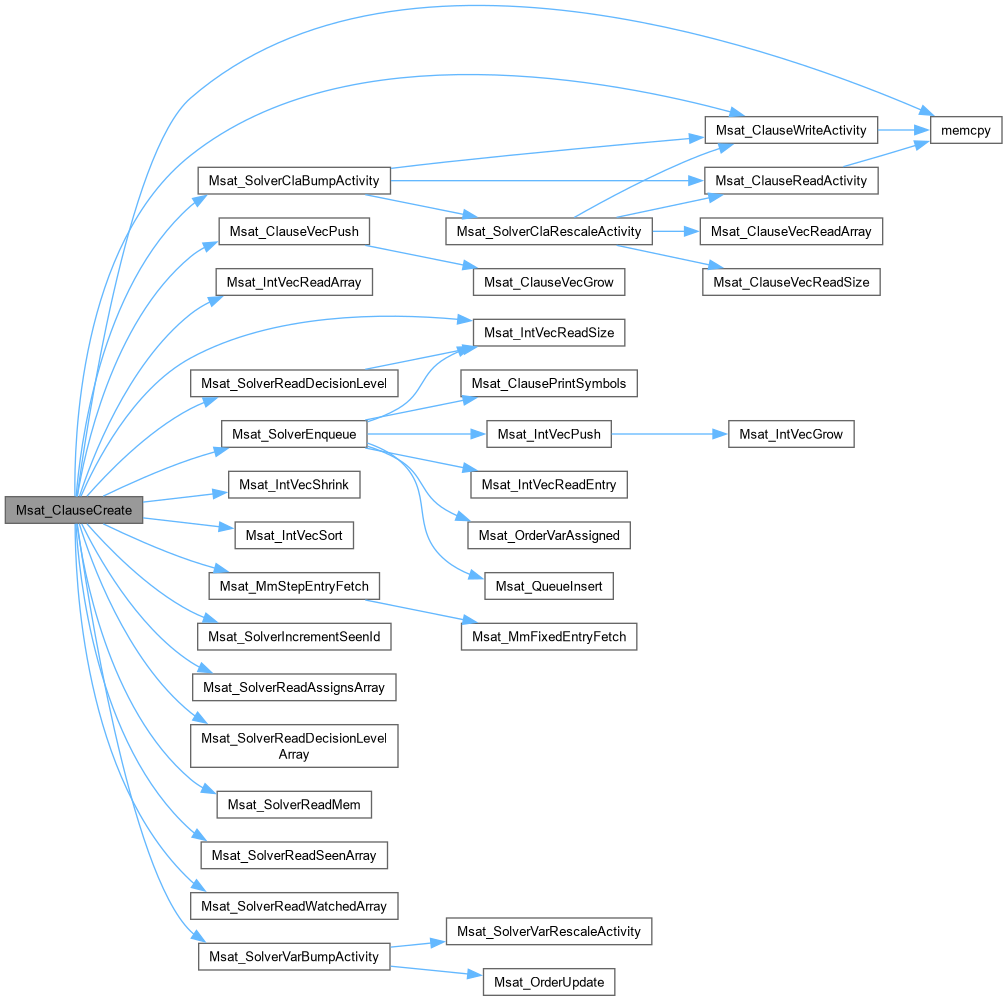
Here is the call graph for this function:
Here is the caller graph for this function:

◆ Msat_ClauseCreateFake()

Msat_Clause_t * Msat_ClauseCreateFake ( Msat_Solver_t * p,
Msat_IntVec_t * vLits )
extern

◆ Msat_ClauseCreateFakeLit()

Msat_Clause_t * Msat_ClauseCreateFakeLit ( Msat_Solver_t * p,
Msat_Lit_t Lit )
extern

◆ Msat_ClauseFree()

void Msat_ClauseFree ( Msat_Solver_t * p,
Msat_Clause_t * pC,
int fRemoveWatched )
extern

Function*************************************************************

Synopsis [Deallocates the clause.]

Description []

SideEffects []

SeeAlso []

Definition at line 223 of file msatClause.c.
224{
225 if ( fRemoveWatched )
226 {
227 Msat_Lit_t Lit;
228 Msat_ClauseVec_t ** pvWatched;
229 pvWatched = Msat_SolverReadWatchedArray( p );
230 Lit = MSAT_LITNOT( pC->pData[0] );
231 Msat_ClauseRemoveWatch( pvWatched[Lit], pC );
232 Lit = MSAT_LITNOT( pC->pData[1] );
233 Msat_ClauseRemoveWatch( pvWatched[Lit], pC );
234 }
235
236#ifdef USE_SYSTEM_MEMORY_MANAGEMENT
237 ABC_FREE( pC );
238#else
239 Msat_MmStepEntryRecycle( Msat_SolverReadMem(p), (char *)pC, pC->nSizeAlloc );
240#endif
241
242}
#define ABC_FREE(obj)
Definition abc_global.h:267
void Msat_ClauseRemoveWatch(Msat_ClauseVec_t *vClauses, Msat_Clause_t *pC)
Definition msatClause.c:444
void Msat_MmStepEntryRecycle(Msat_MmStep_t *p, char *pEntry, int nBytes)
Definition msatMem.c:503
int Msat_Lit_t
Definition msatInt.h:65
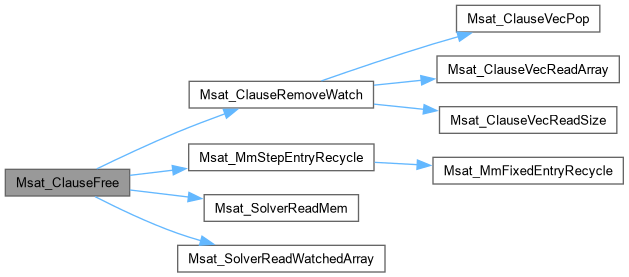
Here is the call graph for this function:
Here is the caller graph for this function:

◆ Msat_ClauseIsLocked()

int Msat_ClauseIsLocked ( Msat_Solver_t * p,
Msat_Clause_t * pC )
extern

Function*************************************************************

Synopsis [Checks whether the learned clause is locked.]

Description [The clause may be locked if it is the reason of a recent conflict. Such clause cannot be removed from the database.]

SideEffects []

SeeAlso []

Definition at line 278 of file msatClause.c.

279{
281 return (int )(pReasons[MSAT_LIT2VAR(pC->pData[0])] == pC);
282}
Msat_Clause_t ** Msat_SolverReadReasonArray(Msat_Solver_t *p)
Here is the call graph for this function:
Here is the caller graph for this function:

◆ Msat_ClausePrint()

void Msat_ClausePrint ( Msat_Clause_t * pC)
extern

Function*************************************************************

Synopsis [Prints the given clause.]

Description []

SideEffects []

SeeAlso []

Definition at line 468 of file msatClause.c.

469{
470 int i;
471 if ( pC == NULL )
472 printf( "NULL pointer" );
473 else
474 {
475 if ( pC->fLearned )
476 printf( "Act = %.4f ", Msat_ClauseReadActivity(pC) );
477 for ( i = 0; i < (int)pC->nSize; i++ )
478 printf( " %s%d", ((pC->pData[i]&1)? "-": ""), pC->pData[i]/2 + 1 );
479 }
480 printf( "\n" );
481}
float Msat_ClauseReadActivity(Msat_Clause_t *pC)
Definition msatClause.c:295
Here is the call graph for this function:
Here is the caller graph for this function:

◆ Msat_ClausePrintSymbols()

void Msat_ClausePrintSymbols ( Msat_Clause_t * pC)
extern

Function*************************************************************

Synopsis [Prints the given clause.]

Description []

SideEffects []

SeeAlso []

Definition at line 515 of file msatClause.c.

516{
517 int i;
518 if ( pC == NULL )
519 printf( "NULL pointer" );
520 else
521 {
522// if ( pC->fLearned )
523// printf( "Act = %.4f ", Msat_ClauseReadActivity(pC) );
524 for ( i = 0; i < (int)pC->nSize; i++ )
525 printf(" " L_LIT, L_lit(pC->pData[i]));
526 }
527 printf( "\n" );
528}
#define L_lit(p)
Definition satSolver.c:43
#define L_LIT
Definition satSolver.c:42
Here is the caller graph for this function:

◆ Msat_ClausePropagate()

int Msat_ClausePropagate ( Msat_Clause_t * pC,
Msat_Lit_t Lit,
int * pAssigns,
Msat_Lit_t * pLit_out )
extern

Function*************************************************************

Synopsis [Propages the assignment.]

Description [The literal that has become true (Lit) is given to this procedure. The array of current variable assignments is given for efficiency. The output literal (pLit_out) can be the second watched literal (if TRUE is returned) or the conflict literal (if FALSE is returned). This messy interface is used to improve performance. This procedure accounts for ~50% of the runtime of the solver.]

SideEffects []

SeeAlso []

Definition at line 335 of file msatClause.c.

336{
337 // make sure the false literal is pC->pData[1]
338 Msat_Lit_t LitF = MSAT_LITNOT(Lit);
339 if ( pC->pData[0] == LitF )
340 pC->pData[0] = pC->pData[1], pC->pData[1] = LitF;
341 assert( pC->pData[1] == LitF );
342 // if the 0-th watch is true, clause is already satisfied
343 if ( pAssigns[MSAT_LIT2VAR(pC->pData[0])] == pC->pData[0] )
344 return 1;
345 // look for a new watch
346 if ( pC->nSize > 2 )
347 {
348 int i;
349 for ( i = 2; i < (int)pC->nSize; i++ )
350 if ( pAssigns[MSAT_LIT2VAR(pC->pData[i])] != MSAT_LITNOT(pC->pData[i]) )
351 {
352 pC->pData[1] = pC->pData[i], pC->pData[i] = LitF;
353 *pLit_out = MSAT_LITNOT(pC->pData[1]);
354 return 1;
355 }
356 }
357 // clause is unit under assignment
358 *pLit_out = pC->pData[0];
359 return 0;
360}
Here is the caller graph for this function:

◆ Msat_ClauseReadActivity()

float Msat_ClauseReadActivity ( Msat_Clause_t * pC)
extern

Function*************************************************************

Synopsis [Reads the activity of the given clause.]

Description []

SideEffects []

SeeAlso []

Definition at line 295 of file msatClause.c.

296{
297 float f;
298
299 memcpy( &f, pC->pData + pC->nSize, sizeof (f));
300 return f;
301}
Here is the call graph for this function:
Here is the caller graph for this function:

◆ Msat_ClauseReadLearned()

int Msat_ClauseReadLearned ( Msat_Clause_t * pC)
extern

Function*************************************************************

Synopsis [Access the data field of the clause.]

Description []

SideEffects []

SeeAlso []

Definition at line 255 of file msatClause.c.

255{ return pC->fLearned; }

◆ Msat_ClauseReadLits()

int * Msat_ClauseReadLits ( Msat_Clause_t * pC)
extern

Definition at line 257 of file msatClause.c.

257{ return pC->pData; }

◆ Msat_ClauseReadMark()

int Msat_ClauseReadMark ( Msat_Clause_t * pC)
extern

Definition at line 258 of file msatClause.c.

258{ return pC->fMark; }

◆ Msat_ClauseReadNum()

int Msat_ClauseReadNum ( Msat_Clause_t * pC)
extern

Definition at line 259 of file msatClause.c.

259{ return pC->Num; }

◆ Msat_ClauseReadSize()

int Msat_ClauseReadSize ( Msat_Clause_t * pC)
extern

Definition at line 256 of file msatClause.c.

256{ return pC->nSize; }

◆ Msat_ClauseReadTypeA()

int Msat_ClauseReadTypeA ( Msat_Clause_t * pC)
extern

Definition at line 260 of file msatClause.c.

260{ return pC->fTypeA; }

◆ Msat_ClauseRemoveWatch()

void Msat_ClauseRemoveWatch ( Msat_ClauseVec_t * vClauses,
Msat_Clause_t * pC )
extern

Function*************************************************************

Synopsis [Removes the given clause from the watched list.]

Description []

SideEffects []

SeeAlso []

Definition at line 444 of file msatClause.c.
445{
446 Msat_Clause_t ** pClauses;
447 int nClauses, i;
448 nClauses = Msat_ClauseVecReadSize( vClauses );
449 pClauses = Msat_ClauseVecReadArray( vClauses );
450 for ( i = 0; pClauses[i] != pC; i++ )
451 assert( i < nClauses );
452 for ( ; i < nClauses - 1; i++ )
453 pClauses[i] = pClauses[i+1];
454 Msat_ClauseVecPop( vClauses );
455}
int Msat_ClauseVecReadSize(Msat_ClauseVec_t *p)
Msat_Clause_t ** Msat_ClauseVecReadArray(Msat_ClauseVec_t *p)
Msat_Clause_t * Msat_ClauseVecPop(Msat_ClauseVec_t *p)
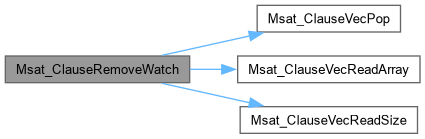
Here is the call graph for this function:
Here is the caller graph for this function:

◆ Msat_ClauseSetMark()

void Msat_ClauseSetMark ( Msat_Clause_t * pC,
int fMark )
extern

Definition at line 262 of file msatClause.c.

262{ pC->fMark = fMark; }

◆ Msat_ClauseSetNum()

void Msat_ClauseSetNum ( Msat_Clause_t * pC,
int Num )
extern

Definition at line 263 of file msatClause.c.

263{ pC->Num = Num; }
Here is the caller graph for this function:

◆ Msat_ClauseSetTypeA()

void Msat_ClauseSetTypeA ( Msat_Clause_t * pC,
int fTypeA )
extern

Definition at line 264 of file msatClause.c.

264{ pC->fTypeA = fTypeA; }
Here is the caller graph for this function:

◆ Msat_ClauseSimplify()

int Msat_ClauseSimplify ( Msat_Clause_t * pC,
int * pAssigns )
extern

Function*************************************************************

Synopsis [Simplifies the clause.]

Description [Assumes everything has been propagated! (esp. watches in clauses are NOT unsatisfied)]

SideEffects []

SeeAlso []

Definition at line 374 of file msatClause.c.

375{
377 int i, j;
378 for ( i = j = 0; i < (int)pC->nSize; i++ )
379 {
380 Var = MSAT_LIT2VAR(pC->pData[i]);
381 if ( pAssigns[Var] == MSAT_VAR_UNASSIGNED )
382 {
383 pC->pData[j++] = pC->pData[i];
384 continue;
385 }
386 if ( pAssigns[Var] == pC->pData[i] )
387 return 1;
388 // otherwise, the value of the literal is false
389 // make sure, this literal is not watched
390 assert( i >= 2 );
391 }
392 // if the size has changed, update it and move activity
393 if ( j < (int)pC->nSize )
394 {
395 float Activ = Msat_ClauseReadActivity(pC);
396 pC->nSize = j;
397 Msat_ClauseWriteActivity(pC, Activ);
398 }
399 return 0;
400}
Here is the call graph for this function:
Here is the caller graph for this function:

◆ Msat_ClauseVecAlloc()

Msat_ClauseVec_t * Msat_ClauseVecAlloc ( int nCap)
extern

DECLARATIONS ///.

CFile****************************************************************

FileName [msatClauseVec.c]

PackageName [A C version of SAT solver MINISAT, originally developed in C++ by Niklas Een and Niklas Sorensson, Chalmers University of Technology, Sweden: http://www.cs.chalmers.se/~een/Satzoo.]

Synopsis [Procedures working with arrays of SAT clauses.]

Author [Alan Mishchenko alanm.nosp@m.i@ee.nosp@m.cs.be.nosp@m.rkel.nosp@m.ey.ed.nosp@m.u]

Affiliation [UC Berkeley]

Date [Ver. 1.0. Started - January 1, 2004.]

Revision [

Id
msatClauseVec.c,v 1.0 2004/01/01 1:00:00 alanmi Exp

] FUNCTION DEFINITIONS /// Function*************************************************************

Synopsis [Allocates a vector with the given capacity.]

Description []

SideEffects []

SeeAlso []

Definition at line 45 of file msatClauseVec.c.

46{
49 if ( nCap > 0 && nCap < 16 )
50 nCap = 16;
51 p->nSize = 0;
52 p->nCap = nCap;
53 p->pArray = p->nCap? ABC_ALLOC( Msat_Clause_t *, p->nCap ) : NULL;
54 return p;
55}
Here is the caller graph for this function:

◆ Msat_ClauseVecClear()

void Msat_ClauseVecClear ( Msat_ClauseVec_t * p)
extern

Function*************************************************************

Synopsis []

Description []

SideEffects []

SeeAlso []

Definition at line 153 of file msatClauseVec.c.

154{
155 p->nSize = 0;
156}
Here is the caller graph for this function:

◆ Msat_ClauseVecFree()

void Msat_ClauseVecFree ( Msat_ClauseVec_t * p)
extern

Function*************************************************************

Synopsis []

Description []

SideEffects []

SeeAlso []

Definition at line 68 of file msatClauseVec.c.

69{
70 ABC_FREE( p->pArray );
71 ABC_FREE( p );
72}
Here is the caller graph for this function:

◆ Msat_ClauseVecGrow()

void Msat_ClauseVecGrow ( Msat_ClauseVec_t * p,
int nCapMin )
extern

Function*************************************************************

Synopsis [Resizes the vector to the given capacity.]

Description []

SideEffects []

SeeAlso []

Definition at line 117 of file msatClauseVec.c.

118{
119 if ( p->nCap >= nCapMin )
120 return;
121 p->pArray = ABC_REALLOC( Msat_Clause_t *, p->pArray, nCapMin );
122 p->nCap = nCapMin;
123}
#define ABC_REALLOC(type, obj, num)
Definition abc_global.h:268
Here is the caller graph for this function:

◆ Msat_ClauseVecPop()

Msat_Clause_t * Msat_ClauseVecPop ( Msat_ClauseVec_t * p)
extern

Function*************************************************************

Synopsis []

Description []

SideEffects []

SeeAlso []

Definition at line 192 of file msatClauseVec.c.

193{
194 return p->pArray[--p->nSize];
195}
Here is the caller graph for this function:

◆ Msat_ClauseVecPush()

void Msat_ClauseVecPush ( Msat_ClauseVec_t * p,
Msat_Clause_t * Entry )
extern

Function*************************************************************

Synopsis []

Description []

SideEffects []

SeeAlso []

Definition at line 169 of file msatClauseVec.c.

170{
171 if ( p->nSize == p->nCap )
172 {
173 if ( p->nCap < 16 )
174 Msat_ClauseVecGrow( p, 16 );
175 else
176 Msat_ClauseVecGrow( p, 2 * p->nCap );
177 }
178 p->pArray[p->nSize++] = Entry;
179}
void Msat_ClauseVecGrow(Msat_ClauseVec_t *p, int nCapMin)
Here is the call graph for this function:
Here is the caller graph for this function:

◆ Msat_ClauseVecReadArray()

Msat_Clause_t ** Msat_ClauseVecReadArray ( Msat_ClauseVec_t * p)
extern

Function*************************************************************

Synopsis []

Description []

SideEffects []

SeeAlso []

Definition at line 85 of file msatClauseVec.c.
86{
87 return p->pArray;
88}
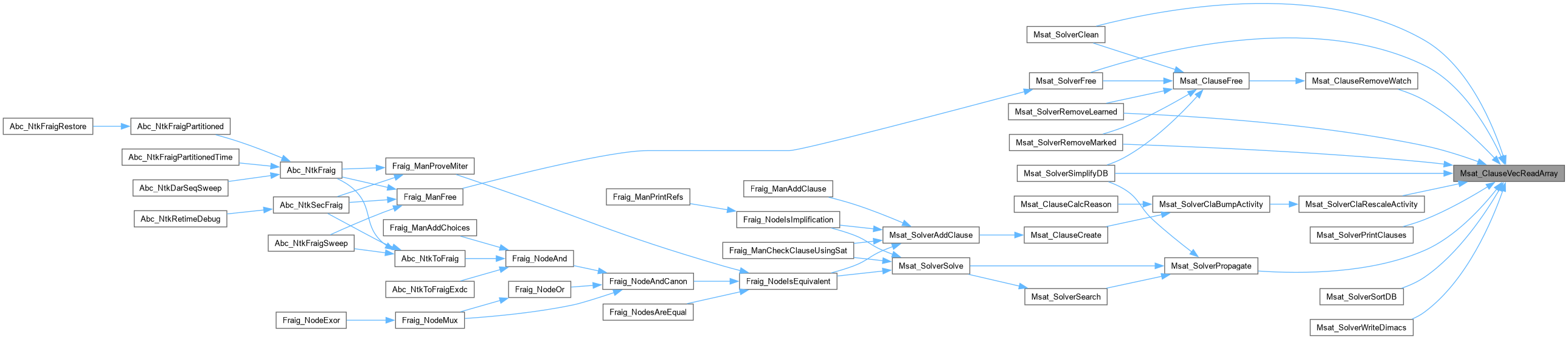
Here is the caller graph for this function:

◆ Msat_ClauseVecReadEntry()

Msat_Clause_t * Msat_ClauseVecReadEntry ( Msat_ClauseVec_t * p,
int i )
extern

Function*************************************************************

Synopsis []

Description []

SideEffects []

SeeAlso []

Definition at line 225 of file msatClauseVec.c.
226{
227 assert( i >= 0 && i < p->nSize );
228 return p->pArray[i];
229}
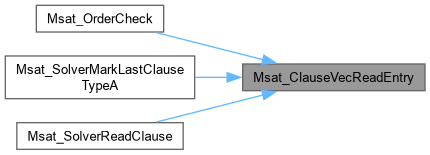
Here is the caller graph for this function:

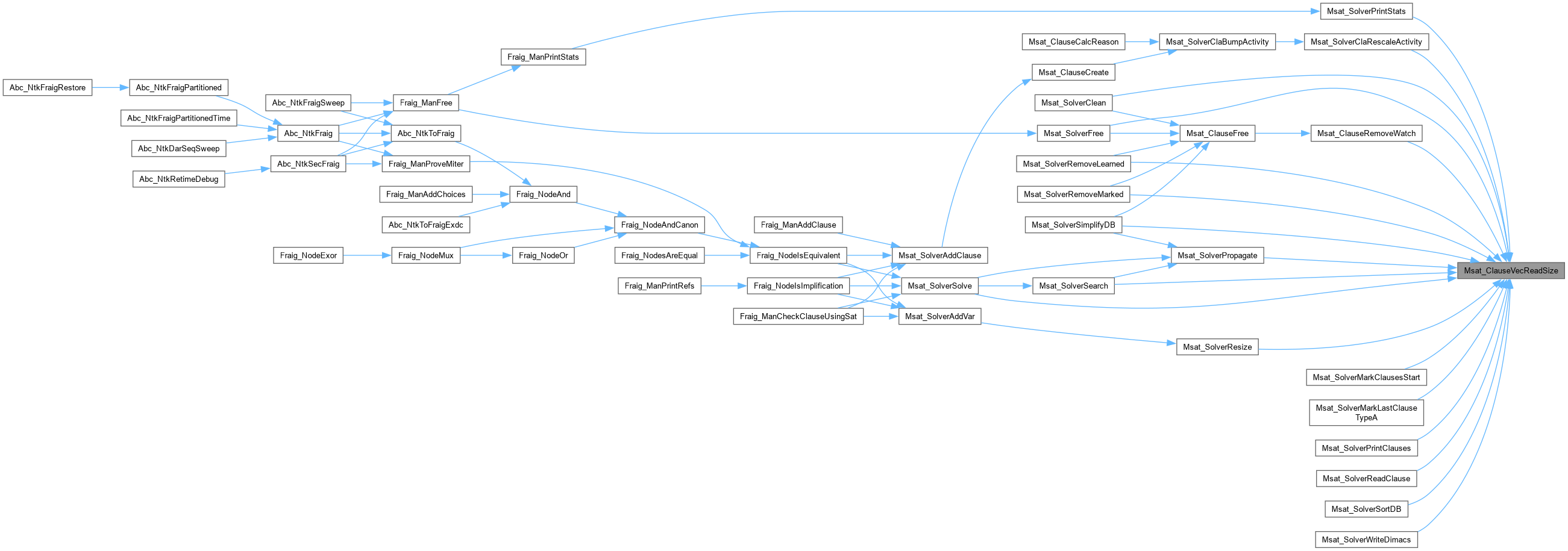
◆ Msat_ClauseVecReadSize()

int Msat_ClauseVecReadSize ( Msat_ClauseVec_t * p)
extern

Function*************************************************************

Synopsis []

Description []

SideEffects []

SeeAlso []

Definition at line 101 of file msatClauseVec.c.
102{
103 return p->nSize;
104}
Here is the caller graph for this function:

◆ Msat_ClauseVecShrink()

void Msat_ClauseVecShrink ( Msat_ClauseVec_t * p,
int nSizeNew )
extern

Function*************************************************************

Synopsis []

Description []

SideEffects []

SeeAlso []

Definition at line 136 of file msatClauseVec.c.

137{
138 assert( p->nSize >= nSizeNew );
139 p->nSize = nSizeNew;
140}
Here is the caller graph for this function:

◆ Msat_ClauseVecWriteEntry()

void Msat_ClauseVecWriteEntry ( Msat_ClauseVec_t * p,
int i,
Msat_Clause_t * Entry )
extern

Function*************************************************************

Synopsis []

Description []

SideEffects []

SeeAlso []

Definition at line 208 of file msatClauseVec.c.

209{
210 assert( i >= 0 && i < p->nSize );
211 p->pArray[i] = Entry;
212}

◆ Msat_ClauseWriteActivity()

void Msat_ClauseWriteActivity ( Msat_Clause_t * pC,
float Num )
extern

Function*************************************************************

Synopsis [Sets the activity of the clause.]

Description []

SideEffects []

SeeAlso []

Definition at line 314 of file msatClause.c.

315{
316 memcpy( pC->pData + pC->nSize, &Num, sizeof (Num) );
317}
Here is the call graph for this function:
Here is the caller graph for this function:

◆ Msat_ClauseWriteDimacs()

void Msat_ClauseWriteDimacs ( FILE * pFile,
Msat_Clause_t * pC,
int fIncrement )
extern

Function*************************************************************

Synopsis [Writes the given clause in a file in DIMACS format.]

Description []

SideEffects []

SeeAlso []

Definition at line 494 of file msatClause.c.

495{
496 int i;
497 for ( i = 0; i < (int)pC->nSize; i++ )
498 fprintf( pFile, "%s%d ", ((pC->pData[i]&1)? "-": ""), pC->pData[i]/2 + (int)(fIncrement>0) );
499 if ( fIncrement )
500 fprintf( pFile, "0" );
501 fprintf( pFile, "\n" );
502}
Here is the caller graph for this function:

◆ Msat_MmFixedEntryFetch()

char * Msat_MmFixedEntryFetch ( Msat_MmFixed_t * p)
extern

Function*************************************************************

Synopsis []

Description []

SideEffects []

SeeAlso []

Definition at line 161 of file msatMem.c.

162{
163 char * pTemp;
164 int i;
165
166 // check if there are still free entries
167 if ( p->nEntriesUsed == p->nEntriesAlloc )
168 { // need to allocate more entries
169 assert( p->pEntriesFree == NULL );
170 if ( p->nChunks == p->nChunksAlloc )
171 {
172 p->nChunksAlloc *= 2;
173 p->pChunks = ABC_REALLOC( char *, p->pChunks, p->nChunksAlloc );
174 }
175 p->pEntriesFree = ABC_ALLOC( char, p->nEntrySize * p->nChunkSize );
176 p->nMemoryAlloc += p->nEntrySize * p->nChunkSize;
177 // transform these entries into a linked list
178 pTemp = p->pEntriesFree;
179 for ( i = 1; i < p->nChunkSize; i++ )
180 {
181 *((char **)pTemp) = pTemp + p->nEntrySize;
182 pTemp += p->nEntrySize;
183 }
184 // set the last link
185 *((char **)pTemp) = NULL;
186 // add the chunk to the chunk storage
187 p->pChunks[ p->nChunks++ ] = p->pEntriesFree;
188 // add to the number of entries allocated
189 p->nEntriesAlloc += p->nChunkSize;
190 }
191 // incrememt the counter of used entries
192 p->nEntriesUsed++;
193 if ( p->nEntriesMax < p->nEntriesUsed )
194 p->nEntriesMax = p->nEntriesUsed;
195 // return the first entry in the free entry list
196 pTemp = p->pEntriesFree;
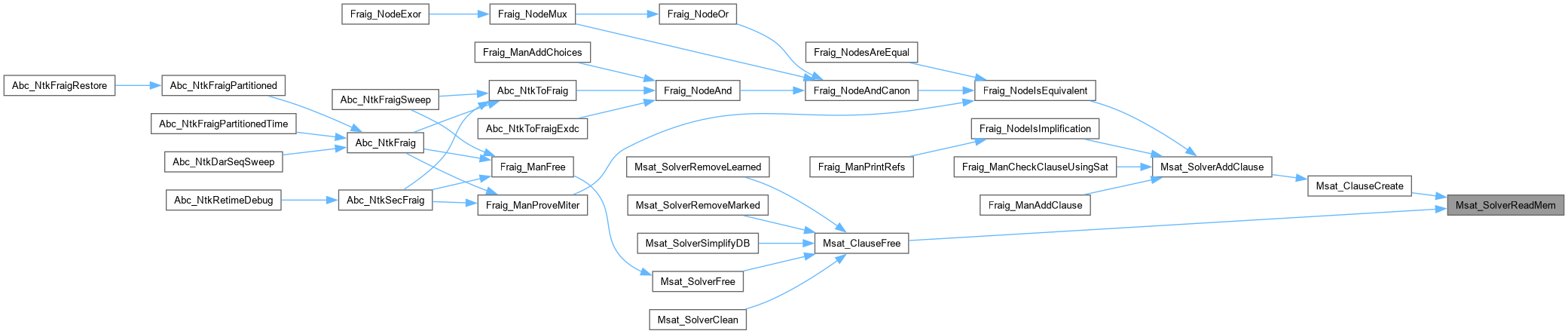
197 p->pEntriesFree = *((char **)pTemp);
198 return pTemp;
199}
Here is the caller graph for this function:

◆ Msat_MmFixedEntryRecycle()

void Msat_MmFixedEntryRecycle ( Msat_MmFixed_t * p,
char * pEntry )
extern

Function*************************************************************

Synopsis []

Description []

SideEffects []

SeeAlso []

Definition at line 212 of file msatMem.c.

213{
214 // decrement the counter of used entries
215 p->nEntriesUsed--;
216 // add the entry to the linked list of free entries
217 *((char **)pEntry) = p->pEntriesFree;
218 p->pEntriesFree = pEntry;
219}
Here is the caller graph for this function:

◆ Msat_MmFixedReadMemUsage()

int Msat_MmFixedReadMemUsage ( Msat_MmFixed_t * p)
extern

Function*************************************************************

Synopsis []

Description []

SideEffects []

SeeAlso []

Definition at line 270 of file msatMem.c.

271{
272 return p->nMemoryAlloc;
273}

◆ Msat_MmFixedRestart()

void Msat_MmFixedRestart ( Msat_MmFixed_t * p)
extern

Function*************************************************************

Synopsis []

Description [Relocates all the memory except the first chunk.]

SideEffects []

SeeAlso []

Definition at line 232 of file msatMem.c.

233{
234 int i;
235 char * pTemp;
236
237 // deallocate all chunks except the first one
238 for ( i = 1; i < p->nChunks; i++ )
239 ABC_FREE( p->pChunks[i] );
240 p->nChunks = 1;
241 // transform these entries into a linked list
242 pTemp = p->pChunks[0];
243 for ( i = 1; i < p->nChunkSize; i++ )
244 {
245 *((char **)pTemp) = pTemp + p->nEntrySize;
246 pTemp += p->nEntrySize;
247 }
248 // set the last link
249 *((char **)pTemp) = NULL;
250 // set the free entry list
251 p->pEntriesFree = p->pChunks[0];
252 // set the correct statistics
253 p->nMemoryAlloc = p->nEntrySize * p->nChunkSize;
254 p->nMemoryUsed = 0;
255 p->nEntriesAlloc = p->nChunkSize;
256 p->nEntriesUsed = 0;
257}

◆ Msat_MmFixedStart()

Msat_MmFixed_t * Msat_MmFixedStart ( int nEntrySize)
extern

FUNCTION DEFINITIONS ///.

Function*************************************************************

Synopsis [Allocates memory pieces of fixed size.]

Description [The size of the chunk is computed as the minimum of 1024 entries and 64K. Can only work with entry size at least 4 byte long.]

SideEffects []

SeeAlso []

Definition at line 93 of file msatMem.c.

94{
96
98 memset( p, 0, sizeof(Msat_MmFixed_t) );
99
100 p->nEntrySize = nEntrySize;
101 p->nEntriesAlloc = 0;
102 p->nEntriesUsed = 0;
103 p->pEntriesFree = NULL;
104
105 if ( nEntrySize * (1 << 10) < (1<<16) )
106 p->nChunkSize = (1 << 10);
107 else
108 p->nChunkSize = (1<<16) / nEntrySize;
109 if ( p->nChunkSize < 8 )
110 p->nChunkSize = 8;
111
112 p->nChunksAlloc = 64;
113 p->nChunks = 0;
114 p->pChunks = ABC_ALLOC( char *, p->nChunksAlloc );
115
116 p->nMemoryUsed = 0;
117 p->nMemoryAlloc = 0;
118 return p;
119}
struct Msat_MmFixed_t_ Msat_MmFixed_t
Definition msatInt.h:61
char * memset()
Here is the call graph for this function:
Here is the caller graph for this function:

◆ Msat_MmFixedStop()

void Msat_MmFixedStop ( Msat_MmFixed_t * p,
int fVerbose )
extern

Function*************************************************************

Synopsis []

Description []

SideEffects []

SeeAlso []

Definition at line 132 of file msatMem.c.

133{
134 int i;
135 if ( p == NULL )
136 return;
137 if ( fVerbose )
138 {
139 printf( "Fixed memory manager: Entry = %5d. Chunk = %5d. Chunks used = %5d.\n",
140 p->nEntrySize, p->nChunkSize, p->nChunks );
141 printf( " Entries used = %8d. Entries peak = %8d. Memory used = %8d. Memory alloc = %8d.\n",
142 p->nEntriesUsed, p->nEntriesMax, p->nEntrySize * p->nEntriesUsed, p->nMemoryAlloc );
143 }
144 for ( i = 0; i < p->nChunks; i++ )
145 ABC_FREE( p->pChunks[i] );
146 ABC_FREE( p->pChunks );
147 ABC_FREE( p );
148}
Here is the caller graph for this function:

◆ Msat_MmFlexEntryFetch()

char * Msat_MmFlexEntryFetch ( Msat_MmFlex_t * p,
int nBytes )
extern

Function*************************************************************

Synopsis []

Description []

SideEffects []

SeeAlso []

Definition at line 349 of file msatMem.c.

350{
351 char * pTemp;
352 // check if there are still free entries
353 if ( p->pCurrent == NULL || p->pCurrent + nBytes > p->pEnd )
354 { // need to allocate more entries
355 if ( p->nChunks == p->nChunksAlloc )
356 {
357 p->nChunksAlloc *= 2;
358 p->pChunks = ABC_REALLOC( char *, p->pChunks, p->nChunksAlloc );
359 }
360 if ( nBytes > p->nChunkSize )
361 {
362 // resize the chunk size if more memory is requested than it can give
363 // (ideally, this should never happen)
364 p->nChunkSize = 2 * nBytes;
365 }
366 p->pCurrent = ABC_ALLOC( char, p->nChunkSize );
367 p->pEnd = p->pCurrent + p->nChunkSize;
368 p->nMemoryAlloc += p->nChunkSize;
369 // add the chunk to the chunk storage
370 p->pChunks[ p->nChunks++ ] = p->pCurrent;
371 }
372 assert( p->pCurrent + nBytes <= p->pEnd );
373 // increment the counter of used entries
374 p->nEntriesUsed++;
375 // keep track of the memory used
376 p->nMemoryUsed += nBytes;
377 // return the next entry
378 pTemp = p->pCurrent;
379 p->pCurrent += nBytes;
380 return pTemp;
381}

◆ Msat_MmFlexReadMemUsage()

int Msat_MmFlexReadMemUsage ( Msat_MmFlex_t * p)
extern

Function*************************************************************

Synopsis []

Description []

SideEffects []

SeeAlso []

Definition at line 394 of file msatMem.c.

395{
396 return p->nMemoryAlloc;
397}

◆ Msat_MmFlexStart()

Msat_MmFlex_t * Msat_MmFlexStart ( )
extern

Function*************************************************************

Synopsis [Allocates entries of flexible size.]

Description [Can only work with entry size at least 4 byte long.]

SideEffects []

SeeAlso []

Definition at line 288 of file msatMem.c.

289{
291
292 p = ABC_ALLOC( Msat_MmFlex_t, 1 );
293 memset( p, 0, sizeof(Msat_MmFlex_t) );
294
295 p->nEntriesUsed = 0;
296 p->pCurrent = NULL;
297 p->pEnd = NULL;
298
299 p->nChunkSize = (1 << 12);
300 p->nChunksAlloc = 64;
301 p->nChunks = 0;
302 p->pChunks = ABC_ALLOC( char *, p->nChunksAlloc );
303
304 p->nMemoryUsed = 0;
305 p->nMemoryAlloc = 0;
306 return p;
307}
struct Msat_MmFlex_t_ Msat_MmFlex_t
Definition msatInt.h:62
Here is the call graph for this function:

◆ Msat_MmFlexStop()

void Msat_MmFlexStop ( Msat_MmFlex_t * p,
int fVerbose )
extern

Function*************************************************************

Synopsis []

Description []

SideEffects []

SeeAlso []

Definition at line 320 of file msatMem.c.

321{
322 int i;
323 if ( p == NULL )
324 return;
325 if ( fVerbose )
326 {
327 printf( "Flexible memory manager: Chunk size = %d. Chunks used = %d.\n",
328 p->nChunkSize, p->nChunks );
329 printf( " Entries used = %d. Memory used = %d. Memory alloc = %d.\n",
330 p->nEntriesUsed, p->nMemoryUsed, p->nMemoryAlloc );
331 }
332 for ( i = 0; i < p->nChunks; i++ )
333 ABC_FREE( p->pChunks[i] );
334 ABC_FREE( p->pChunks );
335 ABC_FREE( p );
336}

◆ Msat_MmStepEntryFetch()

char * Msat_MmStepEntryFetch ( Msat_MmStep_t * p,
int nBytes )
extern

Function*************************************************************

Synopsis [Creates the entry.]

Description []

SideEffects []

SeeAlso []

Definition at line 479 of file msatMem.c.

480{
481 if ( nBytes == 0 )
482 return NULL;
483 if ( nBytes > p->nMapSize )
484 {
485// printf( "Allocating %d bytes.\n", nBytes );
486 return ABC_ALLOC( char, nBytes );
487 }
488 return Msat_MmFixedEntryFetch( p->pMap[nBytes] );
489}
char * Msat_MmFixedEntryFetch(Msat_MmFixed_t *p)
Definition msatMem.c:161
Here is the call graph for this function:
Here is the caller graph for this function:

◆ Msat_MmStepEntryRecycle()

void Msat_MmStepEntryRecycle ( Msat_MmStep_t * p,
char * pEntry,
int nBytes )
extern

Function*************************************************************

Synopsis [Recycles the entry.]

Description []

SideEffects []

SeeAlso []

Definition at line 503 of file msatMem.c.

504{
505 if ( nBytes == 0 )
506 return;
507 if ( nBytes > p->nMapSize )
508 {
509 ABC_FREE( pEntry );
510 return;
511 }
512 Msat_MmFixedEntryRecycle( p->pMap[nBytes], pEntry );
513}
void Msat_MmFixedEntryRecycle(Msat_MmFixed_t *p, char *pEntry)
Definition msatMem.c:212
Here is the call graph for this function:
Here is the caller graph for this function:

◆ Msat_MmStepReadMemUsage()

int Msat_MmStepReadMemUsage ( Msat_MmStep_t * p)
extern

Function*************************************************************

Synopsis []

Description []

SideEffects []

SeeAlso []

Definition at line 526 of file msatMem.c.

527{
528 int i, nMemTotal = 0;
529 for ( i = 0; i < p->nMems; i++ )
530 nMemTotal += p->pMems[i]->nMemoryAlloc;
531 return nMemTotal;
532}

◆ Msat_MmStepStart()

Msat_MmStep_t * Msat_MmStepStart ( int nSteps)
extern

Function*************************************************************

Synopsis [Starts the hierarchical memory manager.]

Description [This manager can allocate entries of any size. Iternally they are mapped into the entries with the number of bytes equal to the power of 2. The smallest entry size is 8 bytes. The next one is 16 bytes etc. So, if the user requests 6 bytes, he gets 8 byte entry. If we asks for 25 bytes, he gets 32 byte entry etc. The input parameters "nSteps" says how many fixed memory managers are employed internally. Calling this procedure with nSteps equal to 10 results in 10 hierarchically arranged internal memory managers, which can allocate up to 4096 (1Kb) entries. Requests for larger entries are handed over to malloc() and then ABC_FREE()ed.]

SideEffects []

SeeAlso []

Definition at line 423 of file msatMem.c.

424{
426 int i, k;
427 p = ABC_ALLOC( Msat_MmStep_t, 1 );
428 p->nMems = nSteps;
429 // start the fixed memory managers
430 p->pMems = ABC_ALLOC( Msat_MmFixed_t *, p->nMems );
431 for ( i = 0; i < p->nMems; i++ )
432 p->pMems[i] = Msat_MmFixedStart( (8<<i) );
433 // set up the mapping of the required memory size into the corresponding manager
434 p->nMapSize = (4<<p->nMems);
435 p->pMap = ABC_ALLOC( Msat_MmFixed_t *, p->nMapSize+1 );
436 p->pMap[0] = NULL;
437 for ( k = 1; k <= 4; k++ )
438 p->pMap[k] = p->pMems[0];
439 for ( i = 0; i < p->nMems; i++ )
440 for ( k = (4<<i)+1; k <= (8<<i); k++ )
441 p->pMap[k] = p->pMems[i];
442//for ( i = 1; i < 100; i ++ )
443//printf( "%10d: size = %10d\n", i, p->pMap[i]->nEntrySize );
444 return p;
445}
Msat_MmFixed_t * Msat_MmFixedStart(int nEntrySize)
FUNCTION DEFINITIONS ///.
Definition msatMem.c:93
struct Msat_MmStep_t_ Msat_MmStep_t
Definition msatInt.h:63
Here is the call graph for this function:
Here is the caller graph for this function:

◆ Msat_MmStepStop()

void Msat_MmStepStop ( Msat_MmStep_t * p,
int fVerbose )
extern

Function*************************************************************

Synopsis [Stops the memory manager.]

Description []

SideEffects []

SeeAlso []

Definition at line 458 of file msatMem.c.

459{
460 int i;
461 for ( i = 0; i < p->nMems; i++ )
462 Msat_MmFixedStop( p->pMems[i], fVerbose );
463 ABC_FREE( p->pMems );
464 ABC_FREE( p->pMap );
465 ABC_FREE( p );
466}
void Msat_MmFixedStop(Msat_MmFixed_t *p, int fVerbose)
Definition msatMem.c:132
Here is the call graph for this function:
Here is the caller graph for this function:

◆ Msat_OrderAlloc()

Msat_Order_t * Msat_OrderAlloc ( Msat_Solver_t * pSat)
extern

FUNCTION DEFINITIONS ///.

Function*************************************************************

Synopsis [Allocates the ordering structure.]

Description []

SideEffects []

SeeAlso []

Definition at line 78 of file msatOrderH.c.
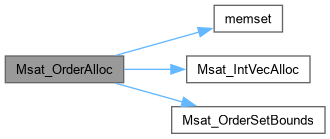
79{
81 p = ABC_ALLOC( Msat_Order_t, 1 );
82 memset( p, 0, sizeof(Msat_Order_t) );
83 p->pSat = pSat;
84 p->vIndex = Msat_IntVecAlloc( 0 );
85 p->vHeap = Msat_IntVecAlloc( 0 );
86 Msat_OrderSetBounds( p, pSat->nVarsAlloc );
87 return p;
88}
struct Msat_Order_t_ Msat_Order_t
Definition msatInt.h:59
void Msat_OrderSetBounds(Msat_Order_t *p, int nVarsMax)
Definition msatOrderH.c:101
Msat_IntVec_t * Msat_IntVecAlloc(int nCap)
FUNCTION DEFINITIONS ///.
Definition msatVec.c:48
Here is the call graph for this function:
Here is the caller graph for this function:

◆ Msat_OrderCheck()

int Msat_OrderCheck ( Msat_Order_t * p)
extern

Function*************************************************************

Synopsis [Checks that the J-boundary is okay.]

Description []

SideEffects []

SeeAlso []

Definition at line 147 of file msatOrderH.c.
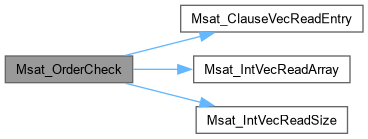
148{
149 return Msat_HeapCheck_rec( p, 1 );
150}
Here is the call graph for this function:

◆ Msat_OrderClean()

void Msat_OrderClean ( Msat_Order_t * p,
Msat_IntVec_t * vCone )
extern

Function*************************************************************

Synopsis [Cleans the ordering structure.]

Description []

SideEffects []

SeeAlso []

Definition at line 120 of file msatOrderH.c.

121{
122 int i;
123 for ( i = 0; i < p->vIndex->nSize; i++ )
124 p->vIndex->pArray[i] = 0;
125 for ( i = 0; i < vCone->nSize; i++ )
126 {
127 assert( i+1 < p->vHeap->nCap );
128 p->vHeap->pArray[i+1] = vCone->pArray[i];
129
130 assert( vCone->pArray[i] < p->vIndex->nSize );
131 p->vIndex->pArray[vCone->pArray[i]] = i+1;
132 }
133 p->vHeap->nSize = vCone->nSize + 1;
134}
Here is the caller graph for this function:

◆ Msat_OrderFree()

void Msat_OrderFree ( Msat_Order_t * p)
extern

Function*************************************************************

Synopsis [Frees the ordering structure.]

Description []

SideEffects []

SeeAlso []

Definition at line 163 of file msatOrderH.c.
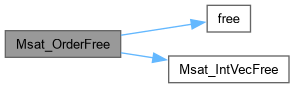
164{
165 Msat_IntVecFree( p->vHeap );
166 Msat_IntVecFree( p->vIndex );
167 ABC_FREE( p );
168}
void Msat_IntVecFree(Msat_IntVec_t *p)
Definition msatVec.c:160
Here is the call graph for this function:
Here is the caller graph for this function:

◆ Msat_OrderSetBounds()

void Msat_OrderSetBounds ( Msat_Order_t * p,
int nVarsMax )
extern

Function*************************************************************

Synopsis [Sets the bound of the ordering structure.]

Description [Should be called whenever the SAT solver is resized.]

SideEffects []

SeeAlso []

Definition at line 101 of file msatOrderH.c.

102{
103 Msat_IntVecGrow( p->vIndex, nVarsMax );
104 Msat_IntVecGrow( p->vHeap, nVarsMax + 1 );
105 p->vIndex->nSize = nVarsMax;
106 p->vHeap->nSize = 0;
107}
void Msat_IntVecGrow(Msat_IntVec_t *p, int nCapMin)
Definition msatVec.c:299
Here is the call graph for this function:
Here is the caller graph for this function:

◆ Msat_OrderUpdate()

void Msat_OrderUpdate ( Msat_Order_t * p,
int Var )
extern

Function*************************************************************

Synopsis [Updates the order after a variable changed weight.]

Description []

SideEffects []

SeeAlso []

Definition at line 257 of file msatOrderH.c.

258{
259// if (heap.inHeap(x))
260// heap.increase(x);
261
262 abctime clk = Abc_Clock();
263 if ( HINHEAP(p,Var) )
264 Msat_HeapIncrease( p, Var );
265timeSelect += Abc_Clock() - clk;
266}
ABC_INT64_T abctime
Definition abc_global.h:332
ABC_NAMESPACE_IMPL_START abctime timeSelect
DECLARATIONS ///.
Definition fraigMan.c:28
#define HINHEAP(p, i)
Definition msatOrderH.c:51
Here is the caller graph for this function:

◆ Msat_OrderVarAssigned()

void Msat_OrderVarAssigned ( Msat_Order_t * p,
int Var )
extern

Function*************************************************************

Synopsis [Updates J-boundary when the variable is assigned.]

Description []

SideEffects []

SeeAlso []

Definition at line 220 of file msatOrderH.c.

221{
222}
Here is the caller graph for this function:

◆ Msat_OrderVarSelect()

int Msat_OrderVarSelect ( Msat_Order_t * p)
extern

Function*************************************************************

Synopsis [Selects the next variable to assign.]

Description []

SideEffects []

SeeAlso []

Definition at line 183 of file msatOrderH.c.

184{
185 // Activity based decision:
186// while (!heap.empty()){
187// Var next = heap.getmin();
188// if (toLbool(assigns[next]) == l_Undef)
189// return next;
190// }
191// return var_Undef;
192
193 int Var;
194 abctime clk = Abc_Clock();
195
196 while ( !HEMPTY(p) )
197 {
198 Var = Msat_HeapGetTop(p);
199 if ( (p)->pSat->pAssigns[Var] == MSAT_VAR_UNASSIGNED )
200 {
201//assert( Msat_OrderCheck(p) );
202timeSelect += Abc_Clock() - clk;
203 return Var;
204 }
205 }
206 return MSAT_ORDER_UNKNOWN;
207}
#define MSAT_ORDER_UNKNOWN
Definition msatInt.h:70
#define HEMPTY(p)
Definition msatOrderH.c:52
Here is the caller graph for this function:

◆ Msat_OrderVarUnassigned()

void Msat_OrderVarUnassigned ( Msat_Order_t * p,
int Var )
extern

Function*************************************************************

Synopsis [Updates the order after a variable is unassigned.]

Description []

SideEffects []

SeeAlso []

Definition at line 235 of file msatOrderH.c.

236{
237// if (!heap.inHeap(x))
238// heap.insert(x);
239
240 abctime clk = Abc_Clock();
241 if ( !HINHEAP(p,Var) )
242 Msat_HeapInsert( p, Var );
243timeSelect += Abc_Clock() - clk;
244}

◆ Msat_QueueAlloc()

Msat_Queue_t * Msat_QueueAlloc ( int nVars)
extern

FUNCTION DEFINITIONS ///.

Function*************************************************************

Synopsis [Allocates the variable propagation queue.]

Description []

SideEffects []

SeeAlso []

Definition at line 53 of file msatQueue.c.

54{
56 p = ABC_ALLOC( Msat_Queue_t, 1 );
57 memset( p, 0, sizeof(Msat_Queue_t) );
58 p->nVars = nVars;
59 p->pVars = ABC_ALLOC( int, nVars );
60 return p;
61}
struct Msat_Queue_t_ Msat_Queue_t
Definition msatInt.h:58
Here is the call graph for this function:
Here is the caller graph for this function:

◆ Msat_QueueClear()

void Msat_QueueClear ( Msat_Queue_t * p)
extern

Function*************************************************************

Synopsis [Resets the queue.]

Description []

SideEffects []

SeeAlso []

Definition at line 149 of file msatQueue.c.

150{
151 p->iFirst = 0;
152 p->iLast = 0;
153}
Here is the caller graph for this function:

◆ Msat_QueueExtract()

int Msat_QueueExtract ( Msat_Queue_t * p)
extern

Function*************************************************************

Synopsis [Extracts an entry from the queue.]

Description []

SideEffects []

SeeAlso []

Definition at line 131 of file msatQueue.c.

132{
133 if ( p->iFirst == p->iLast )
134 return -1;
135 return p->pVars[p->iFirst++];
136}
Here is the caller graph for this function:

◆ Msat_QueueFree()

void Msat_QueueFree ( Msat_Queue_t * p)
extern

Function*************************************************************

Synopsis [Deallocate the variable propagation queue.]

Description []

SideEffects []

SeeAlso []

Definition at line 74 of file msatQueue.c.

75{
76 ABC_FREE( p->pVars );
77 ABC_FREE( p );
78}
Here is the caller graph for this function:

◆ Msat_QueueInsert()

void Msat_QueueInsert ( Msat_Queue_t * p,
int Lit )
extern

Function*************************************************************

Synopsis [Insert an entry into the queue.]

Description []

SideEffects []

SeeAlso []

Definition at line 107 of file msatQueue.c.

108{
109 if ( p->iLast == p->nVars )
110 {
111 int i;
112 assert( 0 );
113 for ( i = 0; i < p->iLast; i++ )
114 printf( "entry = %2d lit = %2d var = %2d \n", i, p->pVars[i], p->pVars[i]/2 );
115 }
116 assert( p->iLast < p->nVars );
117 p->pVars[p->iLast++] = Lit;
118}
Here is the caller graph for this function:

◆ Msat_QueueReadSize()

int Msat_QueueReadSize ( Msat_Queue_t * p)
extern

Function*************************************************************

Synopsis [Reads the queue size.]

Description []

SideEffects []

SeeAlso []

Definition at line 91 of file msatQueue.c.

92{
93 return p->iLast - p->iFirst;
94}
Here is the caller graph for this function:

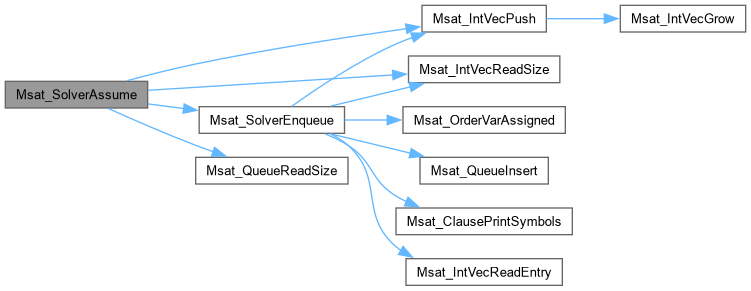
◆ Msat_SolverAssume()

int Msat_SolverAssume ( Msat_Solver_t * p,
Msat_Lit_t Lit )
extern

FUNCTION DEFINITIONS ///.

Function*************************************************************

Synopsis [Makes the next assumption (Lit).]

Description [Returns FALSE if immediate conflict.]

SideEffects []

SeeAlso []

Definition at line 51 of file msatSolverSearch.c.
52{
53 assert( Msat_QueueReadSize(p->pQueue) == 0 );
54 if ( p->fVerbose )
55 printf(L_IND "assume(" L_LIT ")\n", L_ind, L_lit(Lit));
56 Msat_IntVecPush( p->vTrailLim, Msat_IntVecReadSize(p->vTrail) );
57// assert( Msat_IntVecReadSize(p->vTrailLim) <= Msat_IntVecReadSize(p->vTrail) + 1 );
58// assert( Msat_IntVecReadSize( p->vTrailLim ) < p->nVars );
59 return Msat_SolverEnqueue( p, Lit, NULL );
60}
int Msat_QueueReadSize(Msat_Queue_t *p)
Definition msatQueue.c:91
int Msat_SolverEnqueue(Msat_Solver_t *p, Msat_Lit_t Lit, Msat_Clause_t *pC)
#define L_ind
Definition satSolver.c:41
#define L_IND
Definition satSolver.c:40
Here is the call graph for this function:
Here is the caller graph for this function:

◆ Msat_SolverCancelUntil()

void Msat_SolverCancelUntil ( Msat_Solver_t * p,
int Level )
extern

Function*************************************************************

Synopsis [Reverts to the state at given level.]

Description []

SideEffects []

SeeAlso []

Definition at line 128 of file msatSolverSearch.c.

129{
130 while ( Msat_IntVecReadSize(p->vTrailLim) > Level )
131 Msat_SolverCancel(p);
132}
Here is the call graph for this function:
Here is the caller graph for this function:

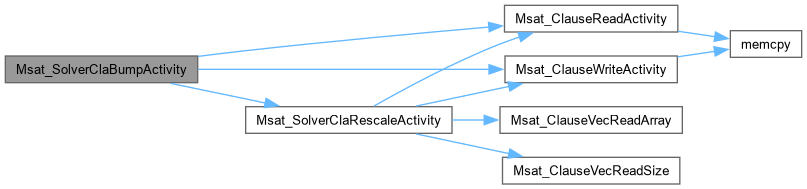
◆ Msat_SolverClaBumpActivity()

void Msat_SolverClaBumpActivity ( Msat_Solver_t * p,
Msat_Clause_t * pC )
extern

Function*************************************************************

Synopsis []

Description []

SideEffects []

SeeAlso []

Definition at line 105 of file msatActivity.c.
106{
107 float Activ;
108 Activ = Msat_ClauseReadActivity(pC);
109 if ( Activ + p->dClaInc > 1e20 )
110 {
112 Activ = Msat_ClauseReadActivity( pC );
113 }
114 Msat_ClauseWriteActivity( pC, Activ + (float)p->dClaInc );
115}
void Msat_SolverClaRescaleActivity(Msat_Solver_t *p)
Here is the call graph for this function:
Here is the caller graph for this function:

◆ Msat_SolverClaDecayActivity()

void Msat_SolverClaDecayActivity ( Msat_Solver_t * p)
extern

Function*************************************************************

Synopsis []

Description []

SideEffects []

SeeAlso []

Definition at line 128 of file msatActivity.c.

129{
130 p->dClaInc *= p->dClaDecay;
131}
Here is the caller graph for this function:

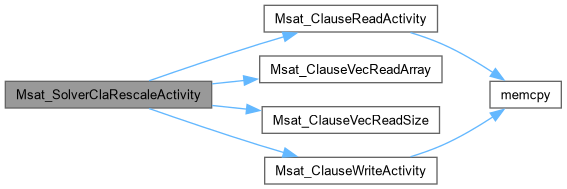
◆ Msat_SolverClaRescaleActivity()

void Msat_SolverClaRescaleActivity ( Msat_Solver_t * p)
extern

Function*************************************************************

Synopsis [Divide all constraint activities by 1e20.]

Description []

SideEffects []

SeeAlso []

Definition at line 144 of file msatActivity.c.
145{
146 Msat_Clause_t ** pLearned;
147 int nLearned, i;
148 float Activ;
149 nLearned = Msat_ClauseVecReadSize( p->vLearned );
150 pLearned = Msat_ClauseVecReadArray( p->vLearned );
151 for ( i = 0; i < nLearned; i++ )
152 {
153 Activ = Msat_ClauseReadActivity( pLearned[i] );
154 Msat_ClauseWriteActivity( pLearned[i], Activ * (float)1e-20 );
155 }
156 p->dClaInc *= 1e-20;
157}
Here is the call graph for this function:
Here is the caller graph for this function:

◆ Msat_SolverClausesDecrement()

void Msat_SolverClausesDecrement ( Msat_Solver_t * p)
extern

Definition at line 65 of file msatSolverApi.c.

65{ p->nClausesAlloc--; }

◆ Msat_SolverClausesDecrementL()

void Msat_SolverClausesDecrementL ( Msat_Solver_t * p)
extern

Definition at line 67 of file msatSolverApi.c.

67{ p->nClausesAllocL--; }

◆ Msat_SolverClausesIncrement()

void Msat_SolverClausesIncrement ( Msat_Solver_t * p)
extern

Definition at line 64 of file msatSolverApi.c.

64{ p->nClausesAlloc++; }

◆ Msat_SolverClausesIncrementL()

void Msat_SolverClausesIncrementL ( Msat_Solver_t * p)
extern

Definition at line 66 of file msatSolverApi.c.

66{ p->nClausesAllocL++; }

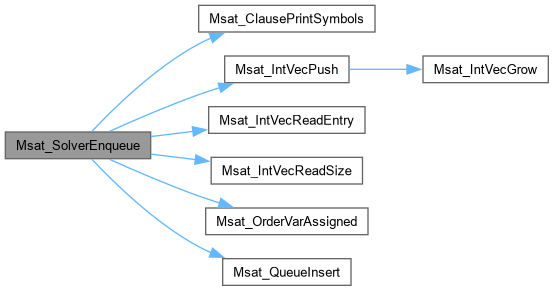
◆ Msat_SolverEnqueue()

int Msat_SolverEnqueue ( Msat_Solver_t * p,
Msat_Lit_t Lit,
Msat_Clause_t * pC )
extern

Function*************************************************************

Synopsis [Enqueues one variable assignment.]

Description [Puts a new fact on the propagation queue and immediately updates the variable value. Should a conflict arise, FALSE is returned. Otherwise returns TRUE.]

SideEffects []

SeeAlso []

Definition at line 173 of file msatSolverSearch.c.
174{
176
177 // skip literals that are not in the current cone
178 if ( !Msat_IntVecReadEntry( p->vVarsUsed, Var ) )
179 return 1;
180
181// assert( Msat_QueueReadSize(p->pQueue) == Msat_IntVecReadSize(p->vTrail) );
182 // if the literal is assigned
183 // return 1 if the assignment is consistent
184 // return 0 if the assignment is inconsistent (conflict)
185 if ( p->pAssigns[Var] != MSAT_VAR_UNASSIGNED )
186 return p->pAssigns[Var] == Lit;
187 // new fact - store it
188 if ( p->fVerbose )
189 {
190// printf(L_IND"bind("L_LIT")\n", L_ind, L_lit(Lit));
191 printf(L_IND "bind(" L_LIT ") ", L_ind, L_lit(Lit));
193 }
194 p->pAssigns[Var] = Lit;
195 p->pLevel[Var] = Msat_IntVecReadSize(p->vTrailLim);
196// p->pReasons[Var] = p->pLevel[Var]? pC: NULL;
197 p->pReasons[Var] = pC;
198 Msat_IntVecPush( p->vTrail, Lit );
199 Msat_QueueInsert( p->pQueue, Lit );
200
201 Msat_OrderVarAssigned( p->pOrder, Var );
202 return 1;
203}
void Msat_ClausePrintSymbols(Msat_Clause_t *pC)
Definition msatClause.c:515
void Msat_QueueInsert(Msat_Queue_t *p, int Lit)
Definition msatQueue.c:107
void Msat_OrderVarAssigned(Msat_Order_t *p, int Var)
Definition msatOrderH.c:220
int Msat_IntVecReadEntry(Msat_IntVec_t *p, int i)
Definition msatVec.c:249
Here is the call graph for this function:
Here is the caller graph for this function:

◆ Msat_SolverIncrementSeenId()

int Msat_SolverIncrementSeenId ( Msat_Solver_t * p)
extern

Definition at line 62 of file msatSolverApi.c.

62{ return ++p->nSeenId; }
Here is the caller graph for this function:

◆ Msat_SolverProgressEstimate()

double Msat_SolverProgressEstimate ( Msat_Solver_t * p)
extern

Function*************************************************************

Synopsis [Returns search-space coverage. Not extremely reliable.]

Description []

SideEffects []

SeeAlso []

Definition at line 88 of file msatSolverCore.c.

89{
90 double dProgress = 0.0;
91 double dF = 1.0 / p->nVars;
92 int i;
93 for ( i = 0; i < p->nVars; i++ )
94 if ( p->pAssigns[i] != MSAT_VAR_UNASSIGNED )
95 dProgress += pow( dF, p->pLevel[i] );
96 return dProgress / p->nVars;
97}
Here is the caller graph for this function:

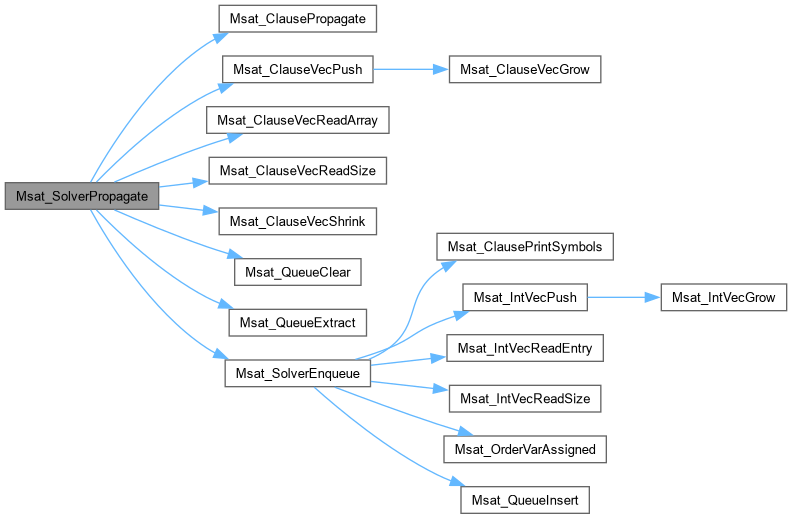
◆ Msat_SolverPropagate()

Msat_Clause_t * Msat_SolverPropagate ( Msat_Solver_t * p)
extern

Function*************************************************************

Synopsis [Propagates the assignments in the queue.]

Description [Propagates all enqueued facts. If a conflict arises, the conflicting clause is returned, otherwise NULL.]

SideEffects [The propagation queue is empty, even if there was a conflict.]

SeeAlso []

Definition at line 217 of file msatSolverSearch.c.
218{
219 Msat_ClauseVec_t ** pvWatched = p->pvWatched;
220 Msat_Clause_t ** pClauses;
221 Msat_Clause_t * pConflict;
222 Msat_Lit_t Lit, Lit_out;
223 int i, j, nClauses;
224
225 // propagate all the literals in the queue
226 while ( (Lit = Msat_QueueExtract( p->pQueue )) >= 0 )
227 {
228 p->Stats.nPropagations++;
229 // get the clauses watched by this literal
230 nClauses = Msat_ClauseVecReadSize( pvWatched[Lit] );
231 pClauses = Msat_ClauseVecReadArray( pvWatched[Lit] );
232 // go through the watched clauses and decide what to do with them
233 for ( i = j = 0; i < nClauses; i++ )
234 {
235 p->Stats.nInspects++;
236 // clear the returned literal
237 Lit_out = -1;
238 // propagate the clause
239 if ( !Msat_ClausePropagate( pClauses[i], Lit, p->pAssigns, &Lit_out ) )
240 { // the clause is unit
241 // "Lit_out" contains the new assignment to be enqueued
242 if ( Msat_SolverEnqueue( p, Lit_out, pClauses[i] ) )
243 { // consistent assignment
244 // no changes to the implication queue; the watch is the same too
245 pClauses[j++] = pClauses[i];
246 continue;
247 }
248 // remember the reason of conflict (will be returned)
249 pConflict = pClauses[i];
250 // leave the remaning clauses in the same watched list
251 for ( ; i < nClauses; i++ )
252 pClauses[j++] = pClauses[i];
253 Msat_ClauseVecShrink( pvWatched[Lit], j );
254 // clear the propagation queue
255 Msat_QueueClear( p->pQueue );
256 return pConflict;
257 }
258 // the clause is not unit
259 // in this case "Lit_out" contains the new watch if it has changed
260 if ( Lit_out >= 0 )
261 Msat_ClauseVecPush( pvWatched[Lit_out], pClauses[i] );
262 else // the watch did not change
263 pClauses[j++] = pClauses[i];
264 }
265 Msat_ClauseVecShrink( pvWatched[Lit], j );
266 }
267 return NULL;
268}
void Msat_ClauseVecShrink(Msat_ClauseVec_t *p, int nSizeNew)
int Msat_ClausePropagate(Msat_Clause_t *pC, Msat_Lit_t Lit, int *pAssigns, Msat_Lit_t *pLit_out)
Definition msatClause.c:335
void Msat_QueueClear(Msat_Queue_t *p)
Definition msatQueue.c:149
int Msat_QueueExtract(Msat_Queue_t *p)
Definition msatQueue.c:131
Here is the call graph for this function:
Here is the caller graph for this function:

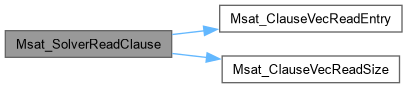
◆ Msat_SolverReadClause()

Msat_Clause_t * Msat_SolverReadClause ( Msat_Solver_t * p,
int Num )
extern

Function*************************************************************

Synopsis [Reads the clause with the given number.]

Description []

SideEffects []

SeeAlso []

Definition at line 83 of file msatSolverApi.c.
84{
85 int nClausesP;
86 assert( Num < p->nClauses );
87 nClausesP = Msat_ClauseVecReadSize( p->vClauses );
88 if ( Num < nClausesP )
89 return Msat_ClauseVecReadEntry( p->vClauses, Num );
90 return Msat_ClauseVecReadEntry( p->vLearned, Num - nClausesP );
91}
Msat_Clause_t * Msat_ClauseVecReadEntry(Msat_ClauseVec_t *p, int i)
Here is the call graph for this function:

◆ Msat_SolverReadDecisionLevel()

int Msat_SolverReadDecisionLevel ( Msat_Solver_t * p)
extern

Definition at line 50 of file msatSolverApi.c.

50{ return Msat_IntVecReadSize(p->vTrailLim); }
Here is the call graph for this function:
Here is the caller graph for this function:

◆ Msat_SolverReadDecisionLevelArray()

int * Msat_SolverReadDecisionLevelArray ( Msat_Solver_t * p)
extern

Definition at line 51 of file msatSolverApi.c.

51{ return p->pLevel; }
Here is the caller graph for this function:

◆ Msat_SolverReadLearned()

Msat_ClauseVec_t * Msat_SolverReadLearned ( Msat_Solver_t * p)
extern

Definition at line 54 of file msatSolverApi.c.

54{ return p->vLearned; }
Here is the caller graph for this function:

◆ Msat_SolverReadMem()

Msat_MmStep_t * Msat_SolverReadMem ( Msat_Solver_t * p)
extern

Definition at line 60 of file msatSolverApi.c.

60{ return p->pMem; }
Here is the caller graph for this function:

◆ Msat_SolverReadReasonArray()

Msat_Clause_t ** Msat_SolverReadReasonArray ( Msat_Solver_t * p)
extern

Definition at line 52 of file msatSolverApi.c.

52{ return p->pReasons; }
Here is the caller graph for this function:

◆ Msat_SolverReadSeenArray()

int * Msat_SolverReadSeenArray ( Msat_Solver_t * p)
extern

Definition at line 61 of file msatSolverApi.c.

61{ return p->pSeen; }
Here is the caller graph for this function:

◆ Msat_SolverReadVarValue()

Msat_Type_t Msat_SolverReadVarValue ( Msat_Solver_t * p,
Msat_Var_t Var )
extern

Definition at line 53 of file msatSolverApi.c.

53{ return (Msat_Type_t)p->pAssigns[Var]; }
Msat_Type_t
Definition msat.h:50

◆ Msat_SolverReadWatchedArray()

Msat_ClauseVec_t ** Msat_SolverReadWatchedArray ( Msat_Solver_t * p)
extern

Definition at line 55 of file msatSolverApi.c.

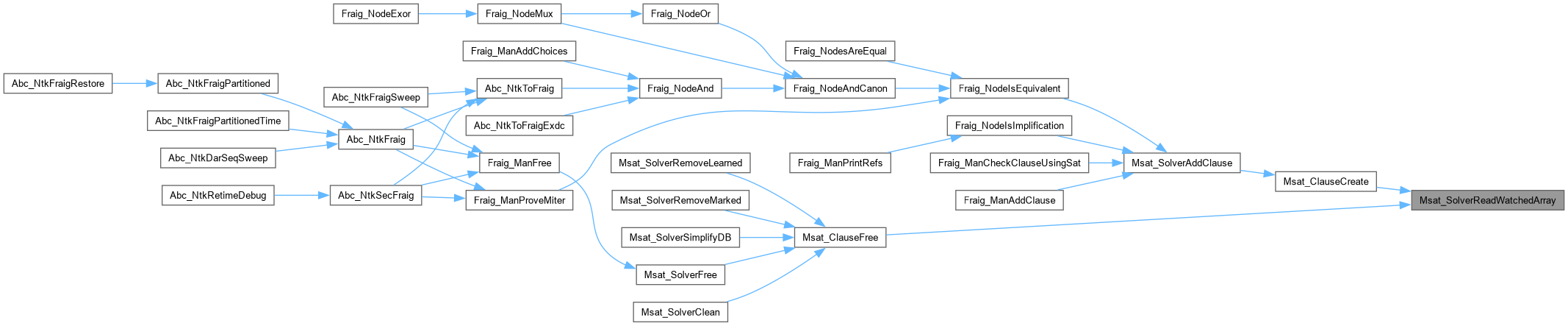
55{ return p->pvWatched; }
Here is the caller graph for this function:

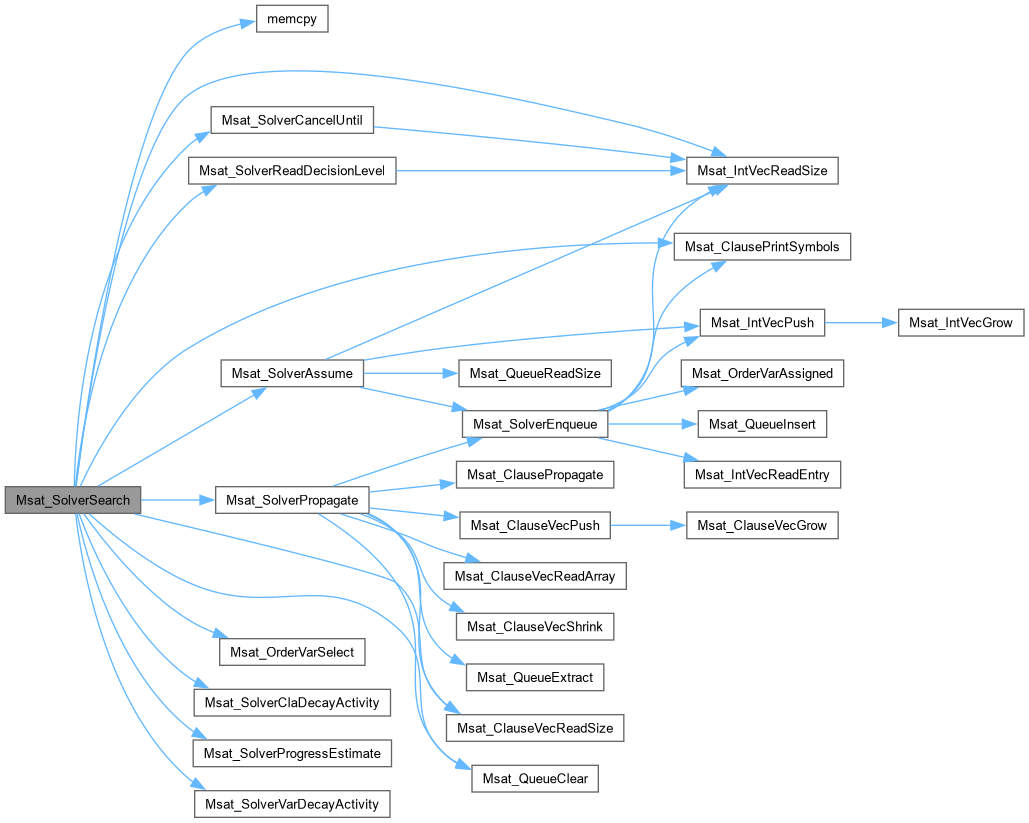
◆ Msat_SolverSearch()

Msat_Type_t Msat_SolverSearch ( Msat_Solver_t * p,
int nConfLimit,
int nLearnedLimit,
int nBackTrackLimit,
Msat_SearchParams_t * pPars )
extern

Function*************************************************************

Synopsis [The search procedure called between the restarts.]

Description [Search for a satisfying solution as long as the number of conflicts does not exceed the limit (nConfLimit) while keeping the number of learnt clauses below the provided limit (nLearnedLimit). NOTE! Use negative value for nConfLimit or nLearnedLimit to indicate infinity.]

SideEffects []

SeeAlso []

Definition at line 535 of file msatSolverSearch.c.
536{
537 Msat_Clause_t * pConf;
539 int nLevelBack, nConfs, nAssigns, Value;
540 int i;
541
542 assert( Msat_SolverReadDecisionLevel(p) == p->nLevelRoot );
543 p->Stats.nStarts++;
544 p->dVarDecay = 1 / pPars->dVarDecay;
545 p->dClaDecay = 1 / pPars->dClaDecay;
546
547 // reset the activities
548 for ( i = 0; i < p->nVars; i++ )
549 p->pdActivity[i] = (double)p->pFactors[i];
550// p->pdActivity[i] = 0.0;
551
552 nConfs = 0;
553 while ( 1 )
554 {
555 pConf = Msat_SolverPropagate( p );
556 if ( pConf != NULL ){
557 // CONFLICT
558 if ( p->fVerbose )
559 {
560// printf(L_IND"**CONFLICT**\n", L_ind);
561 printf(L_IND"**CONFLICT** ", L_ind);
563 }
564 // count conflicts
565 p->Stats.nConflicts++;
566 nConfs++;
567
568 // if top level, return UNSAT
569 if ( Msat_SolverReadDecisionLevel(p) == p->nLevelRoot )
570 return MSAT_FALSE;
571
572 // perform conflict analysis
573 Msat_SolverAnalyze( p, pConf, p->vTemp, &nLevelBack );
574 Msat_SolverCancelUntil( p, (p->nLevelRoot > nLevelBack)? p->nLevelRoot : nLevelBack );
575 Msat_SolverRecord( p, p->vTemp );
576
577 // it is important that recording is done after cancelling
578 // because canceling cleans the queue while recording adds to it
581
582 }
583 else{
584 // NO CONFLICT
585 if ( Msat_IntVecReadSize(p->vTrailLim) == 0 ) {
586 // Simplify the set of problem clauses:
587// Value = Msat_SolverSimplifyDB(p);
588// assert( Value );
589 }
590 nAssigns = Msat_IntVecReadSize( p->vTrail );
591 if ( nLearnedLimit >= 0 && Msat_ClauseVecReadSize(p->vLearned) >= nLearnedLimit + nAssigns ) {
592 // Reduce the set of learnt clauses:
593 Msat_SolverReduceDB(p);
594 }
595
596 Var = Msat_OrderVarSelect( p->pOrder );
597 if ( Var == MSAT_ORDER_UNKNOWN ) {
598 // Model found and stored in p->pAssigns
599 memcpy( p->pModel, p->pAssigns, sizeof(int) * p->nVars );
600 Msat_QueueClear( p->pQueue );
601 Msat_SolverCancelUntil( p, p->nLevelRoot );
602 return MSAT_TRUE;
603 }
604 if ( nConfLimit > 0 && nConfs > nConfLimit ) {
605 // Reached bound on number of conflicts:
606 p->dProgress = Msat_SolverProgressEstimate( p );
607 Msat_QueueClear( p->pQueue );
608 Msat_SolverCancelUntil( p, p->nLevelRoot );
609 return MSAT_UNKNOWN;
610 }
611 else if ( nBackTrackLimit > 0 && (int)p->Stats.nConflicts - p->nBackTracks > nBackTrackLimit ) {
612 // Reached bound on number of conflicts:
613 Msat_QueueClear( p->pQueue );
614 Msat_SolverCancelUntil( p, p->nLevelRoot );
615 return MSAT_UNKNOWN;
616 }
617 else{
618 // New variable decision:
619 p->Stats.nDecisions++;
620 assert( Var != MSAT_ORDER_UNKNOWN && Var >= 0 && Var < p->nVars );
621 Value = Msat_SolverAssume(p, MSAT_VAR2LIT(Var,0) );
622 assert( Value );
623 }
624 }
625 }
626}
void Msat_SolverVarDecayActivity(Msat_Solver_t *p)
GLOBAL VARIABLES ///.
void Msat_SolverClaDecayActivity(Msat_Solver_t *p)
int Msat_OrderVarSelect(Msat_Order_t *p)
Definition msatOrderH.c:183
double Msat_SolverProgressEstimate(Msat_Solver_t *p)
int Msat_SolverAssume(Msat_Solver_t *p, Msat_Lit_t Lit)
FUNCTION DEFINITIONS ///.
void Msat_SolverCancelUntil(Msat_Solver_t *p, int Level)
Msat_Clause_t * Msat_SolverPropagate(Msat_Solver_t *p)
#define MSAT_VAR2LIT(v, s)
Definition msat.h:56
@ MSAT_TRUE
Definition msat.h:50
@ MSAT_FALSE
Definition msat.h:50
@ MSAT_UNKNOWN
Definition msat.h:50
Here is the call graph for this function:
Here is the caller graph for this function:

◆ Msat_SolverSortDB()

void Msat_SolverSortDB ( Msat_Solver_t * p)
extern

FUNCTION DEFINITIONS ///.

Function*************************************************************

Synopsis [Msat_SolverSort the learned clauses in the increasing order of activity.]

Description []

SideEffects []

SeeAlso []

Definition at line 61 of file msatSort.c.
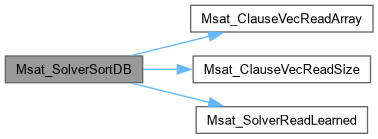
62{
63 Msat_ClauseVec_t * pVecClauses;
64 Msat_Clause_t ** pLearned;
65 int nLearned;
66 // read the parameters
67 pVecClauses = Msat_SolverReadLearned( p );
68 nLearned = Msat_ClauseVecReadSize( pVecClauses );
69 pLearned = Msat_ClauseVecReadArray( pVecClauses );
70 // Msat_SolverSort the array
71// qMsat_SolverSort( (void *)pLearned, nLearned, sizeof(Msat_Clause_t *),
72// (int (*)(const void *, const void *)) Msat_SolverSortCompare );
73// printf( "Msat_SolverSorting.\n" );
74 Msat_SolverSort( pLearned, nLearned, 91648253 );
75/*
76 if ( nLearned > 2 )
77 {
78 printf( "Clause 1: %0.20f\n", Msat_ClauseReadActivity(pLearned[0]) );
79 printf( "Clause 2: %0.20f\n", Msat_ClauseReadActivity(pLearned[1]) );
80 printf( "Clause 3: %0.20f\n", Msat_ClauseReadActivity(pLearned[2]) );
81 }
82*/
83}
Msat_ClauseVec_t * Msat_SolverReadLearned(Msat_Solver_t *p)
Here is the call graph for this function:

◆ Msat_SolverVarBumpActivity()

void Msat_SolverVarBumpActivity ( Msat_Solver_t * p,
Msat_Lit_t Lit )
extern

DECLARATIONS ///.

CFile****************************************************************

FileName [msatActivity.c]

PackageName [A C version of SAT solver MINISAT, originally developed in C++ by Niklas Een and Niklas Sorensson, Chalmers University of Technology, Sweden: http://www.cs.chalmers.se/~een/Satzoo.]

Synopsis [Procedures controlling activity of variables and clauses.]

Author [Alan Mishchenko alanm.nosp@m.i@ee.nosp@m.cs.be.nosp@m.rkel.nosp@m.ey.ed.nosp@m.u]

Affiliation [UC Berkeley]

Date [Ver. 1.0. Started - January 1, 2004.]

Revision [

Id
msatActivity.c,v 1.0 2004/01/01 1:00:00 alanmi Exp

] FUNCTION DEFINITIONS /// Function*************************************************************

Synopsis []

Description []

SideEffects []

SeeAlso []

Definition at line 45 of file msatActivity.c.

46{
48 if ( p->dVarDecay < 0 ) // (negative decay means static variable order -- don't bump)
49 return;
50 Var = MSAT_LIT2VAR(Lit);
51 p->pdActivity[Var] += p->dVarInc;
52// p->pdActivity[Var] += p->dVarInc * p->pFactors[Var];
53 if ( p->pdActivity[Var] > 1e100 )
55 Msat_OrderUpdate( p->pOrder, Var );
56}
void Msat_SolverVarRescaleActivity(Msat_Solver_t *p)
void Msat_OrderUpdate(Msat_Order_t *p, int Var)
Definition msatOrderH.c:257
Here is the call graph for this function:
Here is the caller graph for this function:

◆ Msat_SolverVarDecayActivity()

void Msat_SolverVarDecayActivity ( Msat_Solver_t * p)
extern

GLOBAL VARIABLES ///.

MACRO DEFINITIONS /// FUNCTION DECLARATIONS ///

Function*************************************************************

Synopsis []

Description []

SideEffects []

SeeAlso []

Definition at line 69 of file msatActivity.c.

70{
71 if ( p->dVarDecay >= 0 )
72 p->dVarInc *= p->dVarDecay;
73}
Here is the caller graph for this function:

◆ Msat_SolverVarRescaleActivity()

void Msat_SolverVarRescaleActivity ( Msat_Solver_t * p)
extern

Function*************************************************************

Synopsis [Divide all variable activities by 1e100.]

Description []

SideEffects []

SeeAlso []

Definition at line 86 of file msatActivity.c.

87{
88 int i;
89 for ( i = 0; i < p->nVars; i++ )
90 p->pdActivity[i] *= 1e-100;
91 p->dVarInc *= 1e-100;
92}
Here is the caller graph for this function: