ABC: A System for Sequential Synthesis and Verification
 
Loading...
Searching...
No Matches
satInterP.c File Reference
#include <stdio.h>
#include <stdlib.h>
#include <string.h>
#include <assert.h>
#include "satStore.h"
#include "misc/vec/vec.h"
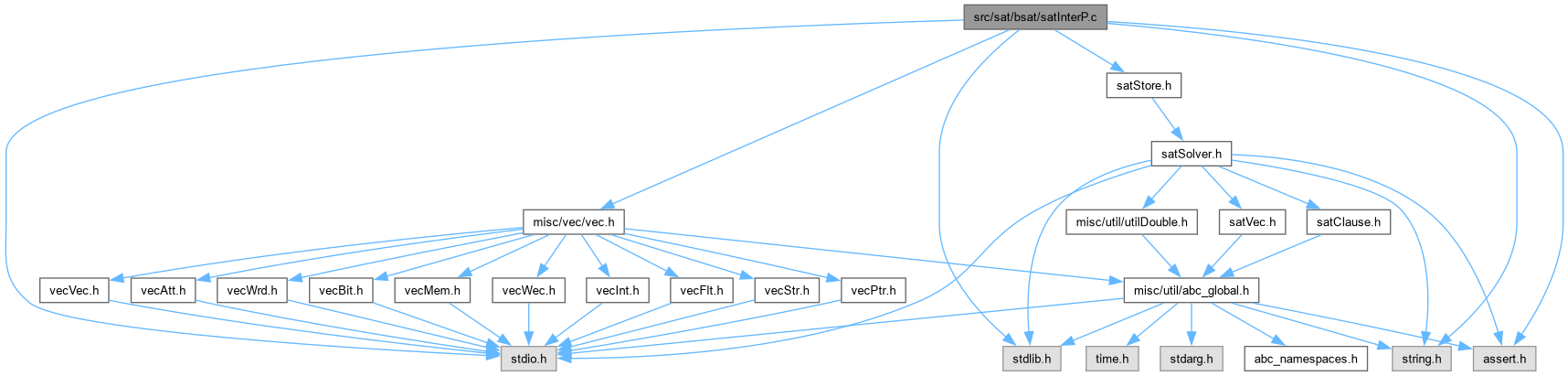
Include dependency graph for satInterP.c:

Go to the source code of this file.

Classes

struct  Intp_Man_t_
 

Functions

Intp_Man_tIntp_ManAlloc ()
 FUNCTION DEFINITIONS ///.
 
void Intp_ManResize (Intp_Man_t *p)
 
void Intp_ManFree (Intp_Man_t *p)
 
void Intp_ManPrintClause (Intp_Man_t *p, Sto_Cls_t *pClause)
 
void Intp_ManPrintResolvent (lit *pResLits, int nResLits)
 
void Intp_ManPrintInterOne (Intp_Man_t *p, Sto_Cls_t *pClause)
 
Sto_Cls_tIntp_ManPropagate (Intp_Man_t *p, int Start)
 
void Intp_ManProofWriteOne (Intp_Man_t *p, Sto_Cls_t *pClause)
 
int Intp_ManProofTraceOne (Intp_Man_t *p, Sto_Cls_t *pConflict, Sto_Cls_t *pFinal)
 
int Intp_ManProofRecordOne (Intp_Man_t *p, Sto_Cls_t *pClause)
 
int Intp_ManProcessRoots (Intp_Man_t *p)
 
void Intp_ManUnsatCoreVerify (Sto_Man_t *pCnf, Vec_Int_t *vCore)
 
void Intp_ManUnsatCore_rec (Vec_Ptr_t *vAntClas, int iThis, Vec_Int_t *vCore, int nRoots, Vec_Str_t *vVisited, int fLearned)
 
void * Intp_ManUnsatCore (Intp_Man_t *p, Sto_Man_t *pCnf, int fLearned, int fVerbose)
 
void Intp_ManUnsatCorePrintForBmc (FILE *pFile, Sto_Man_t *pCnf, void *vCore0, void *vVarMap0)
 

Function Documentation

◆ Intp_ManAlloc()

Intp_Man_t * Intp_ManAlloc ( )

FUNCTION DEFINITIONS ///.

Function*************************************************************

Synopsis [Allocate proof manager.]

Description []

SideEffects []

SeeAlso []

Definition at line 96 of file satInterP.c.

97{
98 Intp_Man_t * p;
99 // allocate the manager
100 p = (Intp_Man_t *)ABC_ALLOC( char, sizeof(Intp_Man_t) );
101 memset( p, 0, sizeof(Intp_Man_t) );
102 // verification
103 p->nResLitsAlloc = (1<<16);
104 p->pResLits = ABC_ALLOC( lit, p->nResLitsAlloc );
105 // proof recording
106// p->vAnties = Vec_IntAlloc( 1000 );
107// p->vBreaks = Vec_IntAlloc( 1000 );
108 p->vAntClas = Vec_PtrAlloc( 1000 );
109 p->nAntStart = 0;
110 // parameters
111 p->fProofWrite = 0;
112 p->fProofVerif = 1;
113 return p;
114}
#define ABC_ALLOC(type, num)
Definition abc_global.h:264
Cube * p
Definition exorList.c:222
struct Intp_Man_t_ Intp_Man_t
Definition satStore.h:142
int lit
Definition satVec.h:130
char * memset()
Here is the call graph for this function:
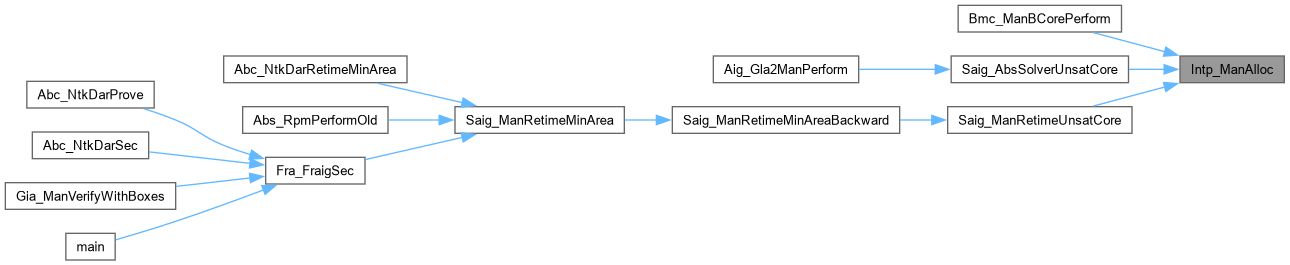
Here is the caller graph for this function:

◆ Intp_ManFree()

void Intp_ManFree ( Intp_Man_t * p)

Function*************************************************************

Synopsis [Deallocate proof manager.]

Description []

SideEffects []

SeeAlso []

Definition at line 178 of file satInterP.c.
179{
180/*
181 printf( "Runtime stats:\n" );
182ABC_PRT( "BCP ", p->timeBcp );
183ABC_PRT( "Trace ", p->timeTrace );
184ABC_PRT( "TOTAL ", p->timeTotal );
185*/
186// Vec_IntFree( p->vAnties );
187// Vec_IntFree( p->vBreaks );
188 Vec_VecFree( (Vec_Vec_t *)p->vAntClas );
189// ABC_FREE( p->pInters );
190 ABC_FREE( p->pProofNums );
191 ABC_FREE( p->pTrail );
192 ABC_FREE( p->pAssigns );
193 ABC_FREE( p->pSeens );
194// ABC_FREE( p->pVarTypes );
195 ABC_FREE( p->pReasons );
196 ABC_FREE( p->pWatches );
197 ABC_FREE( p->pResLits );
198 ABC_FREE( p );
199}
#define ABC_FREE(obj)
Definition abc_global.h:267
typedefABC_NAMESPACE_HEADER_START struct Vec_Vec_t_ Vec_Vec_t
INCLUDES ///.
Definition vecVec.h:42
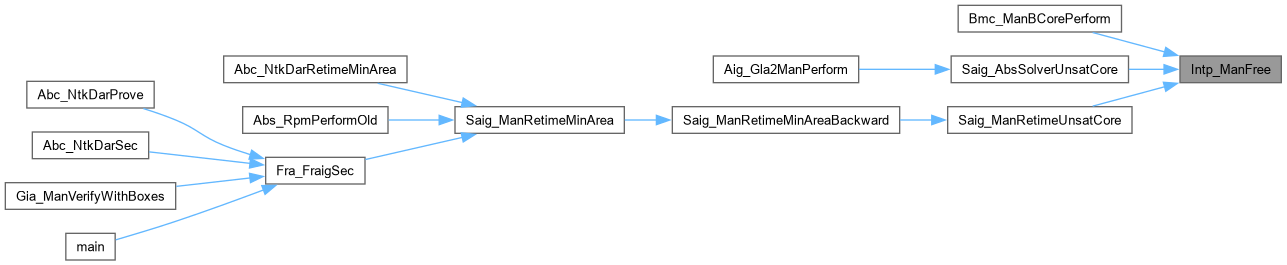
Here is the caller graph for this function:

◆ Intp_ManPrintClause()

void Intp_ManPrintClause ( Intp_Man_t * p,
Sto_Cls_t * pClause )

Function*************************************************************

Synopsis [Prints the clause.]

Description []

SideEffects []

SeeAlso []

Definition at line 215 of file satInterP.c.

216{
217 int i;
218 printf( "Clause ID = %d. Proof = %d. {", pClause->Id, Intp_ManProofGet(p, pClause) );
219 for ( i = 0; i < (int)pClause->nLits; i++ )
220 printf( " %d", pClause->pLits[i] );
221 printf( " }\n" );
222}
lit pLits[0]
Definition satStore.h:78
unsigned nLits
Definition satStore.h:77
Here is the caller graph for this function:

◆ Intp_ManPrintInterOne()

void Intp_ManPrintInterOne ( Intp_Man_t * p,
Sto_Cls_t * pClause )

Function*************************************************************

Synopsis [Prints the interpolant for one clause.]

Description []

SideEffects []

SeeAlso []

Definition at line 255 of file satInterP.c.

256{
257 printf( "Clause %2d : ", pClause->Id );
258// Extra_PrintBinary___( stdout, Intp_ManAigRead(p, pClause), (1 << p->nVarsAB) );
259 printf( "\n" );
260}

◆ Intp_ManPrintResolvent()

void Intp_ManPrintResolvent ( lit * pResLits,
int nResLits )

Function*************************************************************

Synopsis [Prints the resolvent.]

Description []

SideEffects []

SeeAlso []

Definition at line 235 of file satInterP.c.

236{
237 int i;
238 printf( "Resolvent: {" );
239 for ( i = 0; i < nResLits; i++ )
240 printf( " %d", pResLits[i] );
241 printf( " }\n" );
242}
Here is the caller graph for this function:

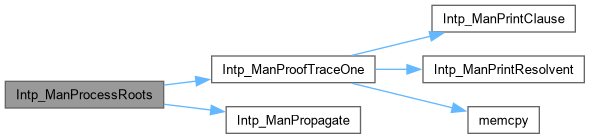
◆ Intp_ManProcessRoots()

int Intp_ManProcessRoots ( Intp_Man_t * p)

Function*************************************************************

Synopsis [Propagate the root clauses.]

Description []

SideEffects []

SeeAlso []

Definition at line 782 of file satInterP.c.
783{
784 Sto_Cls_t * pClause;
785 int Counter;
786
787 // make sure the root clauses are preceeding the learnt clauses
788 Counter = 0;
789 Sto_ManForEachClause( p->pCnf, pClause )
790 {
791 assert( (int)pClause->fA == (Counter < (int)p->pCnf->nClausesA) );
792 assert( (int)pClause->fRoot == (Counter < (int)p->pCnf->nRoots) );
793 Counter++;
794 }
795 assert( p->pCnf->nClauses == Counter );
796
797 // make sure the last clause if empty
798 assert( p->pCnf->pTail->nLits == 0 );
799
800 // go through the root unit clauses
801 p->nTrailSize = 0;
802 Sto_ManForEachClauseRoot( p->pCnf, pClause )
803 {
804 // create watcher lists for the root clauses
805 if ( pClause->nLits > 1 )
806 {
807 Intp_ManWatchClause( p, pClause, pClause->pLits[0] );
808 Intp_ManWatchClause( p, pClause, pClause->pLits[1] );
809 }
810 // empty clause and large clauses
811 if ( pClause->nLits != 1 )
812 continue;
813 // unit clause
814 assert( lit_check(pClause->pLits[0], p->pCnf->nVars) );
815 if ( !Intp_ManEnqueue( p, pClause->pLits[0], pClause ) )
816 {
817 // detected root level conflict
818// printf( "Error in Intp_ManProcessRoots(): Detected a root-level conflict too early!\n" );
819// assert( 0 );
820 // detected root level conflict
821 Intp_ManProofTraceOne( p, pClause, p->pCnf->pEmpty );
822 if ( p->fVerbose )
823 printf( "Found root level conflict!\n" );
824 return 0;
825 }
826 }
827
828 // propagate the root unit clauses
829 pClause = Intp_ManPropagate( p, 0 );
830 if ( pClause )
831 {
832 // detected root level conflict
833 Intp_ManProofTraceOne( p, pClause, p->pCnf->pEmpty );
834 if ( p->fVerbose )
835 printf( "Found root level conflict!\n" );
836 return 0;
837 }
838
839 // set the root level
840 p->nRootSize = p->nTrailSize;
841 return 1;
842}
int Intp_ManProofTraceOne(Intp_Man_t *p, Sto_Cls_t *pConflict, Sto_Cls_t *pFinal)
Definition satInterP.c:473
Sto_Cls_t * Intp_ManPropagate(Intp_Man_t *p, int Start)
Definition satInterP.c:418
#define Sto_ManForEachClause(p, pCls)
Definition satStore.h:99
struct Sto_Cls_t_ Sto_Cls_t
BASIC TYPES ///.
Definition satStore.h:67
#define Sto_ManForEachClauseRoot(p, pCls)
Definition satStore.h:100
unsigned fA
Definition satStore.h:74
unsigned fRoot
Definition satStore.h:75
#define assert(ex)
Definition util_old.h:213
Here is the call graph for this function:
Here is the caller graph for this function:

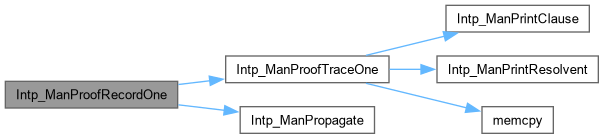
◆ Intp_ManProofRecordOne()

int Intp_ManProofRecordOne ( Intp_Man_t * p,
Sto_Cls_t * pClause )

Function*************************************************************

Synopsis [Records the proof for one clause.]

Description []

SideEffects []

SeeAlso []

Definition at line 668 of file satInterP.c.
669{
670 Sto_Cls_t * pConflict;
671 int i;
672
673 // empty clause never ends up there
674 assert( pClause->nLits > 0 );
675 if ( pClause->nLits == 0 )
676 printf( "Error: Empty clause is attempted.\n" );
677
678 assert( !pClause->fRoot );
679 assert( p->nTrailSize == p->nRootSize );
680
681 // if any of the clause literals are already assumed
682 // it means that the clause is redundant and can be skipped
683 for ( i = 0; i < (int)pClause->nLits; i++ )
684 if ( p->pAssigns[lit_var(pClause->pLits[i])] == pClause->pLits[i] )
685 {
686// Vec_IntPush( p->vBreaks, Vec_IntSize(p->vAnties) );
687 Vec_PtrPush( p->vAntClas, Vec_IntAlloc(0) );
688 return 1;
689 }
690
691 // add assumptions to the trail
692 for ( i = 0; i < (int)pClause->nLits; i++ )
693 if ( !Intp_ManEnqueue( p, lit_neg(pClause->pLits[i]), NULL ) )
694 {
695 assert( 0 ); // impossible
696 return 0;
697 }
698
699 // propagate the assumptions
700 pConflict = Intp_ManPropagate( p, p->nRootSize );
701 if ( pConflict == NULL )
702 {
703 assert( 0 ); // cannot prove
704 return 0;
705 }
706
707 // skip the clause if it is weaker or the same as the conflict clause
708 if ( pClause->nLits >= pConflict->nLits )
709 {
710 // check if every literal of conflict clause can be found in the given clause
711 int j;
712 for ( i = 0; i < (int)pConflict->nLits; i++ )
713 {
714 for ( j = 0; j < (int)pClause->nLits; j++ )
715 if ( pConflict->pLits[i] == pClause->pLits[j] )
716 break;
717 if ( j == (int)pClause->nLits ) // literal pConflict->pLits[i] is not found
718 break;
719 }
720 if ( i == (int)pConflict->nLits ) // all lits are found
721 {
722 // undo to the root level
723 Intp_ManCancelUntil( p, p->nRootSize );
724// Vec_IntPush( p->vBreaks, Vec_IntSize(p->vAnties) );
725 Vec_PtrPush( p->vAntClas, Vec_IntAlloc(0) );
726 return 1;
727 }
728 }
729
730 // construct the proof
731 Intp_ManProofTraceOne( p, pConflict, pClause );
732
733 // undo to the root level
734 Intp_ManCancelUntil( p, p->nRootSize );
735
736 // add large clauses to the watched lists
737 if ( pClause->nLits > 1 )
738 {
739 Intp_ManWatchClause( p, pClause, pClause->pLits[0] );
740 Intp_ManWatchClause( p, pClause, pClause->pLits[1] );
741 return 1;
742 }
743 assert( pClause->nLits == 1 );
744
745 // if the clause proved is unit, add it and propagate
746 if ( !Intp_ManEnqueue( p, pClause->pLits[0], pClause ) )
747 {
748 assert( 0 ); // impossible
749 return 0;
750 }
751
752 // propagate the assumption
753 pConflict = Intp_ManPropagate( p, p->nRootSize );
754 if ( pConflict )
755 {
756 // insert place-holders till the empty clause
757 while ( Vec_PtrSize(p->vAntClas) < p->pCnf->pEmpty->Id - p->nAntStart )
758 Vec_PtrPush( p->vAntClas, Vec_IntAlloc(0) );
759 // construct the proof for the empty clause
760 Intp_ManProofTraceOne( p, pConflict, p->pCnf->pEmpty );
761// if ( p->fVerbose )
762// printf( "Found last conflict after adding unit clause number %d!\n", pClause->Id );
763 return 0;
764 }
765
766 // update the root level
767 p->nRootSize = p->nTrailSize;
768 return 1;
769}
Here is the call graph for this function:
Here is the caller graph for this function:

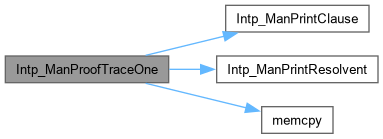
◆ Intp_ManProofTraceOne()

int Intp_ManProofTraceOne ( Intp_Man_t * p,
Sto_Cls_t * pConflict,
Sto_Cls_t * pFinal )

Function*************************************************************

Synopsis [Traces the proof for one clause.]

Description []

SideEffects []

SeeAlso []

Definition at line 473 of file satInterP.c.
474{
475 Sto_Cls_t * pReason;
476 int i, v, Var, PrevId;
477 int fPrint = 0;
478 abctime clk = Abc_Clock();
479
480 // collect resolvent literals
481 if ( p->fProofVerif )
482 {
483 assert( (int)pConflict->nLits <= p->nResLitsAlloc );
484 memcpy( p->pResLits, pConflict->pLits, sizeof(lit) * pConflict->nLits );
485 p->nResLits = pConflict->nLits;
486 }
487
488 // mark all the variables in the conflict as seen
489 for ( v = 0; v < (int)pConflict->nLits; v++ )
490 p->pSeens[lit_var(pConflict->pLits[v])] = 1;
491
492 // start the anticedents
493// pFinal->pAntis = Vec_PtrAlloc( 32 );
494// Vec_PtrPush( pFinal->pAntis, pConflict );
495
496// assert( pFinal->Id == Vec_IntSize(p->vBreaks) );
497// Vec_IntPush( p->vBreaks, Vec_IntSize(p->vAnties) );
498// Vec_IntPush( p->vAnties, pConflict->Id );
499 {
500 Vec_Int_t * vAnts = Vec_IntAlloc( 16 );
501 assert( Vec_PtrSize(p->vAntClas) == pFinal->Id - p->nAntStart );
502 Vec_IntPush( vAnts, pConflict->Id );
503 Vec_PtrPush( p->vAntClas, vAnts );
504 }
505
506// if ( p->pCnf->nClausesA )
507// Intp_ManAigCopy( p, Intp_ManAigRead(p, pFinal), Intp_ManAigRead(p, pConflict) );
508
509 // follow the trail backwards
510 PrevId = Intp_ManProofGet(p, pConflict);
511 for ( i = p->nTrailSize - 1; i >= 0; i-- )
512 {
513 // skip literals that are not involved
514 Var = lit_var(p->pTrail[i]);
515 if ( !p->pSeens[Var] )
516 continue;
517 p->pSeens[Var] = 0;
518
519 // skip literals of the resulting clause
520 pReason = p->pReasons[Var];
521 if ( pReason == NULL )
522 continue;
523 assert( p->pTrail[i] == pReason->pLits[0] );
524
525 // add the variables to seen
526 for ( v = 1; v < (int)pReason->nLits; v++ )
527 p->pSeens[lit_var(pReason->pLits[v])] = 1;
528
529
530 // record the reason clause
531 assert( Intp_ManProofGet(p, pReason) > 0 );
532 p->Counter++;
533 if ( p->fProofWrite )
534 fprintf( p->pFile, "%d * %d %d 0\n", p->Counter, PrevId, Intp_ManProofGet(p, pReason) );
535 PrevId = p->Counter;
536
537// if ( p->pCnf->nClausesA )
538// {
539// if ( p->pVarTypes[Var] == 1 ) // var of A
540// Intp_ManAigOr( p, Intp_ManAigRead(p, pFinal), Intp_ManAigRead(p, pReason) );
541// else
542// Intp_ManAigAnd( p, Intp_ManAigRead(p, pFinal), Intp_ManAigRead(p, pReason) );
543// }
544
545 // resolve the temporary resolvent with the reason clause
546 if ( p->fProofVerif )
547 {
548 int v1, v2;
549 if ( fPrint )
550 Intp_ManPrintResolvent( p->pResLits, p->nResLits );
551 // check that the var is present in the resolvent
552 for ( v1 = 0; v1 < p->nResLits; v1++ )
553 if ( lit_var(p->pResLits[v1]) == Var )
554 break;
555 if ( v1 == p->nResLits )
556 printf( "Recording clause %d: Cannot find variable %d in the temporary resolvent.\n", pFinal->Id, Var );
557 if ( p->pResLits[v1] != lit_neg(pReason->pLits[0]) )
558 printf( "Recording clause %d: The resolved variable %d is in the wrong polarity.\n", pFinal->Id, Var );
559 // remove this variable from the resolvent
560 assert( lit_var(p->pResLits[v1]) == Var );
561 p->nResLits--;
562 for ( ; v1 < p->nResLits; v1++ )
563 p->pResLits[v1] = p->pResLits[v1+1];
564 // add variables of the reason clause
565 for ( v2 = 1; v2 < (int)pReason->nLits; v2++ )
566 {
567 for ( v1 = 0; v1 < p->nResLits; v1++ )
568 if ( lit_var(p->pResLits[v1]) == lit_var(pReason->pLits[v2]) )
569 break;
570 // if it is a new variable, add it to the resolvent
571 if ( v1 == p->nResLits )
572 {
573 if ( p->nResLits == p->nResLitsAlloc )
574 printf( "Recording clause %d: Ran out of space for intermediate resolvent.\n", pFinal->Id );
575 p->pResLits[ p->nResLits++ ] = pReason->pLits[v2];
576 continue;
577 }
578 // if the variable is the same, the literal should be the same too
579 if ( p->pResLits[v1] == pReason->pLits[v2] )
580 continue;
581 // the literal is different
582 printf( "Recording clause %d: Trying to resolve the clause with more than one opposite literal.\n", pFinal->Id );
583 }
584 }
585
586// Vec_PtrPush( pFinal->pAntis, pReason );
587// Vec_IntPush( p->vAnties, pReason->Id );
588 Vec_IntPush( (Vec_Int_t *)Vec_PtrEntryLast(p->vAntClas), pReason->Id );
589 }
590
591 // unmark all seen variables
592// for ( i = p->nTrailSize - 1; i >= 0; i-- )
593// p->pSeens[lit_var(p->pTrail[i])] = 0;
594 // check that the literals are unmarked
595// for ( i = p->nTrailSize - 1; i >= 0; i-- )
596// assert( p->pSeens[lit_var(p->pTrail[i])] == 0 );
597
598 // use the resulting clause to check the correctness of resolution
599 if ( p->fProofVerif )
600 {
601 int v1, v2;
602 if ( fPrint )
603 Intp_ManPrintResolvent( p->pResLits, p->nResLits );
604 for ( v1 = 0; v1 < p->nResLits; v1++ )
605 {
606 for ( v2 = 0; v2 < (int)pFinal->nLits; v2++ )
607 if ( pFinal->pLits[v2] == p->pResLits[v1] )
608 break;
609 if ( v2 < (int)pFinal->nLits )
610 continue;
611 break;
612 }
613 if ( v1 < p->nResLits )
614 {
615 printf( "Recording clause %d: The final resolvent is wrong.\n", pFinal->Id );
616 Intp_ManPrintClause( p, pConflict );
617 Intp_ManPrintResolvent( p->pResLits, p->nResLits );
618 Intp_ManPrintClause( p, pFinal );
619 }
620
621 // if there are literals in the clause that are not in the resolvent
622 // it means that the derived resolvent is stronger than the clause
623 // we can replace the clause with the resolvent by removing these literals
624 if ( p->nResLits != (int)pFinal->nLits )
625 {
626 for ( v1 = 0; v1 < (int)pFinal->nLits; v1++ )
627 {
628 for ( v2 = 0; v2 < p->nResLits; v2++ )
629 if ( pFinal->pLits[v1] == p->pResLits[v2] )
630 break;
631 if ( v2 < p->nResLits )
632 continue;
633 // remove literal v1 from the final clause
634 pFinal->nLits--;
635 for ( v2 = v1; v2 < (int)pFinal->nLits; v2++ )
636 pFinal->pLits[v2] = pFinal->pLits[v2+1];
637 v1--;
638 }
639 assert( p->nResLits == (int)pFinal->nLits );
640 }
641 }
642p->timeTrace += Abc_Clock() - clk;
643
644 // return the proof pointer
645// if ( p->pCnf->nClausesA )
646// {
647// Intp_ManPrintInterOne( p, pFinal );
648// }
649 Intp_ManProofSet( p, pFinal, p->Counter );
650 // make sure the same proof ID is not asssigned to two consecutive clauses
651 assert( p->pProofNums[pFinal->Id-1] != p->Counter );
652// if ( p->pProofNums[pFinal->Id] == p->pProofNums[pFinal->Id-1] )
653// p->pProofNums[pFinal->Id] = p->pProofNums[pConflict->Id];
654 return p->Counter;
655}
ABC_INT64_T abctime
Definition abc_global.h:332
typedefABC_NAMESPACE_IMPL_START struct Vec_Int_t_ Vec_Int_t
DECLARATIONS ///.
Definition bblif.c:37
int Var
Definition exorList.c:228
void Intp_ManPrintResolvent(lit *pResLits, int nResLits)
Definition satInterP.c:235
void Intp_ManPrintClause(Intp_Man_t *p, Sto_Cls_t *pClause)
Definition satInterP.c:215
char * memcpy()
Here is the call graph for this function:
Here is the caller graph for this function:

◆ Intp_ManProofWriteOne()

void Intp_ManProofWriteOne ( Intp_Man_t * p,
Sto_Cls_t * pClause )

Function*************************************************************

Synopsis [Writes one root clause into a file.]

Description []

SideEffects []

SeeAlso []

Definition at line 448 of file satInterP.c.

449{
450 Intp_ManProofSet( p, pClause, ++p->Counter );
451
452 if ( p->fProofWrite )
453 {
454 int v;
455 fprintf( p->pFile, "%d", Intp_ManProofGet(p, pClause) );
456 for ( v = 0; v < (int)pClause->nLits; v++ )
457 fprintf( p->pFile, " %d", lit_print(pClause->pLits[v]) );
458 fprintf( p->pFile, " 0 0\n" );
459 }
460}
Here is the caller graph for this function:

◆ Intp_ManPropagate()

Sto_Cls_t * Intp_ManPropagate ( Intp_Man_t * p,
int Start )

Function*************************************************************

Synopsis [Propagate the current assignments.]

Description []

SideEffects []

SeeAlso []

Definition at line 418 of file satInterP.c.

419{
420 Sto_Cls_t * pClause;
421 int i;
422 abctime clk = Abc_Clock();
423 for ( i = Start; i < p->nTrailSize; i++ )
424 {
425 pClause = Intp_ManPropagateOne( p, p->pTrail[i] );
426 if ( pClause )
427 {
428p->timeBcp += Abc_Clock() - clk;
429 return pClause;
430 }
431 }
432p->timeBcp += Abc_Clock() - clk;
433 return NULL;
434}
Here is the caller graph for this function:

◆ Intp_ManResize()

void Intp_ManResize ( Intp_Man_t * p)

Function*************************************************************

Synopsis [Resize proof manager.]

Description []

SideEffects []

SeeAlso []

Definition at line 127 of file satInterP.c.

128{
129 // check if resizing is needed
130 if ( p->nVarsAlloc < p->pCnf->nVars )
131 {
132 // find the new size
133 if ( p->nVarsAlloc == 0 )
134 p->nVarsAlloc = 1;
135 while ( p->nVarsAlloc < p->pCnf->nVars )
136 p->nVarsAlloc *= 2;
137 // resize the arrays
138 p->pTrail = ABC_REALLOC(lit, p->pTrail, p->nVarsAlloc );
139 p->pAssigns = ABC_REALLOC(lit, p->pAssigns, p->nVarsAlloc );
140 p->pSeens = ABC_REALLOC(char, p->pSeens, p->nVarsAlloc );
141// p->pVarTypes = ABC_REALLOC(int, p->pVarTypes, p->nVarsAlloc );
142 p->pReasons = ABC_REALLOC(Sto_Cls_t *, p->pReasons, p->nVarsAlloc );
143 p->pWatches = ABC_REALLOC(Sto_Cls_t *, p->pWatches, p->nVarsAlloc*2 );
144 }
145
146 // clean the free space
147 memset( p->pAssigns , 0xff, sizeof(lit) * p->pCnf->nVars );
148 memset( p->pSeens , 0, sizeof(char) * p->pCnf->nVars );
149// memset( p->pVarTypes, 0, sizeof(int) * p->pCnf->nVars );
150 memset( p->pReasons , 0, sizeof(Sto_Cls_t *) * p->pCnf->nVars );
151 memset( p->pWatches , 0, sizeof(Sto_Cls_t *) * p->pCnf->nVars*2 );
152
153 // check if resizing of clauses is needed
154 if ( p->nClosAlloc < p->pCnf->nClauses )
155 {
156 // find the new size
157 if ( p->nClosAlloc == 0 )
158 p->nClosAlloc = 1;
159 while ( p->nClosAlloc < p->pCnf->nClauses )
160 p->nClosAlloc *= 2;
161 // resize the arrays
162 p->pProofNums = ABC_REALLOC( int, p->pProofNums, p->nClosAlloc );
163 }
164 memset( p->pProofNums, 0, sizeof(int) * p->pCnf->nClauses );
165}
#define ABC_REALLOC(type, obj, num)
Definition abc_global.h:268
Here is the call graph for this function:
Here is the caller graph for this function:

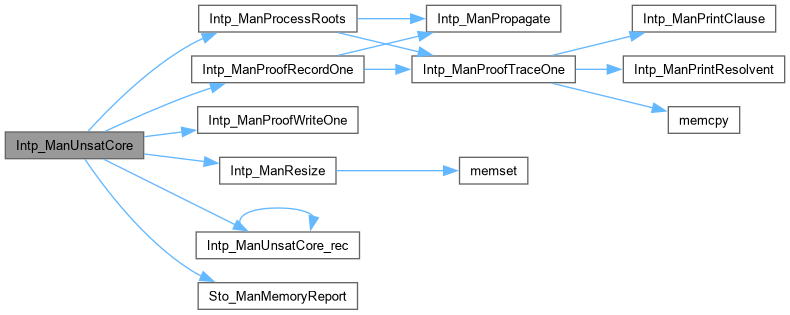
◆ Intp_ManUnsatCore()

void * Intp_ManUnsatCore ( Intp_Man_t * p,
Sto_Man_t * pCnf,
int fLearned,
int fVerbose )

Function*************************************************************

Synopsis [Computes UNSAT core of the satisfiablity problem.]

Description [Takes the interpolation manager, the CNF derived by the SAT solver, which includes the root clauses and the learned clauses. Returns the array of integers representing the number of root clauses that are in the UNSAT core.]

SideEffects []

SeeAlso []

Definition at line 963 of file satInterP.c.
964{
965 Vec_Int_t * vCore;
966 Vec_Str_t * vVisited;
967 Sto_Cls_t * pClause;
968 int RetValue = 1;
969 abctime clkTotal = Abc_Clock();
970
971 // check that the CNF makes sense
972 assert( pCnf->nVars > 0 && pCnf->nClauses > 0 );
973 p->pCnf = pCnf;
974 p->fVerbose = fVerbose;
975
976 // adjust the manager
977 Intp_ManResize( p );
978
979 // construct proof for each clause
980 // start the proof
981 if ( p->fProofWrite )
982 {
983 p->pFile = fopen( "proof.cnf_", "w" );
984 p->Counter = 0;
985 }
986
987 // write the root clauses
988// Vec_IntClear( p->vAnties );
989// Vec_IntFill( p->vBreaks, p->pCnf->nRoots, 0 );
990 Vec_PtrClear( p->vAntClas );
991 p->nAntStart = p->pCnf->nRoots;
992
993 Sto_ManForEachClauseRoot( p->pCnf, pClause )
994 Intp_ManProofWriteOne( p, pClause );
995
996 // propagate root level assignments
997 if ( Intp_ManProcessRoots( p ) )
998 {
999 // if there is no conflict, consider learned clauses
1000 Sto_ManForEachClause( p->pCnf, pClause )
1001 {
1002 if ( pClause->fRoot )
1003 continue;
1004 if ( !Intp_ManProofRecordOne( p, pClause ) )
1005 {
1006 RetValue = 0;
1007 break;
1008 }
1009 }
1010 }
1011
1012 // add the last breaker
1013// assert( p->pCnf->pEmpty->Id == Vec_IntSize(p->vBreaks) - 1 );
1014// Vec_IntPush( p->vBreaks, Vec_IntSize(p->vAnties) );
1015 assert( p->pCnf->pEmpty->Id - p->nAntStart == Vec_PtrSize(p->vAntClas) - 1 );
1016 Vec_PtrPush( p->vAntClas, Vec_IntAlloc(0) );
1017
1018 // stop the proof
1019 if ( p->fProofWrite )
1020 {
1021 fclose( p->pFile );
1022// Sat_ProofChecker( "proof.cnf_" );
1023 p->pFile = NULL;
1024 }
1025
1026 if ( fVerbose )
1027 {
1028// ABC_PRT( "Core", Abc_Clock() - clkTotal );
1029 printf( "Vars = %d. Roots = %d. Learned = %d. Resol steps = %d. Ave = %.2f. Mem = %.2f MB\n",
1030 p->pCnf->nVars, p->pCnf->nRoots, p->pCnf->nClauses-p->pCnf->nRoots, p->Counter,
1031 1.0*(p->Counter-p->pCnf->nRoots)/(p->pCnf->nClauses-p->pCnf->nRoots),
1032 1.0*Sto_ManMemoryReport(p->pCnf)/(1<<20) );
1033p->timeTotal += Abc_Clock() - clkTotal;
1034 }
1035
1036 // derive the UNSAT core
1037 vCore = Vec_IntAlloc( 1000 );
1038 vVisited = Vec_StrStart( p->pCnf->pEmpty->Id+1 );
1039 Intp_ManUnsatCore_rec( p->vAntClas, p->pCnf->pEmpty->Id, vCore, p->pCnf->nRoots, vVisited, fLearned );
1040 Vec_StrFree( vVisited );
1041 if ( fVerbose )
1042 printf( "Root clauses = %d. Learned clauses = %d. UNSAT core size = %d.\n",
1043 p->pCnf->nRoots, p->pCnf->nClauses-p->pCnf->nRoots, Vec_IntSize(vCore) );
1044// Intp_ManUnsatCoreVerify( p->pCnf, vCore );
1045 return vCore;
1046}
struct Vec_Str_t_ Vec_Str_t
Definition bblif.c:46
void Intp_ManUnsatCore_rec(Vec_Ptr_t *vAntClas, int iThis, Vec_Int_t *vCore, int nRoots, Vec_Str_t *vVisited, int fLearned)
Definition satInterP.c:919
void Intp_ManResize(Intp_Man_t *p)
Definition satInterP.c:127
void Intp_ManProofWriteOne(Intp_Man_t *p, Sto_Cls_t *pClause)
Definition satInterP.c:448
int Intp_ManProofRecordOne(Intp_Man_t *p, Sto_Cls_t *pClause)
Definition satInterP.c:668
int Intp_ManProcessRoots(Intp_Man_t *p)
Definition satInterP.c:782
int Sto_ManMemoryReport(Sto_Man_t *p)
Definition satStore.c:97
int nVars
Definition satStore.h:85
int nClauses
Definition satStore.h:87
Here is the call graph for this function:
Here is the caller graph for this function:

◆ Intp_ManUnsatCore_rec()

void Intp_ManUnsatCore_rec ( Vec_Ptr_t * vAntClas,
int iThis,
Vec_Int_t * vCore,
int nRoots,
Vec_Str_t * vVisited,
int fLearned )

Function*************************************************************

Synopsis [Recursively computes the UNSAT core.]

Description []

SideEffects []

SeeAlso []

Definition at line 919 of file satInterP.c.
920{
921// int i, iStop, iStart;
922 Vec_Int_t * vAnt;
923 int i, Entry;
924 // skip visited clauses
925 if ( Vec_StrEntry( vVisited, iThis ) )
926 return;
927 Vec_StrWriteEntry( vVisited, iThis, 1 );
928 // add a root clause to the core
929 if ( iThis < nRoots )
930 {
931 if ( !fLearned )
932 Vec_IntPush( vCore, iThis );
933 return;
934 }
935 // iterate through the clauses
936// iStart = Vec_IntEntry( vBreaks, iThis );
937// iStop = Vec_IntEntry( vBreaks, iThis+1 );
938// assert( iStop != -1 );
939// for ( i = iStart; i < iStop; i++ )
940 vAnt = (Vec_Int_t *)Vec_PtrEntry( vAntClas, iThis - nRoots );
941 Vec_IntForEachEntry( vAnt, Entry, i )
942// Intp_ManUnsatCore_rec( vAntClas, Vec_IntEntry(vAnties, i), vCore, nRoots, vVisited );
943 Intp_ManUnsatCore_rec( vAntClas, Entry, vCore, nRoots, vVisited, fLearned );
944 // collect learned clause
945 if ( fLearned )
946 Vec_IntPush( vCore, iThis );
947}
#define Vec_IntForEachEntry(vVec, Entry, i)
MACRO DEFINITIONS ///.
Definition vecInt.h:54
Here is the call graph for this function:
Here is the caller graph for this function:

◆ Intp_ManUnsatCorePrintForBmc()

void Intp_ManUnsatCorePrintForBmc ( FILE * pFile,
Sto_Man_t * pCnf,
void * vCore0,
void * vVarMap0 )

Function*************************************************************

Synopsis [Prints learned clauses in terms of original problem varibles.]

Description []

SideEffects []

SeeAlso []

Definition at line 1059 of file satInterP.c.

1060{
1061 Vec_Int_t * vCore = (Vec_Int_t *)vCore0;
1062 Vec_Int_t * vVarMap = (Vec_Int_t *)vVarMap0;
1063 Vec_Ptr_t * vClaMap;
1064 Sto_Cls_t * pClause;
1065 int v, i, iClause, fCompl, iObj, iFrame;
1066 // create map of clause
1067 vClaMap = Vec_PtrAlloc( pCnf->nClauses );
1068 Sto_ManForEachClause( pCnf, pClause )
1069 Vec_PtrPush( vClaMap, pClause );
1070 // print clauses
1071 fprintf( pFile, "UNSAT contains %d learned clauses:\n", Vec_IntSize(vCore) );
1072 Vec_IntForEachEntry( vCore, iClause, i )
1073 {
1074 pClause = (Sto_Cls_t *)Vec_PtrEntry(vClaMap, iClause);
1075 fprintf( pFile, "%6d : %6d : ", i, iClause - pCnf->nRoots );
1076 for ( v = 0; v < (int)pClause->nLits; v++ )
1077 {
1078 fCompl = Abc_LitIsCompl(pClause->pLits[v]);
1079 iObj = Vec_IntEntry(vVarMap, 2*Abc_Lit2Var(pClause->pLits[v]));
1080 iFrame = Vec_IntEntry(vVarMap, 2*Abc_Lit2Var(pClause->pLits[v])+1);
1081 fprintf( pFile, "%s%d(%d) ", fCompl ? "!":"", iObj, iFrame );
1082 }
1083 if ( pClause->nLits == 0 )
1084 fprintf( pFile, "Empty" );
1085 fprintf( pFile, "\n" );
1086 }
1087 Vec_PtrFree( vClaMap );
1088}
int nRoots
Definition satStore.h:86
typedefABC_NAMESPACE_HEADER_START struct Vec_Ptr_t_ Vec_Ptr_t
INCLUDES ///.
Definition vecPtr.h:42
Here is the caller graph for this function:

◆ Intp_ManUnsatCoreVerify()

void Intp_ManUnsatCoreVerify ( Sto_Man_t * pCnf,
Vec_Int_t * vCore )

Function*************************************************************

Synopsis [Verifies the UNSAT core.]

Description [Takes the interpolation manager, the CNF derived by the SAT solver, which includes the root clauses and the learned clauses. Returns the array of integers representing the number of root clauses that are in the UNSAT core.]

SideEffects []

SeeAlso []

Definition at line 859 of file satInterP.c.

860{
861 int fVerbose = 0;
862 int nConfMax = 1000000;
863 sat_solver * pSat;
864 Sto_Cls_t * pClause;
865 Vec_Ptr_t * vClauses;
866 int i, iClause, RetValue;
867 abctime clk = Abc_Clock();
868 // collect the clauses
869 vClauses = Vec_PtrAlloc( 1000 );
870 Sto_ManForEachClauseRoot( pCnf, pClause )
871 {
872 assert( Vec_PtrSize(vClauses) == pClause->Id );
873 Vec_PtrPush( vClauses, pClause );
874 }
875 // create new SAT solver
876 pSat = sat_solver_new();
877// sat_solver_setnvars( pSat, nSatVars );
878 Vec_IntForEachEntry( vCore, iClause, i )
879 {
880 pClause = (Sto_Cls_t *)Vec_PtrEntry( vClauses, iClause );
881 if ( !sat_solver_addclause( pSat, pClause->pLits, pClause->pLits+pClause->nLits ) )
882 {
883 printf( "The core verification problem is trivially UNSAT.\n" );
884 break;
885 }
886 }
887 Vec_PtrFree( vClauses );
888 // solve the problem
889 RetValue = sat_solver_solve( pSat, NULL, NULL, (ABC_INT64_T)nConfMax, (ABC_INT64_T)0, (ABC_INT64_T)0, (ABC_INT64_T)0 );
890 sat_solver_delete( pSat );
891 if ( fVerbose )
892 {
893 if ( RetValue == l_Undef )
894 printf( "Conflict limit is reached. " );
895 else if ( RetValue == l_True )
896 printf( "UNSAT core verification FAILED. " );
897 else
898 printf( "UNSAT core verification succeeded. " );
899 ABC_PRT( "Time", Abc_Clock() - clk );
900 }
901 else
902 {
903 if ( RetValue == l_True )
904 printf( "UNSAT core verification FAILED. \n" );
905 }
906}
#define ABC_PRT(a, t)
Definition abc_global.h:255
#define l_True
Definition bmcBmcS.c:35
#define l_Undef
Definition bmcBmcS.c:34
#define sat_solver_addclause
Definition cecSatG2.c:37
#define sat_solver
Definition cecSatG2.c:34
#define sat_solver_solve
Definition cecSatG2.c:45
sat_solver * sat_solver_new(void)
Definition satSolver.c:1137
void sat_solver_delete(sat_solver *s)
Definition satSolver.c:1341
Here is the call graph for this function: