ABC: A System for Sequential Synthesis and Verification
 
Loading...
Searching...
No Matches
absOldSat.c File Reference
#include "abs.h"
#include "sat/cnf/cnf.h"
#include "sat/bsat/satSolver.h"
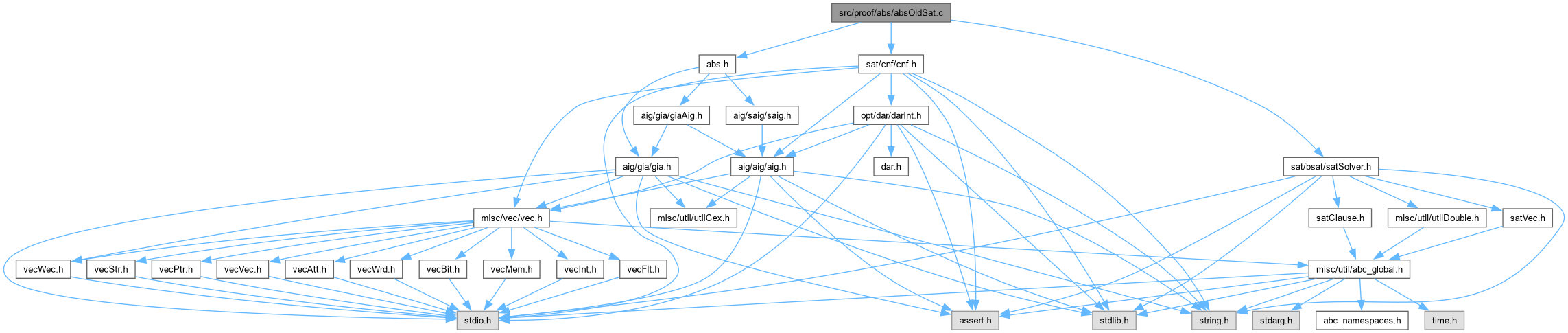
Include dependency graph for absOldSat.c:

Go to the source code of this file.

Classes

struct  Saig_RefMan_t_
 

Functions

int Saig_ManSimDataInit (Aig_Man_t *p, Abc_Cex_t *pCex, Vec_Ptr_t *vSimInfo, Vec_Int_t *vRes)
 
Vec_Int_tSaig_RefManReason2Inputs (Saig_RefMan_t *p, Vec_Int_t *vReasons)
 FUNCTION DEFINITIONS ///.
 
Abc_Cex_tSaig_RefManReason2Cex (Saig_RefMan_t *p, Vec_Int_t *vReasons)
 
void Saig_RefManFindReason_rec (Aig_Man_t *p, Aig_Obj_t *pObj, Vec_Int_t *vPrios, Vec_Int_t *vReasons)
 
Vec_Int_tSaig_RefManFindReason (Saig_RefMan_t *p)
 
void Saig_ManUnrollCollect_rec (Aig_Man_t *pAig, Aig_Obj_t *pObj, Vec_Int_t *vObjs, Vec_Int_t *vRoots)
 
Aig_Man_tSaig_ManUnrollWithCex (Aig_Man_t *pAig, Abc_Cex_t *pCex, int nInputs, Vec_Int_t **pvMapPiF2A)
 
Saig_RefMan_tSaig_RefManStart (Aig_Man_t *pAig, Abc_Cex_t *pCex, int nInputs, int fVerbose)
 
void Saig_RefManStop (Saig_RefMan_t *p)
 
int Saig_RefManSetPhases (Saig_RefMan_t *p, Abc_Cex_t *pCare, int fValue1)
 
Vec_Vec_tSaig_RefManOrderLiterals (Saig_RefMan_t *p, Vec_Int_t *vVar2PiId, Vec_Int_t *vAssumps)
 
Abc_Cex_tSaig_RefManCreateCex (Saig_RefMan_t *p, Vec_Int_t *vVar2PiId, Vec_Int_t *vAssumps)
 
Abc_Cex_tSaig_RefManRunSat (Saig_RefMan_t *p, int fNewOrder)
 
Vec_Int_tSaig_RefManRefineWithSat (Saig_RefMan_t *p, Vec_Int_t *vAigPis)
 
Abc_Cex_tSaig_ManFindCexCareBits (Aig_Man_t *pAig, Abc_Cex_t *pCex, int nInputs, int fNewOrder, int fVerbose)
 
Vec_Int_tSaig_ManExtendCounterExampleTest3 (Aig_Man_t *pAig, int iFirstFlopPi, Abc_Cex_t *pCex, int fVerbose)
 

Function Documentation

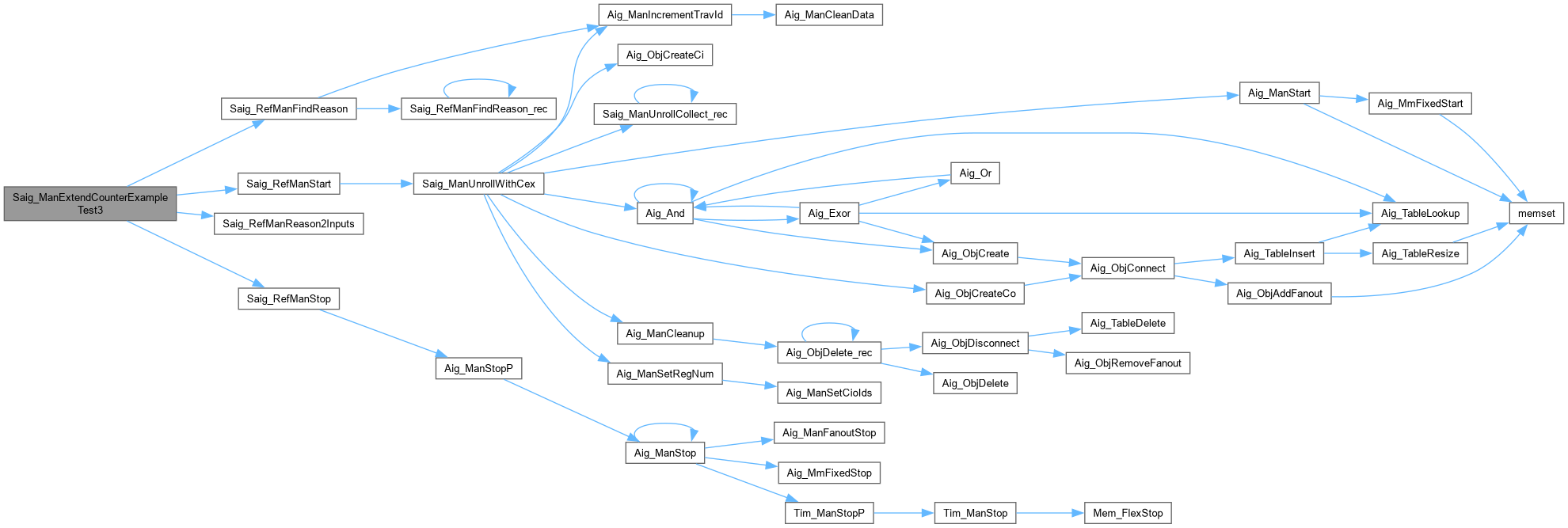
◆ Saig_ManExtendCounterExampleTest3()

Vec_Int_t * Saig_ManExtendCounterExampleTest3 ( Aig_Man_t * pAig,
int iFirstFlopPi,
Abc_Cex_t * pCex,
int fVerbose )

Function*************************************************************

Synopsis [Returns the array of PIs for flops that should not be absracted.]

Description []

SideEffects []

SeeAlso []

Definition at line 930 of file absOldSat.c.
931{
933 Vec_Int_t * vRes, * vReasons;
934 abctime clk;
935 if ( Saig_ManPiNum(pAig) != pCex->nPis )
936 {
937 printf( "Saig_ManExtendCounterExampleTest3(): The PI count of AIG (%d) does not match that of cex (%d).\n",
938 Aig_ManCiNum(pAig), pCex->nPis );
939 return NULL;
940 }
941
942clk = Abc_Clock();
943
944 p = Saig_RefManStart( pAig, pCex, iFirstFlopPi, fVerbose );
945 vReasons = Saig_RefManFindReason( p );
946 vRes = Saig_RefManReason2Inputs( p, vReasons );
947
948// if ( fVerbose )
949 {
950 printf( "Frame PIs = %4d (essential = %4d) AIG PIs = %4d (essential = %4d) ",
951 Aig_ManCiNum(p->pFrames), Vec_IntSize(vReasons),
952 Saig_ManPiNum(p->pAig) - p->nInputs, Vec_IntSize(vRes) );
953ABC_PRT( "Time", Abc_Clock() - clk );
954 }
955
956/*
958 Vec_IntFree( vReasons );
959 vReasons = Saig_RefManRefineWithSat( p, vRes );
961
962 // derive new result
963 Vec_IntFree( vRes );
964 vRes = Saig_RefManReason2Inputs( p, vReasons );
965// if ( fVerbose )
966 {
967 printf( "Frame PIs = %4d (essential = %4d) AIG PIs = %4d (essential = %4d) ",
968 Aig_ManCiNum(p->pFrames), Vec_IntSize(vReasons),
969 Saig_ManPiNum(p->pAig) - p->nInputs, Vec_IntSize(vRes) );
970ABC_PRT( "Time", Abc_Clock() - clk );
971 }
972*/
973
974 Vec_IntFree( vReasons );
976 return vRes;
977}
ABC_INT64_T abctime
Definition abc_global.h:332
#define ABC_PRT(a, t)
Definition abc_global.h:255
void Saig_RefManStop(Saig_RefMan_t *p)
Definition absOldSat.c:386
Vec_Int_t * Saig_RefManFindReason(Saig_RefMan_t *p)
Definition absOldSat.c:168
Saig_RefMan_t * Saig_RefManStart(Aig_Man_t *pAig, Abc_Cex_t *pCex, int nInputs, int fVerbose)
Definition absOldSat.c:363
Vec_Int_t * Saig_RefManReason2Inputs(Saig_RefMan_t *p, Vec_Int_t *vReasons)
FUNCTION DEFINITIONS ///.
Definition absOldSat.c:64
typedefABC_NAMESPACE_IMPL_START struct Vec_Int_t_ Vec_Int_t
DECLARATIONS ///.
Definition bblif.c:37
Cube * p
Definition exorList.c:222
typedefABC_NAMESPACE_IMPL_START struct Saig_RefMan_t_ Saig_RefMan_t
DECLARATIONS ///.
Definition saigRefSat.c:33
Here is the call graph for this function:

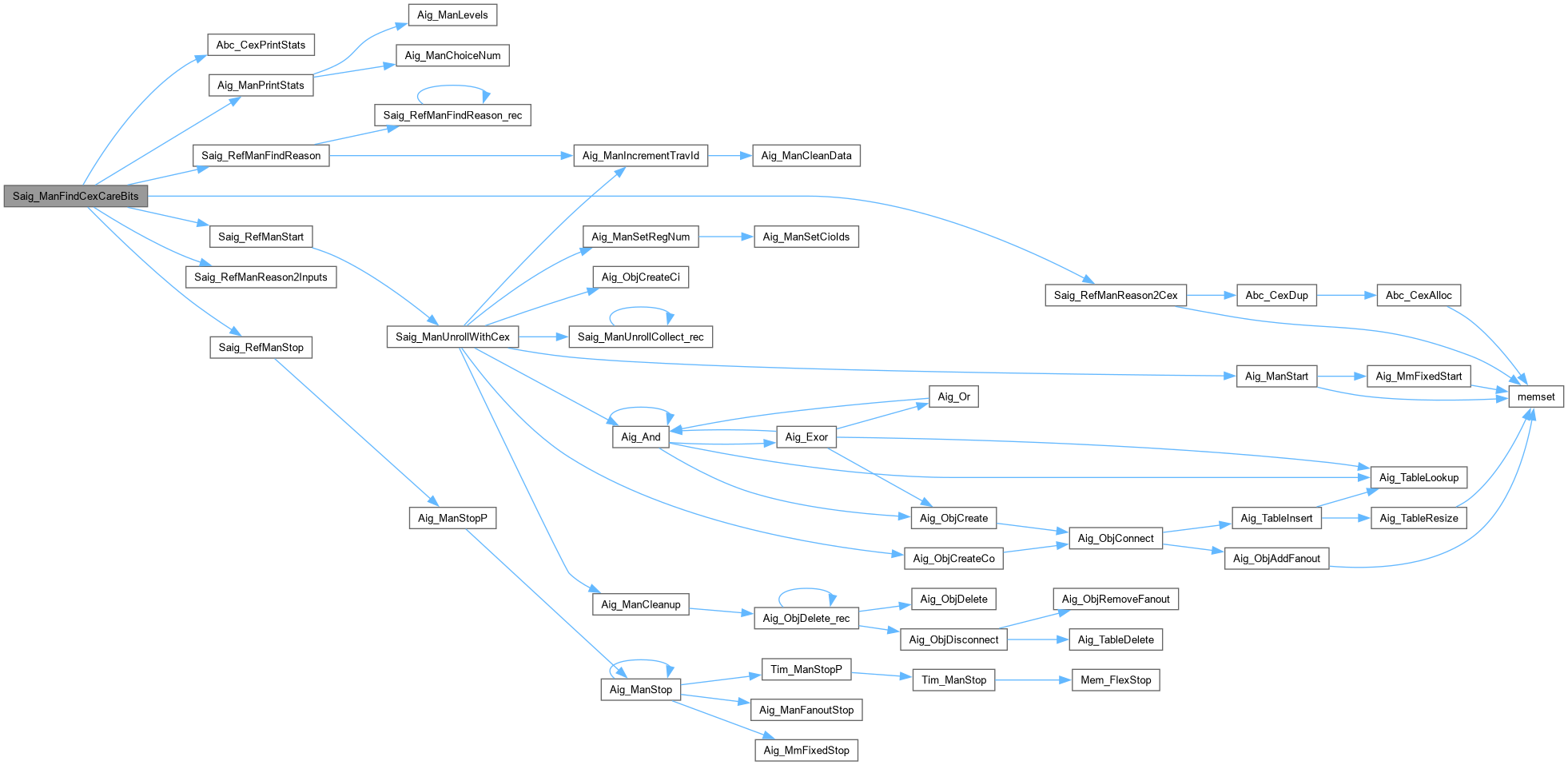
◆ Saig_ManFindCexCareBits()

Abc_Cex_t * Saig_ManFindCexCareBits ( Aig_Man_t * pAig,
Abc_Cex_t * pCex,
int nInputs,
int fNewOrder,
int fVerbose )

Function*************************************************************

Synopsis [SAT-based refinement of the counter-example.]

Description [The first parameter (nInputs) indicates how many first primary inputs to skip without considering as care candidates.]

SideEffects []

SeeAlso []

Definition at line 866 of file absOldSat.c.
867{
869 Vec_Int_t * vReasons;
870 Abc_Cex_t * pCare;
871 abctime clk = Abc_Clock();
872
873 clk = Abc_Clock();
874 p = Saig_RefManStart( pAig, pCex, nInputs, fVerbose );
875 vReasons = Saig_RefManFindReason( p );
876
877if ( fVerbose )
878Aig_ManPrintStats( p->pFrames );
879
880// if ( fVerbose )
881 {
882 Vec_Int_t * vRes = Saig_RefManReason2Inputs( p, vReasons );
883 printf( "Frame PIs = %4d (essential = %4d) AIG PIs = %4d (essential = %4d) ",
884 Aig_ManCiNum(p->pFrames), Vec_IntSize(vReasons),
885 Saig_ManPiNum(p->pAig) - p->nInputs, Vec_IntSize(vRes) );
886ABC_PRT( "Time", Abc_Clock() - clk );
887
888 Vec_IntFree( vRes );
889
890/*
892 Vec_IntFree( vReasons );
893 vReasons = Saig_RefManRefineWithSat( p, vRes );
895
896 Vec_IntFree( vRes );
897 vRes = Saig_RefManReason2Inputs( p, vReasons );
898 printf( "Frame PIs = %4d (essential = %4d) AIG PIs = %4d (essential = %4d) ",
899 Aig_ManCiNum(p->pFrames), Vec_IntSize(vReasons),
900 Saig_ManPiNum(p->pAig) - p->nInputs, Vec_IntSize(vRes) );
901
902 Vec_IntFree( vRes );
903ABC_PRT( "Time", Abc_Clock() - clk );
904*/
905 }
906
907 pCare = Saig_RefManReason2Cex( p, vReasons );
908 Vec_IntFree( vReasons );
910
911if ( fVerbose )
912Abc_CexPrintStats( pCex );
913if ( fVerbose )
914Abc_CexPrintStats( pCare );
915
916 return pCare;
917}
Abc_Cex_t * Saig_RefManReason2Cex(Saig_RefMan_t *p, Vec_Int_t *vReasons)
Definition absOldSat.c:93
void Aig_ManPrintStats(Aig_Man_t *p)
Definition aigMan.c:379
void Abc_CexPrintStats(Abc_Cex_t *p)
Definition utilCex.c:256
typedefABC_NAMESPACE_HEADER_START struct Abc_Cex_t_ Abc_Cex_t
INCLUDES ///.
Definition utilCex.h:39
Here is the call graph for this function:

◆ Saig_ManSimDataInit()

int Saig_ManSimDataInit ( Aig_Man_t * p,
Abc_Cex_t * pCex,
Vec_Ptr_t * vSimInfo,
Vec_Int_t * vRes )
extern

Function*************************************************************

Synopsis [Performs ternary simulation for one design.]

Description []

SideEffects []

SeeAlso []

Definition at line 174 of file absOldSim.c.

175{
176 Aig_Obj_t * pObj, * pObjLi, * pObjLo;
177 int i, f, Entry, iBit = 0;
178 Saig_ManForEachLo( p, pObj, i )
179 Saig_ManSimInfoSet( vSimInfo, pObj, 0, Abc_InfoHasBit(pCex->pData, iBit++)?SAIG_ONE:SAIG_ZER );
180 for ( f = 0; f <= pCex->iFrame; f++ )
181 {
182 Saig_ManSimInfoSet( vSimInfo, Aig_ManConst1(p), f, SAIG_ONE );
183 Saig_ManForEachPi( p, pObj, i )
184 Saig_ManSimInfoSet( vSimInfo, pObj, f, Abc_InfoHasBit(pCex->pData, iBit++)?SAIG_ONE:SAIG_ZER );
185 if ( vRes )
186 Vec_IntForEachEntry( vRes, Entry, i )
187 Saig_ManSimInfoSet( vSimInfo, Aig_ManCi(p, Entry), f, SAIG_UND );
188 Aig_ManForEachNode( p, pObj, i )
189 Saig_ManExtendOneEval( vSimInfo, pObj, f );
190 Aig_ManForEachCo( p, pObj, i )
191 Saig_ManExtendOneEval( vSimInfo, pObj, f );
192 if ( f == pCex->iFrame )
193 break;
194 Saig_ManForEachLiLo( p, pObjLi, pObjLo, i )
195 Saig_ManSimInfoSet( vSimInfo, pObjLo, f+1, Saig_ManSimInfoGet(vSimInfo, pObjLi, f) );
196 }
197 // make sure the output of the property failed
198 pObj = Aig_ManCo( p, pCex->iPo );
199 return Saig_ManSimInfoGet( vSimInfo, pObj, pCex->iFrame );
200}
int Saig_ManExtendOneEval(Vec_Ptr_t *vSimInfo, Aig_Obj_t *pObj, int iFrame)
FUNCTION DEFINITIONS ///.
Definition absOldSim.c:143
#define SAIG_ZER
DECLARATIONS ///.
Definition absOldSim.c:30
#define SAIG_ONE
Definition absOldSim.c:31
#define SAIG_UND
Definition absOldSim.c:32
struct Aig_Obj_t_ Aig_Obj_t
Definition aig.h:51
#define Aig_ManForEachNode(p, pObj, i)
Definition aig.h:413
#define Aig_ManForEachCo(p, pObj, i)
Definition aig.h:398
#define Saig_ManForEachLiLo(p, pObjLi, pObjLo, i)
Definition saig.h:101
#define Saig_ManForEachLo(p, pObj, i)
Definition saig.h:96
#define Saig_ManForEachPi(p, pObj, i)
Definition saig.h:91
#define Vec_IntForEachEntry(vVec, Entry, i)
MACRO DEFINITIONS ///.
Definition vecInt.h:54
Here is the caller graph for this function:

◆ Saig_ManUnrollCollect_rec()

void Saig_ManUnrollCollect_rec ( Aig_Man_t * pAig,
Aig_Obj_t * pObj,
Vec_Int_t * vObjs,
Vec_Int_t * vRoots )

Function*************************************************************

Synopsis [Collect nodes in the unrolled timeframes.]

Description []

SideEffects []

SeeAlso []

Definition at line 236 of file absOldSat.c.
237{
238 if ( Aig_ObjIsTravIdCurrent(pAig, pObj) )
239 return;
240 Aig_ObjSetTravIdCurrent(pAig, pObj);
241 if ( Aig_ObjIsCo(pObj) )
242 Saig_ManUnrollCollect_rec( pAig, Aig_ObjFanin0(pObj), vObjs, vRoots );
243 else if ( Aig_ObjIsNode(pObj) )
244 {
245 Saig_ManUnrollCollect_rec( pAig, Aig_ObjFanin0(pObj), vObjs, vRoots );
246 Saig_ManUnrollCollect_rec( pAig, Aig_ObjFanin1(pObj), vObjs, vRoots );
247 }
248 if ( vRoots && Saig_ObjIsLo( pAig, pObj ) )
249 Vec_IntPush( vRoots, Aig_ObjId( Saig_ObjLoToLi(pAig, pObj) ) );
250 Vec_IntPush( vObjs, Aig_ObjId(pObj) );
251}
void Saig_ManUnrollCollect_rec(Aig_Man_t *pAig, Aig_Obj_t *pObj, Vec_Int_t *vObjs, Vec_Int_t *vRoots)
Definition absOldSat.c:236
Here is the call graph for this function:
Here is the caller graph for this function:

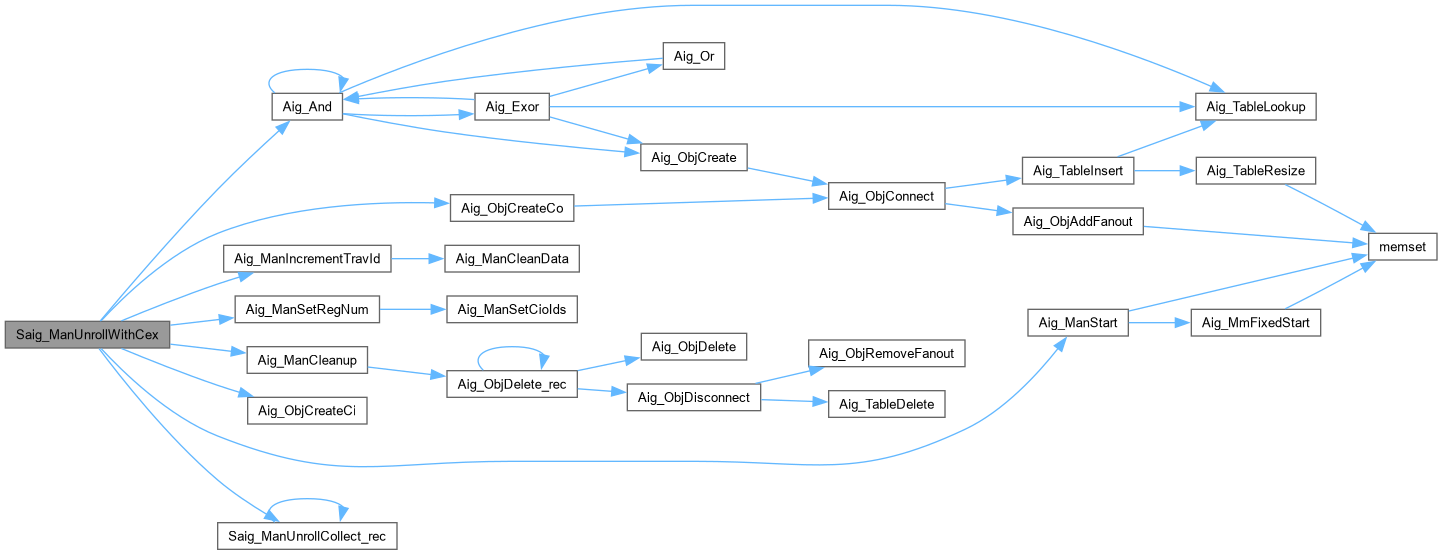
◆ Saig_ManUnrollWithCex()

Aig_Man_t * Saig_ManUnrollWithCex ( Aig_Man_t * pAig,
Abc_Cex_t * pCex,
int nInputs,
Vec_Int_t ** pvMapPiF2A )

Function*************************************************************

Synopsis [Derive unrolled timeframes.]

Description []

SideEffects []

SeeAlso []

Definition at line 264 of file absOldSat.c.
265{
266 Aig_Man_t * pFrames; // unrolled timeframes
267 Vec_Vec_t * vFrameCos; // the list of COs per frame
268 Vec_Vec_t * vFrameObjs; // the list of objects per frame
269 Vec_Int_t * vRoots, * vObjs;
270 Aig_Obj_t * pObj;
271 int i, f;
272 // sanity checks
273 assert( Saig_ManPiNum(pAig) == pCex->nPis );
274 assert( Saig_ManRegNum(pAig) == pCex->nRegs );
275 assert( pCex->iPo >= 0 && pCex->iPo < Saig_ManPoNum(pAig) );
276
277 // map PIs of the unrolled frames into PIs of the original design
278 *pvMapPiF2A = Vec_IntAlloc( 1000 );
279
280 // collect COs and Objs visited in each frame
281 vFrameCos = Vec_VecStart( pCex->iFrame+1 );
282 vFrameObjs = Vec_VecStart( pCex->iFrame+1 );
283 // initialized the topmost frame
284 pObj = Aig_ManCo( pAig, pCex->iPo );
285 Vec_VecPushInt( vFrameCos, pCex->iFrame, Aig_ObjId(pObj) );
286 for ( f = pCex->iFrame; f >= 0; f-- )
287 {
288 // collect nodes starting from the roots
290 vRoots = Vec_VecEntryInt( vFrameCos, f );
291 Aig_ManForEachObjVec( vRoots, pAig, pObj, i )
292 Saig_ManUnrollCollect_rec( pAig, pObj,
293 Vec_VecEntryInt(vFrameObjs, f),
294 (Vec_Int_t *)(f ? Vec_VecEntry(vFrameCos, f-1) : NULL) );
295 }
296
297 // derive unrolled timeframes
298 pFrames = Aig_ManStart( 10000 );
299 pFrames->pName = Abc_UtilStrsav( pAig->pName );
300 pFrames->pSpec = Abc_UtilStrsav( pAig->pSpec );
301 // initialize the flops
302 Saig_ManForEachLo( pAig, pObj, i )
303 pObj->pData = Aig_NotCond( Aig_ManConst1(pFrames), !Abc_InfoHasBit(pCex->pData, i) );
304 // iterate through the frames
305 for ( f = 0; f <= pCex->iFrame; f++ )
306 {
307 // construct
308 vObjs = Vec_VecEntryInt( vFrameObjs, f );
309 Aig_ManForEachObjVec( vObjs, pAig, pObj, i )
310 {
311 if ( Aig_ObjIsNode(pObj) )
312 pObj->pData = Aig_And( pFrames, Aig_ObjChild0Copy(pObj), Aig_ObjChild1Copy(pObj) );
313 else if ( Aig_ObjIsCo(pObj) )
314 pObj->pData = Aig_ObjChild0Copy(pObj);
315 else if ( Aig_ObjIsConst1(pObj) )
316 pObj->pData = Aig_ManConst1(pFrames);
317 else if ( Saig_ObjIsPi(pAig, pObj) )
318 {
319 if ( Aig_ObjCioId(pObj) < nInputs )
320 {
321 int iBit = pCex->nRegs + f * pCex->nPis + Aig_ObjCioId(pObj);
322 pObj->pData = Aig_NotCond( Aig_ManConst1(pFrames), !Abc_InfoHasBit(pCex->pData, iBit) );
323 }
324 else
325 {
326 pObj->pData = Aig_ObjCreateCi( pFrames );
327 Vec_IntPush( *pvMapPiF2A, Aig_ObjCioId(pObj) );
328 Vec_IntPush( *pvMapPiF2A, f );
329 }
330 }
331 }
332 if ( f == pCex->iFrame )
333 break;
334 // transfer
335 vRoots = Vec_VecEntryInt( vFrameCos, f );
336 Aig_ManForEachObjVec( vRoots, pAig, pObj, i )
337 Saig_ObjLiToLo( pAig, pObj )->pData = pObj->pData;
338 }
339 // create output
340 pObj = Aig_ManCo( pAig, pCex->iPo );
341 Aig_ObjCreateCo( pFrames, Aig_Not((Aig_Obj_t *)pObj->pData) );
342 Aig_ManSetRegNum( pFrames, 0 );
343 // cleanup
344 Vec_VecFree( vFrameCos );
345 Vec_VecFree( vFrameObjs );
346 // finallize
347 Aig_ManCleanup( pFrames );
348 // return
349 return pFrames;
350}
void Aig_ManSetRegNum(Aig_Man_t *p, int nRegs)
Definition aigMan.c:438
void Aig_ManIncrementTravId(Aig_Man_t *p)
DECLARATIONS ///.
Definition aigUtil.c:44
Aig_Obj_t * Aig_And(Aig_Man_t *p, Aig_Obj_t *p0, Aig_Obj_t *p1)
Definition aigOper.c:104
Aig_Obj_t * Aig_ObjCreateCo(Aig_Man_t *p, Aig_Obj_t *pDriver)
Definition aigObj.c:66
Aig_Man_t * Aig_ManStart(int nNodesMax)
DECLARATIONS ///.
Definition aigMan.c:47
typedefABC_NAMESPACE_HEADER_START struct Aig_Man_t_ Aig_Man_t
INCLUDES ///.
Definition aig.h:50
int Aig_ManCleanup(Aig_Man_t *p)
Definition aigMan.c:265
Aig_Obj_t * Aig_ObjCreateCi(Aig_Man_t *p)
DECLARATIONS ///.
Definition aigObj.c:45
#define Aig_ManForEachObjVec(vIds, p, pObj, i)
Definition aig.h:408
void * pData
Definition aig.h:87
#define assert(ex)
Definition util_old.h:213
typedefABC_NAMESPACE_HEADER_START struct Vec_Vec_t_ Vec_Vec_t
INCLUDES ///.
Definition vecVec.h:42
Here is the call graph for this function:
Here is the caller graph for this function:

◆ Saig_RefManCreateCex()

Abc_Cex_t * Saig_RefManCreateCex ( Saig_RefMan_t * p,
Vec_Int_t * vVar2PiId,
Vec_Int_t * vAssumps )

Function*************************************************************

Synopsis [Generate the care set using SAT solver.]

Description []

SideEffects []

SeeAlso []

Definition at line 473 of file absOldSat.c.

474{
475 Abc_Cex_t * pCare;
476 int i, Entry, iInput, iFrame;
477 // create counter-example
478 pCare = Abc_CexDup( p->pCex, p->pCex->nRegs );
479 memset( pCare->pData, 0, sizeof(unsigned) * Abc_BitWordNum(pCare->nBits) );
480 Vec_IntForEachEntry( vAssumps, Entry, i )
481 {
482 int iPiNum = Vec_IntEntry( vVar2PiId, lit_var(Entry) );
483 assert( iPiNum >= 0 && iPiNum < Aig_ManCiNum(p->pFrames) );
484 iInput = Vec_IntEntry( p->vMapPiF2A, 2*iPiNum );
485 iFrame = Vec_IntEntry( p->vMapPiF2A, 2*iPiNum+1 );
486 Abc_InfoSetBit( pCare->pData, pCare->nRegs + pCare->nPis * iFrame + iInput );
487 }
488 return pCare;
489}
Abc_Cex_t * Abc_CexDup(Abc_Cex_t *p, int nRegsNew)
Definition utilCex.c:145
char * memset()
Here is the call graph for this function:
Here is the caller graph for this function:

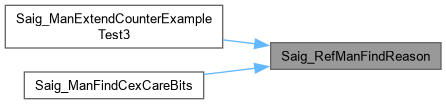
◆ Saig_RefManFindReason()

Vec_Int_t * Saig_RefManFindReason ( Saig_RefMan_t * p)

Function*************************************************************

Synopsis [Returns reasons for the property to fail.]

Description []

SideEffects []

SeeAlso []

Definition at line 168 of file absOldSat.c.

169{
170 Aig_Obj_t * pObj;
171 Vec_Int_t * vPrios, * vPi2Prio, * vReasons;
172 int i, CountPrios;
173
174 vPi2Prio = Vec_IntStartFull( Saig_ManPiNum(p->pAig) );
175 vPrios = Vec_IntStartFull( Aig_ManObjNumMax(p->pFrames) );
176
177 // set PI values according to CEX
178 CountPrios = 0;
179 Aig_ManConst1(p->pFrames)->fPhase = 1;
180 Aig_ManForEachCi( p->pFrames, pObj, i )
181 {
182 int iInput = Vec_IntEntry( p->vMapPiF2A, 2*i );
183 int iFrame = Vec_IntEntry( p->vMapPiF2A, 2*i+1 );
184 pObj->fPhase = Abc_InfoHasBit( p->pCex->pData, p->pCex->nRegs + p->pCex->nPis * iFrame + iInput );
185 // assign priority
186 if ( Vec_IntEntry(vPi2Prio, iInput) == ~0 )
187 Vec_IntWriteEntry( vPi2Prio, iInput, CountPrios++ );
188// Vec_IntWriteEntry( vPrios, Aig_ObjId(pObj), Vec_IntEntry(vPi2Prio, iInput) );
189 Vec_IntWriteEntry( vPrios, Aig_ObjId(pObj), i );
190 }
191// printf( "Priority numbers = %d.\n", CountPrios );
192 Vec_IntFree( vPi2Prio );
193
194 // traverse and set the priority
195 Aig_ManForEachNode( p->pFrames, pObj, i )
196 {
197 int fPhase0 = Aig_ObjFaninC0(pObj) ^ Aig_ObjFanin0(pObj)->fPhase;
198 int fPhase1 = Aig_ObjFaninC1(pObj) ^ Aig_ObjFanin1(pObj)->fPhase;
199 int iPrio0 = Vec_IntEntry( vPrios, Aig_ObjFaninId0(pObj) );
200 int iPrio1 = Vec_IntEntry( vPrios, Aig_ObjFaninId1(pObj) );
201 pObj->fPhase = fPhase0 && fPhase1;
202 if ( fPhase0 && fPhase1 ) // both are one
203 Vec_IntWriteEntry( vPrios, Aig_ObjId(pObj), Abc_MaxInt(iPrio0, iPrio1) );
204 else if ( !fPhase0 && fPhase1 )
205 Vec_IntWriteEntry( vPrios, Aig_ObjId(pObj), iPrio0 );
206 else if ( fPhase0 && !fPhase1 )
207 Vec_IntWriteEntry( vPrios, Aig_ObjId(pObj), iPrio1 );
208 else // both are zero
209 Vec_IntWriteEntry( vPrios, Aig_ObjId(pObj), Abc_MinInt(iPrio0, iPrio1) );
210 }
211 // check the property output
212 pObj = Aig_ManCo( p->pFrames, 0 );
213 assert( (int)Aig_ObjFanin0(pObj)->fPhase == Aig_ObjFaninC0(pObj) );
214
215 // select the reason
216 vReasons = Vec_IntAlloc( 100 );
217 Aig_ManIncrementTravId( p->pFrames );
218 if ( !Aig_ObjIsConst1(Aig_ObjFanin0(pObj)) )
219 Saig_RefManFindReason_rec( p->pFrames, Aig_ObjFanin0(pObj), vPrios, vReasons );
220 Vec_IntFree( vPrios );
221 return vReasons;
222}
void Saig_RefManFindReason_rec(Aig_Man_t *p, Aig_Obj_t *pObj, Vec_Int_t *vPrios, Vec_Int_t *vReasons)
Definition absOldSat.c:120
#define Aig_ManForEachCi(p, pObj, i)
ITERATORS ///.
Definition aig.h:393
unsigned int fPhase
Definition aig.h:78
Here is the call graph for this function:
Here is the caller graph for this function:

◆ Saig_RefManFindReason_rec()

void Saig_RefManFindReason_rec ( Aig_Man_t * p,
Aig_Obj_t * pObj,
Vec_Int_t * vPrios,
Vec_Int_t * vReasons )

Function*************************************************************

Synopsis [Returns reasons for the property to fail.]

Description []

SideEffects []

SeeAlso []

Definition at line 120 of file absOldSat.c.
121{
122 if ( Aig_ObjIsTravIdCurrent(p, pObj) )
123 return;
124 Aig_ObjSetTravIdCurrent(p, pObj);
125 if ( Aig_ObjIsCi(pObj) )
126 {
127 Vec_IntPush( vReasons, Aig_ObjCioId(pObj) );
128 return;
129 }
130 assert( Aig_ObjIsNode(pObj) );
131 if ( pObj->fPhase )
132 {
133 Saig_RefManFindReason_rec( p, Aig_ObjFanin0(pObj), vPrios, vReasons );
134 Saig_RefManFindReason_rec( p, Aig_ObjFanin1(pObj), vPrios, vReasons );
135 }
136 else
137 {
138 int fPhase0 = Aig_ObjFaninC0(pObj) ^ Aig_ObjFanin0(pObj)->fPhase;
139 int fPhase1 = Aig_ObjFaninC1(pObj) ^ Aig_ObjFanin1(pObj)->fPhase;
140 assert( !fPhase0 || !fPhase1 );
141 if ( !fPhase0 && fPhase1 )
142 Saig_RefManFindReason_rec( p, Aig_ObjFanin0(pObj), vPrios, vReasons );
143 else if ( fPhase0 && !fPhase1 )
144 Saig_RefManFindReason_rec( p, Aig_ObjFanin1(pObj), vPrios, vReasons );
145 else
146 {
147 int iPrio0 = Vec_IntEntry( vPrios, Aig_ObjFaninId0(pObj) );
148 int iPrio1 = Vec_IntEntry( vPrios, Aig_ObjFaninId1(pObj) );
149 if ( iPrio0 <= iPrio1 )
150 Saig_RefManFindReason_rec( p, Aig_ObjFanin0(pObj), vPrios, vReasons );
151 else
152 Saig_RefManFindReason_rec( p, Aig_ObjFanin1(pObj), vPrios, vReasons );
153 }
154 }
155}
Here is the call graph for this function:
Here is the caller graph for this function:

◆ Saig_RefManOrderLiterals()

Vec_Vec_t * Saig_RefManOrderLiterals ( Saig_RefMan_t * p,
Vec_Int_t * vVar2PiId,
Vec_Int_t * vAssumps )

Function*************************************************************

Synopsis [Tries to remove literals from abstraction.]

Description [The literals are sorted more desirable first.]

SideEffects []

SeeAlso []

Definition at line 438 of file absOldSat.c.
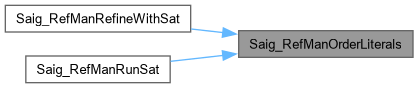
439{
440 Vec_Vec_t * vLits;
441 Vec_Int_t * vVar2New;
442 int i, Entry, iInput, iFrame;
443 // collect literals
444 vLits = Vec_VecAlloc( 100 );
445 vVar2New = Vec_IntStartFull( Saig_ManPiNum(p->pAig) );
446 Vec_IntForEachEntry( vAssumps, Entry, i )
447 {
448 int iPiNum = Vec_IntEntry( vVar2PiId, lit_var(Entry) );
449 assert( iPiNum >= 0 && iPiNum < Aig_ManCiNum(p->pFrames) );
450 iInput = Vec_IntEntry( p->vMapPiF2A, 2*iPiNum );
451 iFrame = Vec_IntEntry( p->vMapPiF2A, 2*iPiNum+1 );
452// Abc_InfoSetBit( pCare->pData, pCare->nRegs + pCare->nPis * iFrame + iInput );
453 if ( Vec_IntEntry( vVar2New, iInput ) == ~0 )
454 Vec_IntWriteEntry( vVar2New, iInput, Vec_VecSize(vLits) );
455 Vec_VecPushInt( vLits, Vec_IntEntry( vVar2New, iInput ), Entry );
456 }
457 Vec_IntFree( vVar2New );
458 return vLits;
459}
Here is the caller graph for this function:

◆ Saig_RefManReason2Cex()

Abc_Cex_t * Saig_RefManReason2Cex ( Saig_RefMan_t * p,
Vec_Int_t * vReasons )

Function*************************************************************

Synopsis [Creates the counter-example.]

Description []

SideEffects []

SeeAlso []

Definition at line 93 of file absOldSat.c.

94{
95 Abc_Cex_t * pCare;
96 int i, Entry, iInput, iFrame;
97 pCare = Abc_CexDup( p->pCex, p->pCex->nRegs );
98 memset( pCare->pData, 0, sizeof(unsigned) * Abc_BitWordNum(pCare->nBits) );
99 Vec_IntForEachEntry( vReasons, Entry, i )
100 {
101 assert( Entry >= 0 && Entry < Aig_ManCiNum(p->pFrames) );
102 iInput = Vec_IntEntry( p->vMapPiF2A, 2*Entry );
103 iFrame = Vec_IntEntry( p->vMapPiF2A, 2*Entry+1 );
104 Abc_InfoSetBit( pCare->pData, pCare->nRegs + pCare->nPis * iFrame + iInput );
105 }
106 return pCare;
107}
Here is the call graph for this function:
Here is the caller graph for this function:

◆ Saig_RefManReason2Inputs()

Vec_Int_t * Saig_RefManReason2Inputs ( Saig_RefMan_t * p,
Vec_Int_t * vReasons )

FUNCTION DEFINITIONS ///.

Function*************************************************************

Synopsis [Maps array of frame PI IDs into array of original PI IDs.]

Description []

SideEffects []

SeeAlso []

Definition at line 64 of file absOldSat.c.
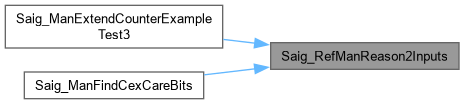
65{
66 Vec_Int_t * vOriginal, * vVisited;
67 int i, Entry;
68 vOriginal = Vec_IntAlloc( Saig_ManPiNum(p->pAig) );
69 vVisited = Vec_IntStart( Saig_ManPiNum(p->pAig) );
70 Vec_IntForEachEntry( vReasons, Entry, i )
71 {
72 int iInput = Vec_IntEntry( p->vMapPiF2A, 2*Entry );
73 assert( iInput >= 0 && iInput < Aig_ManCiNum(p->pAig) );
74 if ( Vec_IntEntry(vVisited, iInput) == 0 )
75 Vec_IntPush( vOriginal, iInput );
76 Vec_IntAddToEntry( vVisited, iInput, 1 );
77 }
78 Vec_IntFree( vVisited );
79 return vOriginal;
80}
Here is the caller graph for this function:

◆ Saig_RefManRefineWithSat()

Vec_Int_t * Saig_RefManRefineWithSat ( Saig_RefMan_t * p,
Vec_Int_t * vAigPis )

Function*************************************************************

Synopsis []

Description []

SideEffects []

SeeAlso []

Definition at line 706 of file absOldSat.c.

707{
708 int nConfLimit = 1000000;
709 Cnf_Dat_t * pCnf;
710 sat_solver * pSat;
711 Aig_Obj_t * pObj;
712 Vec_Vec_t * vLits;
713 Vec_Int_t * vReasons, * vAssumps, * vVisited, * vVar2PiId;
714 int i, k, f, Entry, RetValue, Counter;
715
716 // create CNF and SAT solver
717 pCnf = Cnf_DeriveSimple( p->pFrames, 0 );
718 pSat = (sat_solver *)Cnf_DataWriteIntoSolver( pCnf, 1, 0 );
719 if ( pSat == NULL )
720 {
721 Cnf_DataFree( pCnf );
722 return NULL;
723 }
724
725 // mark used AIG inputs
726 vVisited = Vec_IntStart( Saig_ManPiNum(p->pAig) );
727 Vec_IntForEachEntry( vAigPis, Entry, i )
728 {
729 assert( Entry >= 0 && Entry < Aig_ManCiNum(p->pAig) );
730 Vec_IntWriteEntry( vVisited, Entry, 1 );
731 }
732
733 // create assumptions
734 vVar2PiId = Vec_IntStartFull( pCnf->nVars );
735 vAssumps = Vec_IntAlloc( Aig_ManCiNum(p->pFrames) );
736 Aig_ManForEachCi( p->pFrames, pObj, i )
737 {
738 int iInput = Vec_IntEntry( p->vMapPiF2A, 2*i );
739 int iFrame = Vec_IntEntry( p->vMapPiF2A, 2*i+1 );
740 if ( Vec_IntEntry(vVisited, iInput) == 0 )
741 continue;
742 RetValue = Abc_InfoHasBit( p->pCex->pData, p->pCex->nRegs + p->pCex->nPis * iFrame + iInput );
743 Vec_IntPush( vAssumps, toLitCond( pCnf->pVarNums[Aig_ObjId(pObj)], !RetValue ) );
744// Vec_IntPush( vAssumps, toLitCond( pCnf->pVarNums[Aig_ObjId(pObj)], 1 ) );
745 Vec_IntWriteEntry( vVar2PiId, pCnf->pVarNums[Aig_ObjId(pObj)], i );
746 }
747 Vec_IntFree( vVisited );
748
749 // try assumptions in different order
750 RetValue = sat_solver_solve( pSat, Vec_IntArray(vAssumps), Vec_IntArray(vAssumps) + Vec_IntSize(vAssumps),
751 (ABC_INT64_T)nConfLimit, (ABC_INT64_T)0, (ABC_INT64_T)0, (ABC_INT64_T)0 );
752 printf( "Assumpts = %2d. Intermediate instance is %5s. Conflicts = %2d.\n",
753 Vec_IntSize(vAssumps), (RetValue == l_False ? "UNSAT" : "SAT"), (int)pSat->stats.conflicts );
754
755/*
756 // AnalizeFinal does not work because it implications propagate directly
757 // and SAT solver does not kick in (the number of conflicts in 0).
758
759 // count the number of lits in the unsat core
760 {
761 int nCoreLits, * pCoreLits;
762 nCoreLits = sat_solver_final( pSat, &pCoreLits );
763 assert( nCoreLits > 0 );
764
765 // count the number of flops
766 vVisited = Vec_IntStart( Saig_ManPiNum(p->pAig) );
767 for ( i = 0; i < nCoreLits; i++ )
768 {
769 int iPiNum = Vec_IntEntry( vVar2PiId, lit_var(pCoreLits[i]) );
770 int iInput = Vec_IntEntry( p->vMapPiF2A, 2*iPiNum );
771 int iFrame = Vec_IntEntry( p->vMapPiF2A, 2*iPiNum+1 );
772 Vec_IntWriteEntry( vVisited, iInput, 1 );
773 }
774 // count the number of entries
775 Counter = 0;
776 Vec_IntForEachEntry( vVisited, Entry, i )
777 Counter += Entry;
778 Vec_IntFree( vVisited );
779
780// if ( p->fVerbose )
781 printf( "AnalizeFinal: Assumptions %d (out of %d). Essential PIs = %d. Conflicts = %d.\n",
782 nCoreLits, Vec_IntSize(vAssumps), Counter, (int)pSat->stats.conflicts );
783 }
784*/
785
786 // derive literals
787 vLits = Saig_RefManOrderLiterals( p, vVar2PiId, vAssumps );
788 for ( i = 0; i < Vec_VecSize(vLits); i++ )
789 printf( "%d ", Vec_IntSize( Vec_VecEntryInt(vLits, i) ) );
790 printf( "\n" );
791
792 // create different sets of assumptions
793 Counter = Vec_VecSize(vLits);
794 for ( f = 0; f < Vec_VecSize(vLits); f++ )
795 {
796 Vec_IntClear( vAssumps );
797 Vec_VecForEachEntryInt( vLits, Entry, i, k )
798 if ( i != f )
799 Vec_IntPush( vAssumps, Entry );
800
801 // try the new assumptions
802 RetValue = sat_solver_solve( pSat, Vec_IntArray(vAssumps), Vec_IntArray(vAssumps) + Vec_IntSize(vAssumps),
803 (ABC_INT64_T)nConfLimit, (ABC_INT64_T)0, (ABC_INT64_T)0, (ABC_INT64_T)0 );
804 printf( "Assumpts = %2d. Intermediate instance is %5s. Conflicts = %2d.\n",
805 Vec_IntSize(vAssumps), RetValue == l_False ? "UNSAT" : "SAT", (int)pSat->stats.conflicts );
806 if ( RetValue != l_False )
807 continue;
808
809 // UNSAT - remove literals
810 Vec_IntClear( Vec_VecEntryInt(vLits, f) );
811 Counter--;
812 }
813
814 for ( i = 0; i < Vec_VecSize(vLits); i++ )
815 printf( "%d ", Vec_IntSize( Vec_VecEntryInt(vLits, i) ) );
816 printf( "\n" );
817
818 // create assumptions
819 Vec_IntClear( vAssumps );
820 Vec_VecForEachEntryInt( vLits, Entry, i, k )
821 Vec_IntPush( vAssumps, Entry );
822
823 // try assumptions in different order
824 RetValue = sat_solver_solve( pSat, Vec_IntArray(vAssumps), Vec_IntArray(vAssumps) + Vec_IntSize(vAssumps),
825 (ABC_INT64_T)nConfLimit, (ABC_INT64_T)0, (ABC_INT64_T)0, (ABC_INT64_T)0 );
826 printf( "Assumpts = %2d. Intermediate instance is %5s. Conflicts = %2d.\n",
827 Vec_IntSize(vAssumps), (RetValue == l_False ? "UNSAT" : "SAT"), (int)pSat->stats.conflicts );
828
829// if ( p->fVerbose )
830// printf( "Total PIs = %d. Essential PIs = %d.\n",
831// Saig_ManPiNum(p->pAig) - p->nInputs, Counter );
832
833
834 // transform assumptions into reasons
835 vReasons = Vec_IntAlloc( 100 );
836 Vec_IntForEachEntry( vAssumps, Entry, i )
837 {
838 int iPiNum = Vec_IntEntry( vVar2PiId, lit_var(Entry) );
839 assert( iPiNum >= 0 && iPiNum < Aig_ManCiNum(p->pFrames) );
840 Vec_IntPush( vReasons, iPiNum );
841 }
842
843 // cleanup
844 Cnf_DataFree( pCnf );
845 sat_solver_delete( pSat );
846 Vec_IntFree( vAssumps );
847 Vec_IntFree( vVar2PiId );
848 Vec_VecFreeP( &vLits );
849
850 return vReasons;
851}
Vec_Vec_t * Saig_RefManOrderLiterals(Saig_RefMan_t *p, Vec_Int_t *vVar2PiId, Vec_Int_t *vAssumps)
Definition absOldSat.c:438
#define l_False
Definition bmcBmcS.c:36
#define sat_solver
Definition cecSatG2.c:34
#define sat_solver_solve
Definition cecSatG2.c:45
Cnf_Dat_t * Cnf_DeriveSimple(Aig_Man_t *p, int nOutputs)
Definition cnfWrite.c:587
struct Cnf_Dat_t_ Cnf_Dat_t
Definition cnf.h:52
void Cnf_DataFree(Cnf_Dat_t *p)
Definition cnfMan.c:207
void * Cnf_DataWriteIntoSolver(Cnf_Dat_t *p, int nFrames, int fInit)
Definition cnfMan.c:579
void sat_solver_delete(sat_solver *s)
Definition satSolver.c:1341
int nVars
Definition cnf.h:59
int * pVarNums
Definition cnf.h:63
stats_t stats
Definition satSolver.h:163
ABC_INT64_T conflicts
Definition satVec.h:156
#define Vec_VecForEachEntryInt(vGlob, Entry, i, k)
Definition vecVec.h:109
Here is the call graph for this function:

◆ Saig_RefManRunSat()

Abc_Cex_t * Saig_RefManRunSat ( Saig_RefMan_t * p,
int fNewOrder )

Function*************************************************************

Synopsis [Generate the care set using SAT solver.]

Description []

SideEffects []

SeeAlso []

Definition at line 502 of file absOldSat.c.
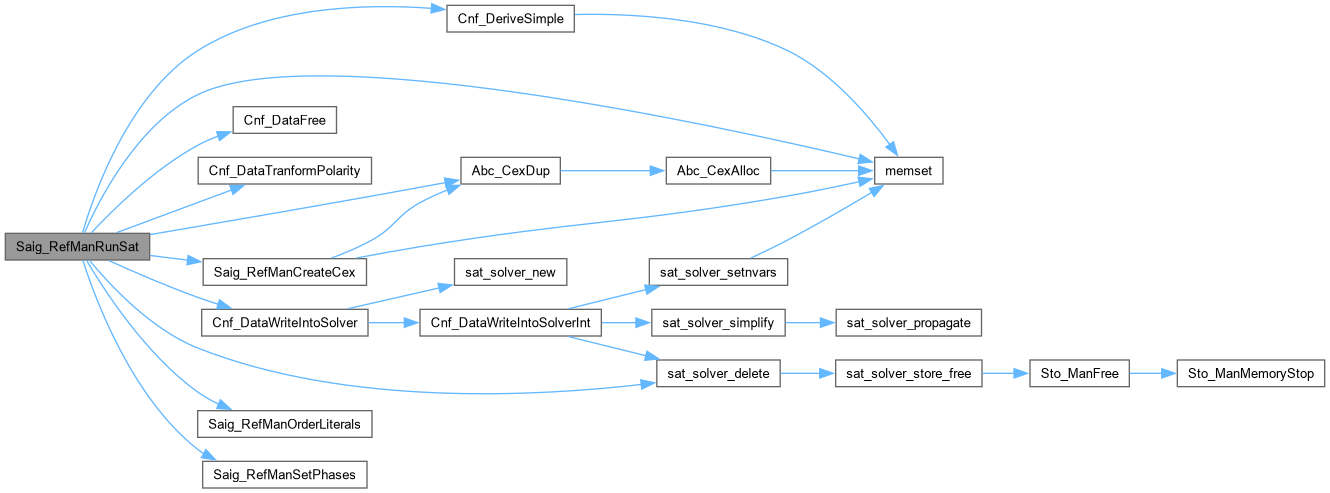
503{
504 int nConfLimit = 1000000;
505 Abc_Cex_t * pCare;
506 Cnf_Dat_t * pCnf;
507 sat_solver * pSat;
508 Aig_Obj_t * pObj;
509 Vec_Vec_t * vLits = NULL;
510 Vec_Int_t * vAssumps, * vVar2PiId;
511 int i, k, Entry, RetValue;//, f = 0, Counter = 0;
512 int nCoreLits, * pCoreLits;
513 abctime clk = Abc_Clock();
514 // create CNF
515 assert( Aig_ManRegNum(p->pFrames) == 0 );
516// pCnf = Cnf_Derive( p->pFrames, 0 ); // too slow
517 pCnf = Cnf_DeriveSimple( p->pFrames, 0 );
518 RetValue = Saig_RefManSetPhases( p, NULL, 0 );
519 if ( RetValue )
520 {
521 printf( "Constructed frames are incorrect.\n" );
522 Cnf_DataFree( pCnf );
523 return NULL;
524 }
525 Cnf_DataTranformPolarity( pCnf, 0 );
526 // create SAT solver
527 pSat = (sat_solver *)Cnf_DataWriteIntoSolver( pCnf, 1, 0 );
528 if ( pSat == NULL )
529 {
530 Cnf_DataFree( pCnf );
531 return NULL;
532 }
533//Abc_PrintTime( 1, "Preparing", Abc_Clock() - clk );
534 // look for a true counter-example
535 if ( p->nInputs > 0 )
536 {
537 RetValue = sat_solver_solve( pSat, NULL, NULL,
538 (ABC_INT64_T)nConfLimit, (ABC_INT64_T)0, (ABC_INT64_T)0, (ABC_INT64_T)0 );
539 if ( RetValue == l_False )
540 {
541 printf( "The problem is trivially UNSAT. The CEX is real.\n" );
542 // create counter-example
543 pCare = Abc_CexDup( p->pCex, p->pCex->nRegs );
544 memset( pCare->pData, 0, sizeof(unsigned) * Abc_BitWordNum(pCare->nBits) );
545 return pCare;
546 }
547 // the problem is SAT - it is expected
548 }
549 // create assumptions
550 vVar2PiId = Vec_IntStartFull( pCnf->nVars );
551 vAssumps = Vec_IntAlloc( Aig_ManCiNum(p->pFrames) );
552 Aig_ManForEachCi( p->pFrames, pObj, i )
553 {
554// RetValue = Abc_InfoHasBit( p->pCex->pData, p->pCex->nRegs + p->pCex->nPis * iFrame + iInput );
555// Vec_IntPush( vAssumps, toLitCond( pCnf->pVarNums[Aig_ObjId(pObj)], !RetValue ) );
556 Vec_IntPush( vAssumps, toLitCond( pCnf->pVarNums[Aig_ObjId(pObj)], 1 ) );
557 Vec_IntWriteEntry( vVar2PiId, pCnf->pVarNums[Aig_ObjId(pObj)], i );
558 }
559
560 // reverse the order of assumptions
561// if ( fNewOrder )
562// Vec_IntReverseOrder( vAssumps );
563
564 if ( fNewOrder )
565 {
566 // create literals
567 vLits = Saig_RefManOrderLiterals( p, vVar2PiId, vAssumps );
568 // sort literals
569 Vec_VecSort( vLits, 1 );
570 // save literals
571 Vec_IntClear( vAssumps );
572 Vec_VecForEachEntryInt( vLits, Entry, i, k )
573 Vec_IntPush( vAssumps, Entry );
574
575 for ( i = 0; i < Vec_VecSize(vLits); i++ )
576 printf( "%d ", Vec_IntSize( Vec_VecEntryInt(vLits, i) ) );
577 printf( "\n" );
578
579 if ( p->fVerbose )
580 printf( "Total PIs = %d. Essential PIs = %d.\n",
581 Saig_ManPiNum(p->pAig) - p->nInputs, Vec_VecSize(vLits) );
582 }
583
584 // solve
585clk = Abc_Clock();
586 RetValue = sat_solver_solve( pSat, Vec_IntArray(vAssumps), Vec_IntArray(vAssumps) + Vec_IntSize(vAssumps),
587 (ABC_INT64_T)nConfLimit, (ABC_INT64_T)0, (ABC_INT64_T)0, (ABC_INT64_T)0 );
588//Abc_PrintTime( 1, "Solving", Abc_Clock() - clk );
589 if ( RetValue != l_False )
590 {
591 if ( RetValue == l_True )
592 printf( "Internal Error!!! The resulting problem is SAT.\n" );
593 else
594 printf( "Internal Error!!! SAT solver timed out.\n" );
595 Cnf_DataFree( pCnf );
596 sat_solver_delete( pSat );
597 Vec_IntFree( vAssumps );
598 Vec_IntFree( vVar2PiId );
599 return NULL;
600 }
601 assert( RetValue == l_False ); // UNSAT
602
603 // get relevant SAT literals
604 nCoreLits = sat_solver_final( pSat, &pCoreLits );
605 assert( nCoreLits > 0 );
606 if ( p->fVerbose )
607 printf( "AnalizeFinal selected %d assumptions (out of %d). Conflicts = %d.\n",
608 nCoreLits, Vec_IntSize(vAssumps), (int)pSat->stats.conflicts );
609
610 // save literals
611 Vec_IntClear( vAssumps );
612 for ( i = 0; i < nCoreLits; i++ )
613 Vec_IntPush( vAssumps, pCoreLits[i] );
614
615
616 // create literals
617 vLits = Saig_RefManOrderLiterals( p, vVar2PiId, vAssumps );
618 // sort literals
619// Vec_VecSort( vLits, 0 );
620 // save literals
621 Vec_IntClear( vAssumps );
622 Vec_VecForEachEntryInt( vLits, Entry, i, k )
623 Vec_IntPush( vAssumps, Entry );
624
625// for ( i = 0; i < Vec_VecSize(vLits); i++ )
626// printf( "%d ", Vec_IntSize( Vec_VecEntryInt(vLits, i) ) );
627// printf( "\n" );
628
629 if ( p->fVerbose )
630 printf( "Total PIs = %d. Essential PIs = %d.\n",
631 Saig_ManPiNum(p->pAig) - p->nInputs, Vec_VecSize(vLits) );
632/*
633 // try assumptions in different order
634 RetValue = sat_solver_solve( pSat, Vec_IntArray(vAssumps), Vec_IntArray(vAssumps) + Vec_IntSize(vAssumps),
635 (ABC_INT64_T)nConfLimit, (ABC_INT64_T)0, (ABC_INT64_T)0, (ABC_INT64_T)0 );
636 printf( "Assumpts = %2d. Intermediate instance is %5s. Conflicts = %2d.\n",
637 Vec_IntSize(vAssumps), (RetValue == l_False ? "UNSAT" : "SAT"), (int)pSat->stats.conflicts );
638
639 // create different sets of assumptions
640 Counter = Vec_VecSize(vLits);
641 for ( f = 0; f < Vec_VecSize(vLits); f++ )
642 {
643 Vec_IntClear( vAssumps );
644 Vec_VecForEachEntryInt( vLits, Entry, i, k )
645 if ( i != f )
646 Vec_IntPush( vAssumps, Entry );
647
648 // try the new assumptions
649 RetValue = sat_solver_solve( pSat, Vec_IntArray(vAssumps), Vec_IntArray(vAssumps) + Vec_IntSize(vAssumps),
650 (ABC_INT64_T)nConfLimit, (ABC_INT64_T)0, (ABC_INT64_T)0, (ABC_INT64_T)0 );
651 printf( "Assumpts = %2d. Intermediate instance is %5s. Conflicts = %2d.\n",
652 Vec_IntSize(vAssumps), RetValue == l_False ? "UNSAT" : "SAT", (int)pSat->stats.conflicts );
653 if ( RetValue != l_False )
654 continue;
655
656 // UNSAT - remove literals
657 Vec_IntClear( Vec_VecEntryInt(vLits, f) );
658 Counter--;
659 }
660
661 for ( i = 0; i < Vec_VecSize(vLits); i++ )
662 printf( "%d ", Vec_IntSize( Vec_VecEntryInt(vLits, i) ) );
663 printf( "\n" );
664
665 if ( p->fVerbose )
666 printf( "Total PIs = %d. Essential PIs = %d.\n",
667 Saig_ManPiNum(p->pAig) - p->nInputs, Counter );
668
669 // save literals
670 Vec_IntClear( vAssumps );
671 Vec_VecForEachEntryInt( vLits, Entry, i, k )
672 Vec_IntPush( vAssumps, Entry );
673*/
674 // create counter-example
675 pCare = Saig_RefManCreateCex( p, vVar2PiId, vAssumps );
676
677 // cleanup
678 Cnf_DataFree( pCnf );
679 sat_solver_delete( pSat );
680 Vec_IntFree( vAssumps );
681 Vec_IntFree( vVar2PiId );
682 Vec_VecFreeP( &vLits );
683
684 // verify counter-example
685 RetValue = Saig_RefManSetPhases( p, pCare, 0 );
686 if ( RetValue )
687 printf( "Reduced CEX verification has failed.\n" );
688 RetValue = Saig_RefManSetPhases( p, pCare, 1 );
689 if ( RetValue )
690 printf( "Reduced CEX verification has failed.\n" );
691 return pCare;
692}
Abc_Cex_t * Saig_RefManCreateCex(Saig_RefMan_t *p, Vec_Int_t *vVar2PiId, Vec_Int_t *vAssumps)
Definition absOldSat.c:473
int Saig_RefManSetPhases(Saig_RefMan_t *p, Abc_Cex_t *pCare, int fValue1)
Definition absOldSat.c:404
#define l_True
Definition bmcBmcS.c:35
void Cnf_DataTranformPolarity(Cnf_Dat_t *pCnf, int fTransformPos)
Definition cnfMan.c:768
Here is the call graph for this function:

◆ Saig_RefManSetPhases()

int Saig_RefManSetPhases ( Saig_RefMan_t * p,
Abc_Cex_t * pCare,
int fValue1 )

Function*************************************************************

Synopsis [Sets phase bits in the timeframe AIG.]

Description []

SideEffects []

SeeAlso []

Definition at line 404 of file absOldSat.c.

405{
406 Aig_Obj_t * pObj;
407 int i, iFrame, iInput;
408 Aig_ManConst1( p->pFrames )->fPhase = 1;
409 Aig_ManForEachCi( p->pFrames, pObj, i )
410 {
411 iInput = Vec_IntEntry( p->vMapPiF2A, 2*i );
412 iFrame = Vec_IntEntry( p->vMapPiF2A, 2*i+1 );
413 pObj->fPhase = Abc_InfoHasBit( p->pCex->pData, p->pCex->nRegs + p->pCex->nPis * iFrame + iInput );
414 // update value if it is a don't-care
415 if ( pCare && !Abc_InfoHasBit( pCare->pData, p->pCex->nRegs + p->pCex->nPis * iFrame + iInput ) )
416 pObj->fPhase = fValue1;
417 }
418 Aig_ManForEachNode( p->pFrames, pObj, i )
419 pObj->fPhase = ( Aig_ObjFanin0(pObj)->fPhase ^ Aig_ObjFaninC0(pObj) )
420 & ( Aig_ObjFanin1(pObj)->fPhase ^ Aig_ObjFaninC1(pObj) );
421 Aig_ManForEachCo( p->pFrames, pObj, i )
422 pObj->fPhase = ( Aig_ObjFanin0(pObj)->fPhase ^ Aig_ObjFaninC0(pObj) );
423 pObj = Aig_ManCo( p->pFrames, 0 );
424 return pObj->fPhase;
425}
Here is the caller graph for this function:

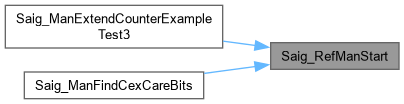
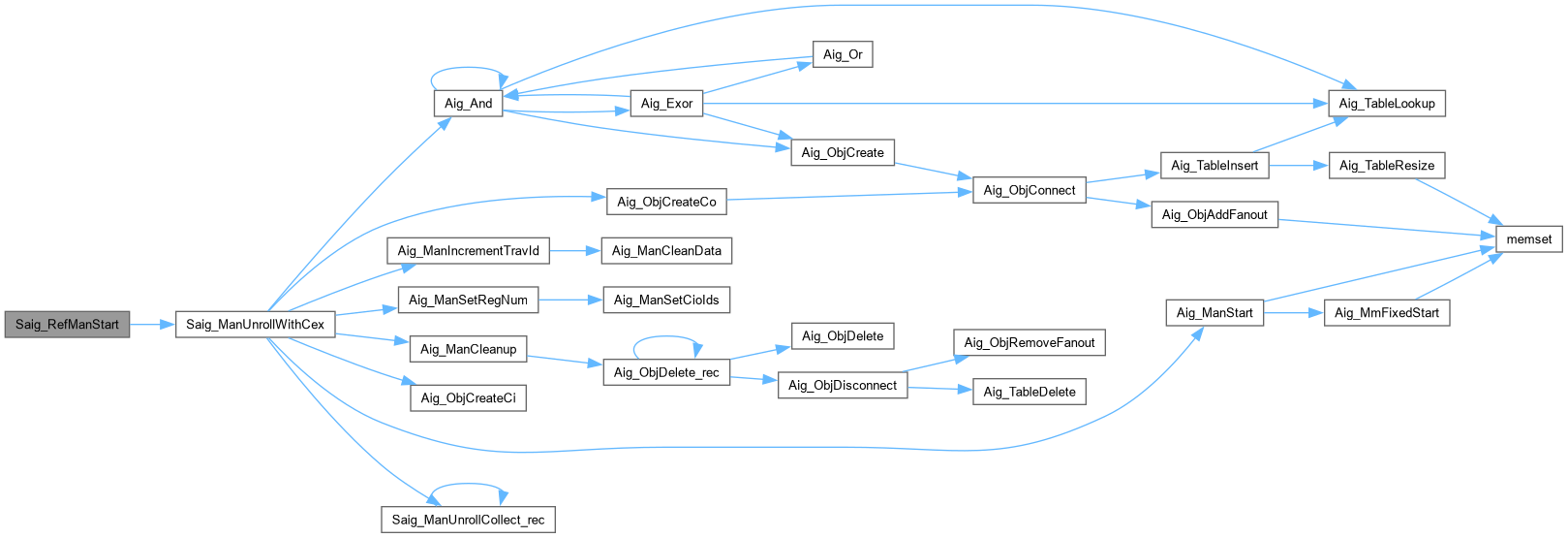
◆ Saig_RefManStart()

Saig_RefMan_t * Saig_RefManStart ( Aig_Man_t * pAig,
Abc_Cex_t * pCex,
int nInputs,
int fVerbose )

Function*************************************************************

Synopsis [Creates refinement manager.]

Description []

SideEffects []

SeeAlso []

Definition at line 363 of file absOldSat.c.
364{
366 p = ABC_CALLOC( Saig_RefMan_t, 1 );
367 p->pAig = pAig;
368 p->pCex = pCex;
369 p->nInputs = nInputs;
370 p->fVerbose = fVerbose;
371 p->pFrames = Saig_ManUnrollWithCex( pAig, pCex, nInputs, &p->vMapPiF2A );
372 return p;
373}
#define ABC_CALLOC(type, num)
Definition abc_global.h:265
Aig_Man_t * Saig_ManUnrollWithCex(Aig_Man_t *pAig, Abc_Cex_t *pCex, int nInputs, Vec_Int_t **pvMapPiF2A)
Definition absOldSat.c:264
Here is the call graph for this function:
Here is the caller graph for this function:

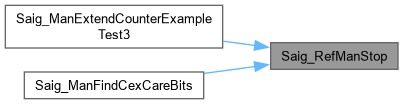
◆ Saig_RefManStop()

void Saig_RefManStop ( Saig_RefMan_t * p)

Function*************************************************************

Synopsis [Destroys refinement manager.]

Description []

SideEffects []

SeeAlso []

Definition at line 386 of file absOldSat.c.

387{
388 Aig_ManStopP( &p->pFrames );
389 Vec_IntFreeP( &p->vMapPiF2A );
390 ABC_FREE( p );
391}
#define ABC_FREE(obj)
Definition abc_global.h:267
void Aig_ManStopP(Aig_Man_t **p)
Definition aigMan.c:246
Here is the call graph for this function:
Here is the caller graph for this function: