ABC: A System for Sequential Synthesis and Verification
 
Loading...
Searching...
No Matches
fraImp.c File Reference
#include "fra.h"
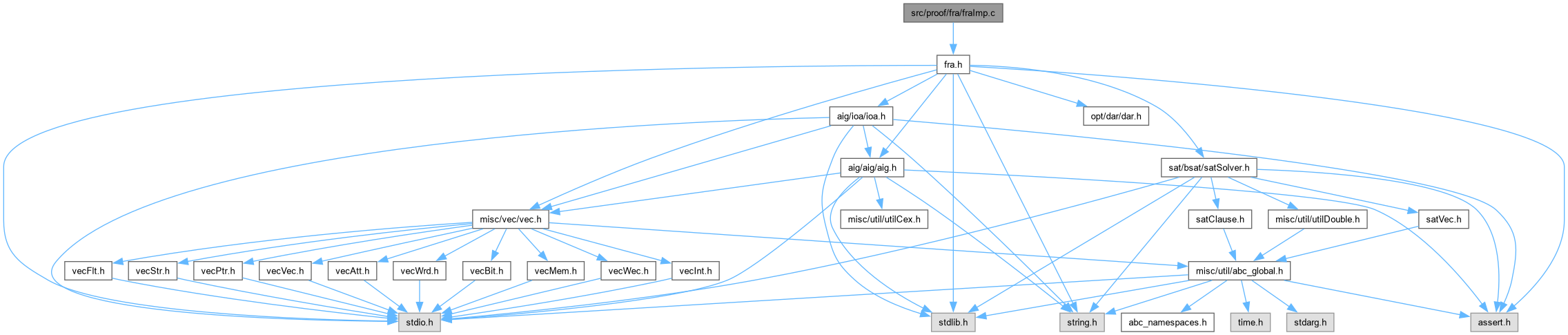
Include dependency graph for fraImp.c:

Go to the source code of this file.

Functions

Vec_Ptr_tFra_SmlSortUsingOnes (Fra_Sml_t *p, int fLatchCorr)
 
Vec_Int_tFra_SmlSelectMaxCost (Vec_Int_t *vImps, int *pCosts, int nCostMax, int nImpLimit, int *pCostRange)
 
int Sml_CompareMaxId (unsigned short *pImp1, unsigned short *pImp2)
 
Vec_Int_tFra_ImpDerive (Fra_Man_t *p, int nImpMaxLimit, int nImpUseLimit, int fLatchCorr)
 
void Fra_ImpAddToSolver (Fra_Man_t *p, Vec_Int_t *vImps, int *pSatVarNums)
 
int Fra_ImpCheckForNode (Fra_Man_t *p, Vec_Int_t *vImps, Aig_Obj_t *pNode, int Pos)
 
int Fra_ImpRefineUsingCex (Fra_Man_t *p, Vec_Int_t *vImps)
 
void Fra_ImpCompactArray (Vec_Int_t *vImps)
 
double Fra_ImpComputeStateSpaceRatio (Fra_Man_t *p)
 
int Fra_ImpVerifyUsingSimulation (Fra_Man_t *p)
 
void Fra_ImpRecordInManager (Fra_Man_t *p, Aig_Man_t *pNew)
 

Function Documentation

◆ Fra_ImpAddToSolver()

void Fra_ImpAddToSolver ( Fra_Man_t * p,
Vec_Int_t * vImps,
int * pSatVarNums )

Function*************************************************************

Synopsis [Add implication clauses to the SAT solver.]

Description [Note that implications should be checked in the first frame!]

SideEffects []

SeeAlso []

Definition at line 428 of file fraImp.c.

429{
430 sat_solver * pSat = p->pSat;
431 Aig_Obj_t * pLeft, * pRight;
432 Aig_Obj_t * pLeftF, * pRightF;
433 int pLits[2], Imp, Left, Right, i, f, status;
434 int fComplL, fComplR;
435 Vec_IntForEachEntry( vImps, Imp, i )
436 {
437 // get the corresponding nodes
438 pLeft = Aig_ManObj( p->pManAig, Fra_ImpLeft(Imp) );
439 pRight = Aig_ManObj( p->pManAig, Fra_ImpRight(Imp) );
440 // check if all the nodes are present
441 for ( f = 0; f < p->pPars->nFramesK; f++ )
442 {
443 // map these info fraig
444 pLeftF = Fra_ObjFraig( pLeft, f );
445 pRightF = Fra_ObjFraig( pRight, f );
446 if ( Aig_ObjIsNone(Aig_Regular(pLeftF)) || Aig_ObjIsNone(Aig_Regular(pRightF)) )
447 {
448 Vec_IntWriteEntry( vImps, i, 0 );
449 break;
450 }
451 }
452 if ( f < p->pPars->nFramesK )
453 continue;
454 // add constraints in each timeframe
455 for ( f = 0; f < p->pPars->nFramesK; f++ )
456 {
457 // map these info fraig
458 pLeftF = Fra_ObjFraig( pLeft, f );
459 pRightF = Fra_ObjFraig( pRight, f );
460 // get the corresponding SAT numbers
461 Left = pSatVarNums[ Aig_Regular(pLeftF)->Id ];
462 Right = pSatVarNums[ Aig_Regular(pRightF)->Id ];
463 assert( Left > 0 && Left < p->nSatVars );
464 assert( Right > 0 && Right < p->nSatVars );
465 // get the complemented attributes
466 fComplL = pLeft->fPhase ^ Aig_IsComplement(pLeftF);
467 fComplR = pRight->fPhase ^ Aig_IsComplement(pRightF);
468 // get the constraint
469 // L => R L' v R (complement = L & R')
470 pLits[0] = 2 * Left + !fComplL;
471 pLits[1] = 2 * Right + fComplR;
472 // add constraint to solver
473 if ( !sat_solver_addclause( pSat, pLits, pLits + 2 ) )
474 {
475 sat_solver_delete( pSat );
476 p->pSat = NULL;
477 return;
478 }
479 }
480 }
481 status = sat_solver_simplify(pSat);
482 if ( status == 0 )
483 {
484 sat_solver_delete( pSat );
485 p->pSat = NULL;
486 }
487// printf( "Total imps = %d. ", Vec_IntSize(vImps) );
488 Fra_ImpCompactArray( vImps );
489// printf( "Valid imps = %d. \n", Vec_IntSize(vImps) );
490}
struct Aig_Obj_t_ Aig_Obj_t
Definition aig.h:51
#define sat_solver_addclause
Definition cecSatG2.c:37
#define sat_solver
Definition cecSatG2.c:34
Cube * p
Definition exorList.c:222
void Fra_ImpCompactArray(Vec_Int_t *vImps)
Definition fraImp.c:607
int sat_solver_simplify(sat_solver *s)
Definition satSolver.c:1515
void sat_solver_delete(sat_solver *s)
Definition satSolver.c:1341
unsigned int fPhase
Definition aig.h:78
#define assert(ex)
Definition util_old.h:213
#define Vec_IntForEachEntry(vVec, Entry, i)
MACRO DEFINITIONS ///.
Definition vecInt.h:54
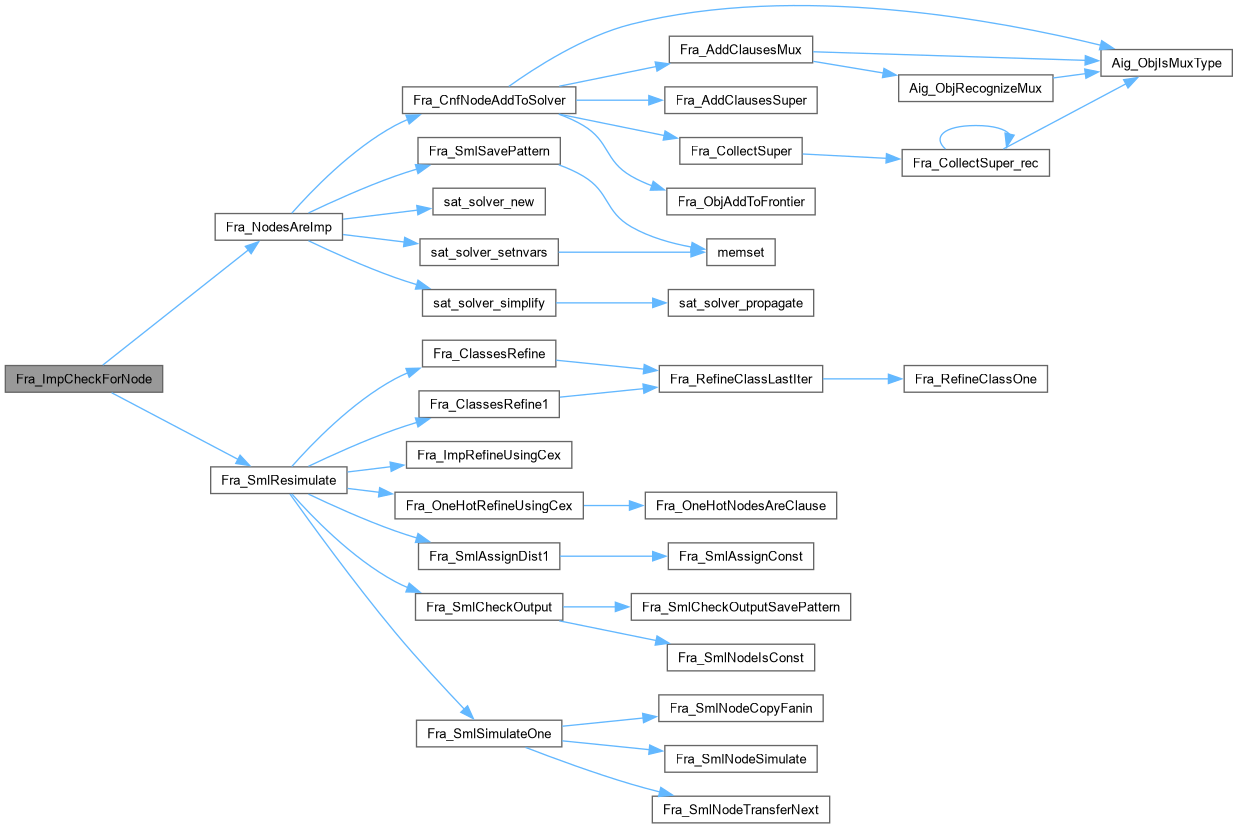
Here is the call graph for this function:
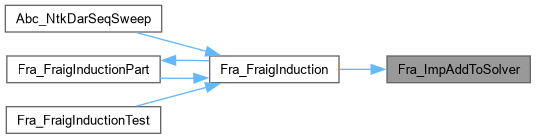
Here is the caller graph for this function:

◆ Fra_ImpCheckForNode()

int Fra_ImpCheckForNode ( Fra_Man_t * p,
Vec_Int_t * vImps,
Aig_Obj_t * pNode,
int Pos )

Function*************************************************************

Synopsis [Check implications for the node (if they are present).]

Description [Returns the new position in the array.]

SideEffects []

SeeAlso []

Definition at line 503 of file fraImp.c.
504{
505 Aig_Obj_t * pLeft, * pRight;
506 Aig_Obj_t * pLeftF, * pRightF;
507 int i, Imp, Left, Right, Max, RetValue;
508 int fComplL, fComplR;
509 Vec_IntForEachEntryStart( vImps, Imp, i, Pos )
510 {
511 if ( Imp == 0 )
512 continue;
513 Left = Fra_ImpLeft(Imp);
514 Right = Fra_ImpRight(Imp);
515 Max = Abc_MaxInt( Left, Right );
516 assert( Max >= pNode->Id );
517 if ( Max > pNode->Id )
518 return i;
519 // get the corresponding nodes
520 pLeft = Aig_ManObj( p->pManAig, Left );
521 pRight = Aig_ManObj( p->pManAig, Right );
522 // get the corresponding FRAIG nodes
523 pLeftF = Fra_ObjFraig( pLeft, p->pPars->nFramesK );
524 pRightF = Fra_ObjFraig( pRight, p->pPars->nFramesK );
525 // get the complemented attributes
526 fComplL = pLeft->fPhase ^ Aig_IsComplement(pLeftF);
527 fComplR = pRight->fPhase ^ Aig_IsComplement(pRightF);
528 // check equality
529 if ( Aig_Regular(pLeftF) == Aig_Regular(pRightF) )
530 {
531 if ( fComplL == fComplR ) // x => x - always true
532 continue;
533 assert( fComplL != fComplR );
534 // consider 4 possibilities:
535 // NOT(1) => 1 or 0 => 1 - always true
536 // 1 => NOT(1) or 1 => 0 - never true
537 // NOT(x) => x or x - not always true
538 // x => NOT(x) or NOT(x) - not always true
539 if ( Aig_ObjIsConst1(Aig_Regular(pLeftF)) && fComplL ) // proved implication
540 continue;
541 // disproved implication
542 p->pCla->fRefinement = 1;
543 Vec_IntWriteEntry( vImps, i, 0 );
544 continue;
545 }
546 // check the implication
547 // - if true, a clause is added
548 // - if false, a cex is simulated
549 // make sure the implication is refined
550 RetValue = Fra_NodesAreImp( p, Aig_Regular(pLeftF), Aig_Regular(pRightF), fComplL, fComplR );
551 if ( RetValue != 1 )
552 {
553 p->pCla->fRefinement = 1;
554 if ( RetValue == 0 )
556 if ( Vec_IntEntry(vImps, i) != 0 )
557 printf( "Fra_ImpCheckForNode(): Implication is not refined!\n" );
558 assert( Vec_IntEntry(vImps, i) == 0 );
559 }
560 }
561 return i;
562}
ush Pos
Definition deflate.h:88
int Fra_NodesAreImp(Fra_Man_t *p, Aig_Obj_t *pOld, Aig_Obj_t *pNew, int fComplL, int fComplR)
Definition fraSat.c:209
void Fra_SmlResimulate(Fra_Man_t *p)
Definition fraSim.c:703
int Id
Definition aig.h:85
#define Vec_IntForEachEntryStart(vVec, Entry, i, Start)
Definition vecInt.h:56
Here is the call graph for this function:
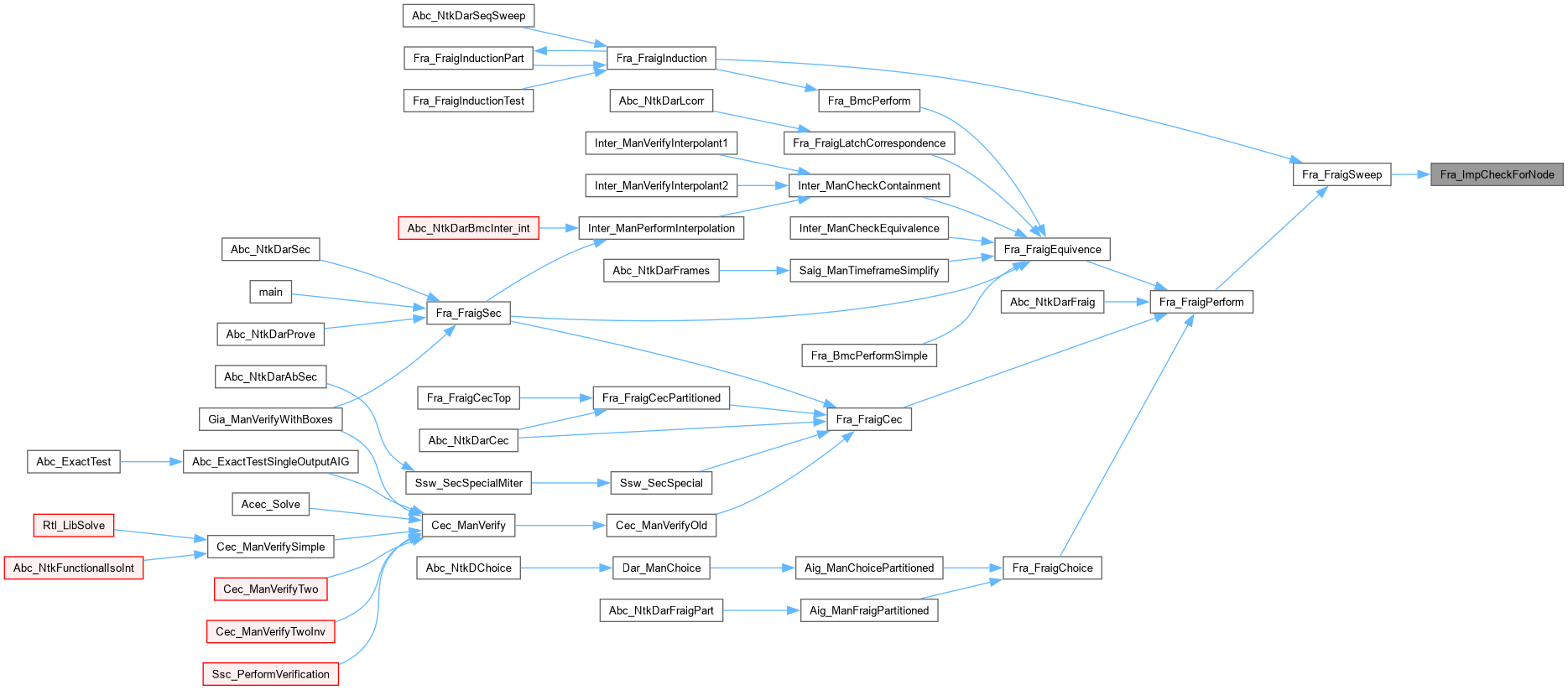
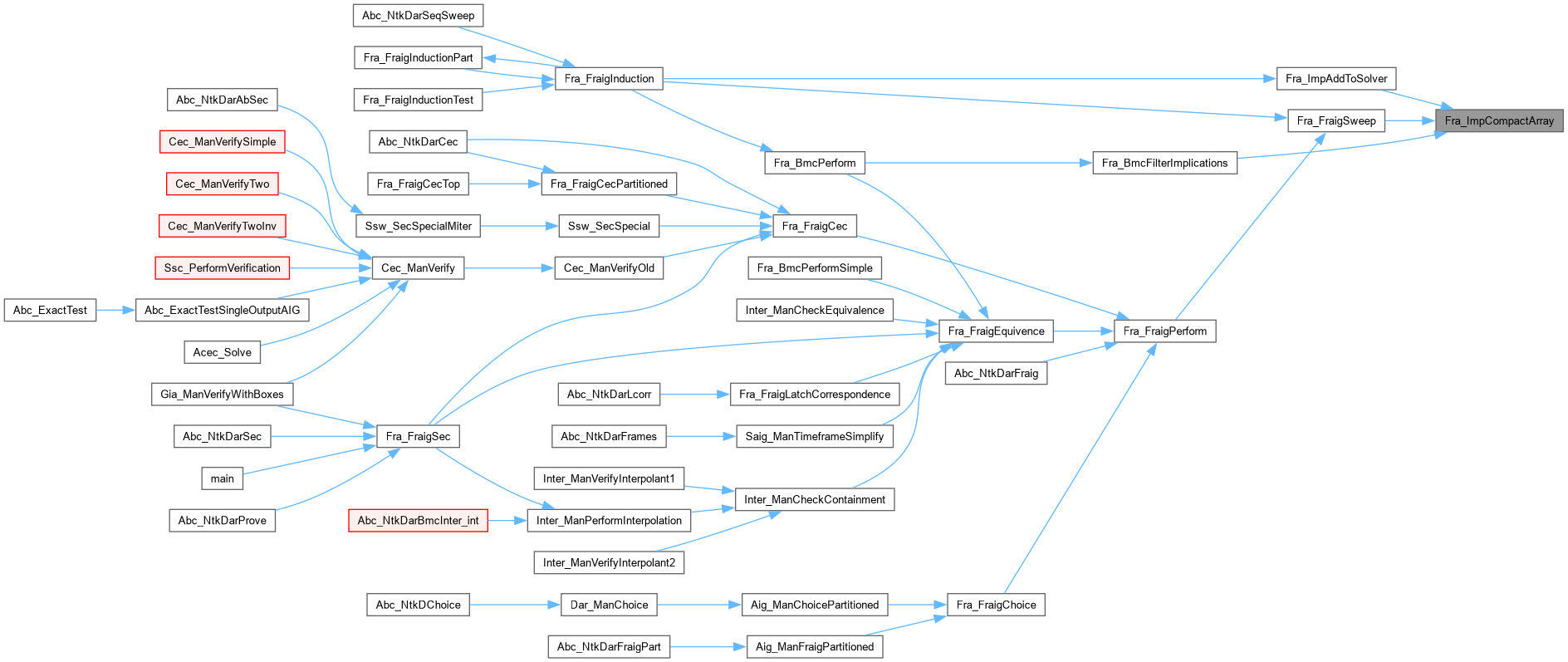
Here is the caller graph for this function:

◆ Fra_ImpCompactArray()

void Fra_ImpCompactArray ( Vec_Int_t * vImps)

Function*************************************************************

Synopsis [Removes empty implications.]

Description []

SideEffects []

SeeAlso []

Definition at line 607 of file fraImp.c.
608{
609 int i, k, Imp;
610 k = 0;
611 Vec_IntForEachEntry( vImps, Imp, i )
612 if ( Imp )
613 Vec_IntWriteEntry( vImps, k++, Imp );
614 Vec_IntShrink( vImps, k );
615}
Here is the caller graph for this function:

◆ Fra_ImpComputeStateSpaceRatio()

double Fra_ImpComputeStateSpaceRatio ( Fra_Man_t * p)

Function*************************************************************

Synopsis [Determines the ratio of the state space by computed implications.]

Description []

SideEffects []

SeeAlso []

Definition at line 628 of file fraImp.c.
629{
630 int nSimWords = 64;
631 Fra_Sml_t * pComb;
632 unsigned * pResult;
633 double Ratio = 0.0;
634 int Left, Right, Imp, i;
635 if ( p->pCla->vImps == NULL || Vec_IntSize(p->pCla->vImps) == 0 )
636 return Ratio;
637 // simulate the AIG manager with combinational patterns
638 pComb = Fra_SmlSimulateComb( p->pManAig, nSimWords, 0 );
639 // go through the implications and collect where they do not hold
640 pResult = Fra_ObjSim( pComb, 0 );
641 assert( pResult[0] == 0 );
642 Vec_IntForEachEntry( p->pCla->vImps, Imp, i )
643 {
644 Left = Fra_ImpLeft(Imp);
645 Right = Fra_ImpRight(Imp);
646 Sml_NodeSaveNotImpPatterns( pComb, Left, Right, pResult );
647 }
648 // count the number of ones in this area
649 Ratio = 100.0 * Fra_SmlCountOnesOne( pComb, 0 ) / (32*(pComb->nWordsTotal-pComb->nWordsPref));
650 Fra_SmlStop( pComb );
651 return Ratio;
652}
void Fra_SmlStop(Fra_Sml_t *p)
Definition fraSim.c:839
struct Fra_Sml_t_ Fra_Sml_t
Definition fra.h:58
Fra_Sml_t * Fra_SmlSimulateComb(Aig_Man_t *pAig, int nWords, int fCheckMiter)
Definition fraSim.c:856
int nWordsPref
Definition fra.h:178
int nWordsTotal
Definition fra.h:177
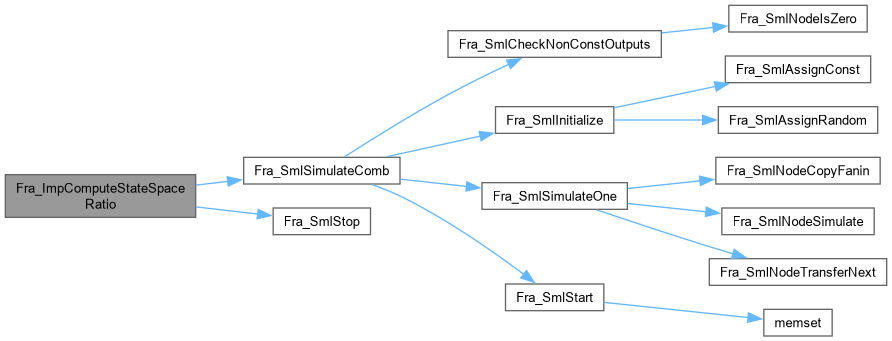
Here is the call graph for this function:
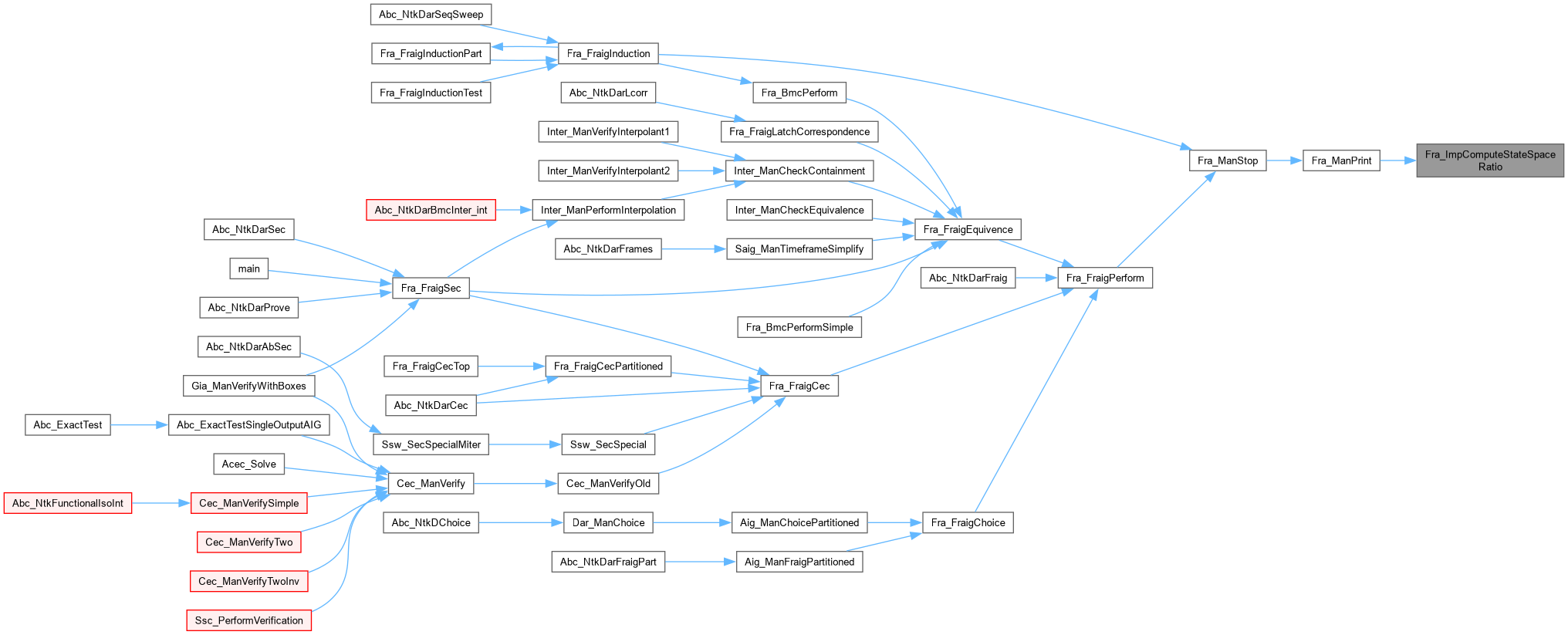
Here is the caller graph for this function:

◆ Fra_ImpDerive()

Vec_Int_t * Fra_ImpDerive ( Fra_Man_t * p,
int nImpMaxLimit,
int nImpUseLimit,
int fLatchCorr )

Function*************************************************************

Synopsis [Derives implication candidates.]

Description [Implication candidates have the property that (1) they hold using sequential simulation information (2) they do not hold using combinational simulation information (3) they have as high expressive power as possible (heuristically) that is, they are easy to disprove combinationally meaning they cover relatively larger sequential subspace.]

SideEffects []

SeeAlso []

Definition at line 321 of file fraImp.c.
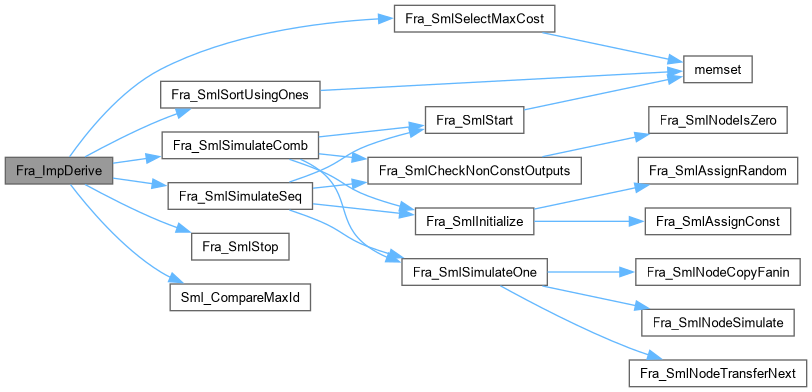
322{
323 int nSimWords = 64;
324 Fra_Sml_t * pSeq, * pComb;
325 Vec_Int_t * vImps, * vTemp;
326 Vec_Ptr_t * vNodes;
327 int * pImpCosts, * pNodesI, * pNodesK;
328 int nImpsTotal = 0, nImpsTried = 0, nImpsNonSeq = 0, nImpsComb = 0, nImpsCollected = 0;
329 int CostMin = ABC_INFINITY, CostMax = 0;
330 int i, k, Imp, CostRange;
331 abctime clk = Abc_Clock();
332 assert( Aig_ManObjNumMax(p->pManAig) < (1 << 15) );
333 assert( nImpMaxLimit > 0 && nImpUseLimit > 0 && nImpUseLimit <= nImpMaxLimit );
334 // normalize both managers
335 pComb = Fra_SmlSimulateComb( p->pManAig, nSimWords, 0 );
336 pSeq = Fra_SmlSimulateSeq( p->pManAig, p->pPars->nFramesP, nSimWords, 1, 1 );
337 // get the nodes sorted by the number of 1s
338 vNodes = Fra_SmlSortUsingOnes( pSeq, fLatchCorr );
339 // count the total number of implications
340 for ( k = nSimWords * 32; k > 0; k-- )
341 for ( i = k - 1; i > 0; i-- )
342 for ( pNodesI = (int *)Vec_PtrEntry( vNodes, i ); *pNodesI; pNodesI++ )
343 for ( pNodesK = (int *)Vec_PtrEntry( vNodes, k ); *pNodesK; pNodesK++ )
344 nImpsTotal++;
345
346 // compute implications and their costs
347 pImpCosts = ABC_ALLOC( int, nImpMaxLimit );
348 vImps = Vec_IntAlloc( nImpMaxLimit );
349 for ( k = pSeq->nWordsTotal * 32; k > 0; k-- )
350 for ( i = k - 1; i > 0; i-- )
351 {
352 // HERE WE ARE MISSING SOME POTENTIAL IMPLICATIONS (with complement!)
353
354 for ( pNodesI = (int *)Vec_PtrEntry( vNodes, i ); *pNodesI; pNodesI++ )
355 for ( pNodesK = (int *)Vec_PtrEntry( vNodes, k ); *pNodesK; pNodesK++ )
356 {
357 nImpsTried++;
358 if ( !Sml_NodeCheckImp(pSeq, *pNodesI, *pNodesK) )
359 {
360 nImpsNonSeq++;
361 continue;
362 }
363 if ( Sml_NodeCheckImp(pComb, *pNodesI, *pNodesK) )
364 {
365 nImpsComb++;
366 continue;
367 }
368 nImpsCollected++;
369 Imp = Fra_ImpCreate( *pNodesI, *pNodesK );
370 pImpCosts[ Vec_IntSize(vImps) ] = Sml_NodeNotImpWeight(pComb, *pNodesI, *pNodesK);
371 CostMin = Abc_MinInt( CostMin, pImpCosts[ Vec_IntSize(vImps) ] );
372 CostMax = Abc_MaxInt( CostMax, pImpCosts[ Vec_IntSize(vImps) ] );
373 Vec_IntPush( vImps, Imp );
374 if ( Vec_IntSize(vImps) == nImpMaxLimit )
375 goto finish;
376 }
377 }
378finish:
379 Fra_SmlStop( pComb );
380 Fra_SmlStop( pSeq );
381
382 // select implications with the highest cost
383 CostRange = CostMin;
384 if ( Vec_IntSize(vImps) > nImpUseLimit )
385 {
386 vImps = Fra_SmlSelectMaxCost( vTemp = vImps, pImpCosts, nSimWords * 32, nImpUseLimit, &CostRange );
387 Vec_IntFree( vTemp );
388 }
389
390 // dealloc
391 ABC_FREE( pImpCosts );
392 {
393 void * pTemp = Vec_PtrEntry(vNodes, 0);
394 ABC_FREE( pTemp );
395 }
396 Vec_PtrFree( vNodes );
397 // reorder implications topologically
398 qsort( (void *)Vec_IntArray(vImps), (size_t)Vec_IntSize(vImps), sizeof(int),
399 (int (*)(const void *, const void *)) Sml_CompareMaxId );
400if ( p->pPars->fVerbose )
401{
402printf( "Implications: All = %d. Try = %d. NonSeq = %d. Comb = %d. Res = %d.\n",
403 nImpsTotal, nImpsTried, nImpsNonSeq, nImpsComb, nImpsCollected );
404printf( "Implication weight: Min = %d. Pivot = %d. Max = %d. ",
405 CostMin, CostRange, CostMax );
406ABC_PRT( "Time", Abc_Clock() - clk );
407}
408 return vImps;
409}
ABC_INT64_T abctime
Definition abc_global.h:332
#define ABC_PRT(a, t)
Definition abc_global.h:255
#define ABC_ALLOC(type, num)
Definition abc_global.h:264
#define ABC_INFINITY
MACRO DEFINITIONS ///.
Definition abc_global.h:250
#define ABC_FREE(obj)
Definition abc_global.h:267
typedefABC_NAMESPACE_IMPL_START struct Vec_Int_t_ Vec_Int_t
DECLARATIONS ///.
Definition bblif.c:37
int Sml_CompareMaxId(unsigned short *pImp1, unsigned short *pImp2)
Definition fraImp.c:294
Vec_Ptr_t * Fra_SmlSortUsingOnes(Fra_Sml_t *p, int fLatchCorr)
Definition fraImp.c:154
Vec_Int_t * Fra_SmlSelectMaxCost(Vec_Int_t *vImps, int *pCosts, int nCostMax, int nImpLimit, int *pCostRange)
Definition fraImp.c:244
Fra_Sml_t * Fra_SmlSimulateSeq(Aig_Man_t *pAig, int nPref, int nFrames, int nWords, int fCheckMiter)
Definition fraSim.c:1027
typedefABC_NAMESPACE_HEADER_START struct Vec_Ptr_t_ Vec_Ptr_t
INCLUDES ///.
Definition vecPtr.h:42
Here is the call graph for this function:
Here is the caller graph for this function:

◆ Fra_ImpRecordInManager()

void Fra_ImpRecordInManager ( Fra_Man_t * p,
Aig_Man_t * pNew )

Function*************************************************************

Synopsis [Record proven implications in the AIG manager.]

Description []

SideEffects []

SeeAlso []

Definition at line 705 of file fraImp.c.

706{
707 Aig_Obj_t * pLeft, * pRight, * pMiter;
708 int nPosOld, Imp, i;
709 if ( p->pCla->vImps == NULL || Vec_IntSize(p->pCla->vImps) == 0 )
710 return;
711 // go through the implication
712 nPosOld = Aig_ManCoNum(pNew);
713 Vec_IntForEachEntry( p->pCla->vImps, Imp, i )
714 {
715 pLeft = Aig_ManObj( p->pManAig, Fra_ImpLeft(Imp) );
716 pRight = Aig_ManObj( p->pManAig, Fra_ImpRight(Imp) );
717 // record the implication: L' + R
718 pMiter = Aig_Or( pNew,
719 Aig_NotCond((Aig_Obj_t *)pLeft->pData, !pLeft->fPhase),
720 Aig_NotCond((Aig_Obj_t *)pRight->pData, pRight->fPhase) );
721 Aig_ObjCreateCo( pNew, pMiter );
722 }
723 pNew->nAsserts = Aig_ManCoNum(pNew) - nPosOld;
724}
Aig_Obj_t * Aig_ObjCreateCo(Aig_Man_t *p, Aig_Obj_t *pDriver)
Definition aigObj.c:66
Aig_Obj_t * Aig_Or(Aig_Man_t *p, Aig_Obj_t *p0, Aig_Obj_t *p1)
Definition aigOper.c:259
void * pData
Definition aig.h:87
Here is the call graph for this function:

◆ Fra_ImpRefineUsingCex()

int Fra_ImpRefineUsingCex ( Fra_Man_t * p,
Vec_Int_t * vImps )

Function*************************************************************

Synopsis [Removes those implications that no longer hold.]

Description [Returns 1 if refinement has happened.]

SideEffects []

SeeAlso []

Definition at line 575 of file fraImp.c.
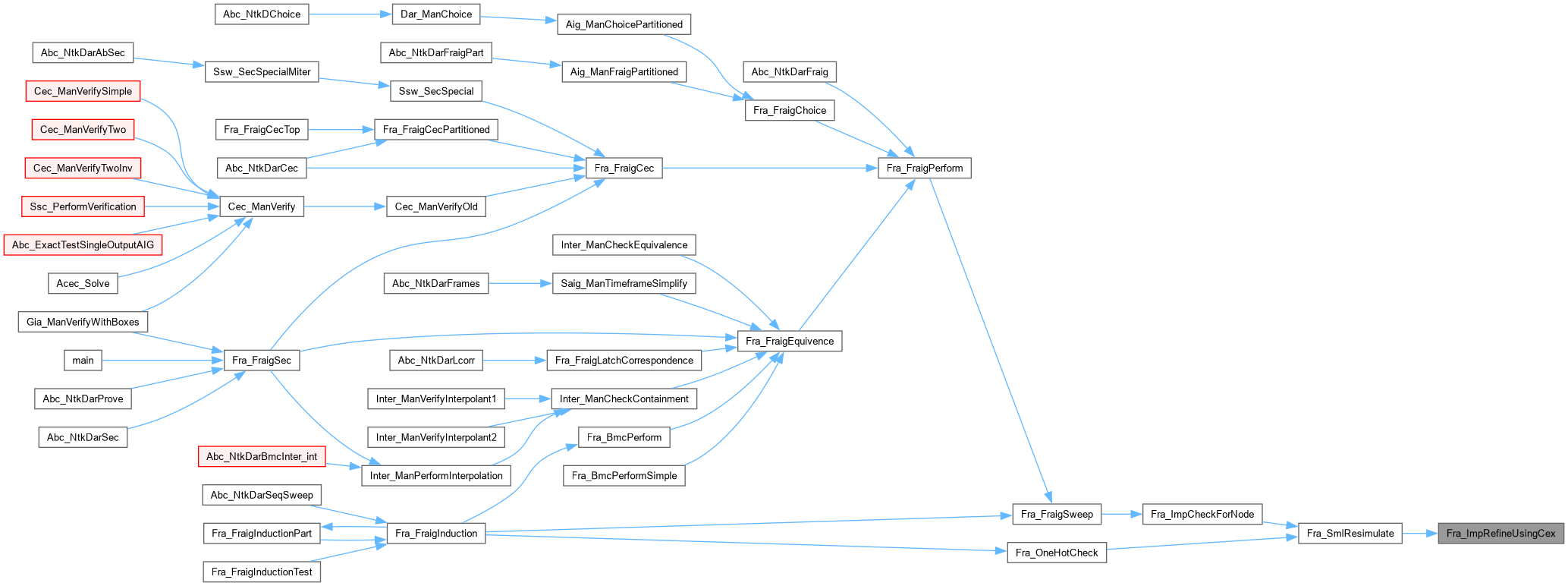
576{
577 Aig_Obj_t * pLeft, * pRight;
578 int Imp, i, RetValue = 0;
579 Vec_IntForEachEntry( vImps, Imp, i )
580 {
581 if ( Imp == 0 )
582 continue;
583 // get the corresponding nodes
584 pLeft = Aig_ManObj( p->pManAig, Fra_ImpLeft(Imp) );
585 pRight = Aig_ManObj( p->pManAig, Fra_ImpRight(Imp) );
586 // check if implication holds using this simulation info
587 if ( !Sml_NodeCheckImp(p->pSml, pLeft->Id, pRight->Id) )
588 {
589 Vec_IntWriteEntry( vImps, i, 0 );
590 RetValue = 1;
591 }
592 }
593 return RetValue;
594}
Here is the caller graph for this function:

◆ Fra_ImpVerifyUsingSimulation()

int Fra_ImpVerifyUsingSimulation ( Fra_Man_t * p)

Function*************************************************************

Synopsis [Returns the number of failed implications.]

Description []

SideEffects []

SeeAlso []

Definition at line 665 of file fraImp.c.
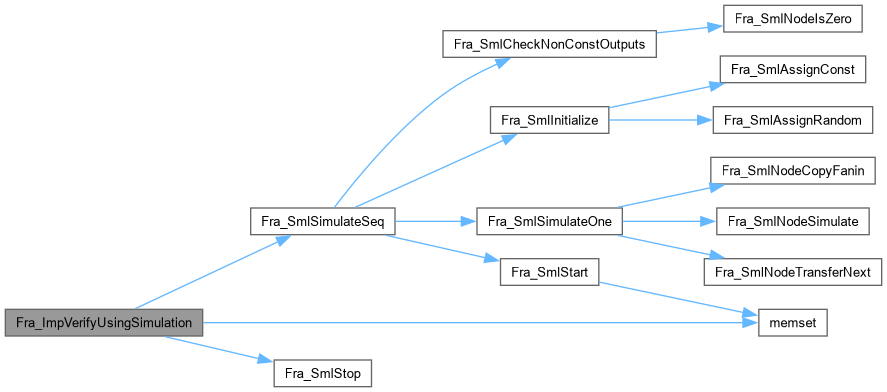
666{
667 int nFrames = 2000;
668 int nSimWords = 8;
669 Fra_Sml_t * pSeq;
670 char * pfFails;
671 int Left, Right, Imp, i, Counter;
672 if ( p->pCla->vImps == NULL || Vec_IntSize(p->pCla->vImps) == 0 )
673 return 0;
674 // simulate the AIG manager with combinational patterns
675 pSeq = Fra_SmlSimulateSeq( p->pManAig, p->pPars->nFramesP, nFrames, nSimWords, 1 );
676 // go through the implications and check how many of them do not hold
677 pfFails = ABC_ALLOC( char, Vec_IntSize(p->pCla->vImps) );
678 memset( pfFails, 0, sizeof(char) * Vec_IntSize(p->pCla->vImps) );
679 Vec_IntForEachEntry( p->pCla->vImps, Imp, i )
680 {
681 Left = Fra_ImpLeft(Imp);
682 Right = Fra_ImpRight(Imp);
683 pfFails[i] = !Sml_NodeCheckImp( pSeq, Left, Right );
684 }
685 // count how many has failed
686 Counter = 0;
687 for ( i = 0; i < Vec_IntSize(p->pCla->vImps); i++ )
688 Counter += pfFails[i];
689 ABC_FREE( pfFails );
690 Fra_SmlStop( pSeq );
691 return Counter;
692}
char * memset()
Here is the call graph for this function:

◆ Fra_SmlSelectMaxCost()

Vec_Int_t * Fra_SmlSelectMaxCost ( Vec_Int_t * vImps,
int * pCosts,
int nCostMax,
int nImpLimit,
int * pCostRange )

Function*************************************************************

Synopsis [Returns the array of implications with the highest cost.]

Description []

SideEffects []

SeeAlso []

Definition at line 244 of file fraImp.c.

245{
246 Vec_Int_t * vImpsNew;
247 int * pCostCount, nImpCount, Imp, i, c;
248 assert( Vec_IntSize(vImps) >= nImpLimit );
249 // count how many implications have each cost
250 pCostCount = ABC_ALLOC( int, nCostMax + 1 );
251 memset( pCostCount, 0, sizeof(int) * (nCostMax + 1) );
252 for ( i = 0; i < Vec_IntSize(vImps); i++ )
253 {
254 assert( pCosts[i] <= nCostMax );
255 pCostCount[ pCosts[i] ]++;
256 }
257 assert( pCostCount[0] == 0 );
258 // select the bound on the cost (above this bound, implication will be included)
259 nImpCount = 0;
260 for ( c = nCostMax; c > 0; c-- )
261 {
262 nImpCount += pCostCount[c];
263 if ( nImpCount >= nImpLimit )
264 break;
265 }
266// printf( "Cost range >= %d.\n", c );
267 // collect implications with the given costs
268 vImpsNew = Vec_IntAlloc( nImpLimit );
269 Vec_IntForEachEntry( vImps, Imp, i )
270 {
271 if ( pCosts[i] < c )
272 continue;
273 Vec_IntPush( vImpsNew, Imp );
274 if ( Vec_IntSize( vImpsNew ) == nImpLimit )
275 break;
276 }
277 ABC_FREE( pCostCount );
278 if ( pCostRange )
279 *pCostRange = c;
280 return vImpsNew;
281}
Here is the call graph for this function:
Here is the caller graph for this function:

◆ Fra_SmlSortUsingOnes()

Vec_Ptr_t * Fra_SmlSortUsingOnes ( Fra_Sml_t * p,
int fLatchCorr )

Function*************************************************************

Synopsis [Returns the array of nodes sorted by the number of 1s.]

Description []

SideEffects []

SeeAlso []

Definition at line 154 of file fraImp.c.

155{
156 Aig_Obj_t * pObj;
157 Vec_Ptr_t * vNodes;
158 int i, nNodes, nTotal, nBits, * pnNodes, * pnBits, * pMemory;
159 assert( p->nWordsTotal > 0 );
160 // count 1s in each node's siminfo
161 pnBits = Fra_SmlCountOnes( p );
162 // count number of nodes having that many 1s
163 nNodes = 0;
164 nBits = p->nWordsTotal * 32;
165 pnNodes = ABC_ALLOC( int, nBits + 1 );
166 memset( pnNodes, 0, sizeof(int) * (nBits + 1) );
167 Aig_ManForEachObj( p->pAig, pObj, i )
168 {
169 if ( i == 0 ) continue;
170 // skip non-PI and non-internal nodes
171 if ( fLatchCorr )
172 {
173 if ( !Aig_ObjIsCi(pObj) )
174 continue;
175 }
176 else
177 {
178 if ( !Aig_ObjIsNode(pObj) && !Aig_ObjIsCi(pObj) )
179 continue;
180 }
181 // skip nodes participating in the classes
182// if ( Fra_ClassObjRepr(pObj) )
183// continue;
184 assert( pnBits[i] <= nBits ); // "<" because of normalized info
185 pnNodes[pnBits[i]]++;
186 nNodes++;
187 }
188 // allocate memory for all the nodes
189 pMemory = ABC_ALLOC( int, nNodes + nBits + 1 );
190 // markup the memory for each node
191 vNodes = Vec_PtrAlloc( nBits + 1 );
192 Vec_PtrPush( vNodes, pMemory );
193 for ( i = 1; i <= nBits; i++ )
194 {
195 pMemory += pnNodes[i-1] + 1;
196 Vec_PtrPush( vNodes, pMemory );
197 }
198 // add the nodes
199 memset( pnNodes, 0, sizeof(int) * (nBits + 1) );
200 Aig_ManForEachObj( p->pAig, pObj, i )
201 {
202 if ( i == 0 ) continue;
203 // skip non-PI and non-internal nodes
204 if ( fLatchCorr )
205 {
206 if ( !Aig_ObjIsCi(pObj) )
207 continue;
208 }
209 else
210 {
211 if ( !Aig_ObjIsNode(pObj) && !Aig_ObjIsCi(pObj) )
212 continue;
213 }
214 // skip nodes participating in the classes
215// if ( Fra_ClassObjRepr(pObj) )
216// continue;
217 pMemory = (int *)Vec_PtrEntry( vNodes, pnBits[i] );
218 pMemory[ pnNodes[pnBits[i]]++ ] = i;
219 }
220 // add 0s in the end
221 nTotal = 0;
222 Vec_PtrForEachEntry( int *, vNodes, pMemory, i )
223 {
224 pMemory[ pnNodes[i]++ ] = 0;
225 nTotal += pnNodes[i];
226 }
227 assert( nTotal == nNodes + nBits + 1 );
228 ABC_FREE( pnNodes );
229 ABC_FREE( pnBits );
230 return vNodes;
231}
#define Aig_ManForEachObj(p, pObj, i)
Definition aig.h:403
int nTotal
DECLARATIONS ///.
Definition cutTruth.c:37
#define Vec_PtrForEachEntry(Type, vVec, pEntry, i)
MACRO DEFINITIONS ///.
Definition vecPtr.h:55
Here is the call graph for this function:
Here is the caller graph for this function:

◆ Sml_CompareMaxId()

int Sml_CompareMaxId ( unsigned short * pImp1,
unsigned short * pImp2 )

Function*************************************************************

Synopsis [Compares two implications using their largest ID.]

Description []

SideEffects []

SeeAlso []

Definition at line 294 of file fraImp.c.
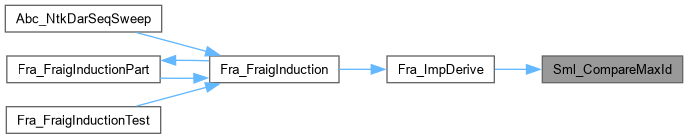
295{
296 int Max1 = Abc_MaxInt( pImp1[0], pImp1[1] );
297 int Max2 = Abc_MaxInt( pImp2[0], pImp2[1] );
298 if ( Max1 < Max2 )
299 return -1;
300 if ( Max1 > Max2 )
301 return 1;
302 return 0;
303}
Here is the caller graph for this function: