ABC: A System for Sequential Synthesis and Verification
 
Loading...
Searching...
No Matches
abcCas.c File Reference
#include "base/abc/abc.h"
#include "bool/kit/kit.h"
#include "aig/miniaig/miniaig.h"
#include "misc/util/utilTruth.h"
Include dependency graph for abcCas.c:

Go to the source code of this file.

Classes

struct  Abc_LutCas_t_
 

Typedefs

typedef struct Abc_BSEval_t_ Abc_BSEval_t
 
typedef struct Abc_LutCas_t_ Abc_LutCas_t
 

Functions

ABC_NAMESPACE_IMPL_START Abc_Ntk_tAbc_NtkCascade (Abc_Ntk_t *pNtk, int nLutSize, int fCheck, int fVerbose)
 DECLARATIONS ///.
 
wordAbc_LutCascade (Mini_Aig_t *p, int nLutSize, int nStages, int nRails, int nIters, int fVerbose)
 
wordAbc_LutCascadeGenTest ()
 
char Abc_LutCascadeChar (int iVar, int nVars)
 
void Abc_LutCascadePrintLut (word *pLuts, int n, int i, int nLutSize, int nVars)
 
void Abc_LutCascadePrint (word *pLuts, int nLutSize)
 
void Abc_LutCascadeGenOne (Vec_Wrd_t *vRes, int nIns, int *pIns, int Out, word *p)
 
wordAbc_LutCascadeGen (int nVars, int nLutSize, int nRails, int nShared)
 
wordAbc_LutCascadeTruth (word *pLuts, int nVars)
 
void Abc_LutCascadeMinBase (word *pLuts, int nVars)
 
int Abc_LutCascadeCount (word *pLuts)
 
wordAbc_LutCascadeTest (Mini_Aig_t *p, int nLutSize, int fVerbose)
 
int Abc_TtGetGuide (char *pGuide, int Iter, Vec_Int_t *vVarIDs, int fShared)
 
void Abc_TtPermuteMask (word *p, int nVars, int Mask, Vec_Int_t *vPerm)
 
int Abc_LutCascadeLookup (word *pStore, int nFuncs, word *pFunc, int nWords)
 
void Abc_LutCascadeDerive (word *p, int nVars, int nBVars, int Myu, word *pRem, word *pDec, int nStep)
 
Abc_BSEval_tAbc_BSEvalAlloc ()
 
void Abc_BSEvalFree (Abc_BSEval_t *p)
 
wordAbc_LutCascadeDec (Abc_BSEval_t *p, char *pGuide, word *pTruth, int nVarsOrig, Vec_Int_t *vVarIDs, int nRails, int nLutSize, int nStages, int fUseRand, int nZParam, int fXRail, int fVerbose, int *pnStages, int *pMyu)
 
Abc_Obj_tAbc_NtkLutCascadeDeriveSop (Abc_Ntk_t *pNtkNew, Abc_Obj_t *pNodeNew, word *pT, int nIns, Vec_Int_t *vCover)
 
Abc_Ntk_tAbc_NtkLutCascadeFromLuts (word *pLuts, int nVars, Abc_Ntk_t *pNtk, int nLutSize, int fVerbose)
 
Abc_Ntk_tAbc_NtkLutCascade (Abc_Ntk_t *pNtk, int nLutSize, int nStages, int nRails, int nIters, int fVerbose)
 
Abc_Ntk_tAbc_NtkLutCascadeOne (Abc_Ntk_t *pNtk, int nLutSize, int nStages, int nRails, int nIters, int nJRatio, int nZParam, int fXRail, int Seed, int fVerbose, int fVeryVerbose, char *pGuide)
 
Abc_Ntk_tAbc_NtkLutCascadeGen (int nLutSize, int nStages, int nRails, int nShared, int fVerbose)
 
Abc_LutCas_tAbc_LutCasAlloc (Abc_Ntk_t *pNtk, int nLutsMax, int nIters, int fDelayLut, int fDelayRoute, int fDelayDirect, int fVerbose)
 
void Abc_LutCasFree (Abc_LutCas_t *p)
 
int Abc_NtkFindPathTimeD_rec (Abc_LutCas_t *p, Abc_Obj_t *pObj)
 
int Abc_NtkFindPathTimeD (Abc_LutCas_t *p)
 
int Abc_NtkFindPathTimeR_rec (Abc_LutCas_t *p, Abc_Obj_t *pObj)
 
int Abc_NtkFindPathTimeR (Abc_LutCas_t *p)
 
void Abc_NtkFindCriticalEdges (Abc_LutCas_t *p)
 
int Abc_NtkFindTiming (Abc_LutCas_t *p)
 
int Abc_NtkUpdateNodeD (Abc_LutCas_t *p, Abc_Obj_t *pObj)
 
int Abc_NtkUpdateNodeR (Abc_LutCas_t *p, Abc_Obj_t *pObj)
 
int Abc_NtkUpdateTiming (Abc_LutCas_t *p, int Node, int Fanin)
 
int Abc_NtkAddEdges (Abc_LutCas_t *p)
 
Vec_Wec_tAbc_NtkProfileCascades (Abc_Ntk_t *pNtk, Vec_Int_t *vTrace)
 
void Abc_LutCasAssignNames (Abc_Ntk_t *pNtk, Abc_Ntk_t *pNtkNew, Vec_Wec_t *vCascs)
 
void Abc_NtkLutCascadeDumpResults (char *pDumpFile, char *pTest, int Nodes, int Edges, int Levs, int DelStart, int DelStop, float DelRatio, int EdgesUsed, float EdgeRatio, int Cascs, float AveLength, abctime time)
 
Abc_Ntk_tAbc_NtkLutCascadeMap (Abc_Ntk_t *pNtk, int nLutsMax, int nIters, int fDelayLut, int fDelayRoute, int fDelayDirect, int fVerbose)
 
Vec_Wrd_tAbc_NtkLutCasReadTruths (char *pFileName, int nVarsOrig)
 
void Abc_NtkLutCascadeFile (char *pFileName, int nVarsOrig, int nLutSize, int nStages, int nRails, int nIters, int nJRatio, int nZParam, int Seed, int fVerbose, int fVeryVerbose, int fPrintMyu, int fPrintLev, int fXRail)
 
void Vec_WrdWriteTruthHex (char *pFileName, Vec_Wrd_t *vTruths, int nVars)
 
void Abc_NtkSuppMinFile (char *pFileName)
 
void Abc_NtkRandFile (char *pFileName, int nVars, int nFuncs, int nMints)
 

Typedef Documentation

◆ Abc_BSEval_t

typedef struct Abc_BSEval_t_ Abc_BSEval_t

Definition at line 741 of file abcCas.c.

◆ Abc_LutCas_t

typedef struct Abc_LutCas_t_ Abc_LutCas_t

Function*************************************************************

Synopsis [Structural LUT cascade mapping.]

Description []

SideEffects []

SeeAlso []

Definition at line 979 of file abcCas.c.

Function Documentation

◆ Abc_BSEvalAlloc()

Abc_BSEval_t * Abc_BSEvalAlloc ( )
extern

Function*************************************************************

Synopsis [Bound-set evalution for one function.]

Description []

SideEffects []

SeeAlso []

Definition at line 556 of file utilBSet.c.
557{
559 p->vCounts = Vec_IntStartFull( 1 << 16 );
560 p->vTable = Vec_IntStartFull( 997 );
561 p->vUsed = Vec_IntAlloc(100);
562 p->vStore = Vec_WrdAlloc(1000);
563 return p;
564}
struct Abc_BSEval_t_ Abc_BSEval_t
Definition abcCas.c:741
#define ABC_CALLOC(type, num)
Definition abc_global.h:265
Cube * p
Definition exorList.c:222
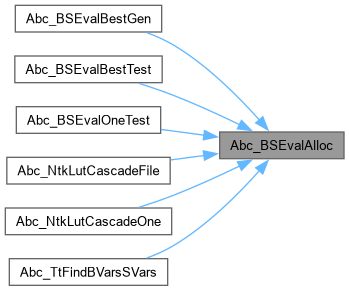
Here is the caller graph for this function:

◆ Abc_BSEvalFree()

void Abc_BSEvalFree ( Abc_BSEval_t * p)
extern

Definition at line 565 of file utilBSet.c.
566{
567 for ( int i = 0; i < MAX_TT_SIZE; i++ )
568 for ( int k = 0; k < MAX_TT_SIZE; k++ )
569 Vec_IntFreeP( &p->vPairs[i][k] );
570 Vec_IntFree( p->vCounts );
571 Vec_IntFree( p->vTable );
572 Vec_IntFree( p->vUsed );
573 Vec_WrdFree( p->vStore );
574 for ( int i = 0; i < MAX_TT_SIZE; i++ )
575 Vec_WecFreeP( &p->vSets[i] );
576 for ( int i = 0; i < MAX_TT_SIZE; i++ )
577 Vec_WrdFreeP( &p->vCofs[i] );
578 ABC_FREE( p->pPat );
579 ABC_FREE( p );
580}
#define ABC_FREE(obj)
Definition abc_global.h:267
#define MAX_TT_SIZE
DECLARATIONS ///.
Definition utilBSet.c:41
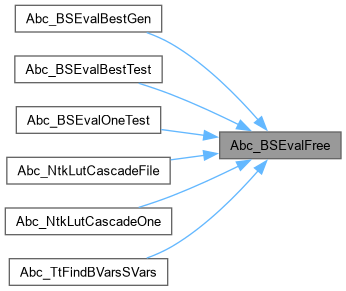
Here is the caller graph for this function:

◆ Abc_LutCasAlloc()

Abc_LutCas_t * Abc_LutCasAlloc ( Abc_Ntk_t * pNtk,
int nLutsMax,
int nIters,
int fDelayLut,
int fDelayRoute,
int fDelayDirect,
int fVerbose )

Definition at line 1004 of file abcCas.c.
1005{
1007 p->pNtk = pNtk;
1008 p->nLutSize = 6;
1009 p->nLutsMax = nLutsMax;
1010 p->nIters = nIters;
1011 p->fDelayLut = fDelayLut;
1012 p->fDelayRoute = fDelayRoute;
1013 p->fDelayDirect = fDelayDirect;
1014 p->fVerbose = fVerbose;
1015 p->vTime[0] = Vec_IntStart( Abc_NtkObjNumMax(pNtk) );
1016 p->vTime[1] = Vec_IntStart( Abc_NtkObjNumMax(pNtk) );
1017 p->vCrits[0] = Vec_IntAlloc(1000);
1018 p->vCrits[1] = Vec_IntAlloc(1000);
1019 p->vPath[0] = Vec_IntStart( Abc_NtkObjNumMax(pNtk) );
1020 p->vPath[1] = Vec_IntStart( Abc_NtkObjNumMax(pNtk) );
1021 p->vStack = Vec_WecStart( Abc_NtkLevel(pNtk) + 1 );
1022 p->vZeroSlack = Vec_IntAlloc( 1000 );
1023 p->vCands = Vec_IntAlloc( 1000 );
1024 p->vTrace = Vec_IntAlloc( 1000 );
1025 p->vTraceBest = Vec_IntAlloc( 1000 );
1026 return p;
1027}
struct Abc_LutCas_t_ Abc_LutCas_t
Definition abcCas.c:979
ABC_DLL int Abc_NtkLevel(Abc_Ntk_t *pNtk)
Definition abcDfs.c:1449
#define ABC_ALLOC(type, num)
Definition abc_global.h:264
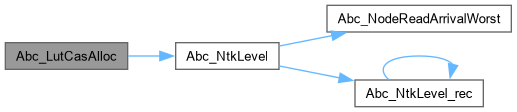
Here is the call graph for this function:
Here is the caller graph for this function:

◆ Abc_LutCasAssignNames()

void Abc_LutCasAssignNames ( Abc_Ntk_t * pNtk,
Abc_Ntk_t * pNtkNew,
Vec_Wec_t * vCascs )

Definition at line 1307 of file abcCas.c.
1308{
1309 Abc_Obj_t * pObj; Vec_Int_t * vLevel; int i, k; char pName[100];
1310 Vec_Int_t * vMap = Vec_IntStart( Abc_NtkObjNumMax(pNtk) );
1311 Abc_NtkForEachCo( pNtkNew, pObj, i )
1312 Vec_IntWriteEntry( vMap, Abc_ObjFaninId0(pObj), pObj->Id );
1313 Vec_WecForEachLevel( vCascs, vLevel, i ) {
1314 Abc_NtkForEachObjVec( vLevel, pNtk, pObj, k ) {
1315 assert( Abc_ObjIsNode(pObj) );
1316 sprintf( pName, "c%d_n%d", i, k );
1317 if ( Vec_IntEntry(vMap, pObj->pCopy->Id) == 0 )
1318 Abc_ObjAssignName( Abc_NtkObj(pNtkNew, pObj->pCopy->Id), pName, NULL );
1319 else {
1320 Nm_ManDeleteIdName( pNtkNew->pManName, Vec_IntEntry(vMap, pObj->pCopy->Id) );
1321 Abc_ObjAssignName( Abc_NtkObj(pNtkNew, Vec_IntEntry(vMap, pObj->pCopy->Id)), pName, NULL );
1322 }
1323 }
1324 }
1325 Vec_IntFree( vMap );
1326}
struct Abc_Obj_t_ Abc_Obj_t
Definition abc.h:116
#define Abc_NtkForEachCo(pNtk, pCo, i)
Definition abc.h:522
ABC_DLL char * Abc_ObjAssignName(Abc_Obj_t *pObj, char *pName, char *pSuffix)
Definition abcNames.c:69
#define Abc_NtkForEachObjVec(vIds, pNtk, pObj, i)
Definition abc.h:455
typedefABC_NAMESPACE_IMPL_START struct Vec_Int_t_ Vec_Int_t
DECLARATIONS ///.
Definition bblif.c:37
void Nm_ManDeleteIdName(Nm_Man_t *p, int ObjId)
Definition nmApi.c:149
Nm_Man_t * pManName
Definition abc.h:160
int Id
Definition abc.h:132
Abc_Obj_t * pCopy
Definition abc.h:148
#define assert(ex)
Definition util_old.h:213
char * sprintf()
#define Vec_WecForEachLevel(vGlob, vVec, i)
MACRO DEFINITIONS ///.
Definition vecWec.h:55
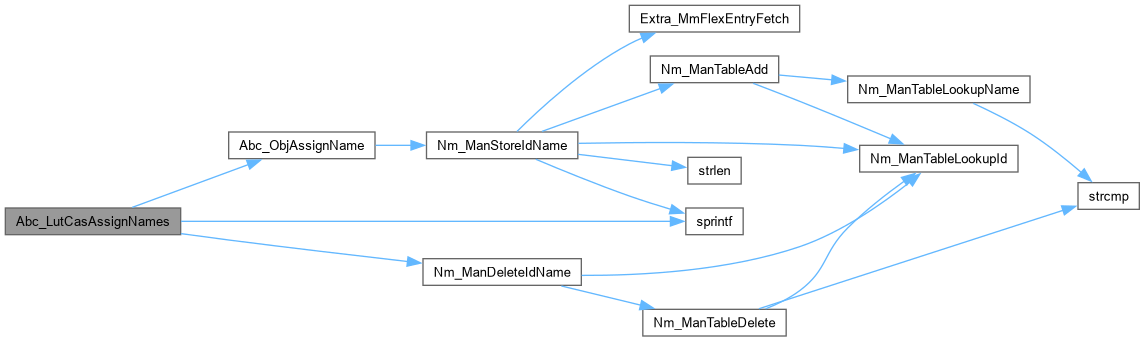
Here is the call graph for this function:
Here is the caller graph for this function:

◆ Abc_LutCascade()

word * Abc_LutCascade ( Mini_Aig_t * p,
int nLutSize,
int nStages,
int nRails,
int nIters,
int fVerbose )

Definition at line 335 of file abcCas.c.

335{ return NULL; }

◆ Abc_LutCascadeChar()

char Abc_LutCascadeChar ( int iVar,
int nVars )

Definition at line 386 of file abcCas.c.

387{
388 if ( iVar < nVars )
389 return 'a'+iVar;
390 return 'A'+(iVar-nVars);
391}
Here is the caller graph for this function:

◆ Abc_LutCascadeCount()

int Abc_LutCascadeCount ( word * pLuts)

Definition at line 553 of file abcCas.c.

554{
555 return (int)pLuts[0];
556}
Here is the caller graph for this function:

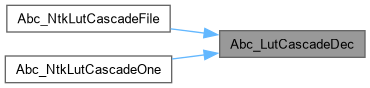
◆ Abc_LutCascadeDec()

word * Abc_LutCascadeDec ( Abc_BSEval_t * p,
char * pGuide,
word * pTruth,
int nVarsOrig,
Vec_Int_t * vVarIDs,
int nRails,
int nLutSize,
int nStages,
int fUseRand,
int nZParam,
int fXRail,
int fVerbose,
int * pnStages,
int * pMyu )

Definition at line 745 of file abcCas.c.
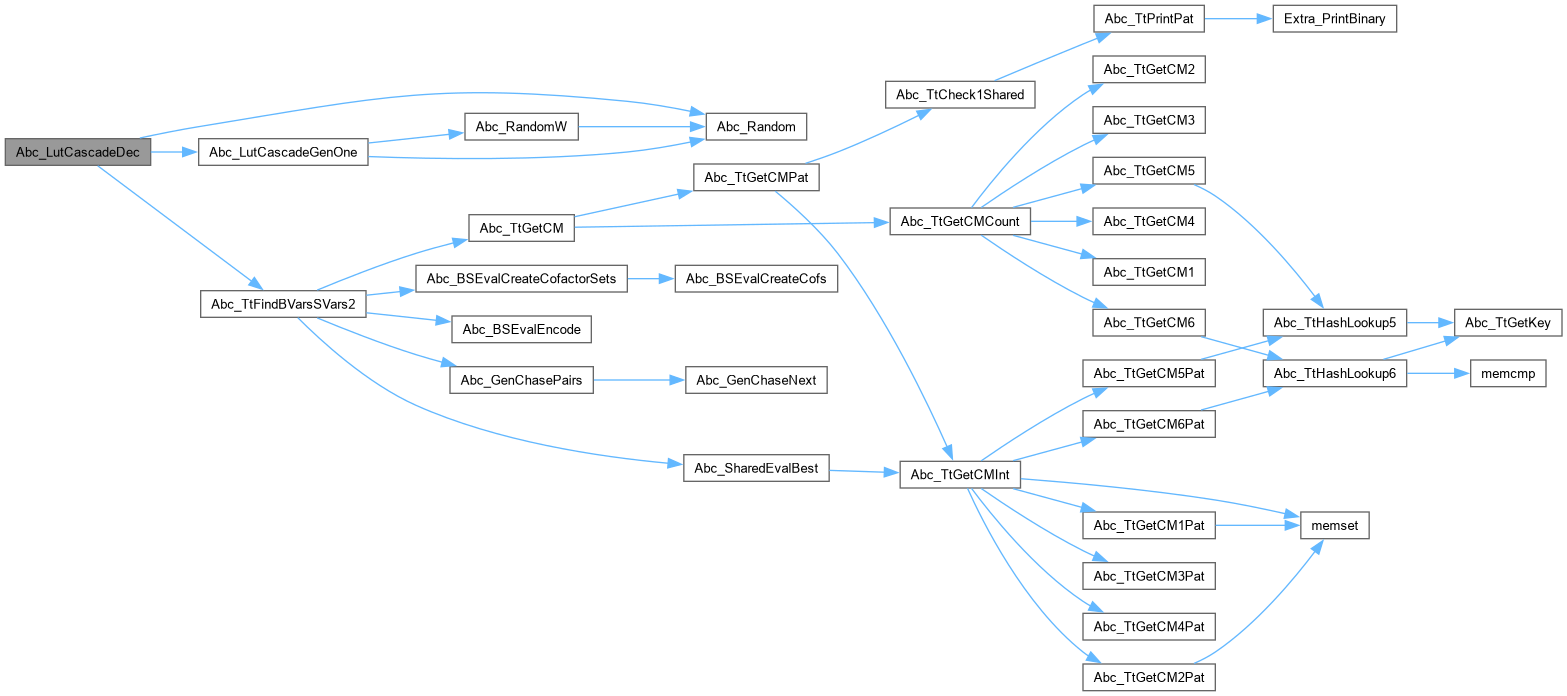
746{
747 extern Vec_Wrd_t * Abc_TtFindBVarsSVars2( Abc_BSEval_t * p, word * pTruth, int nVars, int nCVars, int nRails, int nLutSize, int fVerbose, int * pMyu, int nMyuIncrease );
748 word * pRes = NULL; int i, nRVars = 0, nVars = Vec_IntSize(vVarIDs);
749 Vec_Wrd_t * vFuncs[3] = { Vec_WrdStart(Abc_TtWordNum(nVars)), Vec_WrdAlloc(0), Vec_WrdAlloc(0) };
750 Abc_TtCopy( Vec_WrdArray(vFuncs[0]), pTruth, Abc_TtWordNum(nVars), 0 );
751 Vec_Wrd_t * vCas = Vec_WrdAlloc( 100 ); Vec_WrdPush( vCas, nVarsOrig );
752 if ( pnStages ) *pnStages = 0;
753 for ( i = 0; Vec_IntSize(vVarIDs) > nLutSize; i++ ) {
754 int nRVarsOld = nRVars;
755 Vec_Wrd_t * vGuides = Abc_TtFindBVarsSVars2( p, Vec_WrdArray(vFuncs[0]), Vec_IntSize(vVarIDs), nRVars, nRails, nLutSize, fVerbose, pMyu, nZParam );
756 if ( vGuides ) {
757 int iEntry = fUseRand ? Abc_Random(0) % Vec_WrdSize(vGuides) : 0;
758 nRVars = Abc_LutCascadeDecStage( Vec_WrdEntry(vGuides, iEntry), pGuide, i, vFuncs, vVarIDs, nRVarsOld, nRails, nLutSize, nZParam, fVerbose, vCas, i ? NULL : pMyu );
759 Vec_WrdFree( vGuides );
760 }
761 else
762 nRVars = -1;
763 if ( i+2 > nStages ) {
764 if ( fVerbose )
765 printf( "The length of the cascade (%d) exceeds the max allowed number of stages (%d).\n", i+2, nStages );
766 nRVars = -1;
767 }
768 if ( fXRail && nRVars == -1 && Vec_IntSize(vVarIDs) > nLutSize-1 ) {
769 Vec_Wrd_t * vGuides = Abc_TtFindBVarsSVars2( p, Vec_WrdArray(vFuncs[0]), Vec_IntSize(vVarIDs), nRVarsOld, nRails+1, nLutSize-1, fVerbose, pMyu, nZParam );
770 if ( vGuides ) {
771 int iEntry = fUseRand ? Abc_Random(0) % Vec_WrdSize(vGuides) : 0;
772 nRVars = Abc_LutCascadeDecStage( Vec_WrdEntry(vGuides, iEntry), pGuide, i, vFuncs, vVarIDs, nRVarsOld, nRails+1, nLutSize-1, nZParam, fVerbose, vCas, NULL );
773 Vec_WrdFree( vGuides );
774 }
775 else
776 nRVars = -1;
777 if ( i+2 > nStages ) {
778 if ( fVerbose )
779 printf( "The length of the cascade (%d) exceeds the max allowed number of stages (%d).\n", i+2, nStages );
780 nRVars = -1;
781 }
782 }
783 if ( nRVars == -1 ) {
784 Vec_IntClear( vVarIDs );
785 if ( fVerbose )
786 printf( "The function is not decomposable with %d rails.\n", nRails );
787 break;
788 }
789 }
790 if ( nRVars != -1 && Vec_IntSize(vVarIDs) > 0 ) {
791 Abc_LutCascadeGenOne( vCas, Vec_IntSize(vVarIDs), Vec_IntArray(vVarIDs), Vec_WrdEntry(vCas, 0), Vec_WrdArray(vFuncs[0]) );
792 Vec_WrdAddToEntry( vCas, 0, -nVarsOrig );
793 pRes = Vec_WrdReleaseArray(vCas);
794 if ( pnStages ) *pnStages = i+1;
795 }
796 Vec_WrdFree( vCas );
797 for ( i = 0; i < 3; i++ )
798 Vec_WrdFree( vFuncs[i] );
799 return pRes;
800}
void Abc_LutCascadeGenOne(Vec_Wrd_t *vRes, int nIns, int *pIns, int Out, word *p)
Definition abcCas.c:414
unsigned Abc_Random(int fReset)
Definition utilSort.c:1004
unsigned __int64 word
DECLARATIONS ///.
Definition kitPerm.c:36
Vec_Wrd_t * Abc_TtFindBVarsSVars2(Abc_BSEval_t *p, word *pTruth, int nVars, int nCVars, int nRails, int nLutSize, int fVerbose, int *pMyu, int nMyuIncrease)
Definition utilBSet.c:1009
typedefABC_NAMESPACE_HEADER_START struct Vec_Wrd_t_ Vec_Wrd_t
INCLUDES ///.
Definition vecWrd.h:42
Here is the call graph for this function:
Here is the caller graph for this function:

◆ Abc_LutCascadeDerive()

void Abc_LutCascadeDerive ( word * p,
int nVars,
int nBVars,
int Myu,
word * pRem,
word * pDec,
int nStep )

Definition at line 661 of file abcCas.c.

662{
663 int nFVars = nVars-nBVars; assert( nFVars >= 6 );
664 int nEVars = Abc_Base2Log(Myu);
665 int nFWords = Abc_TtWordNum(nFVars);
666 int m, e, iFunc, nFuncs = 0;
667 //printf( "Decomposition pattern with %d BS vars and %d FS vars: ", nBVars, nFVars );
668 for ( m = 0; m < (1 << nBVars); m++ ) {
669 iFunc = Abc_LutCascadeLookup( pRem, nFuncs, p+m*nFWords, nFWords );
670 //printf( "%x", iFunc );
671 nFuncs = Abc_MaxInt( nFuncs, iFunc+1 );
672 for ( e = 0; e < nEVars; e++ )
673 if ( (iFunc >> e) & 1 )
674 Abc_TtSetBit(pDec+e*nStep, m);
675 }
676 //printf( "\n" );
677 //assert( nFuncs <= Myu );
678 iFunc = nFuncs-1;
679 for ( m = nFuncs; m < (1 << nEVars); m++ )
680 Abc_TtCopy( pRem+m*nFWords, pRem+iFunc*nFWords, nFWords, 0 );
681 if ( nBVars < 6 )
682 for ( e = 0; e < nEVars; e++ )
683 pDec[e*nStep] = Abc_Tt6Stretch( pDec[e*nStep], nBVars );
684}
int Abc_LutCascadeLookup(word *pStore, int nFuncs, word *pFunc, int nWords)
Definition abcCas.c:651
Here is the call graph for this function:

◆ Abc_LutCascadeGen()

word * Abc_LutCascadeGen ( int nVars,
int nLutSize,
int nRails,
int nShared )

Definition at line 431 of file abcCas.c.

432{
433 assert( nLutSize - nRails - nShared > 0 );
434 Vec_Wrd_t * vRes = Vec_WrdStart( 1 );
435 Vec_Int_t * vFanins = Vec_IntAlloc( nLutSize );
436 Vec_Int_t * vVars = Vec_IntStartNatural( nVars );
437 Vec_Str_t * vGuide = Vec_StrAlloc( 100 );
438 Abc_Random(1);
439 int i, c = 0, Obj, iVarNext = nVars, iVarPrev = -1;
440 while ( Vec_IntSize(vVars) > nLutSize ) {
441 if ( Vec_WrdSize(vRes) > 1 )
442 for ( i = 0; i < nRails; i++ )
443 Vec_IntPop( vVars );
444 Vec_StrPush( vGuide, '0'+c++ );
445 Vec_IntClear( vFanins );
446 for ( i = 0; i < nShared; i++ ) {
447 int Index = -1;
448 do Index = Abc_Random(0) % Vec_IntSize(vVars);
449 while ( Vec_IntFind(vFanins, Vec_IntEntry(vVars, Index)) >= 0 );
450 Vec_IntPush( vFanins, Vec_IntEntry(vVars, Index) );
451 Vec_StrPush( vGuide, 'A'+Vec_IntEntry(vVars, Index) );
452 }
453 for ( i = 0; i < nLutSize - nRails - nShared; i++ ) {
454 int Index = -1;
455 do Index = Abc_Random(0) % Vec_IntSize(vVars);
456 while ( Vec_IntFind(vFanins, Vec_IntEntry(vVars, Index)) >= 0 );
457 Vec_IntPush( vFanins, Vec_IntEntry(vVars, Index) );
458 Vec_StrPush( vGuide, 'a'+Vec_IntEntry(vVars, Index) );
459 Vec_IntDrop( vVars, Index );
460 }
461 if ( Vec_WrdSize(vRes) == 1 ) {
462 for ( i = 0; i < nRails; i++ ) {
463 int Index = -1;
464 do Index = Abc_Random(0) % Vec_IntSize(vVars);
465 while ( Vec_IntFind(vFanins, Vec_IntEntry(vVars, Index)) >= 0 );
466 Vec_IntPush( vFanins, Vec_IntEntry(vVars, Index) );
467 Vec_StrPush( vGuide, 'a'+Vec_IntEntry(vVars, Index) );
468 Vec_IntDrop( vVars, Index );
469 }
470 }
471 else {
472 assert( iVarPrev > 0 );
473 for ( i = 0; i < nRails; i++ ) {
474 Vec_IntPush( vFanins, iVarPrev+i );
475 Vec_StrPush( vGuide, 'a'+iVarPrev+i );
476 }
477 }
478 iVarPrev = iVarNext;
479 assert( Vec_IntSize(vFanins) == nLutSize );
480 for ( i = 0; i < nRails; i++ ) {
481 Abc_LutCascadeGenOne( vRes, Vec_IntSize(vFanins), Vec_IntArray(vFanins), iVarNext++, NULL );
482 Vec_IntPush( vVars, iVarPrev+i );
483 }
484 }
485 assert( Vec_IntSize(vVars) <= nLutSize );
486 Abc_LutCascadeGenOne( vRes, Vec_IntSize(vVars), Vec_IntArray(vVars), iVarNext, NULL );
487 Vec_StrPush( vGuide, '0'+c++ );
488 Vec_IntForEachEntry( vVars, Obj, i )
489 Vec_StrPush( vGuide, 'a'+Obj );
490 Vec_StrPush( vGuide, '\0' );
491
492 printf( "Generated %d-LUT cascade for a %d-var function with %d rails and %d shared vars (node = %d, level = %d).\n",
493 nLutSize, nVars, nRails, nShared, (int)Vec_WrdEntry(vRes, 0), c );
494 printf( "Structural info: %s\n", Vec_StrArray(vGuide) );
495 Vec_StrFree( vGuide );
496
497 word * pRes = Vec_WrdReleaseArray(vRes);
498 Vec_WrdFree( vRes );
499 return pRes;
500}
struct Vec_Str_t_ Vec_Str_t
Definition bblif.c:46
#define Vec_IntForEachEntry(vVec, Entry, i)
MACRO DEFINITIONS ///.
Definition vecInt.h:54
Here is the call graph for this function:
Here is the caller graph for this function:

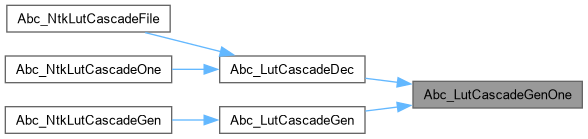
◆ Abc_LutCascadeGenOne()

void Abc_LutCascadeGenOne ( Vec_Wrd_t * vRes,
int nIns,
int * pIns,
int Out,
word * p )

Definition at line 414 of file abcCas.c.

415{
416 int w, nWords = Abc_TtWordNum(nIns);
417 //int iStart = Vec_WrdSize(vRes);
418 Vec_WrdAddToEntry(vRes, 0, 1);
419 Vec_WrdPush( vRes, 3+nIns+nWords );
420 Vec_WrdPush( vRes, nIns );
421 for ( w = 0; w < nIns; w++ )
422 Vec_WrdPush( vRes, pIns[w] );
423 Vec_WrdPush( vRes, Out );
424 if ( nIns < 6 )
425 Vec_WrdPush( vRes, p ? p[0] : Abc_Tt6Stretch(Abc_Random(0), nIns) );
426 else
427 for ( w = 0; w < nWords; w++ )
428 Vec_WrdPush( vRes, p ? p[w] : Abc_RandomW(0) );
429 //printf("Adding LUT: "); Abc_LutCascadePrintLut( Vec_WrdArray(vRes), 0, iStart );
430}
int nWords
Definition abcNpn.c:127
word Abc_RandomW(int fReset)
Definition utilSort.c:1022
Here is the call graph for this function:
Here is the caller graph for this function:

◆ Abc_LutCascadeGenTest()

word * Abc_LutCascadeGenTest ( )

Function*************************************************************

Synopsis []

Description []

SideEffects []

SeeAlso []

Definition at line 365 of file abcCas.c.

366{
367 word * pLuts = ABC_CALLOC( word, 20 ); int i;
368 // node count
369 pLuts[0] = 2;
370 // first node
371 pLuts[1+0] = 10;
372 pLuts[1+1] = 6;
373 for ( i = 0; i < 6; i++ )
374 pLuts[1+2+i] = i;
375 pLuts[1+8] = 9;
376 pLuts[1+9] = ABC_CONST(0x8000000000000000);
377 // second node
378 pLuts[11+0] = 8;
379 pLuts[11+1] = 4;
380 for ( i = 0; i < 4; i++ )
381 pLuts[11+2+i] = i ? i + 5 : 9;
382 pLuts[11+6] = 10;
383 pLuts[11+7] = ABC_CONST(0xFFFEFFFEFFFEFFFE);
384 return pLuts;
385}
#define ABC_CONST(number)
PARAMETERS ///.
Definition abc_global.h:240
Here is the caller graph for this function:

◆ Abc_LutCascadeLookup()

int Abc_LutCascadeLookup ( word * pStore,
int nFuncs,
word * pFunc,
int nWords )

Definition at line 651 of file abcCas.c.

652{
653 int i;
654 for ( i = 0; i < nFuncs; i++ )
655 if ( Abc_TtEqual( pStore+i*nWords, pFunc, nWords ) )
656 return i;
657 Abc_TtCopy( pStore+i*nWords, pFunc, nWords, 0 );
658 assert( i == nFuncs );
659 return i;
660}
Here is the caller graph for this function:

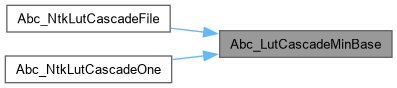
◆ Abc_LutCascadeMinBase()

void Abc_LutCascadeMinBase ( word * pLuts,
int nVars )

Definition at line 533 of file abcCas.c.

534{
535 int i, n, v, pFans[32];
536 for ( n = 0, i = 1; n < pLuts[0]; n++, i += pLuts[i] )
537 {
538 word nIns = pLuts[i+1];
539 word * pIns = pLuts+i+2;
540 word * pT = pLuts+i+2+nIns+1;
541 assert( pLuts[i] == 3+nIns+Abc_TtWordNum(nIns) );
542 assert( pIns[nIns] < nVars+pLuts[0] );
543 for ( v = 0; v < nIns; v++ )
544 pFans[v] = (int)pIns[v];
545 int nFans = Abc_TtMinBase( pT, pFans, (int)nIns, (int)nIns );
546 pLuts[i+1] = (word)nFans;
547 for ( v = 0; v < nFans; v++ )
548 pIns[v] = (word)pFans[v];
549 pIns[nFans] = pIns[nIns];
550 memcpy( pLuts+i+2+nFans+1, pT, sizeof(word)*Abc_TtWordNum(nFans) );
551 }
552}
char * memcpy()
Here is the call graph for this function:
Here is the caller graph for this function:

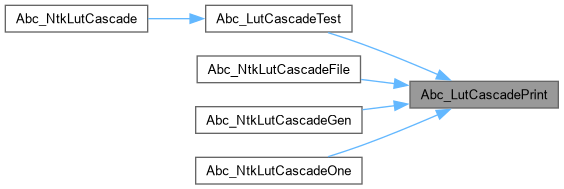
◆ Abc_LutCascadePrint()

void Abc_LutCascadePrint ( word * pLuts,
int nLutSize )

Definition at line 407 of file abcCas.c.

408{
409 int n, i, nVars = pLuts[3+pLuts[2]];
410 printf( "The LUT cascade contains %d LUTs:\n", (int)pLuts[0] );
411 for ( n = 0, i = 1; n < pLuts[0]; n++, i += pLuts[i] )
412 Abc_LutCascadePrintLut( pLuts, n, i, nLutSize, nVars );
413}
void Abc_LutCascadePrintLut(word *pLuts, int n, int i, int nLutSize, int nVars)
Definition abcCas.c:392
Here is the call graph for this function:
Here is the caller graph for this function:

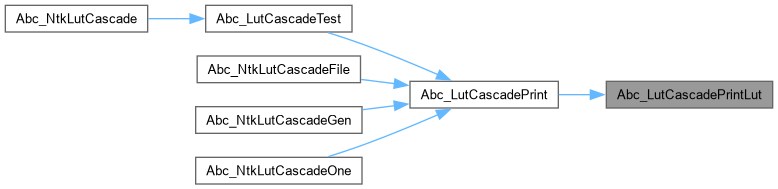
◆ Abc_LutCascadePrintLut()

void Abc_LutCascadePrintLut ( word * pLuts,
int n,
int i,
int nLutSize,
int nVars )

Definition at line 392 of file abcCas.c.

393{
394 word nIns = pLuts[i+1];
395 word * pIns = pLuts+i+2;
396 word * pT = pLuts+i+2+nIns+1; int k;
397 printf( "LUT%d : ", n );
398 printf( "%c = { ", Abc_LutCascadeChar((int)pIns[nIns], nVars) );
399 for ( k = nLutSize-1; k >= nIns; k-- )
400 printf( " " );
401 for ( k = nIns-1; k >= 0; k-- )
402 printf( "%c ", Abc_LutCascadeChar((int)pIns[k], nVars) );
403 printf( "} " );
404 Abc_TtPrintHexRev( stdout, pT, nIns );
405 printf( "\n" );
406}
char Abc_LutCascadeChar(int iVar, int nVars)
Definition abcCas.c:386
Here is the call graph for this function:
Here is the caller graph for this function:

◆ Abc_LutCascadeTest()

word * Abc_LutCascadeTest ( Mini_Aig_t * p,
int nLutSize,
int fVerbose )

Definition at line 557 of file abcCas.c.

558{
559 word * pLuts = Abc_LutCascadeGenTest();
560 Abc_LutCascadePrint( pLuts, nLutSize );
561 return pLuts;
562}
word * Abc_LutCascadeGenTest()
Definition abcCas.c:365
void Abc_LutCascadePrint(word *pLuts, int nLutSize)
Definition abcCas.c:407
Here is the call graph for this function:
Here is the caller graph for this function:

◆ Abc_LutCascadeTruth()

word * Abc_LutCascadeTruth ( word * pLuts,
int nVars )

Definition at line 501 of file abcCas.c.
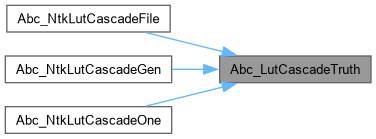
502{
503 int nWords = Abc_TtWordNum(nVars);
504 Vec_Wrd_t * vFuncs = Vec_WrdStartTruthTables6( nVars );
505 Vec_WrdFillExtra( vFuncs, nWords*(nVars+pLuts[0]+1), (word)0 );
506 word * pCube = Vec_WrdEntryP( vFuncs, nWords*(nVars+pLuts[0]) );
507 int n, i, m, v, iLastLut = -1;
508 for ( n = 0, i = 1; n < pLuts[0]; n++, i += pLuts[i] )
509 {
510 word nIns = pLuts[i+1];
511 word * pIns = pLuts+i+2;
512 word * pT = pLuts+i+2+nIns+1;
513 //assert( pLuts[i] == 3+nIns+Abc_TtWordNum(nIns) );
514 assert( pIns[nIns] < nVars+pLuts[0] );
515 word * pIn[30], * pOut = Vec_WrdEntryP( vFuncs, nWords*pIns[nIns] );
516 for ( v = 0; v < nIns; v++ )
517 pIn[v] = Vec_WrdEntryP( vFuncs, nWords*pIns[v] );
518 for ( m = 0; m < (1<<nIns); m++ ) {
519 if ( !Abc_TtGetBit(pT, m) )
520 continue;
521 Abc_TtFill(pCube, nWords);
522 for ( v = 0; v < nIns; v++ )
523 Abc_TtAndCompl(pCube, pCube, 0, pIn[v], !((m>>v)&1), nWords);
524 Abc_TtOr(pOut, pOut, pCube, nWords);
525 }
526 iLastLut = pIns[nIns];
527 }
528 word * pRes = Vec_WrdReleaseArray(vFuncs);
529 Abc_TtCopy( pRes, pRes + nWords*iLastLut, nWords, 0 );
530 Vec_WrdFree( vFuncs );
531 return pRes;
532}
Here is the caller graph for this function:

◆ Abc_LutCasFree()

void Abc_LutCasFree ( Abc_LutCas_t * p)

Definition at line 1028 of file abcCas.c.

1029{
1030 Vec_IntFree( p->vTime[0] );
1031 Vec_IntFree( p->vTime[1] );
1032 Vec_IntFree( p->vCrits[0] );
1033 Vec_IntFree( p->vCrits[1] );
1034 Vec_IntFree( p->vPath[0] );
1035 Vec_IntFree( p->vPath[1] );
1036 Vec_WecFree( p->vStack );
1037 Vec_IntFree( p->vZeroSlack );
1038 Vec_IntFree( p->vCands );
1039 Vec_IntFree( p->vTrace );
1040 Vec_IntFree( p->vTraceBest );
1041 ABC_FREE( p );
1042}
Here is the caller graph for this function:

◆ Abc_NtkAddEdges()

int Abc_NtkAddEdges ( Abc_LutCas_t * p)

Function*************************************************************

Synopsis [Structural LUT cascade mapping.]

Description []

SideEffects []

SeeAlso []

Definition at line 1238 of file abcCas.c.

1239{
1240 int nEdgesMax = 10000;
1241 Vec_IntClear( p->vTrace );
1242 Vec_IntFill( p->vPath[0], Vec_IntSize(p->vPath[0]), 0 );
1243 Vec_IntFill( p->vPath[1], Vec_IntSize(p->vPath[1]), 0 );
1245 if ( p->fVerbose )
1246 printf( "Start : %d\n", p->DelayMax );
1247 int i, LastChange = 0;
1248 for ( i = 0; i < nEdgesMax; i++ )
1249 {
1250 float DelayPrev = p->DelayMax;
1251 if ( Vec_IntSize(p->vCands) == 0 )
1252 break;
1253 int Index = rand() % Vec_IntSize(p->vCands)/2;
1254 int Node = Vec_IntEntry( p->vCands, 2*Index );
1255 int Fanin = Vec_IntEntry( p->vCands, 2*Index+1 );
1256 assert( Vec_IntEntry( p->vPath[0], Node ) == 0 );
1257 Vec_IntWriteEntry( p->vPath[0], Node, Fanin );
1258 assert( Vec_IntEntry( p->vPath[1], Fanin ) == 0 );
1259 Vec_IntWriteEntry( p->vPath[1], Fanin, Node );
1260 Vec_IntPushTwo( p->vTrace, Node, Fanin );
1261 //Abc_NtkFindTiming( p );
1262 Abc_NtkUpdateTiming( p, Node, Fanin );
1263 assert( DelayPrev >= p->DelayMax );
1264 if ( DelayPrev > p->DelayMax )
1265 LastChange = i+1;
1266 DelayPrev = p->DelayMax;
1267 if ( p->fVerbose )
1268 printf( "%5d : %d : %4d -> %4d\n", i, p->DelayMax, Fanin, Node );
1269 }
1270 Vec_IntShrink( p->vTrace, 2*LastChange );
1271 return p->DelayMax;
1272}
int Abc_NtkFindTiming(Abc_LutCas_t *p)
Definition abcCas.c:1130
int Abc_NtkUpdateTiming(Abc_LutCas_t *p, int Node, int Fanin)
Definition abcCas.c:1166
Here is the call graph for this function:
Here is the caller graph for this function:

◆ Abc_NtkCascade()

ABC_NAMESPACE_IMPL_START Abc_Ntk_t * Abc_NtkCascade ( Abc_Ntk_t * pNtk,
int nLutSize,
int fCheck,
int fVerbose )

DECLARATIONS ///.

CFile****************************************************************

FileName [abcCas.c]

SystemName [ABC: Logic synthesis and verification system.]

PackageName [Network and node package.]

Synopsis [Decomposition of shared BDDs into LUT cascade.]

Author [Alan Mishchenko]

Affiliation [UC Berkeley]

Date [Ver. 1.0. Started - June 20, 2005.]

Revision [

Id
abcCas.c,v 1.00 2005/06/20 00:00:00 alanmi Exp

]

Definition at line 334 of file abcCas.c.

334{ return NULL; }

◆ Abc_NtkFindCriticalEdges()

void Abc_NtkFindCriticalEdges ( Abc_LutCas_t * p)

Definition at line 1114 of file abcCas.c.

1115{
1116 Abc_Obj_t * pObj, * pFanin; int i, k;
1117 Vec_IntClear( p->vCands );
1118 Abc_NtkForEachNode( p->pNtk, pObj, i ) {
1119 if ( Vec_IntEntry(p->vPath[0], pObj->Id) )
1120 continue;
1121 if ( Vec_IntEntry(p->vTime[0], pObj->Id) + Vec_IntEntry(p->vTime[1], pObj->Id) < p->DelayMax )
1122 continue;
1123 assert( Vec_IntEntry(p->vTime[0], pObj->Id) + Vec_IntEntry(p->vTime[1], pObj->Id == p->DelayMax) );
1124 Abc_ObjForEachFanin( pObj, pFanin, k )
1125 if ( Abc_ObjIsNode(pFanin) && !Vec_IntEntry(p->vPath[1], pFanin->Id) &&
1126 Vec_IntEntry(p->vTime[0], pFanin->Id) + p->fDelayRoute + p->fDelayLut == Vec_IntEntry(p->vTime[0], pObj->Id) )
1127 Vec_IntPushTwo( p->vCands, pObj->Id, pFanin->Id );
1128 }
1129}
#define Abc_ObjForEachFanin(pObj, pFanin, i)
Definition abc.h:527
#define Abc_NtkForEachNode(pNtk, pNode, i)
Definition abc.h:464
Here is the caller graph for this function:

◆ Abc_NtkFindPathTimeD()

int Abc_NtkFindPathTimeD ( Abc_LutCas_t * p)

Definition at line 1071 of file abcCas.c.

1072{
1073 Abc_Obj_t * pObj; int i, Delay, DelayMax = 0;
1074 Vec_IntFill( p->vTime[0], Abc_NtkObjNumMax(p->pNtk), 0 );
1075 Abc_NtkForEachCo( p->pNtk, pObj, i ) {
1076 Delay = Abc_NtkFindPathTimeD_rec( p, Abc_ObjFanin0(pObj) );
1077 DelayMax = Abc_MaxInt( DelayMax, Delay + p->fDelayRoute );
1078 }
1079 Vec_IntClear( p->vCrits[0] );
1080 Abc_NtkForEachCo( p->pNtk, pObj, i )
1081 if ( DelayMax == Vec_IntEntry(p->vTime[0], Abc_ObjFaninId0(pObj)) + p->fDelayRoute )
1082 Vec_IntPush( p->vCrits[0], pObj->Id );
1083 return DelayMax;
1084}
int Abc_NtkFindPathTimeD_rec(Abc_LutCas_t *p, Abc_Obj_t *pObj)
Definition abcCas.c:1056
Here is the call graph for this function:
Here is the caller graph for this function:

◆ Abc_NtkFindPathTimeD_rec()

int Abc_NtkFindPathTimeD_rec ( Abc_LutCas_t * p,
Abc_Obj_t * pObj )

Function*************************************************************

Synopsis [Structural LUT cascade mapping.]

Description []

SideEffects []

SeeAlso []

Definition at line 1056 of file abcCas.c.
1057{
1058 if ( !Abc_ObjIsNode(pObj) || !Abc_ObjFaninNum(pObj) )
1059 return 0;
1060 if ( Vec_IntEntry(p->vTime[0], pObj->Id) > 0 )
1061 return Vec_IntEntry(p->vTime[0], pObj->Id);
1062 Abc_Obj_t * pNext; int i, Delay, DelayMax = 0;
1063 Abc_ObjForEachFanin( pObj, pNext, i ) {
1064 Delay = Abc_NtkFindPathTimeD_rec( p, pNext );
1065 Delay += Vec_IntEntry(p->vPath[0], pObj->Id) == pNext->Id ? p->fDelayDirect : p->fDelayRoute;
1066 DelayMax = Abc_MaxInt( DelayMax, Delay + p->fDelayLut );
1067 }
1068 Vec_IntWriteEntry( p->vTime[0], pObj->Id, DelayMax );
1069 return DelayMax;
1070}
Here is the call graph for this function:
Here is the caller graph for this function:

◆ Abc_NtkFindPathTimeR()

int Abc_NtkFindPathTimeR ( Abc_LutCas_t * p)

Definition at line 1100 of file abcCas.c.

1101{
1102 Abc_Obj_t * pObj; int i; int Delay, DelayMax = 0;
1103 Vec_IntFill( p->vTime[1], Abc_NtkObjNumMax(p->pNtk), 0 );
1104 Abc_NtkForEachCi( p->pNtk, pObj, i ) {
1105 Delay = Abc_NtkFindPathTimeR_rec( p, pObj );
1106 DelayMax = Abc_MaxInt( DelayMax, Delay );
1107 }
1108 Vec_IntClear( p->vCrits[1] );
1109 Abc_NtkForEachCi( p->pNtk, pObj, i )
1110 if ( DelayMax == Vec_IntEntry(p->vTime[1], pObj->Id) )
1111 Vec_IntPush( p->vCrits[1], pObj->Id );
1112 return DelayMax;
1113}
int Abc_NtkFindPathTimeR_rec(Abc_LutCas_t *p, Abc_Obj_t *pObj)
Definition abcCas.c:1085
#define Abc_NtkForEachCi(pNtk, pCi, i)
Definition abc.h:518
Here is the call graph for this function:
Here is the caller graph for this function:

◆ Abc_NtkFindPathTimeR_rec()

int Abc_NtkFindPathTimeR_rec ( Abc_LutCas_t * p,
Abc_Obj_t * pObj )

Definition at line 1085 of file abcCas.c.
1086{
1087 if ( Abc_ObjIsCo(pObj) )
1088 return 0;
1089 if ( Vec_IntEntry(p->vTime[1], pObj->Id) > 0 )
1090 return Vec_IntEntry(p->vTime[1], pObj->Id) + (Abc_ObjIsNode(pObj) ? p->fDelayLut : 0);
1091 Abc_Obj_t * pNext; int i; float Delay, DelayMax = 0;
1092 Abc_ObjForEachFanout( pObj, pNext, i ) {
1093 Delay = Abc_NtkFindPathTimeR_rec( p, pNext );
1094 Delay += Vec_IntEntry(p->vPath[0], pNext->Id) == pObj->Id ? p->fDelayDirect : p->fDelayRoute;
1095 DelayMax = Abc_MaxInt( DelayMax, Delay );
1096 }
1097 Vec_IntWriteEntry( p->vTime[1], pObj->Id, DelayMax );
1098 return DelayMax + (Abc_ObjIsNode(pObj) ? p->fDelayLut : 0);
1099}
#define Abc_ObjForEachFanout(pObj, pFanout, i)
Definition abc.h:529
Here is the call graph for this function:
Here is the caller graph for this function:

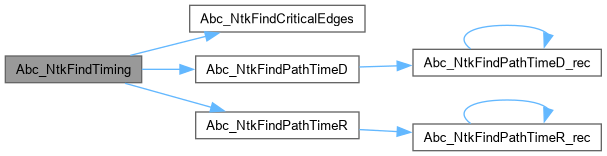
◆ Abc_NtkFindTiming()

int Abc_NtkFindTiming ( Abc_LutCas_t * p)

Definition at line 1130 of file abcCas.c.

1131{
1132 int Delay0 = Abc_NtkFindPathTimeD( p );
1133 int Delay1 = Abc_NtkFindPathTimeR( p );
1134 assert( Delay0 == Delay1 );
1135 p->DelayMax = Delay0;
1137 return Delay0;
1138}
int Abc_NtkFindPathTimeR(Abc_LutCas_t *p)
Definition abcCas.c:1100
int Abc_NtkFindPathTimeD(Abc_LutCas_t *p)
Definition abcCas.c:1071
void Abc_NtkFindCriticalEdges(Abc_LutCas_t *p)
Definition abcCas.c:1114
Here is the call graph for this function:
Here is the caller graph for this function:

◆ Abc_NtkLutCascade()

Abc_Ntk_t * Abc_NtkLutCascade ( Abc_Ntk_t * pNtk,
int nLutSize,
int nStages,
int nRails,
int nIters,
int fVerbose )

Definition at line 878 of file abcCas.c.
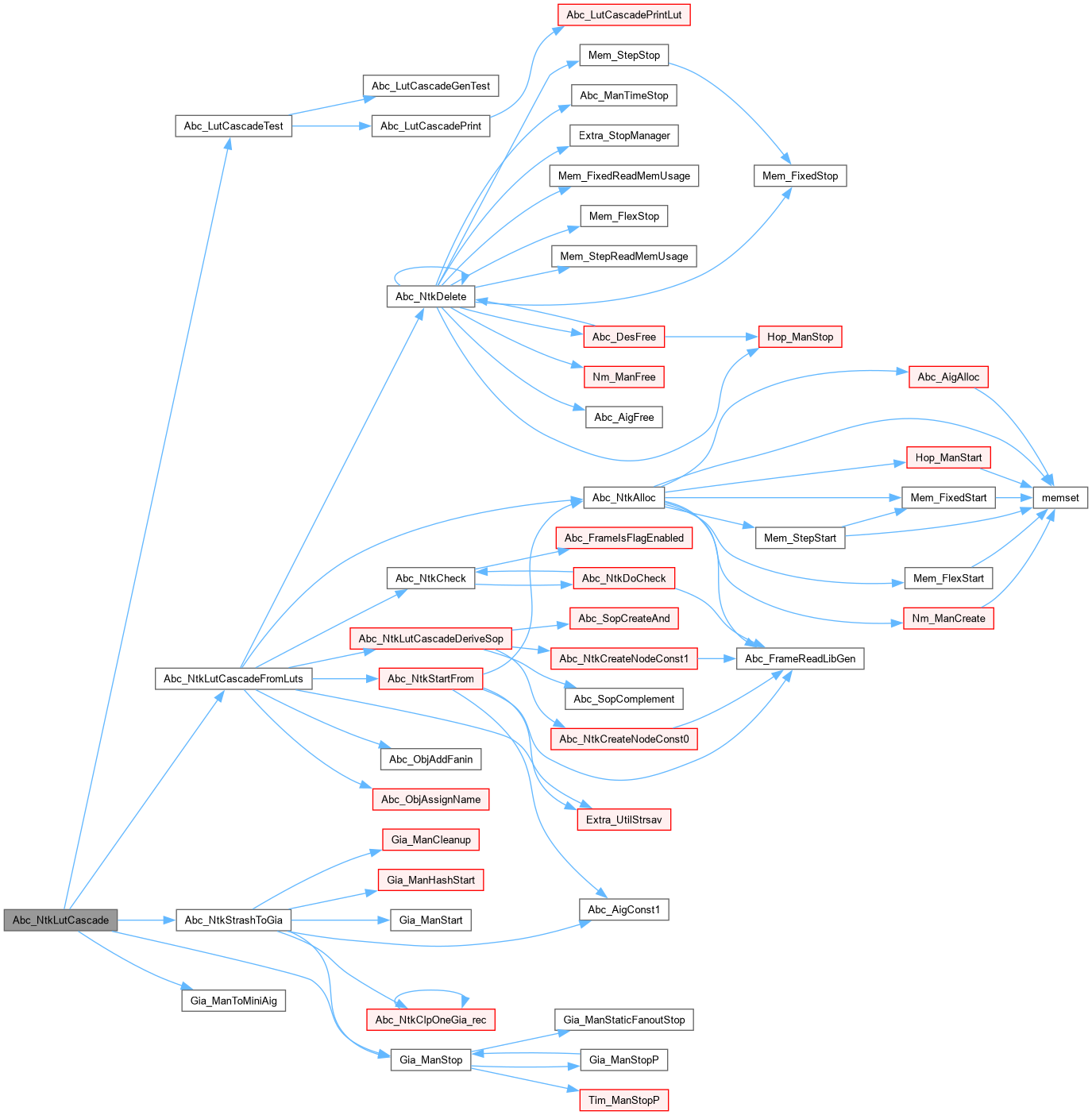
879{
880 extern Gia_Man_t * Abc_NtkStrashToGia( Abc_Ntk_t * pNtk );
881 extern Mini_Aig_t * Gia_ManToMiniAig( Gia_Man_t * pGia );
882 //extern word * Abc_LutCascade( Mini_Aig_t * p, int nLutSize, int nStages, int nRails, int nIters, int fVerbose );
883 Gia_Man_t * pGia = Abc_NtkStrashToGia( pNtk );
884 Mini_Aig_t * pM = Gia_ManToMiniAig( pGia );
885 //word * pLuts = Abc_LutCascade( pM, nLutSize, nStages, nRails, nIters, fVerbose );
886 word * pLuts = Abc_LutCascadeTest( pM, nLutSize, 0 );
887 Abc_Ntk_t * pNew = pLuts ? Abc_NtkLutCascadeFromLuts( pLuts, Abc_NtkCiNum(pNtk), pNtk, nLutSize, fVerbose ) : NULL;
888 ABC_FREE( pLuts );
889 Mini_AigStop( pM );
890 Gia_ManStop( pGia );
891 return pNew;
892}
word * Abc_LutCascadeTest(Mini_Aig_t *p, int nLutSize, int fVerbose)
Definition abcCas.c:557
Abc_Ntk_t * Abc_NtkLutCascadeFromLuts(word *pLuts, int nVars, Abc_Ntk_t *pNtk, int nLutSize, int fVerbose)
Definition abcCas.c:830
Gia_Man_t * Abc_NtkStrashToGia(Abc_Ntk_t *pNtk)
Definition abcUtil.c:3214
struct Abc_Ntk_t_ Abc_Ntk_t
Definition abc.h:115
Mini_Aig_t * Gia_ManToMiniAig(Gia_Man_t *pGia)
Definition giaMini.c:118
void Gia_ManStop(Gia_Man_t *p)
Definition giaMan.c:82
struct Gia_Man_t_ Gia_Man_t
Definition gia.h:96
struct Mini_Aig_t_ Mini_Aig_t
BASIC TYPES ///.
Definition miniaig.h:48
Here is the call graph for this function:

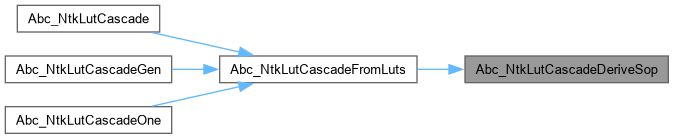
◆ Abc_NtkLutCascadeDeriveSop()

Abc_Obj_t * Abc_NtkLutCascadeDeriveSop ( Abc_Ntk_t * pNtkNew,
Abc_Obj_t * pNodeNew,
word * pT,
int nIns,
Vec_Int_t * vCover )

Function*************************************************************

Synopsis []

Description []

SideEffects []

SeeAlso []

Definition at line 814 of file abcCas.c.
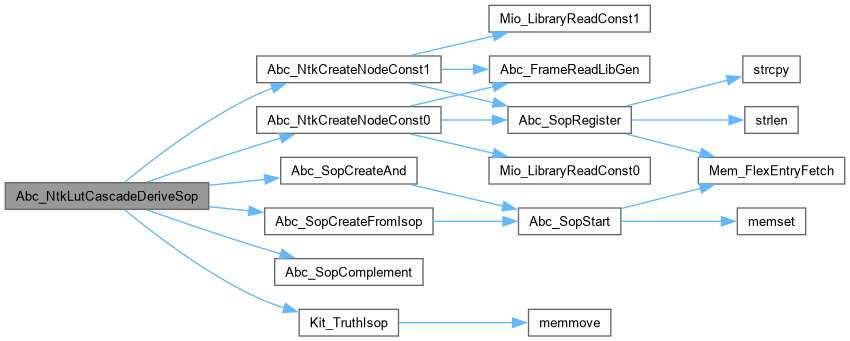
815{
816 int RetValue = Kit_TruthIsop( (unsigned *)pT, nIns, vCover, 1 );
817 assert( RetValue == 0 || RetValue == 1 );
818 if ( Vec_IntSize(vCover) == 0 || (Vec_IntSize(vCover) == 1 && Vec_IntEntry(vCover,0) == 0) ) {
819 assert( RetValue == 0 );
820 pNodeNew->pData = Abc_SopCreateAnd( (Mem_Flex_t *)pNtkNew->pManFunc, nIns, NULL );
821 return (Vec_IntSize(vCover) == 0) ? Abc_NtkCreateNodeConst0(pNtkNew) : Abc_NtkCreateNodeConst1(pNtkNew);
822 }
823 else {
824 char * pSop = Abc_SopCreateFromIsop( (Mem_Flex_t *)pNtkNew->pManFunc, nIns, vCover );
825 if ( RetValue ) Abc_SopComplement( (char *)pSop );
826 pNodeNew->pData = pSop;
827 return pNodeNew;
828 }
829}
ABC_DLL Abc_Obj_t * Abc_NtkCreateNodeConst1(Abc_Ntk_t *pNtk)
Definition abcObj.c:643
ABC_DLL Abc_Obj_t * Abc_NtkCreateNodeConst0(Abc_Ntk_t *pNtk)
Definition abcObj.c:612
ABC_DLL void Abc_SopComplement(char *pSop)
Definition abcSop.c:648
ABC_DLL char * Abc_SopCreateAnd(Mem_Flex_t *pMan, int nVars, int *pfCompl)
Definition abcSop.c:168
ABC_DLL char * Abc_SopCreateFromIsop(Mem_Flex_t *pMan, int nVars, Vec_Int_t *vCover)
Definition abcSop.c:424
int Kit_TruthIsop(unsigned *puTruth, int nVars, Vec_Int_t *vMemory, int fTryBoth)
Definition kitIsop.c:134
struct Mem_Flex_t_ Mem_Flex_t
Definition mem.h:34
void * pManFunc
Definition abc.h:191
void * pData
Definition abc.h:145
Here is the call graph for this function:
Here is the caller graph for this function:

◆ Abc_NtkLutCascadeDumpResults()

void Abc_NtkLutCascadeDumpResults ( char * pDumpFile,
char * pTest,
int Nodes,
int Edges,
int Levs,
int DelStart,
int DelStop,
float DelRatio,
int EdgesUsed,
float EdgeRatio,
int Cascs,
float AveLength,
abctime time )

Definition at line 1327 of file abcCas.c.

1328{
1329 FILE * pTable = fopen( pDumpFile, "a+" );
1330 fprintf( pTable, "%s,", pTest+28 );
1331 fprintf( pTable, "%d,", Nodes );
1332 fprintf( pTable, "%d,", Edges );
1333 fprintf( pTable, "%d,", Levs );
1334 fprintf( pTable, "%d,", DelStart );
1335 fprintf( pTable, "%d,", DelStop );
1336 fprintf( pTable, "%.2f,", DelRatio );
1337 fprintf( pTable, "%d,", EdgesUsed );
1338 fprintf( pTable, "%.2f,", EdgeRatio );
1339 fprintf( pTable, "%d,", Cascs );
1340 fprintf( pTable, "%.1f,", AveLength );
1341 fprintf( pTable, "%.2f,", 1.0*((double)(time))/((double)CLOCKS_PER_SEC) );
1342 fprintf( pTable, "\n" );
1343 fclose( pTable );
1344}

◆ Abc_NtkLutCascadeFile()

void Abc_NtkLutCascadeFile ( char * pFileName,
int nVarsOrig,
int nLutSize,
int nStages,
int nRails,
int nIters,
int nJRatio,
int nZParam,
int Seed,
int fVerbose,
int fVeryVerbose,
int fPrintMyu,
int fPrintLev,
int fXRail )

Function*************************************************************

Synopsis []

Description []

SideEffects []

SeeAlso []

Definition at line 1437 of file abcCas.c.
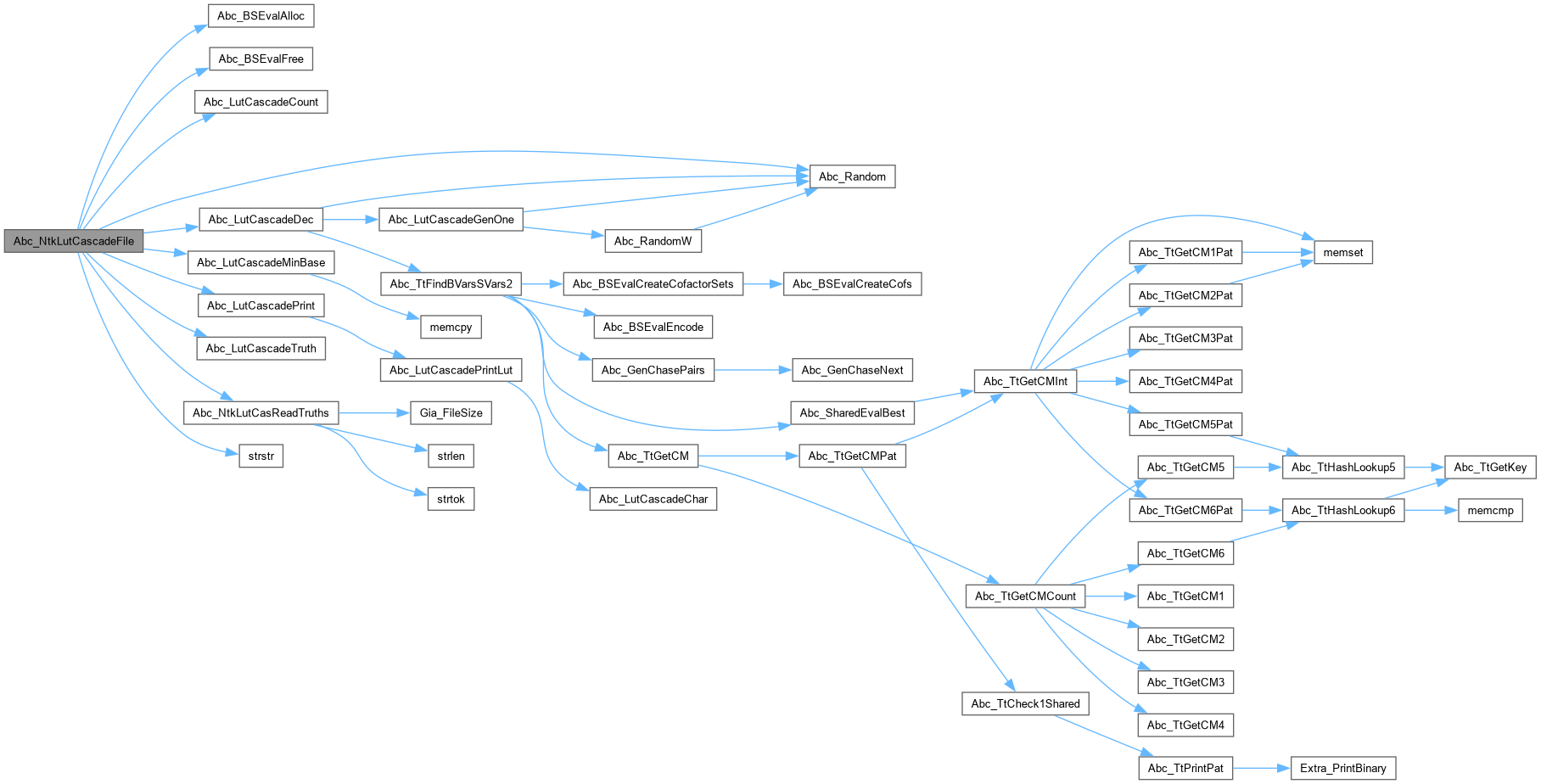
1438{
1439 abctime clkStart = Abc_Clock();
1440 int i, nErrors = 0, Sum = 0, nStageCount = 0, MyuMin = 0, nTotalLuts = 0, nWords = Abc_TtWordNum(nVarsOrig);
1441 Vec_Wrd_t * vTruths = NULL;
1442 if ( strstr(pFileName, ".txt") )
1443 vTruths = Abc_NtkLutCasReadTruths( pFileName, nVarsOrig );
1444 else
1445 vTruths = Vec_WrdReadBin( pFileName, 0 );
1446 if ( vTruths == NULL )
1447 return;
1448
1449 int nFuncs = Vec_WrdSize(vTruths)/nWords;
1450 if ( Vec_WrdSize(vTruths) != nFuncs * nWords ) {
1451 printf( "The files size (%d bytes) does not match the truth table size (%d) for the given number of functions (%d).\n", 8*Vec_WrdSize(vTruths), 8*nWords, nFuncs );
1452 Vec_WrdFree( vTruths );
1453 return;
1454 }
1455
1456 Abc_Random(1);
1457 for ( i = 0; i < Seed; i++ )
1458 Abc_Random(0);
1459 printf( "Considering %d functions having %d variables from file \"%s\".\n", nFuncs, nVarsOrig, pFileName );
1460 word * pCopy = ABC_ALLOC( word, nWords );
1461 int Iter = 0, IterReal = 0, LutStats[50] = {0}, StageStats[50] = {0}, MyuStats[50] = {0};
1463 for ( i = 0; i < nFuncs; i++ )
1464 {
1465 word * pTruth = Vec_WrdEntryP( vTruths, i*nWords );
1466 Abc_TtCopy( pCopy, pTruth, nWords, 0 );
1467
1468 if ( fVeryVerbose )
1469 printf( "\n" );
1470 if ( fVerbose || fVeryVerbose )
1471 printf( "Function %4d : ", i );
1472 if ( fVeryVerbose )
1473 Abc_TtPrintHexRev( stdout, pTruth, nVarsOrig ), printf( "\n" );
1474 //continue;
1475
1476 int nVars = -1;
1477 Vec_Int_t * vVarIDs = Vec_IntStartNatural( nVarsOrig );
1478 Abc_TtMinimumBase( pTruth, Vec_IntArray(vVarIDs), nVarsOrig, &nVars );
1479 Vec_IntShrink( vVarIDs, nVars );
1480 if ( fVeryVerbose ) {
1481 if ( nVarsOrig != nVars )
1482 printf( "The support of the function is reduced from %d to %d variables.\n", nVarsOrig, nVars );
1483 printf( "Decomposing %d-var function into %d-rail cascade of %d-LUTs.\n", nVars, nRails, nLutSize );
1484 }
1485
1486 word * pLuts = Abc_LutCascadeDec( p, NULL, pTruth, nVarsOrig, vVarIDs, nRails, nLutSize, nStages, (int)(Iter >= 0), nZParam, fXRail, fVeryVerbose, &nStageCount, &MyuMin );
1487 Vec_IntFree( vVarIDs );
1488 if ( MyuMin < 50 ) MyuStats[MyuMin]++, IterReal++;
1489 if ( pLuts == NULL ) {
1490 if ( ++Iter < nIters ) {
1491 i--;
1492 continue;
1493 }
1494 Iter = 0;
1495 if ( fVerbose || fVeryVerbose )
1496 printf( "Not decomposable.\n" );
1497 continue;
1498 }
1499 Iter = 0;
1500 Sum++;
1501 nTotalLuts += Abc_LutCascadeCount(pLuts);
1502 if ( Abc_LutCascadeCount(pLuts) < 50 )
1503 LutStats[Abc_LutCascadeCount(pLuts)]++;
1504 if ( nStageCount < 50) StageStats[nStageCount]++;
1505 Abc_LutCascadeMinBase( pLuts, nVarsOrig );
1506 word * pTruth2 = Abc_LutCascadeTruth( pLuts, nVarsOrig );
1507 if ( fVeryVerbose )
1508 Abc_LutCascadePrint( pLuts, nLutSize );
1509 if ( fVerbose || fVeryVerbose )
1510 printf( "Decomposition exists. " );
1511 if ( !Abc_TtEqual(pCopy, pTruth2, nWords) ) {
1512 if ( fVerbose || fVeryVerbose ) printf( "Verification FAILED for function %d.\n", i );
1513 if ( fVerbose || fVeryVerbose ) { printf( "Before: " ); Abc_TtPrintHexRev( stdout, pCopy, nVarsOrig ), printf( "\n" ); }
1514 if ( fVerbose || fVeryVerbose ) { printf( "After: " ); Abc_TtPrintHexRev( stdout, pTruth2, nVarsOrig ), printf( "\n" ); }
1515 nErrors++;
1516 }
1517 else if ( fVerbose || fVeryVerbose )
1518 printf( "Verification passed.\n" );
1519 ABC_FREE( pTruth2 );
1520 ABC_FREE( pLuts );
1521 }
1522 Abc_BSEvalFree( p );
1523 ABC_FREE( pCopy );
1524 Vec_WrdFree( vTruths );
1525 if ( fPrintMyu ) {
1526 printf( "Column multiplicity statistics for %d-rail LUT cascade:\n", nRails );
1527 for ( i = 0; i < 50; i++ )
1528 if ( MyuStats[i] )
1529 printf( " %2d Myu : Function count = %8d (%6.2f %%)\n", i, MyuStats[i], 100.0*MyuStats[i]/Abc_MaxInt(1, nFuncs)/IterReal );
1530 }
1531 if ( fPrintLev ) {
1532 printf( "Level count statistics for %d-rail LUT cascade:\n", nRails );
1533 for ( i = 0; i < 50; i++ )
1534 if ( StageStats[i] )
1535 printf( " %2d level : Function count = %8d (%6.2f %%)\n", i, StageStats[i], 100.0*StageStats[i]/Abc_MaxInt(1, nFuncs) );
1536 }
1537 printf( "LUT count statistics for %d-rail LUT cascade:\n", nRails );
1538 for ( i = 0; i < 50; i++ )
1539 if ( LutStats[i] )
1540 printf( " %2d LUT%d : Function count = %8d (%6.2f %%)\n", i, nLutSize, LutStats[i], 100.0*LutStats[i]/Abc_MaxInt(1, nFuncs) );
1541 printf( "Non-decomp : Function count = %8d (%6.2f %%)\n", nFuncs-Sum, 100.0*(nFuncs-Sum)/Abc_MaxInt(1, nFuncs) );
1542 if ( nErrors ) printf( "Verification ***FAILED*** for %d functions (%6.2f %%)\n", nErrors, 100.0*nErrors/Abc_MaxInt(1, nFuncs) );
1543 printf( "Finished %d functions (%.2f LUTs / function; %.2f functions / sec). ",
1544 nFuncs, 1.0*nTotalLuts/Sum, 1.0*nFuncs/(((double)(Abc_Clock() - clkStart))/((double)CLOCKS_PER_SEC)) );
1545 Abc_PrintTime( 0, "Total time", Abc_Clock() - clkStart );
1546}
void Abc_LutCascadeMinBase(word *pLuts, int nVars)
Definition abcCas.c:533
void Abc_BSEvalFree(Abc_BSEval_t *p)
Definition utilBSet.c:565
int Abc_LutCascadeCount(word *pLuts)
Definition abcCas.c:553
Abc_BSEval_t * Abc_BSEvalAlloc()
Definition utilBSet.c:556
word * Abc_LutCascadeTruth(word *pLuts, int nVars)
Definition abcCas.c:501
Vec_Wrd_t * Abc_NtkLutCasReadTruths(char *pFileName, int nVarsOrig)
Definition abcCas.c:1390
word * Abc_LutCascadeDec(Abc_BSEval_t *p, char *pGuide, word *pTruth, int nVarsOrig, Vec_Int_t *vVarIDs, int nRails, int nLutSize, int nStages, int fUseRand, int nZParam, int fXRail, int fVerbose, int *pnStages, int *pMyu)
Definition abcCas.c:745
ABC_INT64_T abctime
Definition abc_global.h:332
char * strstr()
Here is the call graph for this function:

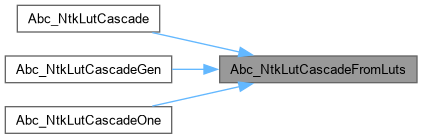
◆ Abc_NtkLutCascadeFromLuts()

Abc_Ntk_t * Abc_NtkLutCascadeFromLuts ( word * pLuts,
int nVars,
Abc_Ntk_t * pNtk,
int nLutSize,
int fVerbose )

Definition at line 830 of file abcCas.c.
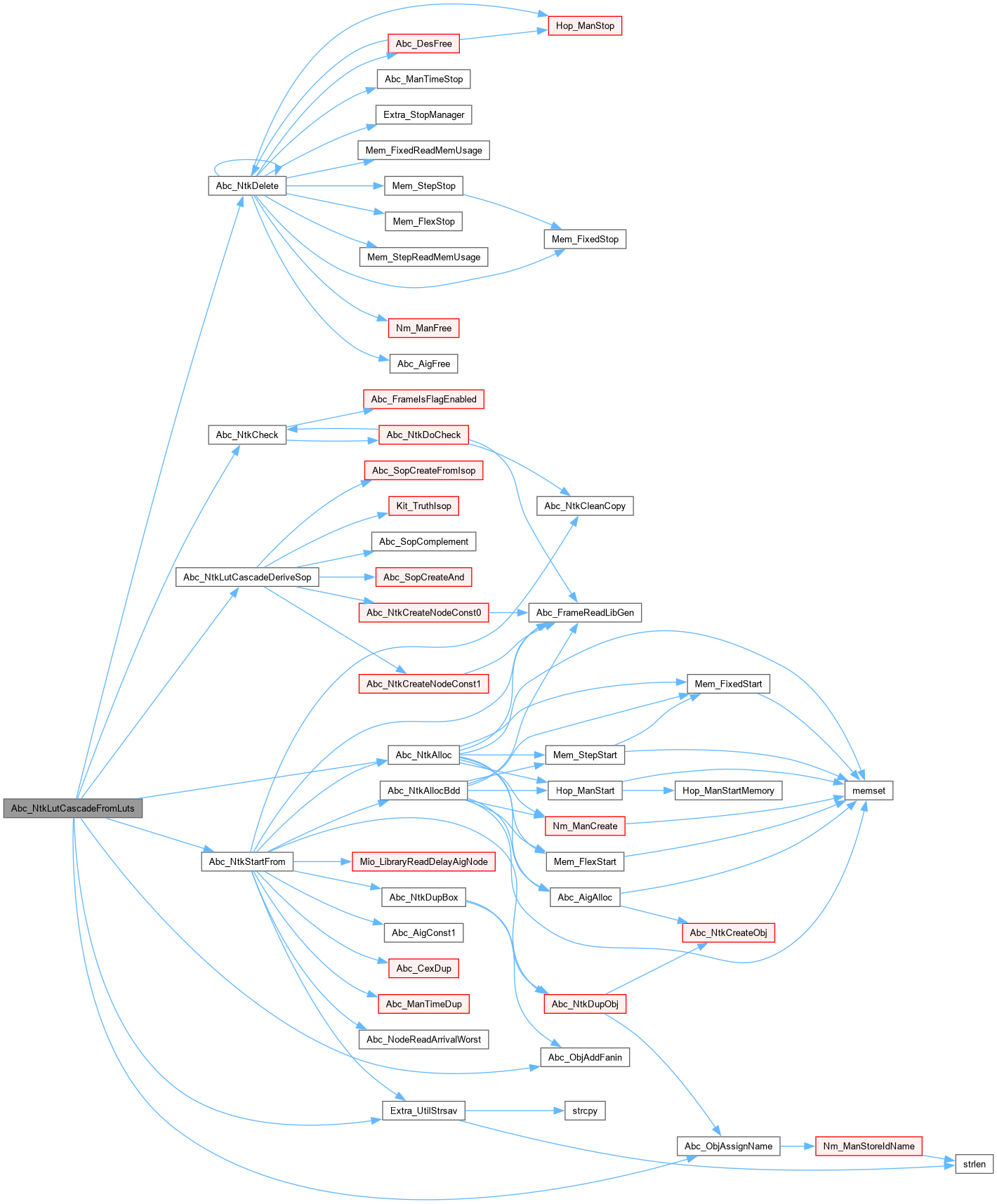
831{
832 Abc_Ntk_t * pNtkNew = NULL;
833 Abc_Obj_t * pObj; int Id; char pName[2] = {0};
834 Vec_Ptr_t * vCopy = Vec_PtrStart( nVars + pLuts[0] + 1000 );
835 if ( pNtk ) {
836 pNtkNew = Abc_NtkStartFrom( pNtk, ABC_NTK_LOGIC, ABC_FUNC_SOP );
837 }
838 else {
839 pNtkNew = Abc_NtkAlloc( ABC_NTK_LOGIC, ABC_FUNC_SOP , 0 );
840 pNtkNew->pName = Extra_UtilStrsav("cas");
841 //pNtkNew->pSpec = Extra_UtilStrsav(pNtk->pSpec);
842 for ( Id = 0; Id < nVars; Id++ ) {
843 pObj = Abc_NtkCreatePi(pNtkNew);
844 pName[0] = 'a' + Id;
845 Abc_ObjAssignName( pObj, pName, NULL );
846 }
847 pObj = Abc_NtkCreatePo(pNtkNew);
848 Abc_ObjAssignName( pObj, "Out", NULL );
849 }
850 Abc_NtkForEachCi( pNtkNew, pObj, Id )
851 Vec_PtrWriteEntry( vCopy, Id, pObj );
852 Vec_Int_t * vCover = Vec_IntAlloc( 1000 );
853 word n, i, k, iLastLut = -1;
854 for ( n = 0, i = 1; n < pLuts[0]; n++, i += pLuts[i] )
855 {
856 word nIns = pLuts[i+1];
857 word * pIns = pLuts+i+2;
858 word * pT = pLuts+i+2+nIns+1;
859 Abc_Obj_t * pNodeNew = Abc_NtkCreateNode( pNtkNew );
860 for ( k = 0; k < nIns; k++ )
861 Abc_ObjAddFanin( pNodeNew, (Abc_Obj_t *)Vec_PtrEntry(vCopy, pIns[k]) );
862 Abc_Obj_t * pObjNew = Abc_NtkLutCascadeDeriveSop( pNtkNew, pNodeNew, pT, nIns, vCover );
863 Vec_PtrWriteEntry( vCopy, pIns[nIns], pObjNew );
864 iLastLut = pIns[nIns];
865 }
866 Vec_IntFree( vCover );
867 assert( Abc_NtkCoNum(pNtkNew) == 1 );
868 Abc_ObjAddFanin( Abc_NtkCo(pNtkNew, 0), (Abc_Obj_t *)Vec_PtrEntry(vCopy, iLastLut) );
869 Vec_PtrFree( vCopy );
870 if ( !Abc_NtkCheck( pNtkNew ) )
871 {
872 printf( "Abc_NtkLutCascadeFromLuts: The network check has failed.\n" );
873 Abc_NtkDelete( pNtkNew );
874 return NULL;
875 }
876 return pNtkNew;
877}
Abc_Obj_t * Abc_NtkLutCascadeDeriveSop(Abc_Ntk_t *pNtkNew, Abc_Obj_t *pNodeNew, word *pT, int nIns, Vec_Int_t *vCover)
Definition abcCas.c:814
ABC_DLL Abc_Ntk_t * Abc_NtkAlloc(Abc_NtkType_t Type, Abc_NtkFunc_t Func, int fUseMemMan)
DECLARATIONS ///.
Definition abcNtk.c:53
ABC_DLL void Abc_ObjAddFanin(Abc_Obj_t *pObj, Abc_Obj_t *pFanin)
Definition abcFanio.c:84
ABC_DLL int Abc_NtkCheck(Abc_Ntk_t *pNtk)
FUNCTION DEFINITIONS ///.
Definition abcCheck.c:64
@ ABC_NTK_LOGIC
Definition abc.h:57
ABC_DLL void Abc_NtkDelete(Abc_Ntk_t *pNtk)
Definition abcNtk.c:1421
@ ABC_FUNC_SOP
Definition abc.h:65
ABC_DLL Abc_Ntk_t * Abc_NtkStartFrom(Abc_Ntk_t *pNtk, Abc_NtkType_t Type, Abc_NtkFunc_t Func)
Definition abcNtk.c:157
char * Extra_UtilStrsav(const char *s)
char * pName
Definition abc.h:158
typedefABC_NAMESPACE_HEADER_START struct Vec_Ptr_t_ Vec_Ptr_t
INCLUDES ///.
Definition vecPtr.h:42
Here is the call graph for this function:
Here is the caller graph for this function:

◆ Abc_NtkLutCascadeGen()

Abc_Ntk_t * Abc_NtkLutCascadeGen ( int nLutSize,
int nStages,
int nRails,
int nShared,
int fVerbose )

Definition at line 949 of file abcCas.c.
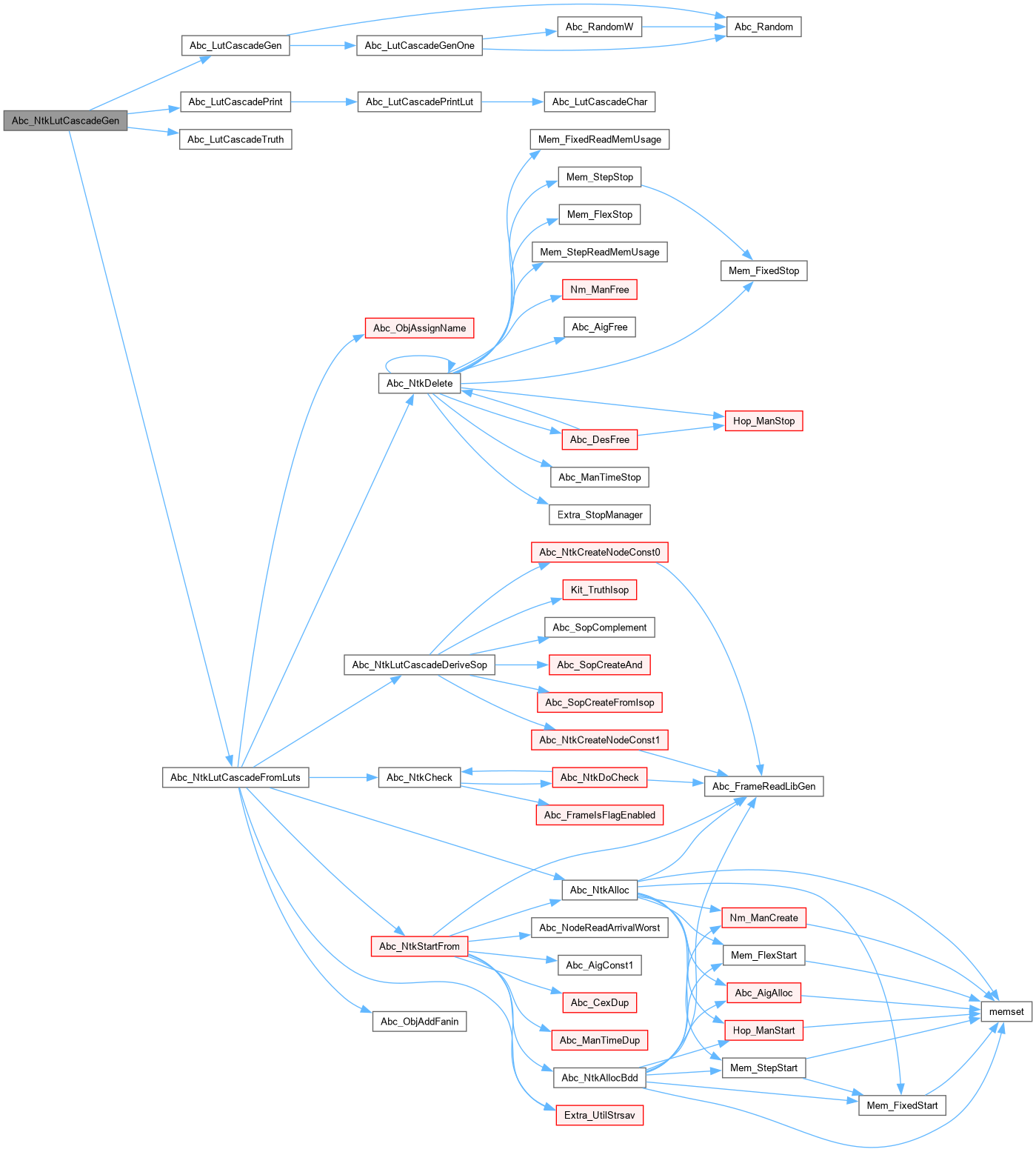
950{
951 int nVars = nStages * nLutSize - (nStages-1) * (nRails + nShared);
952 word * pLuts = Abc_LutCascadeGen( nVars, nLutSize, nRails, nShared );
953 Abc_Ntk_t * pNew = Abc_NtkLutCascadeFromLuts( pLuts, nVars, NULL, nLutSize, fVerbose );
954 Abc_LutCascadePrint( pLuts, nLutSize );
955 if ( fVerbose ) {
956 word * pTruth = Abc_LutCascadeTruth( pLuts, nVars );
957 if ( nVars <= 10 ) {
958 printf( "Function: "); Abc_TtPrintHexRev( stdout, pTruth, nVars ); printf( "\n" );
959 }
960 ABC_FREE( pTruth );
961 }
962 ABC_FREE( pLuts );
963 return pNew;
964}
word * Abc_LutCascadeGen(int nVars, int nLutSize, int nRails, int nShared)
Definition abcCas.c:431
Here is the call graph for this function:

◆ Abc_NtkLutCascadeMap()

Abc_Ntk_t * Abc_NtkLutCascadeMap ( Abc_Ntk_t * pNtk,
int nLutsMax,
int nIters,
int fDelayLut,
int fDelayRoute,
int fDelayDirect,
int fVerbose )

Definition at line 1346 of file abcCas.c.
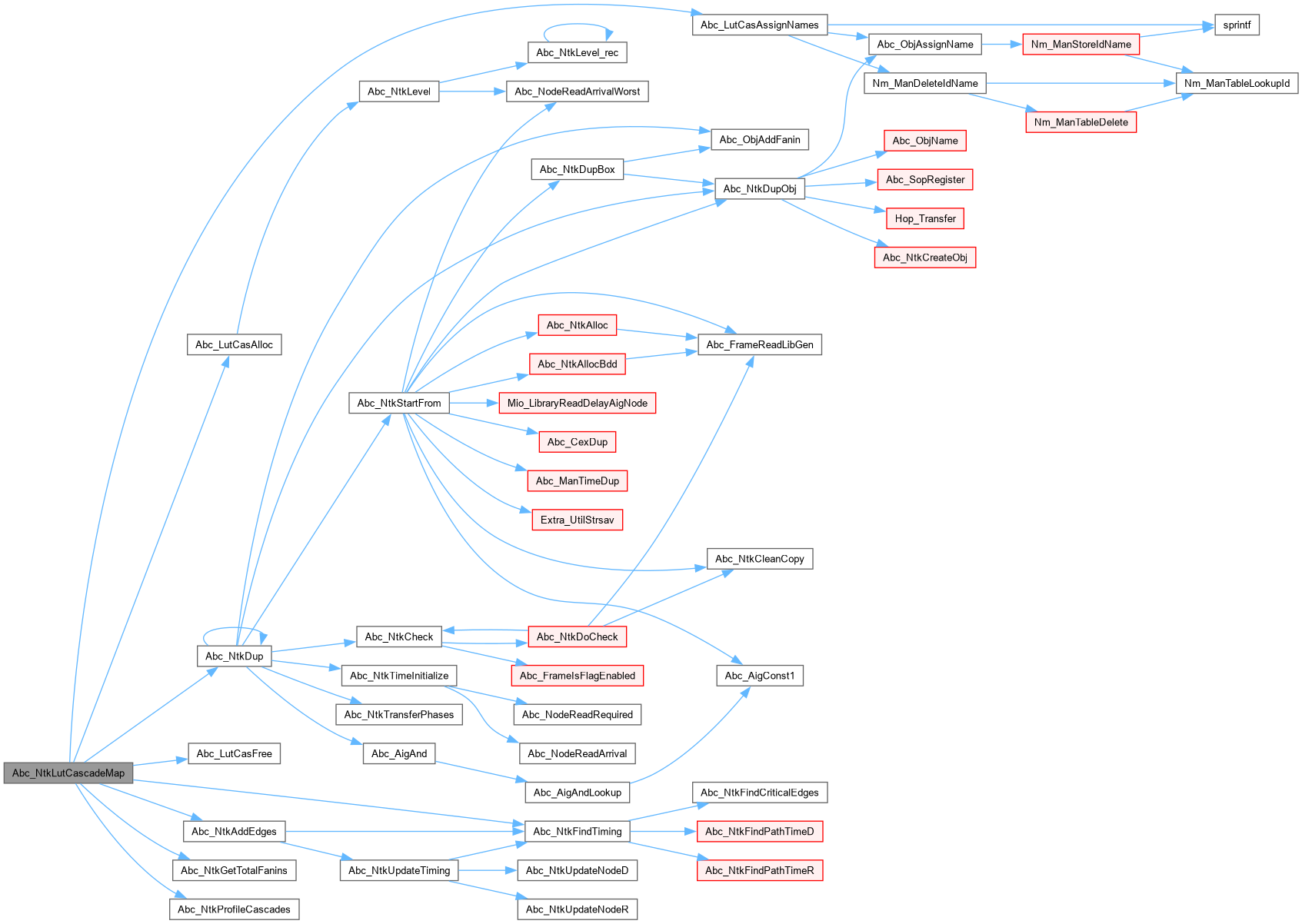
1347{
1348 abctime clk = Abc_Clock();
1349 Abc_Ntk_t * pNtkNew = NULL;
1350 Abc_LutCas_t * p = Abc_LutCasAlloc( pNtk, nLutsMax, nIters, fDelayLut, fDelayRoute, fDelayDirect, fVerbose );
1351 int i, IterBest = 0, DelayStart = Abc_NtkFindTiming( p ), DelayBest = DelayStart, nEdges = Abc_NtkGetTotalFanins(pNtk);
1352 //printf( "Delays: LUT (%d) Route (%d) Direct (%d). Iters = %d. LUTs = %d.\n", fDelayLut, fDelayRoute, fDelayDirect, nIters, Abc_NtkNodeNum(pNtk) );
1353 Vec_IntFill( p->vTraceBest, Abc_NtkNodeNum(pNtk), 0 );
1354 for ( i = 0; i < nIters; i++ )
1355 {
1356 if ( fVerbose )
1357 printf( "ITERATION %2d:\n", i );
1358 float Delay = Abc_NtkAddEdges( p );
1359 if ( DelayBest < Delay || (DelayBest == Delay && Vec_IntSize(p->vTraceBest) <= Vec_IntSize(p->vTrace)) )
1360 continue;
1361 IterBest = i;
1362 DelayBest = Delay;
1363 ABC_SWAP( Vec_Int_t *, p->vTrace, p->vTraceBest );
1364 }
1365 printf( "Delay reduction %d -> %d (-%.2f %%) is found after iter %d with %d edges (%.2f %%). ",
1366 DelayStart, DelayBest, 100.0*(DelayStart - DelayBest)/DelayStart, IterBest, Vec_IntSize(p->vTraceBest)/2, 50.0*Vec_IntSize(p->vTraceBest)/nEdges );
1367 Abc_PrintTime( 1, "Time", Abc_Clock() - clk );
1368 Vec_Wec_t * vCascs = Abc_NtkProfileCascades( p->pNtk, p->vTraceBest );
1369// Abc_NtkLutCascadeDumpResults( "stats.csv", pNtk->pName, Abc_NtkNodeNum(pNtk), nEdges, Abc_NtkLevel(pNtk), DelayStart, DelayBest, 100.0*(DelayStart - DelayBest)/DelayStart,
1370// Vec_IntSize(p->vTraceBest)/2, 50.0*Vec_IntSize(p->vTraceBest)/nEdges, Vec_WecSize(vCascs), 0.5*Vec_IntSize(p->vTraceBest)/Abc_MaxInt(1, Vec_WecSize(vCascs)), Abc_Clock() - clk );
1371 Abc_LutCasFree( p );
1372 pNtkNew = Abc_NtkDup( pNtk );
1373 Abc_LutCasAssignNames( pNtk, pNtkNew, vCascs );
1374 Vec_WecFree( vCascs );
1375 return pNtkNew;
1376}
void Abc_LutCasFree(Abc_LutCas_t *p)
Definition abcCas.c:1028
Abc_LutCas_t * Abc_LutCasAlloc(Abc_Ntk_t *pNtk, int nLutsMax, int nIters, int fDelayLut, int fDelayRoute, int fDelayDirect, int fVerbose)
Definition abcCas.c:1004
Vec_Wec_t * Abc_NtkProfileCascades(Abc_Ntk_t *pNtk, Vec_Int_t *vTrace)
Definition abcCas.c:1273
void Abc_LutCasAssignNames(Abc_Ntk_t *pNtk, Abc_Ntk_t *pNtkNew, Vec_Wec_t *vCascs)
Definition abcCas.c:1307
int Abc_NtkAddEdges(Abc_LutCas_t *p)
Definition abcCas.c:1238
ABC_DLL Abc_Ntk_t * Abc_NtkDup(Abc_Ntk_t *pNtk)
Definition abcNtk.c:472
ABC_DLL int Abc_NtkGetTotalFanins(Abc_Ntk_t *pNtk)
Definition abcUtil.c:520
#define ABC_SWAP(Type, a, b)
Definition abc_global.h:253
typedefABC_NAMESPACE_HEADER_START struct Vec_Wec_t_ Vec_Wec_t
INCLUDES ///.
Definition vecWec.h:42
Here is the call graph for this function:

◆ Abc_NtkLutCascadeOne()

Abc_Ntk_t * Abc_NtkLutCascadeOne ( Abc_Ntk_t * pNtk,
int nLutSize,
int nStages,
int nRails,
int nIters,
int nJRatio,
int nZParam,
int fXRail,
int Seed,
int fVerbose,
int fVeryVerbose,
char * pGuide )

Definition at line 893 of file abcCas.c.
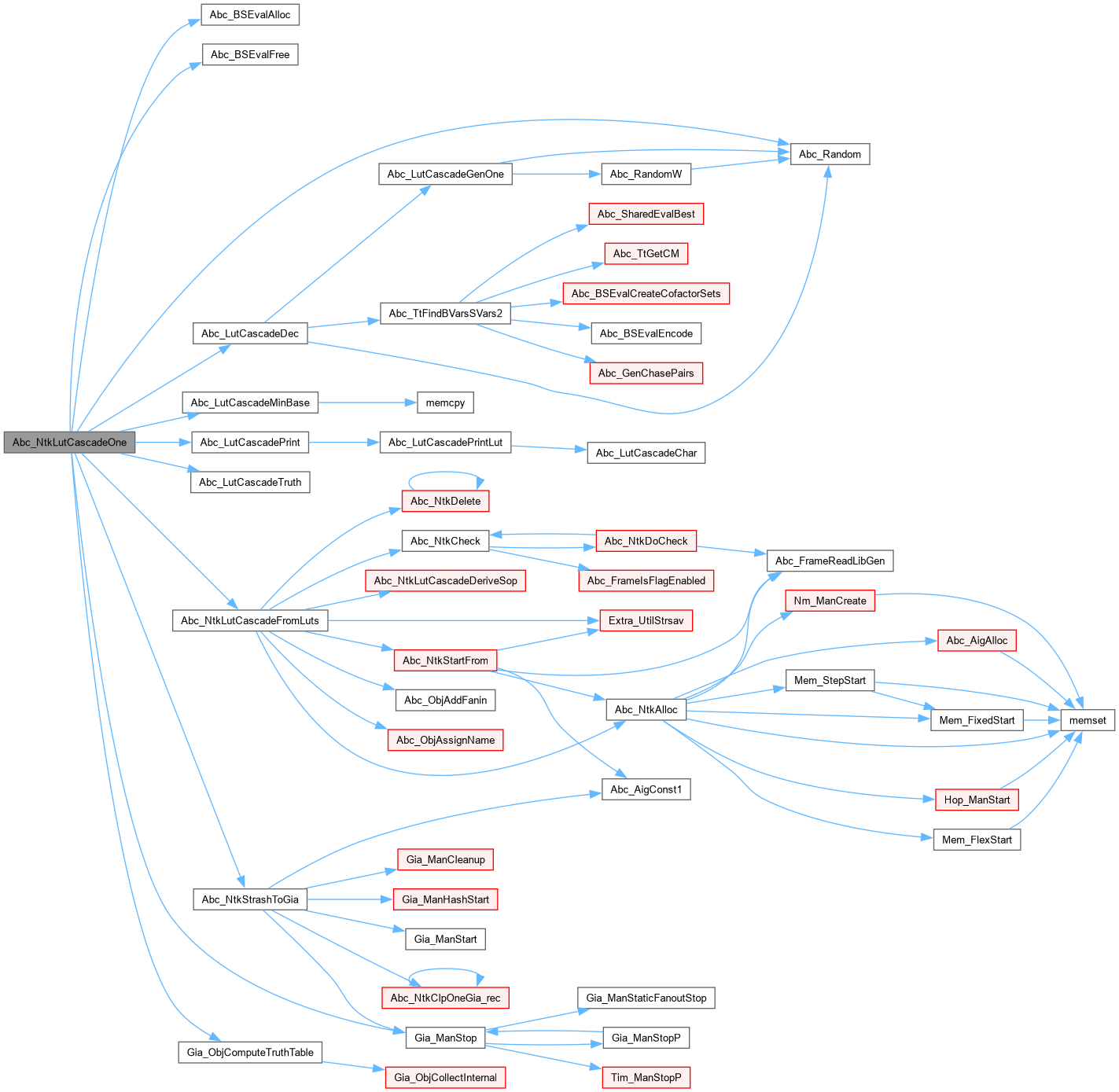
894{
895 extern Gia_Man_t * Abc_NtkStrashToGia( Abc_Ntk_t * pNtk );
896 int i, nWords = Abc_TtWordNum(Abc_NtkCiNum(pNtk));
897 word * pCopy = ABC_ALLOC( word, nWords );
898 Gia_Man_t * pGia = Abc_NtkStrashToGia( pNtk );
899 Abc_Ntk_t * pNew = NULL;
900 Abc_Random(1);
901 for ( i = 0; i < Seed; i++ )
902 Abc_Random(0);
904 for ( int Iter = 0; Iter < nIters; Iter++ ) {
905 word * pTruth1 = Gia_ObjComputeTruthTable( pGia, Gia_ManCo(pGia, 0) );
906 Abc_TtCopy( pCopy, pTruth1, nWords, 0 );
907
908 int nVars = -1;
909 Vec_Int_t * vVarIDs = Vec_IntStartNatural( Abc_NtkCiNum(pNtk) );
910 Abc_TtMinimumBase( pTruth1, Vec_IntArray(vVarIDs), Abc_NtkCiNum(pNtk), &nVars );
911 Vec_IntShrink( vVarIDs, nVars );
912 if ( fVerbose ) {
913 printf( "Iter %2d : ", Iter );
914 if ( Abc_NtkCiNum(pNtk) != nVars )
915 printf( "The support of the function is reduced from %d to %d variables.\n", Abc_NtkCiNum(pNtk), nVars );
916 printf( "Decomposing %d-var function into %d-rail cascade of %d-LUTs", nVars, nRails, nLutSize );
917 if ( pGuide )
918 printf( " using structural info: %s", pGuide );
919 printf( ".\n" );
920 }
921
922 word * pLuts = Abc_LutCascadeDec( p, pGuide, pTruth1, Abc_NtkCiNum(pNtk), vVarIDs, nRails, nLutSize, nStages, (int)(Iter >= 0), nZParam, fXRail, fVeryVerbose, NULL, NULL );
923 pNew = pLuts ? Abc_NtkLutCascadeFromLuts( pLuts, Abc_NtkCiNum(pNtk), pNtk, nLutSize, fVerbose ) : NULL;
924 Vec_IntFree( vVarIDs );
925
926 if ( pLuts ) {
927 Abc_LutCascadeMinBase( pLuts, Abc_NtkCiNum(pNtk) );
928 if ( fVerbose )
929 Abc_LutCascadePrint( pLuts, nLutSize );
930 word * pTruth2 = Abc_LutCascadeTruth( pLuts, Abc_NtkCiNum(pNtk) );
931 if ( !Abc_TtEqual(pCopy, pTruth2, nWords) ) {
932 printf( "Verification FAILED.\n" );
933 printf("Function before: "); Abc_TtPrintHexRev( stdout, pCopy, Abc_NtkCiNum(pNtk) ); printf( "\n" );
934 printf("Function after: "); Abc_TtPrintHexRev( stdout, pTruth2, Abc_NtkCiNum(pNtk) ); printf( "\n" );
935 }
936 else if ( fVerbose )
937 printf( "Verification passed.\n" );
938 ABC_FREE( pLuts );
939 ABC_FREE( pTruth2 );
940 break;
941 }
942 //ABC_FREE( pTruth1 );
943 }
944 Abc_BSEvalFree( p );
945 ABC_FREE( pCopy );
946 Gia_ManStop( pGia );
947 return pNew;
948}
word * Gia_ObjComputeTruthTable(Gia_Man_t *p, Gia_Obj_t *pObj)
Definition giaTruth.c:447
Here is the call graph for this function:

◆ Abc_NtkLutCasReadTruths()

Vec_Wrd_t * Abc_NtkLutCasReadTruths ( char * pFileName,
int nVarsOrig )

Function*************************************************************

Synopsis []

Description []

SideEffects []

SeeAlso []

Definition at line 1390 of file abcCas.c.
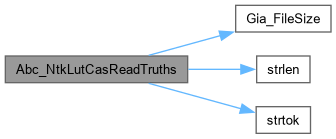
1391{
1392 Vec_Wrd_t * vTruths = NULL;
1393 int nWords = Abc_TtWordNum(nVarsOrig);
1394 int nFileSize = Gia_FileSize( pFileName );
1395 FILE * pFile = fopen( pFileName, "rb" );
1396 if ( pFile == NULL ) { printf("Cannot open file \"%s\" for reading.\n", pFileName); return NULL; }
1397 word * pTruth = ABC_ALLOC( word, 2*nWords );
1398 char * pToken, * pLine = ABC_ALLOC( char, nFileSize );
1399 for ( int i = 0; fgets(pLine, nFileSize, pFile); i++ ) {
1400 pToken = strtok(pLine, " ,\n\r\r");
1401 if ( pToken == NULL )
1402 continue;
1403 if ( pToken[0] == '0' && pToken[1] == 'x' )
1404 pToken += 2;
1405 if ( strlen(pToken) != (1 << (nVarsOrig-2)) ) {
1406 printf( "Line %d has truth table of size %d while expected size is %d.\n", i, (int)strlen(pToken), 1 << (nVarsOrig-2) );
1407 Vec_WrdFreeP( &vTruths );
1408 break;
1409 }
1410 if ( !Abc_TtReadHex( pTruth, pToken ) ) {
1411 printf( "Line %d has truth table that cannot be read correctly (%s).\n", i, pToken );
1412 Vec_WrdFreeP( &vTruths );
1413 break;
1414 }
1415 if ( vTruths == NULL )
1416 vTruths = Vec_WrdAlloc( 10000 );
1417 for ( int w = 0; w < nWords; w++ )
1418 Vec_WrdPush( vTruths, pTruth[w] );
1419 }
1420 ABC_FREE( pTruth );
1421 ABC_FREE( pLine );
1422 fclose( pFile );
1423 return vTruths;
1424}
int Gia_FileSize(char *pFileName)
FUNCTION DECLARATIONS ///.
Definition giaAiger.c:64
int strlen()
char * strtok()
Here is the call graph for this function:
Here is the caller graph for this function:

◆ Abc_NtkProfileCascades()

Vec_Wec_t * Abc_NtkProfileCascades ( Abc_Ntk_t * pNtk,
Vec_Int_t * vTrace )

Definition at line 1273 of file abcCas.c.

1274{
1275 Vec_Wec_t * vCasc = Vec_WecAlloc( 100 );
1276 Vec_Int_t * vMap = Vec_IntStart( Abc_NtkObjNumMax(pNtk) );
1277 Vec_Int_t * vPath = Vec_IntStart( Abc_NtkObjNumMax(pNtk) );
1278 Vec_Int_t * vCounts = Vec_IntStart( Abc_NtkObjNumMax(pNtk) );
1279 Abc_Obj_t * pObj; int i, Node, Fanin, Count, nCascs = 0;
1280 Vec_IntForEachEntryDouble( vTrace, Node, Fanin, i ) {
1281 assert( Vec_IntEntry(vPath, Node) == 0 );
1282 Vec_IntWriteEntry( vPath, Node, Fanin );
1283 Vec_IntWriteEntry( vMap, Fanin, 1 );
1284 }
1285 Abc_NtkForEachNode( pNtk, pObj, i ) {
1286 if ( Vec_IntEntry(vMap, pObj->Id) )
1287 continue;
1288 if ( Vec_IntEntry(vPath, pObj->Id) == 0 )
1289 continue;
1290 Vec_Int_t * vLevel = Vec_WecPushLevel( vCasc );
1291 Node = pObj->Id;
1292 Vec_IntPush( vLevel, Node );
1293 while ( (Node = Vec_IntEntry(vPath, Node)) )
1294 Vec_IntPush( vLevel, Node );
1295 Vec_IntAddToEntry( vCounts, Vec_IntSize(vLevel), 1 );
1296 }
1297 printf( "Cascades: " );
1298 Vec_IntForEachEntry( vCounts, Count, i )
1299 if ( Count )
1300 printf( "%d=%d ", i, Count ), nCascs += Count;
1301 printf( "\n" );
1302 Vec_IntFree( vMap );
1303 Vec_IntFree( vPath );
1304 Vec_IntFree( vCounts );
1305 return vCasc;
1306}
#define Vec_IntForEachEntryDouble(vVec, Entry1, Entry2, i)
Definition vecInt.h:72
Here is the caller graph for this function:

◆ Abc_NtkRandFile()

void Abc_NtkRandFile ( char * pFileName,
int nVars,
int nFuncs,
int nMints )

Function*************************************************************

Synopsis []

Description []

SideEffects []

SeeAlso []

Definition at line 1645 of file abcCas.c.
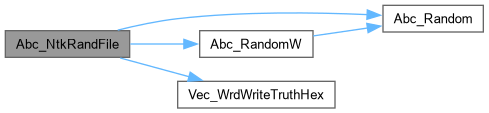
1646{
1647 int i, k, nWords = Abc_TtWordNum(nVars);
1648 Vec_Wrd_t * vTruths = Vec_WrdStart( nWords * nFuncs );
1649 Abc_Random(1);
1650 for ( i = 0; i < nFuncs; i++ ) {
1651 word * pTruth = Vec_WrdEntryP(vTruths, i*nWords);
1652 if ( nMints == 0 )
1653 for ( k = 0; k < nWords; k++ )
1654 pTruth[k] = Abc_RandomW(0);
1655 else {
1656 for ( k = 0; k < nMints; k++ ) {
1657 int iMint = 0;
1658 do iMint = Abc_Random(0) % (1 << nVars);
1659 while ( Abc_TtGetBit(pTruth, iMint) );
1660 Abc_TtSetBit( pTruth, iMint );
1661 }
1662 }
1663 }
1664 Vec_WrdWriteTruthHex( pFileName, vTruths, nVars );
1665 if ( nMints )
1666 printf( "Generated %d random %d-variable functions with %d positive minterms and dumped them into file \"%s\".\n",
1667 nFuncs, nVars, nMints, pFileName );
1668 else
1669 printf( "Generated %d random %d-variable functions and dumped them into file \"%s\".\n",
1670 nFuncs, nVars, pFileName );
1671 Vec_WrdFree( vTruths );
1672}
void Vec_WrdWriteTruthHex(char *pFileName, Vec_Wrd_t *vTruths, int nVars)
Definition abcCas.c:1559
Here is the call graph for this function:

◆ Abc_NtkSuppMinFile()

void Abc_NtkSuppMinFile ( char * pFileName)

Definition at line 1569 of file abcCas.c.
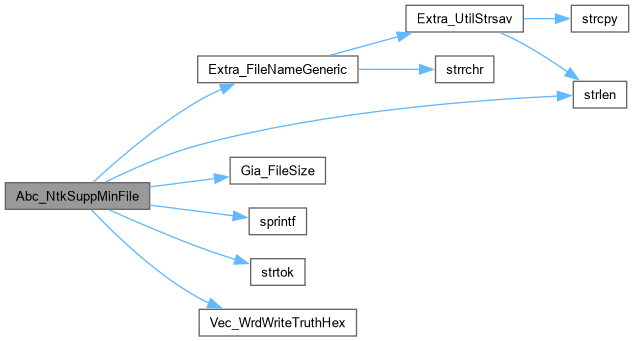
1570{
1571 int fError = 0, nFileSize = Gia_FileSize( pFileName );
1572 FILE * pFile = fopen( pFileName, "rb" );
1573 if ( pFile == NULL ) { printf("Cannot open file \"%s\" for reading.\n", pFileName); return; }
1574 Vec_Wrd_t ** pvTruths = ABC_CALLOC( Vec_Wrd_t *, 32 );
1575 char * pToken, * pLine = ABC_ALLOC( char, nFileSize );
1576 word * pTruth = ABC_ALLOC( word, nFileSize/16 );
1577 int Len, nVars = -1, nWords = -1, nFuncs = 0, nSuppSums[2] = {0};
1578 for ( int i = 0; fgets(pLine, nFileSize, pFile); i++ ) {
1579 pToken = strtok(pLine, " ,\n\r\r");
1580 if ( pToken == NULL )
1581 continue;
1582 if ( pToken[0] == '0' && pToken[1] == 'x' )
1583 pToken += 2;
1584 Len = strlen(pToken);
1585 nVars = Abc_Base2Log(Len);
1586 if ( Len != (1 << nVars) ) {
1587 printf( "The number of hex characters (%d) in the truth table listed in line %d is not a degree of 2.\n", Len, i );
1588 fError = 1;
1589 break;
1590 }
1591 nVars += 2;
1592 if ( !Abc_TtReadHex( pTruth, pToken ) ) {
1593 printf( "Line %d has truth table that cannot be read correctly (%s).\n", i, pToken );
1594 fError = 1;
1595 break;
1596 }
1597 nSuppSums[0] += nVars;
1598 Abc_TtMinimumBase( pTruth, NULL, nVars, &nVars );
1599 nSuppSums[1] += nVars;
1600 if ( pvTruths[nVars] == NULL )
1601 pvTruths[nVars] = Vec_WrdAlloc( 10000 );
1602 nWords = Abc_TtWordNum(nVars);
1603 for ( int w = 0; w < nWords; w++ )
1604 Vec_WrdPush( pvTruths[nVars], pTruth[w] );
1605 nFuncs++;
1606 }
1607 ABC_FREE( pTruth );
1608 ABC_FREE( pLine );
1609 fclose( pFile );
1610 if ( fError ) {
1611 for ( nVars = 0; nVars < 32; nVars++ )
1612 if ( pvTruths[nVars] )
1613 Vec_WrdFreeP( &pvTruths[nVars] );
1614 ABC_FREE( pvTruths );
1615 return;
1616 }
1617 // dump the resulting truth tables
1618 printf( "Read and support-minimized %d functions. Total support reduction %d -> %d (%.2f %%).\n",
1619 nFuncs, nSuppSums[0], nSuppSums[1], 100.0*(nSuppSums[0]-nSuppSums[1])/Abc_MaxInt(nSuppSums[0], 1) );
1620 printf( "The resulting function statistics:\n" );
1621 for ( nVars = 0; nVars < 32; nVars++ ) {
1622 if ( pvTruths[nVars] == NULL )
1623 continue;
1624 char pFileName2[1000];
1625 sprintf( pFileName2, "%s_%02d.txt", Extra_FileNameGeneric(pFileName), nVars );
1626 Vec_WrdWriteTruthHex( pFileName2, pvTruths[nVars], nVars );
1627 printf( "Support size %2d : Dumped %6d truth tables into file \"%s\".\n",
1628 nVars, Vec_WrdSize(pvTruths[nVars])/Abc_TtWordNum(nVars), pFileName2 );
1629 Vec_WrdFreeP( &pvTruths[nVars] );
1630 }
1631 ABC_FREE( pvTruths );
1632}
#define Len
Definition deflate.h:78
char * Extra_FileNameGeneric(char *FileName)
Here is the call graph for this function:

◆ Abc_NtkUpdateNodeD()

int Abc_NtkUpdateNodeD ( Abc_LutCas_t * p,
Abc_Obj_t * pObj )

Definition at line 1140 of file abcCas.c.

1141{
1142 Abc_Obj_t * pNext; int i; int Delay, DelayMax = 0;
1143 Abc_ObjForEachFanin( pObj, pNext, i ) {
1144 Delay = Vec_IntEntry( p->vTime[0], pNext->Id );
1145 Delay += Vec_IntEntry(p->vPath[0], pObj->Id) == pNext->Id ? p->fDelayDirect : p->fDelayRoute;
1146 DelayMax = Abc_MaxInt( DelayMax, Delay + p->fDelayLut );
1147 }
1148 int DelayOld = Vec_IntEntry( p->vTime[0], pObj->Id );
1149 Vec_IntWriteEntry( p->vTime[0], pObj->Id, DelayMax );
1150 assert( DelayOld >= DelayMax );
1151 return DelayOld > DelayMax;
1152}
Here is the caller graph for this function:

◆ Abc_NtkUpdateNodeR()

int Abc_NtkUpdateNodeR ( Abc_LutCas_t * p,
Abc_Obj_t * pObj )

Definition at line 1153 of file abcCas.c.

1154{
1155 Abc_Obj_t * pNext; int i; float Delay, DelayMax = 0;
1156 Abc_ObjForEachFanout( pObj, pNext, i ) {
1157 Delay = Vec_IntEntry(p->vTime[1], pNext->Id) + (Abc_ObjIsNode(pNext) ? p->fDelayLut : 0);
1158 Delay += Vec_IntEntry(p->vPath[0], pNext->Id) == pObj->Id ? p->fDelayDirect : p->fDelayRoute;
1159 DelayMax = Abc_MaxInt( DelayMax, Delay );
1160 }
1161 int DelayOld = Vec_IntEntry( p->vTime[1], pObj->Id );
1162 Vec_IntWriteEntry( p->vTime[1], pObj->Id, DelayMax );
1163 assert( DelayOld >= DelayMax );
1164 return DelayOld > DelayMax;
1165}
Here is the caller graph for this function:

◆ Abc_NtkUpdateTiming()

int Abc_NtkUpdateTiming ( Abc_LutCas_t * p,
int Node,
int Fanin )

Definition at line 1166 of file abcCas.c.
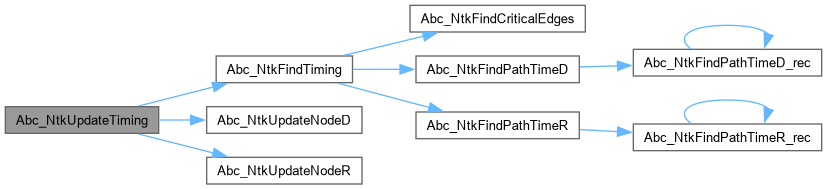
1167{
1168 Abc_Obj_t * pNode = Abc_NtkObj( p->pNtk, Node );
1169 Abc_Obj_t * pFanin = Abc_NtkObj( p->pNtk, Fanin );
1170 Abc_Obj_t * pNext, * pTemp; Vec_Int_t * vLevel; int i, k, j;
1171 assert( Abc_ObjIsNode(pNode) && Abc_ObjIsNode(pFanin) );
1172 Vec_WecForEachLevel( p->vStack, vLevel, i )
1173 Vec_IntClear( vLevel );
1174 Abc_NtkIncrementTravId( p->pNtk );
1175 Abc_NodeSetTravIdCurrentId( p->pNtk, Node );
1176 Abc_NodeSetTravIdCurrentId( p->pNtk, Fanin );
1177 Vec_WecPush( p->vStack, pNode->Level, Node );
1178 Vec_WecPush( p->vStack, pFanin->Level, Fanin );
1179 Vec_WecForEachLevelStart( p->vStack, vLevel, i, pNode->Level )
1180 Abc_NtkForEachObjVec( vLevel, p->pNtk, pTemp, k ) {
1181 if ( !Abc_NtkUpdateNodeD(p, pTemp) )
1182 continue;
1183 Abc_ObjForEachFanout( pTemp, pNext, j ) {
1184 if ( Abc_NodeIsTravIdCurrent(pNext) || Abc_ObjIsCo(pNext) )
1185 continue;
1186 Abc_NodeSetTravIdCurrent( pNext );
1187 Vec_WecPush( p->vStack, pNext->Level, pNext->Id );
1188 }
1189 }
1190 Vec_WecForEachLevelReverseStartStop( p->vStack, vLevel, i, pFanin->Level+1, 0 )
1191 Abc_NtkForEachObjVec( vLevel, p->pNtk, pTemp, k ) {
1192 if ( !Abc_NtkUpdateNodeR(p, pTemp) )
1193 continue;
1194 Abc_ObjForEachFanin( pTemp, pNext, j ) {
1195 if ( Abc_NodeIsTravIdCurrent(pNext) )
1196 continue;
1197 Abc_NodeSetTravIdCurrent( pNext );
1198 Vec_WecPush( p->vStack, pNext->Level, pNext->Id );
1199 }
1200 }
1201 j = 0;
1202 Abc_NtkForEachObjVec( p->vCrits[0], p->pNtk, pTemp, i )
1203 if ( Vec_IntEntry(p->vTime[0], Abc_ObjFaninId0(pTemp)) + p->fDelayRoute == p->DelayMax )
1204 Vec_IntWriteEntry( p->vCrits[0], j++, pTemp->Id );
1205 Vec_IntShrink( p->vCrits[0], j );
1206 j = 0;
1207 Abc_NtkForEachObjVec( p->vCrits[1], p->pNtk, pTemp, i )
1208 if ( Vec_IntEntry(p->vTime[1], pTemp->Id) == p->DelayMax )
1209 Vec_IntWriteEntry( p->vCrits[1], j++, pTemp->Id );
1210 Vec_IntShrink( p->vCrits[1], j );
1211 if ( Vec_IntSize(p->vCrits[0]) && Vec_IntSize(p->vCrits[1]) ) {
1212 int j = 0, Node2, Fanin2;
1213 Vec_IntForEachEntryDouble( p->vCands, Node2, Fanin2, i )
1214 if ( !Vec_IntEntry(p->vPath[0], Node2) && !Vec_IntEntry(p->vPath[1], Fanin2) &&
1215 Vec_IntEntry(p->vTime[0], Node2) + Vec_IntEntry(p->vTime[1], Node2) == p->DelayMax &&
1216 Vec_IntEntry(p->vTime[0], Fanin2) + p->fDelayRoute + p->fDelayLut == Vec_IntEntry(p->vTime[0], Node2) )
1217 Vec_IntWriteEntry( p->vCands, j++, Node2 ), Vec_IntWriteEntry( p->vCands, j++, Fanin2 );
1218 Vec_IntShrink( p->vCands, j );
1219 return p->DelayMax;
1220 }
1221 int DelayOld = p->DelayMax;
1223 assert( DelayOld > p->DelayMax );
1224 return p->DelayMax;
1225}
int Abc_NtkUpdateNodeD(Abc_LutCas_t *p, Abc_Obj_t *pObj)
Definition abcCas.c:1140
int Abc_NtkUpdateNodeR(Abc_LutCas_t *p, Abc_Obj_t *pObj)
Definition abcCas.c:1153
unsigned Level
Definition abc.h:142
#define Vec_WecForEachLevelReverseStartStop(vGlob, vVec, i, LevelStart, LevelStop)
Definition vecWec.h:67
#define Vec_WecForEachLevelStart(vGlob, vVec, i, LevelStart)
Definition vecWec.h:59
Here is the call graph for this function:
Here is the caller graph for this function:

◆ Abc_TtGetGuide()

int Abc_TtGetGuide ( char * pGuide,
int Iter,
Vec_Int_t * vVarIDs,
int fShared )

Function*************************************************************

Synopsis [LUT cascade decomposition.]

Description []

SideEffects []

SeeAlso []

Definition at line 578 of file abcCas.c.

579{
580 int i, Res = 0, Count = 0;
581 for ( i = 0; pGuide[i]; i++ )
582 if ( pGuide[i] >= '0' && pGuide[i] <= '9' ) {
583 if ( Count++ == Iter )
584 break;
585 }
586 assert( i < strlen(pGuide) );
587 assert( pGuide[i] == '0'+Iter );
588 for ( i++; pGuide[i]; i++ )
589 {
590 char Char = pGuide[i];
591 if ( Char >= '0' && Char <= '9' )
592 break;
593 if ( fShared && Char >= 'a' && Char <= 'z' )
594 continue;
595 int Value = -1;
596 if ( Char >= 'a' && Char <= 'z' )
597 Value = Char - 'a';
598 else if ( Char >= 'A' && Char <= 'Z' )
599 Value = Char - 'A';
600 else assert( 0 );
601 int iPlace = Vec_IntFind(vVarIDs, Value);
602 assert( iPlace >= 0 );
603 assert( ((Res >> iPlace) & 1) == 0 );
604 Res |= 1 << iPlace;
605 }
606 return Res;
607}
char Char
Here is the call graph for this function:

◆ Abc_TtPermuteMask()

void Abc_TtPermuteMask ( word * p,
int nVars,
int Mask,
Vec_Int_t * vPerm )

Definition at line 610 of file abcCas.c.

611{
612 assert( !vPerm || nVars == Vec_IntSize(vPerm) );
613 int v, i, iLast = nVars-1, nWords = Abc_TtWordNum(nVars);
614 int * pPerm = vPerm ? Vec_IntArray(vPerm) : NULL;
615 if ( 0 && vPerm ) {
616 printf( "Beg: " );
617 for ( v = 0; v < nVars; v++ )
618 printf( "%c ", 'a'+Vec_IntEntry(vPerm, v) );
619 printf( "\n" );
620 printf( "Bit: " );
621 for ( v = 0; v < nVars; v++ )
622 printf( "%c ", (Mask >> v) & 1 ? '1' : '-' );
623 printf( "\n" );
624 }
625 for ( v = nVars-1; v >= 0; v-- ) {
626 if ( ((Mask >> v) & 1) == 0 )
627 continue;
628 if ( v == iLast ) {
629 iLast--;
630 continue;
631 }
632 assert( v < iLast );
633 for ( i = v; i < iLast; i++ ) {
634 Abc_TtSwapAdjacent( p, nWords, i );
635 if ( pPerm ) ABC_SWAP( int, pPerm[i], pPerm[i+1] )
636 }
637 iLast--;
638 }
639 if ( 0 && vPerm ) {
640 printf( "End: " );
641 for ( v = 0; v < nVars; v++ )
642 printf( "%c ", 'a'+Vec_IntEntry(vPerm, v) );
643 printf( "\n" );
644 }
645}

◆ Vec_WrdWriteTruthHex()

void Vec_WrdWriteTruthHex ( char * pFileName,
Vec_Wrd_t * vTruths,
int nVars )

Function*************************************************************

Synopsis []

Description []

SideEffects []

SeeAlso []

Definition at line 1559 of file abcCas.c.
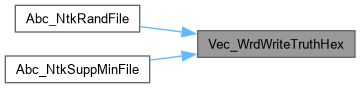
1560{
1561 FILE * pFile = fopen( pFileName, "wb" );
1562 if ( pFile == NULL ) { printf("Cannot open file \"%s\" for reading.\n", pFileName); return; }
1563 int i, nWords = Abc_TtWordNum(nVars), nFuncs = Vec_WrdSize(vTruths)/nWords;
1564 assert( nFuncs * nWords == Vec_WrdSize(vTruths) );
1565 for ( i = 0; i < nFuncs; i++ )
1566 Abc_TtPrintHexRev( pFile, Vec_WrdEntryP(vTruths, i*nWords), nVars ), fprintf( pFile, "\n" );
1567 fclose( pFile );
1568}
Here is the caller graph for this function: